2013 FORD MUSTANG tow
[x] Cancel search: towPage 192 of 437

Steps for determining the correct load limit:
1. Locate the statement “The combined weight of occupants and cargo
should never exceed XXX kg or XXX lbs.” on your vehicle’s placard.
2. Determine the combined weight of the driver and passengers that will
be riding in your vehicle.
3. Subtract the combined weight of the driver and passengers from XXX
kg or XXX lbs.
4. The resulting figure equals the available amount of cargo and luggage
load capacity. For example, if the “XXX” amount equals 1,400 lbs. and
there will be five 150 lb. passengers in your vehicle, the amount of
available cargo and luggage load capacity is 650 lbs. (1400–750 (5 x 150)
= 650 lb.). In metric units (635–340 (5 x 68) = 295 kg.)
5. Determine the combined weight of luggage and cargo being loaded on
the vehicle. That weight may not safely exceed the available cargo and
luggage load capacity calculated in Step 4.
6. If your vehicle will be towing a trailer, load from your trailer will be
transferred to your vehicle. Consult this manual to determine how this
reduces the available cargo and luggage load capacity of your vehicle.
The following gives you a few examples on how to calculate the available
amount of cargo and luggage load capacity:
•Another example for your vehicle with 1,400 lb. (635 kg) of cargo and
luggage capacity. You decide to go golfing. Is there enough load
capacity to carry you, 4 of your friends and all the golf bags? You and
four friends average 220 lb. (99 kg) each and the golf bags weigh
approximately 30 lb. (13.5 kg) each. The calculation would be:
1,400 - (5 x 220) - (5 x 30) = 1,400 - 1,100 - 150 = 150 lb. Yes, you
have enough load capacity in your vehicle to transport four friends and
your golf bags. In metric units, the calculation would be:
635 kg - (5 x 99 kg) - (5 x 13.5 kg) = 635 - 495 - 67.5 = 72.5 kg.
192Load Carrying
2013 05+ Mustang(197)
Owners Guide gf, 1st Printing
USA(fus)
Page 194 of 437

TOWING A TRAILER
WARNING:Do not exceed the GVWR or the GAWR specified on
the certification label.
WARNING:Towing trailers beyond the maximum recommended
gross trailer weight exceeds the limit of the vehicle and could
result in engine damage, transmission damage, structural damage, loss
of vehicle control, vehicle rollover and personal injury.
Your vehicle’s load capacity is designated by weight, not by volume, so
you cannot necessarily use all available space when loading a vehicle.
Towing a trailer places an additional load on your vehicle’s engine,
transmission, axle, brakes, tires and suspension. Inspect these
components periodically during, and after, any towing operation.
RECOMMENDED TOWING WEIGHTS
Your vehicle is capable of towing a trailer up to 1000 lb (454 kg) gross
trailer weight with a maximum tongue load of 100 lb (45 kg).Do not
towwith the Boss 302, Boss 302 Laguna Seca, GT Deluxe or Shelby
GT500 models; they are not rated to tow a trailer.
ESSENTIAL TOWING CHECKS
Follow these guidelines to ensure safe towing:
•Do not tow a trailer until your vehicle has been driven at least
1000 miles (1600 kilometers).
•Consult your local motor vehicle laws for towing a trailer.
•Refer to the instructions included with towing accessories for the
proper installation and adjustment specifications.
•Service your vehicle more frequently if you tow a trailer. Refer to your
scheduled maintenance information.
For load specification terms found on the label and instructions on
calculating your vehicle’s load, refer to theLoad Carryingchapter.
Remember to account for the trailer tongue weight as part of the vehicle
load when calculating the total vehicle weight.
Hitches
Do not use a hitch that either clamps onto the bumper or attaches to the
axle. Distribute the trailer load so 10–15% of the total trailer weight is on
the tongue.
194Towing
2013 05+ Mustang(197)
Owners Guide gf, 1st Printing
USA(fus)
Page 195 of 437

Safety Chains
Always connect the safety chains to the vehicle’s hook retainers. To
connect the safety chains, cross them under the trailer tongue and allow
slack for turning corners.
If you use a rental trailer, follow the rental agency’s instructions.
Note:Never attach safety chains to the bumper.
Trailer Brakes
WARNING:Do not connect a trailer’s hydraulic brake system
directly to your vehicle’s brake system. Your vehicle may not have
enough braking power and your chances of having a collision greatly
increase.
Electric brakes and manual, automatic or surge-type trailer brakes are safe
if installed properly and adjusted to the manufacturer’s specifications. The
trailer brakes must meet local and Federal regulations.
The braking system of the tow vehicle is rated for operation at the
GVWR not GCWR.
Trailer Lamps
Trailer lamps are required on most towed vehicles. Ensure all running
lights, brake lights, turn signals and hazard lights are working. Contact
your authorized dealer or trailer rental agency for proper instructions
and equipment for hooking up the lamps.
Before Towing a Trailer
Practice turning, stopping and backing-up to get the feel of the
vehicle-trailer combination before starting on a trip. When turning, make
wider turns so the trailer wheels will clear curbs and other obstacles.
When Towing a Trailer
•Do not drive faster than 70 mph (113 km/h) during the first 500 miles
(800 kilometers) and do not make full-throttle starts.
•Check your hitch, electrical connections and trailer wheel lug nuts
thoroughly after you have traveled 50 miles (80 kilometers).
•Place the gearshift lever in P (Park) to aid in engine and transmission
cooling and A/C efficiency during hot weather while stopped in traffic.
•Turn off the speed control. The speed control may turn off
automatically when you are towing on long, steep grades.
Towing195
2013 05+ Mustang(197)
Owners Guide gf, 1st Printing
USA(fus)
Page 196 of 437

•Shift to a lower gear when driving down a long or steep hill. Do not apply
the brakes continuously, as they may overheat and become less effective.
•If your transmission is equipped with the grade assist feature, use this
feature when towing. This provides engine braking and helps eliminate
excessive transmission shifting for optimum fuel economy and
transmission cooling.
•Allow more distance for stopping with a trailer attached; anticipate
stops and brake gradually.
•Avoid parking on a grade. However, if you must park on a grade, place
wheel chocks under the trailer’s wheels.
WRECKER TOWING
If you need to have your vehicle towed, contact a professional towing
service or, if you are a member of a roadside assistance program, your
roadside assistance service provider.
It is recommended that your vehicle be towed with a wheel lift and
dollies or flatbed equipment. Do not tow with a slingbelt. Ford Motor
Company has not approved a slingbelt towing procedure. If the vehicle is
towed incorrectly, or by any other means, vehicle damage may occur.
196Towing
2013 05+ Mustang(197)
Owners Guide gf, 1st Printing
USA(fus)
Page 197 of 437

Ford Motor Company produces a towing manual for all authorized tow
truck operators. Have your tow truck operator refer to this manual for
proper hook-up and towing procedures for your vehicle.
If your vehicle is to be towed from the front using wheel lift equipment,
it is recommended that the rear wheels (drive wheels) be placed on a
dolly to prevent damage to the transmission.
If your vehicle is to be towed from the rear using wheel lift equipment, it
is recommended that the front wheels be placed on a dolly to prevent
damage to the front fascia.
TOWING THE VEHICLE ON FOUR WHEELS
Emergency Towing
In the event your vehicle becomes disabled (without access to wheel
dollies, car-hauling trailer, or flatbed transport vehicle), it can be
flat-towed (all wheels on the ground, regardless of the
powertrain/transmission configuration) under the following conditions:
•The vehicle is facing forward so that it is towed in a forward direction.
•The transmission is placed in N (Neutral). Refer toAutomatic
transmissionin theTransmissionchapter if you cannot move the
transmission into N (Neutral).
•Maximum speed is 35 mph (56 km/h).
•Maximum distance is 50 miles (80 kilometers).
Recreational Towing
Note:Put your climate control system in recirculated air mode to
prevent exhaust fumes from entering the vehicle. Refer to theClimate
Controlchapter.
Follow these guidelines if you have a need for recreational (RV) towing.
An example of recreational towing would be towing your vehicle behind a
motorhome. These guidelines are designed to ensure that your
transmission is not damaged.
Do not tow your vehicle with any wheels on the ground, as vehicle or
transmission damage may occur. It is recommended to tow your vehicle
with all four (4) wheels off the ground such as when using a car-hauling
trailer. Otherwise, no recreational towing is permitted.
Towing197
2013 05+ Mustang(197)
Owners Guide gf, 1st Printing
USA(fus)
Page 198 of 437

OPENING THE CONVERTIBLE TOP (IF EQUIPPED)
Note:Do not store articles behind rear seat. Articles stored in the
convertible top stowage compartment may break the rear glass window
when the top is opened.
Note:Opening the convertible top when the top material is wet may
cause mold or mildew.
The convertible top can be opened with the side windows down. The
windows will automatically lower when opening or closing the top.
The convertible top will not operate unless the vehicle is stationary or
traveling under 3 mph (5 km/h).
To open the convertible top:
1. Bring the vehicle to a complete stop. The ignition must be on. It is
recommended that the engine is running when opening the top to
prevent draining the battery.
2. Check the convertible top stowage compartment behind the rear seat
to be sure it is empty. Make sure the convertible top outer surface is free
of debris.
Note:The latch handles must be
pulled downward fully to allow the
latch to fully rotate into the open
position.
198Convertible Top
2013 05+ Mustang(197)
Owners Guide gf, 1st Printing
USA(fus)
Page 201 of 437
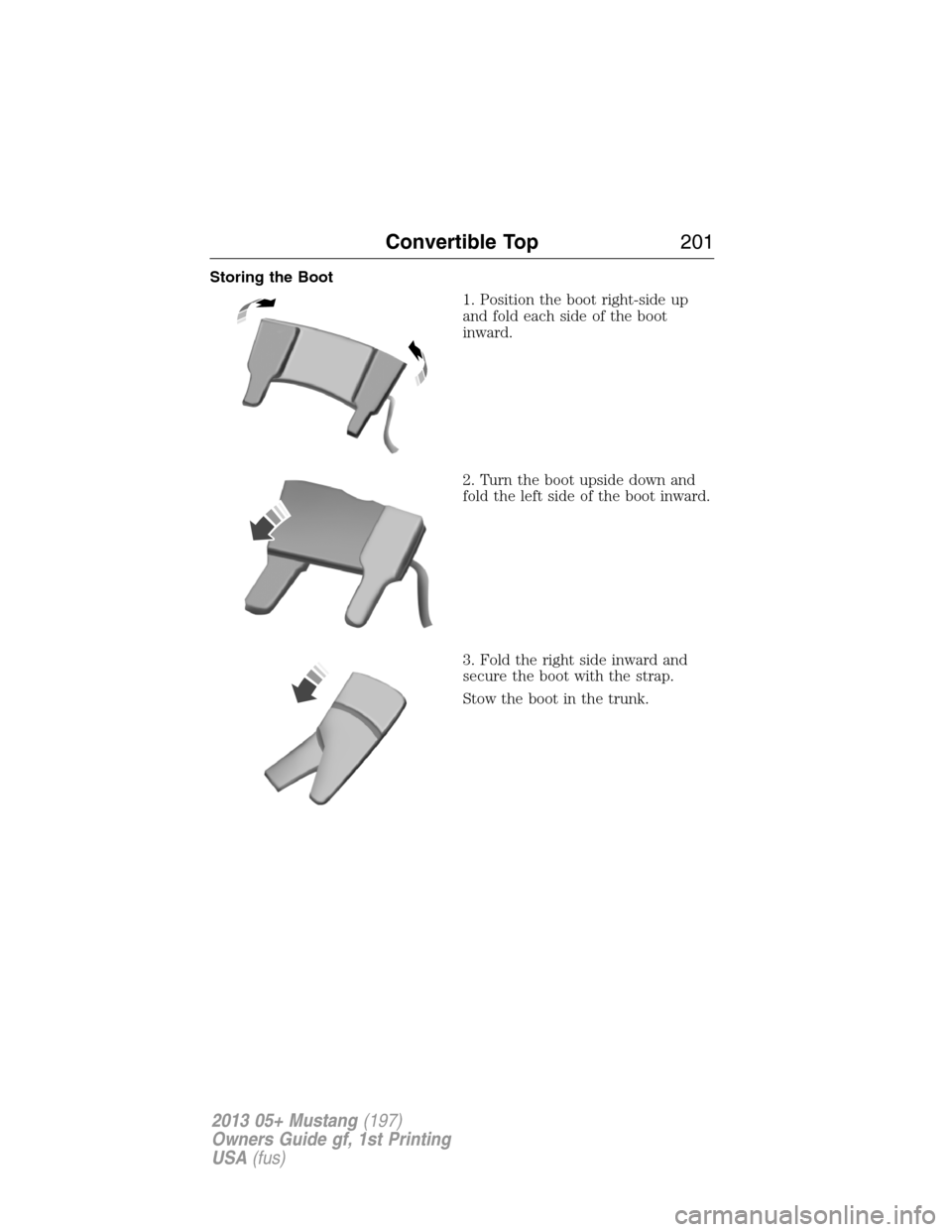
Storing the Boot
1. Position the boot right-side up
and fold each side of the boot
inward.
2. Turn the boot upside down and
fold the left side of the boot inward.
3. Fold the right side inward and
secure the boot with the strap.
Stow the boot in the trunk.
Convertible Top201
2013 05+ Mustang(197)
Owners Guide gf, 1st Printing
USA(fus)
Page 202 of 437

CLOSING THE CONVERTIBLE TOP
Note:The convertible top will not operate unless the vehicle is
stationary or traveling under 3 mph (5 kmh).
Note:Make sure that the latch handles are pulled down and in the fully
opened position before the top makes contact with the windshield
header. This allows for hand clearance and proper closure of the top.
To close the convertible top:
1. Bring the vehicle to a complete stop. The ignition must be on. It is
recommended that the engine is running when opening the top to
prevent draining the battery.
2. Press and hold the convertible
top switch until the windows lower
completely and the top unfolds and
moves forward toward the
windshield header.
Make sure the latch handles are
pulled down and in the fully opened
position before the top and the
windshield header make contact.
3. Continue pressing the convertible top switch to close the top
completely. The top must be flush with the header.
4. Pull down on the drivers latch
handle and rotate it all the way
forward into the windshield header.
5. Press the latch handle up into the
stowed position to secure the latch.
6. Pull down on the passengers side
latch handle and rotate it all the
way forward into the windshield
header.
7. Press the latch handle up into the stowed position to secure the latch.
Note:If the top has been open for an extended period of time or if the
temperature is low, the top material may shrink slightly. If this happens,
pull on the latch handles or the center grip to fasten to top
202Convertible Top
2013 05+ Mustang(197)
Owners Guide gf, 1st Printing
USA(fus)