Page 204 of 475
PRINCIPLES OF OPERATION
Cruise control lets you maintain a set speed without keeping your foot
on the accelerator pedal.
USING CRUISE CONTROL (IF EQUIPPED)
WARNING:Do not use cruise control in heavy traffic or on
roads that are winding, slippery or unpaved.
Note:Vehicle speed may vary momentarily when driving up or down a
steep hill. Apply the brakes if the vehicle speed increases above the set
speed while driving downhill.
Note:Cruise control will disengage if the vehicle speed decreases more
than 10 mph (16 km/h) below your set speed while driving uphill.
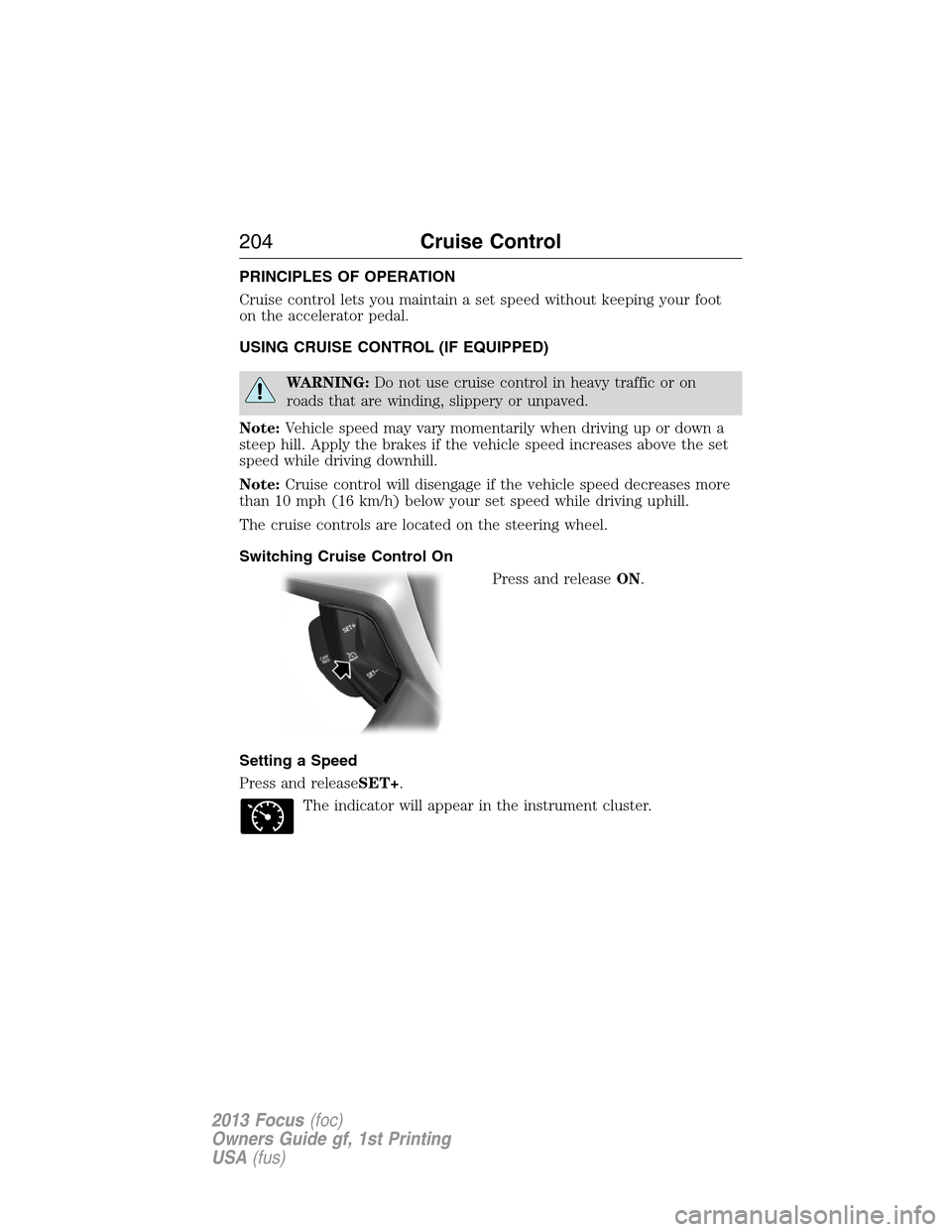
The cruise controls are located on the steering wheel.
Switching Cruise Control On
Press and releaseON.
Setting a Speed
Press and releaseSET+.
The indicator will appear in the instrument cluster.
204Cruise Control
2013 Focus(foc)
Owners Guide gf, 1st Printing
USA(fus)
Page 215 of 475
TOWING A TRAILER
WARNING:Never tow a trailer with this vehicle. Your vehicle is
not equipped to tow. No towing packages are available through
an authorized dealer.
WRECKER TOWING
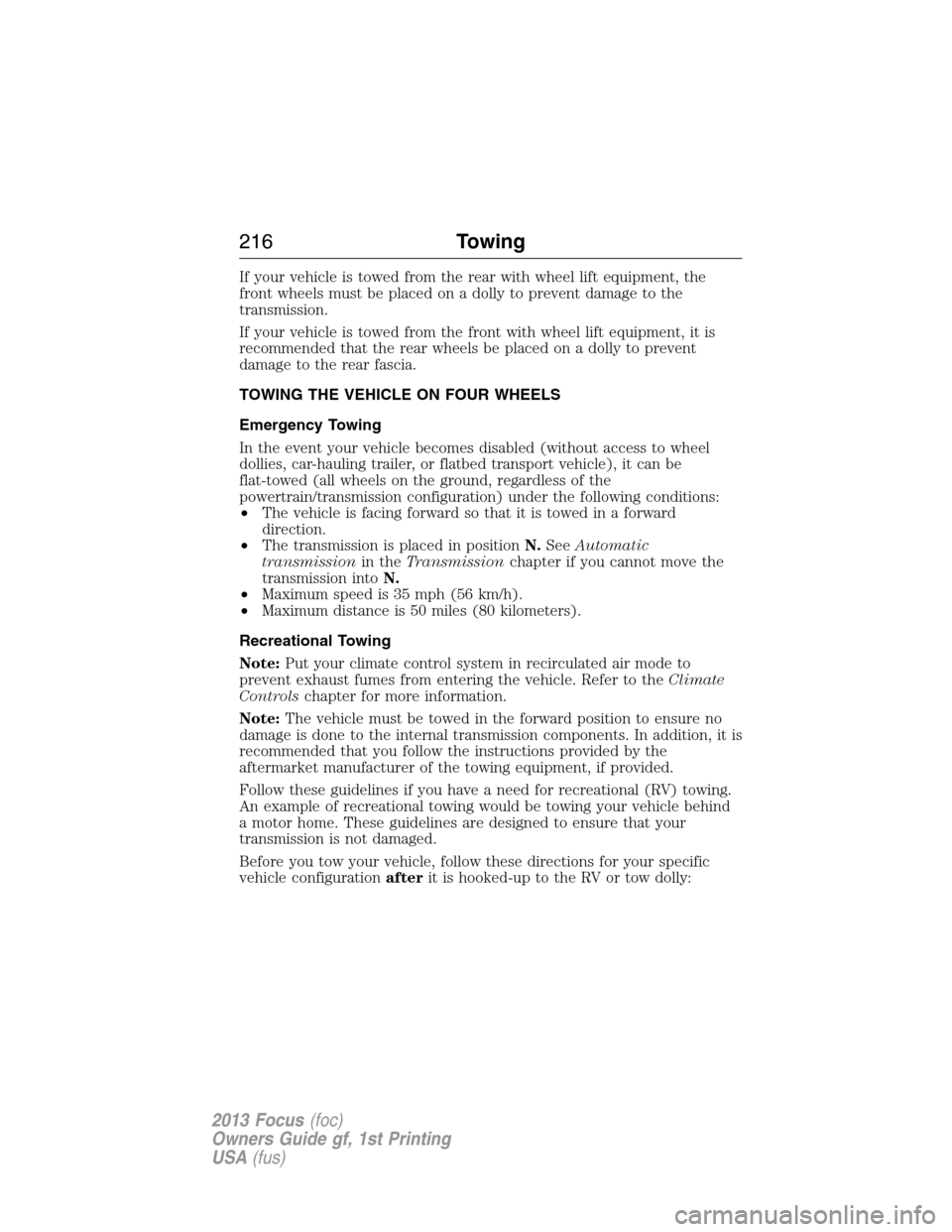
If you need to have your vehicle towed, contact a professional towing
service or, if you are a member of a roadside assistance program, your
roadside assistance service provider.
It is recommended that your vehicle be towed with a wheel lift and
dollies or flatbed equipment. Do not tow with a slingbelt. Ford Motor
Company has not approved a slingbelt towing procedure. If the vehicle is
towed incorrectly, or by any other means, vehicle damage may occur.
Ford Motor Company produces a towing manual for all authorized tow
truck operators. Have your tow truck operator refer to this manual for
proper hook-up and towing procedures for your vehicle.
Towing215
2013 Focus(foc)
Owners Guide gf, 1st Printing
USA(fus)
Page 216 of 475
If your vehicle is towed from the rear with wheel lift equipment, the
front wheels must be placed on a dolly to prevent damage to the
transmission.
If your vehicle is towed from the front with wheel lift equipment, it is
recommended that the rear wheels be placed on a dolly to prevent
damage to the rear fascia.
TOWING THE VEHICLE ON FOUR WHEELS
Emergency Towing
In the event your vehicle becomes disabled (without access to wheel
dollies, car-hauling trailer, or flatbed transport vehicle), it can be
flat-towed (all wheels on the ground, regardless of the
powertrain/transmission configuration) under the following conditions:
•The vehicle is facing forward so that it is towed in a forward
direction.
•The transmission is placed in positionN.SeeAutomatic
transmissionin theTransmissionchapter if you cannot move the
transmission intoN.
•Maximum speed is 35 mph (56 km/h).
•Maximum distance is 50 miles (80 kilometers).
Recreational Towing
Note:Put your climate control system in recirculated air mode to
prevent exhaust fumes from entering the vehicle. Refer to theClimate
Controlschapter for more information.
Note:The vehicle must be towed in the forward position to ensure no
damage is done to the internal transmission components. In addition, it is
recommended that you follow the instructions provided by the
aftermarket manufacturer of the towing equipment, if provided.
Follow these guidelines if you have a need for recreational (RV) towing.
An example of recreational towing would be towing your vehicle behind
a motor home. These guidelines are designed to ensure that your
transmission is not damaged.
Before you tow your vehicle, follow these directions for your specific
vehicle configurationafterit is hooked-up to the RV or tow dolly:
216Towing
2013 Focus(foc)
Owners Guide gf, 1st Printing
USA(fus)
Page 220 of 475
![FORD FOCUS 2013 3.G Owners Manual •Carry unnecessary weight (approximately 1 mpg [0.4 km/L] is lost for
every 400 lb [180 kg] of weight carried).
•Add particular accessories to your vehicle (e.g. bug deflectors,
rollbars/light bar](/manual-img/11/5144/w960_5144-219.png "FORD FOCUS 2013 3.G Owners Manual •Carry unnecessary weight (approximately 1 mpg [0.4 km/L] is lost for
every 400 lb [180 kg] of weight carried).
•Add particular accessories to your vehicle (e.g. bug deflectors,
rollbars/light bar")
•Carry unnecessary weight (approximately 1 mpg [0.4 km/L] is lost for
every 400 lb [180 kg] of weight carried).
•Add particular accessories to your vehicle (e.g. bug deflectors,
rollbars/light bars, running boards, ski racks).
•Drive with the wheels out of alignment.
DRIVING THROUGH WATER
If driving through deep or standing
water is unavoidable, proceed very
slowly. Never drive through water
that is higher than the bottom of
the wheel rims (for cars) or the
bottom of the hubs (for trucks).
When driving through water, traction or brake capability may be limited.
Also, water may enter your engine’s air intake and severely damage your
engine or your vehicle may stall.
Note:Driving through deep water where the transmission vent tube is
submerged may allow water into the transmission and cause internal
transmission damage.
Note:Once through the water, always dry the brakes by moving your
vehicle slowly while applying light pressure on the brake pedal. Wet
brakes do not stop the vehicle as quickly as dry brakes.
220Driving Hints
2013 Focus(foc)
Owners Guide gf, 1st Printing
USA(fus)
Page 241 of 475

The fuses are coded as follows:
Fuse/Relay
NumberFuse Amp
RatingProtected Components
56 20A Fuel pump supply, Mass air flow
sensor
57 — Not used
58 — Not used
59 5A Passive anti-theft transceiver
60 10A Interior light, Driver door switch
pack, Glove box illumination,
Overhead console switch bank
61 20A Cigar lighter, Power point
62 5A Rain sensor module, Humidity sensor,
Auto-dimming rear view mirror
63 — Not used
64 — Not used
65 10A Luggage compartment release
66 20A Driver door unlock supply, double
lock
67 7.5A SYNC�, Multifunction display, Global
positioning system module, Compass
68 — Not used
69 5A Instrument cluster
70 20A Central lock and unlock supply
71 10A Heating control head (manual air
conditioning), Duel electronic
automatic temperature control
72 7.5A Steering wheel module
73 5A Data link connector
74 15A Low beam headlamp supply
75 15A Fog lamp supply
76 10A Reversing lamp supply
77 20A Windshield washer supply
78 5A Ignition switch, Start button
Fuses241
2013 Focus(foc)
Owners Guide gf, 1st Printing
USA(fus)
Page 243 of 475
Luggage Compartment Fuse Panel
The fuse panel is located in the luggage compartment behind the left
side wheel well. Remove the fuse panel cover to gain access to the fuses.
The fuses are coded as follows.
Fuse/Relay
NumberFuse Amp
RatingProtected Components
F1 — Not used
F2 10A Keyless vehicle module
F3 5A Keyless vehicle door handles
F4 25A Door control unit front left
F5 25A Door control unit front right
F6 25A Door control unit rear left
F7 25A Door control unit rear right
F8 — Not used
F9 25A Driver seat motor
F10 — Not used
R4
R5
R6R2
R1R3
F46
F28F16
F15
F14
F13
F12
F11
F10
F9
F8
F7
F6
F5
F4
F3
F2
F1 F27
F26
F25
F24 F45
F44
F43
F42
F41
F40
F39
F38
F37
F36
F35 F23
F22
F21
F20
F19
F18
F17 F34
F33
F32
F31
F30
F29
Fuses243
2013 Focus(foc)
Owners Guide gf, 1st Printing
USA(fus)
Page 246 of 475

GENERAL INFORMATION
Have your vehicle serviced regularly to help maintain its roadworthiness
and resale value. There is a large network of Ford authorized dealers
that are there to help you with their professional servicing expertise. We
believe that their specially trained technicians are best qualified to
service your vehicle properly and expertly. They are supported by a wide
range of highly specialized tools developed specifically for servicing your
vehicle.
To help you service your vehicle, we providescheduled maintenance
informationwhich makes tracking routine service easy.
If your vehicle requires professional service, your authorized dealer can
provide the necessary parts and service. Check your warranty
information to find out which parts and services are covered.
Use only recommended fuels, lubricants, fluids and service parts
conforming to specifications. Motorcraft�parts are designed and built to
provide the best performance in your vehicle.
Precautions
•Do not work on a hot engine.
•Make sure that nothing gets caught in moving parts.
•Do not work on a vehicle with the engine running in an enclosed
space, unless you are sure you have enough ventilation.
•Keep all open flames and other burning material (such as cigarettes)
away from the battery and all fuel related parts.
Working with the Engine Off
1. For vehicles equipped with an automatic transmission, set the parking
brake and shift to P (Park). For vehicles equipped with a manual
transmission, set the parking brake, press and hold the clutch pedal, shift
to 1 (First), and release the clutch pedal.
2. Turn off the engine and remove the key.
3. Block the wheels.
246Maintenance
2013 Focus(foc)
Owners Guide gf, 1st Printing
USA(fus)
Page 247 of 475
Working with the Engine On
WARNING:To reduce the risk of vehicle damage and/or personal
burn injuries, do not start your engine with the air cleaner
removed and do not remove it while the engine is running.
1. For vehicles equipped with an automatic transmission, set the parking
brake and shift to P (Park). For vehicles equipped with a manual
transmission, set the parking brake, press and hold the clutch pedal, shift
in N (Neutral), and release the clutch pedal.
2. Block the wheels.
OPENING AND CLOSING THE HOOD
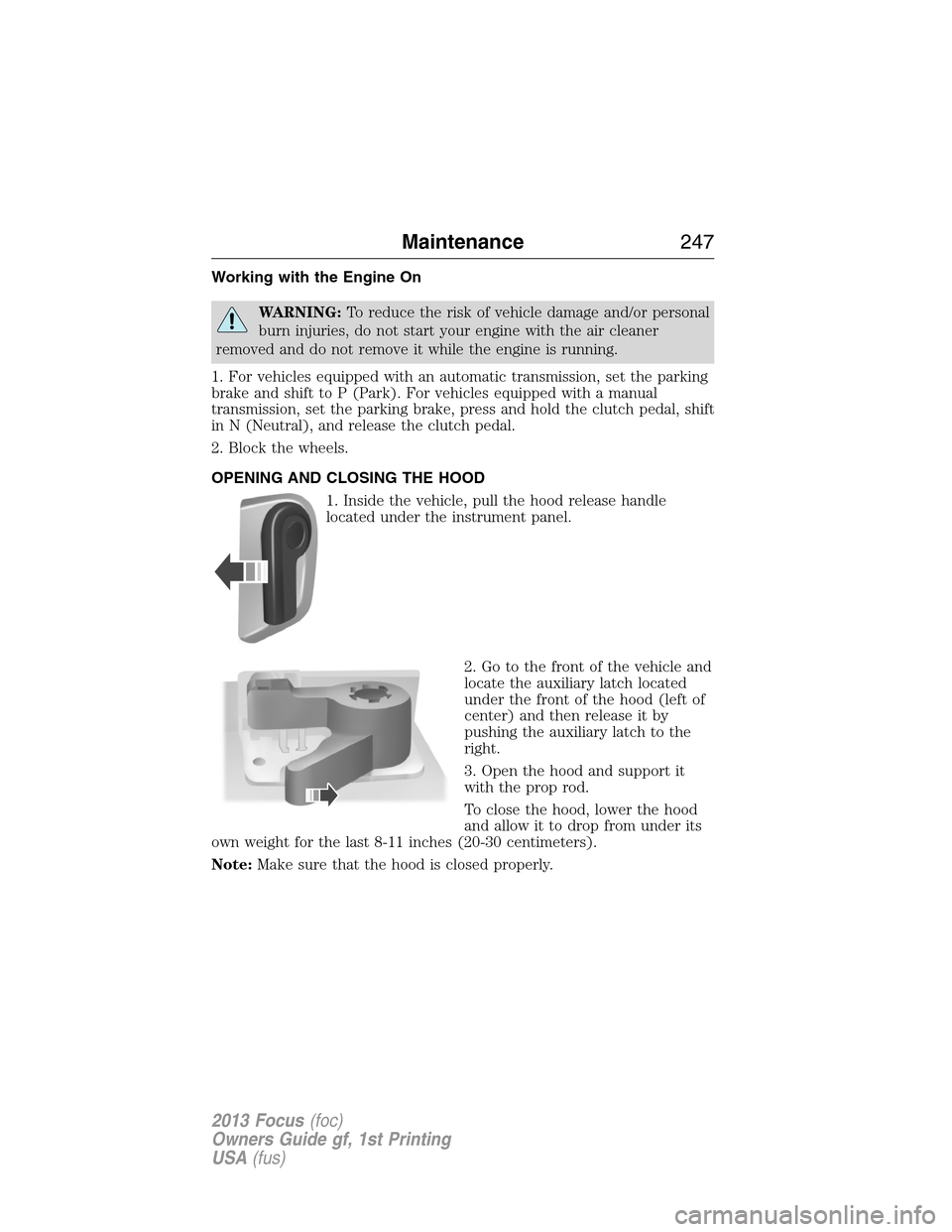
1. Inside the vehicle, pull the hood release handle
located under the instrument panel.
2. Go to the front of the vehicle and
locate the auxiliary latch located
under the front of the hood (left of
center) and then release it by
pushing the auxiliary latch to the
right.
3. Open the hood and support it
with the prop rod.
To close the hood, lower the hood
and allow it to drop from under its
own weight for the last 8-11 inches (20-30 centimeters).
Note:Make sure that the hood is closed properly.
Maintenance247
2013 Focus(foc)
Owners Guide gf, 1st Printing
USA(fus)