Page 226 of 475
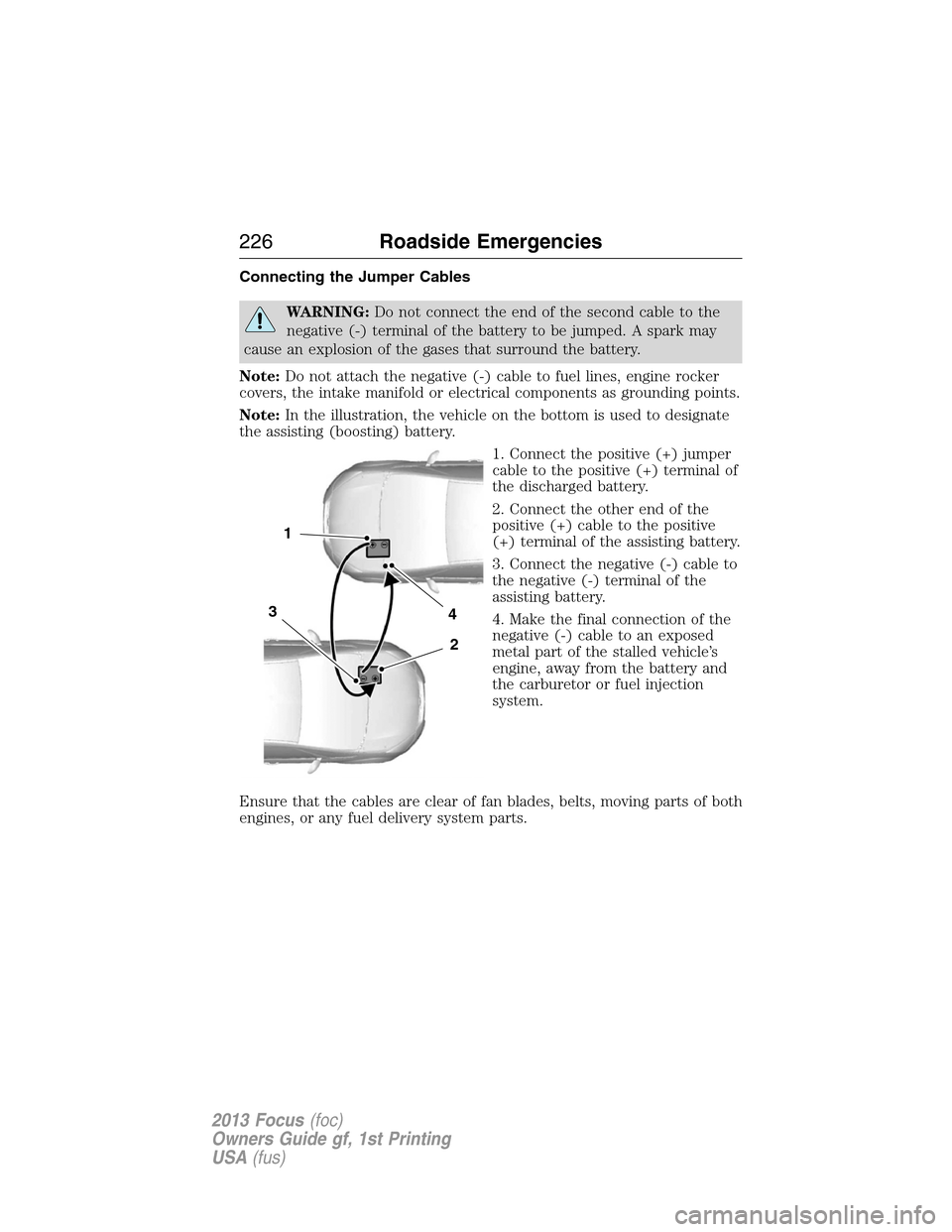
Connecting the Jumper Cables
WARNING:Do not connect the end of the second cable to the
negative (-) terminal of the battery to be jumped. A spark may
cause an explosion of the gases that surround the battery.
Note:Do not attach the negative (-) cable to fuel lines, engine rocker
covers, the intake manifold or electrical components as grounding points.
Note:In the illustration, the vehicle on the bottom is used to designate
the assisting (boosting) battery.
1. Connect the positive (+) jumper
cable to the positive (+) terminal of
the discharged battery.
2. Connect the other end of the
positive (+) cable to the positive
(+) terminal of the assisting battery.
3. Connect the negative (-) cable to
the negative (-) terminal of the
assisting battery.
4. Make the final connection of the
negative (-) cable to an exposed
metal part of the stalled vehicle’s
engine, away from the battery and
the carburetor or fuel injection
system.
Ensure that the cables are clear of fan blades, belts, moving parts of both
engines, or any fuel delivery system parts.
4
2
1
3
226Roadside Emergencies
2013 Focus(foc)
Owners Guide gf, 1st Printing
USA(fus)
Page 227 of 475
Jump Starting
1. Start the engine of the booster vehicle and run the engine at a
moderately increased speed.
2. Start the engine of the disabled vehicle.
3. Once the disabled vehicle has been started, run both engines for an
additional three minutes before disconnecting the jumper cables.
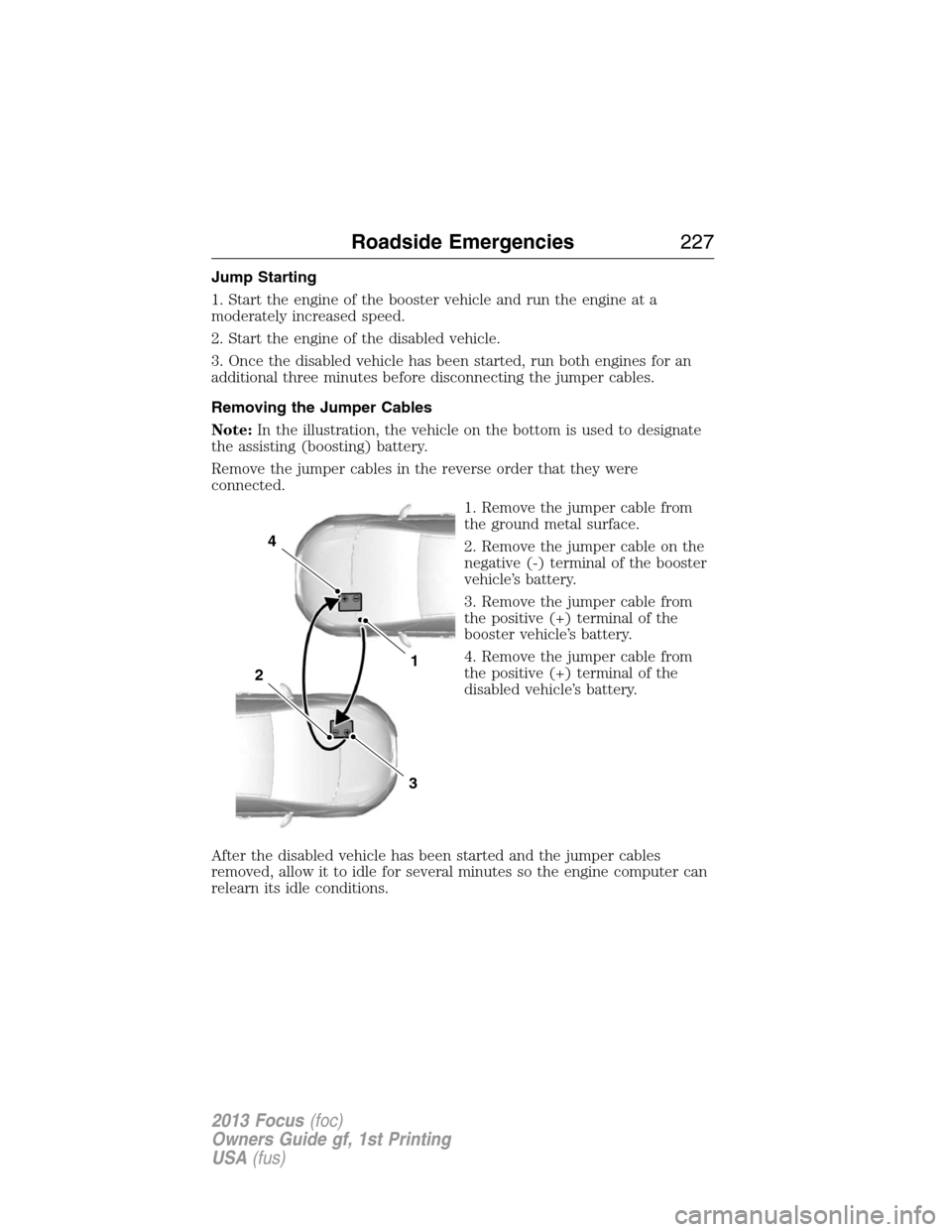
Removing the Jumper Cables
Note:In the illustration, the vehicle on the bottom is used to designate
the assisting (boosting) battery.
Remove the jumper cables in the reverse order that they were
connected.
1. Remove the jumper cable from
the ground metal surface.
2. Remove the jumper cable on the
negative (-) terminal of the booster
vehicle’s battery.
3. Remove the jumper cable from
the positive (+) terminal of the
booster vehicle’s battery.
4. Remove the jumper cable from
the positive (+) terminal of the
disabled vehicle’s battery.
After the disabled vehicle has been started and the jumper cables
removed, allow it to idle for several minutes so the engine computer can
relearn its idle conditions.
4
1
3
2
Roadside Emergencies227
2013 Focus(foc)
Owners Guide gf, 1st Printing
USA(fus)
Page 237 of 475
FUSE SPECIFICATION CHART
Power Distribution Box
WARNING:Always disconnect the battery before servicing high
current fuses.
WARNING:To reduce risk of electrical shock, always replace the
cover to the power distribution box before reconnecting the
battery or refilling fluid reservoirs.
The power distribution box is located in the engine compartment. It has
high-current fuses that protect your vehicle’s main electrical systems
from overloads.
If the battery has been disconnected and reconnected, refer to
Changing the vehicle batteryin theMaintenancechapter.
The high-current fuses are coded as follows:
Fuse/Relay
NumberFuse Amp
RatingProtected Components
F1 — Not used
F2 — Not used
F30 F31
F24 F21 F20
F25 F22
F23F17
R10R9 R6
F15F19 F8 F7
F37
F38
F39
F40
F41 F43
F42
F44
F45 F46
F48
F47 F13 F11 F9
F16 F14 F12 F10
R11
R8R7R16R15
R3
R5 R4 R2R1
F18 F26 F27 F32
F33
F34
F35 F28
F29
R12
R13 R14
F36
Fuses237
2013 Focus(foc)
Owners Guide gf, 1st Printing
USA(fus)
Page 238 of 475
Fuse/Relay
NumberFuse Amp
RatingProtected Components
F3 — Not used
F4 — Not used
F5 — Not used
F6 — Not used
F7 40A** Anti-lock brake system/Electronic
stability program pump
F8 30A** Electronic stability program valve
F9 30A** Heated rear window
F10 40A** Heater blower motor
F11 — Not used
F12 30A** Engine control relay Fuse
F13 30A** Starter relay
F14 25A** Rear power window (without door
control unit)
F15 25A** Automatic transmission
F16 — Not used
F17 — Not used
F18 20A** Front wiper motor
F19 5A* Anti-lock brake system/Electronic
stability program 15 feed
F20 15A* Horn
F21 5A* Stop light switch
F22 15A* Battery monitor system
F23 5A* Relay coils, Light switch module
F24 — Not used
F25 10A* Power exterior mirror (without door
control unit)
F26 15A* Transmission control module 30 feed
automatic transmission
F27 15A* Air conditioning clutch
F28 5A* Mass air flow fuel relay feed
F29 20A* Not used (spare)
238Fuses
2013 Focus(foc)
Owners Guide gf, 1st Printing
USA(fus)
Page 246 of 475

GENERAL INFORMATION
Have your vehicle serviced regularly to help maintain its roadworthiness
and resale value. There is a large network of Ford authorized dealers
that are there to help you with their professional servicing expertise. We
believe that their specially trained technicians are best qualified to
service your vehicle properly and expertly. They are supported by a wide
range of highly specialized tools developed specifically for servicing your
vehicle.
To help you service your vehicle, we providescheduled maintenance
informationwhich makes tracking routine service easy.
If your vehicle requires professional service, your authorized dealer can
provide the necessary parts and service. Check your warranty
information to find out which parts and services are covered.
Use only recommended fuels, lubricants, fluids and service parts
conforming to specifications. Motorcraft�parts are designed and built to
provide the best performance in your vehicle.
Precautions
•Do not work on a hot engine.
•Make sure that nothing gets caught in moving parts.
•Do not work on a vehicle with the engine running in an enclosed
space, unless you are sure you have enough ventilation.
•Keep all open flames and other burning material (such as cigarettes)
away from the battery and all fuel related parts.
Working with the Engine Off
1. For vehicles equipped with an automatic transmission, set the parking
brake and shift to P (Park). For vehicles equipped with a manual
transmission, set the parking brake, press and hold the clutch pedal, shift
to 1 (First), and release the clutch pedal.
2. Turn off the engine and remove the key.
3. Block the wheels.
246Maintenance
2013 Focus(foc)
Owners Guide gf, 1st Printing
USA(fus)
Page 248 of 475
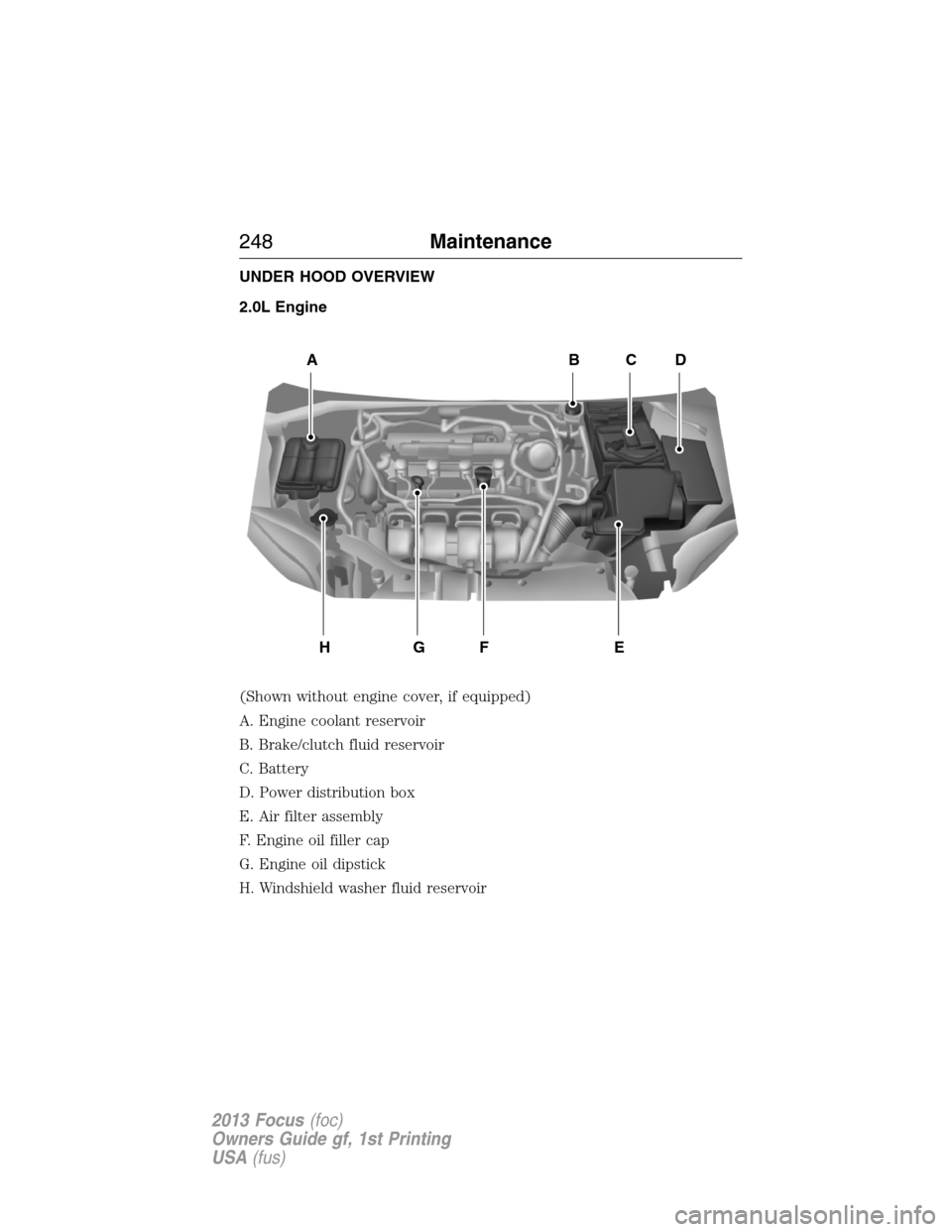
UNDER HOOD OVERVIEW
2.0L Engine
(Shown without engine cover, if equipped)
A. Engine coolant reservoir
B. Brake/clutch fluid reservoir
C. Battery
D. Power distribution box
E. Air filter assembly
F. Engine oil filler cap
G. Engine oil dipstick
H. Windshield washer fluid reservoir
ABCD
EFGH
248Maintenance
2013 Focus(foc)
Owners Guide gf, 1st Printing
USA(fus)
Page 255 of 475

WASHER FLUID CHECK
WARNING:If you operate your vehicle in temperatures below
40°F (5°C), use washer fluid with antifreeze protection. Failure
to use washer fluid with antifreeze protection in cold weather could
result in impaired windshield vision and increase the risk of injury or
accident.
Add fluid to fill the reservoir if the level is low. Only use a washer fluid
that meets Ford specifications. See the technical specifications chart in
theCapacities and Specificationschapter.
Note:The front and rear washer systems are supplied from the same
reservoir.
State or local regulations on volatile organic compounds may restrict the
use of methanol, a common windshield washer antifreeze additive.
Washer fluids containing non-methanol antifreeze agents should be used
only if they provide cold weather protection without damaging the
vehicle’s paint finish, wiper blades or washer system.
CHANGING THE VEHICLE BATTERY
WARNING:Batteries normally produce explosive gases which
can cause personal injury. Therefore, do not allow flames, sparks
or lighted substances to come near the battery. When working near the
battery, always shield your face and protect your eyes. Always provide
proper ventilation.
WARNING:When lifting a plastic-cased battery, excessive
pressure on the end walls could cause acid to flow through the
vent caps, resulting in personal injury and/or damage to the vehicle or
battery. Lift the battery with a battery carrier or with your hands on
opposite corners.
WARNING:Keep batteries out of reach of children. Batteries
contain sulfuric acid. Avoid contact with skin, eyes or clothing.
Shield your eyes when working near the battery to protect against
possible splashing of acid solution. In case of acid contact with skin or
eyes, flush immediately with water for a minimum of 15 minutes and
get prompt medical attention. If acid is swallowed, call a physician
immediately.
Maintenance255
2013 Focus(foc)
Owners Guide gf, 1st Printing
USA(fus)
Page 256 of 475

WARNING:Battery posts, terminals and related accessories
contain lead and lead compounds. Wash hands after handling.
Your vehicle is equipped with a Motorcraft�maintenance-free battery
which normally does not require additional water during its life of service.
Note:If your battery has a cover/shield, make sure it is reinstalled after
the battery has been cleaned or replaced.
For longer, trouble-free operation, keep the top of the battery clean and
dry. Also, make certain the battery cables are always tightly fastened to
the battery terminals.
If you see any corrosion on the battery or terminals, remove the cables
from the terminals and clean with a wire brush. You can neutralize the
acid with a solution of baking soda and water.
It is recommended that the negative battery cable terminal be
disconnected from the battery if you plan to store your vehicle for an
extended period of time.
To ensure proper operation of the battery management system (BMS), any
electrical devices that are added to the vehicle should not have their
ground connection made directly at the negative battery post. A connection
at the negative battery post can cause inaccurate measurements of the
battery condition and potential incorrect system operation.
Note:Electrical or electronic accessories or components added to the
vehicle by the dealer or the owner may adversely affect battery
performance and durability and may also affect the performance of other
electrical systems in the vehicle.
When a battery replacement is required, the battery should only be
replaced with a Ford recommended replacement battery that matches
the electrical requirements of the vehicle.
When the battery is disconnected or a new battery installed, the
automatic transmission must relearn its adaptive strategy. As a result of
this, the transmission may shift firmly when first driven. This operation is
considered normal and will fully update transmission operation to its
optimum shift feel.
If the battery has been disconnected or a new battery has been installed,
the clock and the preset radio stations must be reset once the battery is
reconnected.
Note:Always dispose of automotive batteries in a responsible manner.
Follow your local authorized standards for disposal. Call your local
authorized recycling center to find out more about recycling automotive
batteries.
256Maintenance
2013 Focus(foc)
Owners Guide gf, 1st Printing
USA(fus)