2013 FORD FIESTA climate control
[x] Cancel search: climate controlPage 3 of 341
Information Displays 93
Multifunction display...................................94
Trip computer........................................94
Information messages...................................95
Audio System 99
AM/FMstereowithCD.................................101
AM/FM/CD/SIRIUS Satellite Radio with SYNC.................103
Auxiliary input jack...................................108
USBport...........................................109
Satellite radio information...............................109
Climate Control 113
Manual heating and air conditioning........................113
Rear window defroster.................................116
Cabin air filter.......................................117
Seats 118
Sitting in the correct position............................118
Head restraints.......................................119
Front seats..........................................122
Heated seats........................................123
Rear seats..........................................124
Auxiliary Power Points 126
Storage Compartments 127
Center console.......................................127
Starting and Stopping the Engine 128
Ignition switch.......................................129
Keyless starting......................................129
Engine block heater...................................132
Table of Contents3
2013 Fiesta(fie)
Owners Guide gf, 1st Printing
USA(fus)
Page 47 of 341
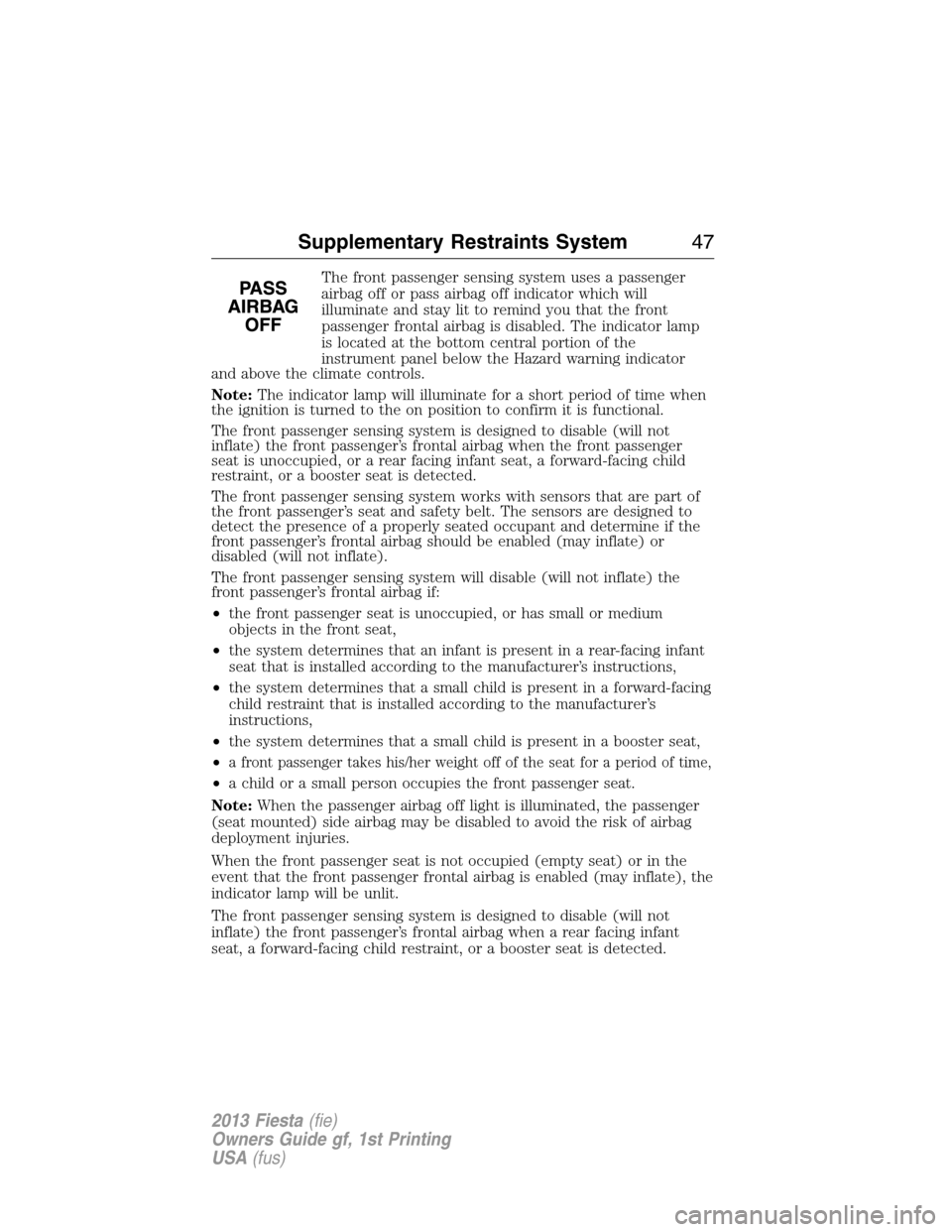
The front passenger sensing system uses a passenger
airbag off or pass airbag off indicator which will
illuminate and stay lit to remind you that the front
passenger frontal airbag is disabled. The indicator lamp
is located at the bottom central portion of the
instrument panel below the Hazard warning indicator
and above the climate controls.
Note:The indicator lamp will illuminate for a short period of time when
the ignition is turned to the on position to confirm it is functional.
The front passenger sensing system is designed to disable (will not
inflate) the front passenger’s frontal airbag when the front passenger
seat is unoccupied, or a rear facing infant seat, a forward-facing child
restraint, or a booster seat is detected.
The front passenger sensing system works with sensors that are part of
the front passenger’s seat and safety belt. The sensors are designed to
detect the presence of a properly seated occupant and determine if the
front passenger’s frontal airbag should be enabled (may inflate) or
disabled (will not inflate).
The front passenger sensing system will disable (will not inflate) the
front passenger’s frontal airbag if:
•the front passenger seat is unoccupied, or has small or medium
objects in the front seat,
•the system determines that an infant is present in a rear-facing infant
seat that is installed according to the manufacturer’s instructions,
•the system determines that a small child is present in a forward-facing
child restraint that is installed according to the manufacturer’s
instructions,
•the system determines that a small child is present in a booster seat,
•
a front passenger takes his/her weight off of the seat for a period of time,
•a child or a small person occupies the front passenger seat.
Note:When the passenger airbag off light is illuminated, the passenger
(seat mounted) side airbag may be disabled to avoid the risk of airbag
deployment injuries.
When the front passenger seat is not occupied (empty seat) or in the
event that the front passenger frontal airbag is enabled (may inflate), the
indicator lamp will be unlit.
The front passenger sensing system is designed to disable (will not
inflate) the front passenger’s frontal airbag when a rear facing infant
seat, a forward-facing child restraint, or a booster seat is detected.
Supplementary Restraints System47
2013 Fiesta(fie)
Owners Guide gf, 1st Printing
USA(fus)
Page 113 of 341
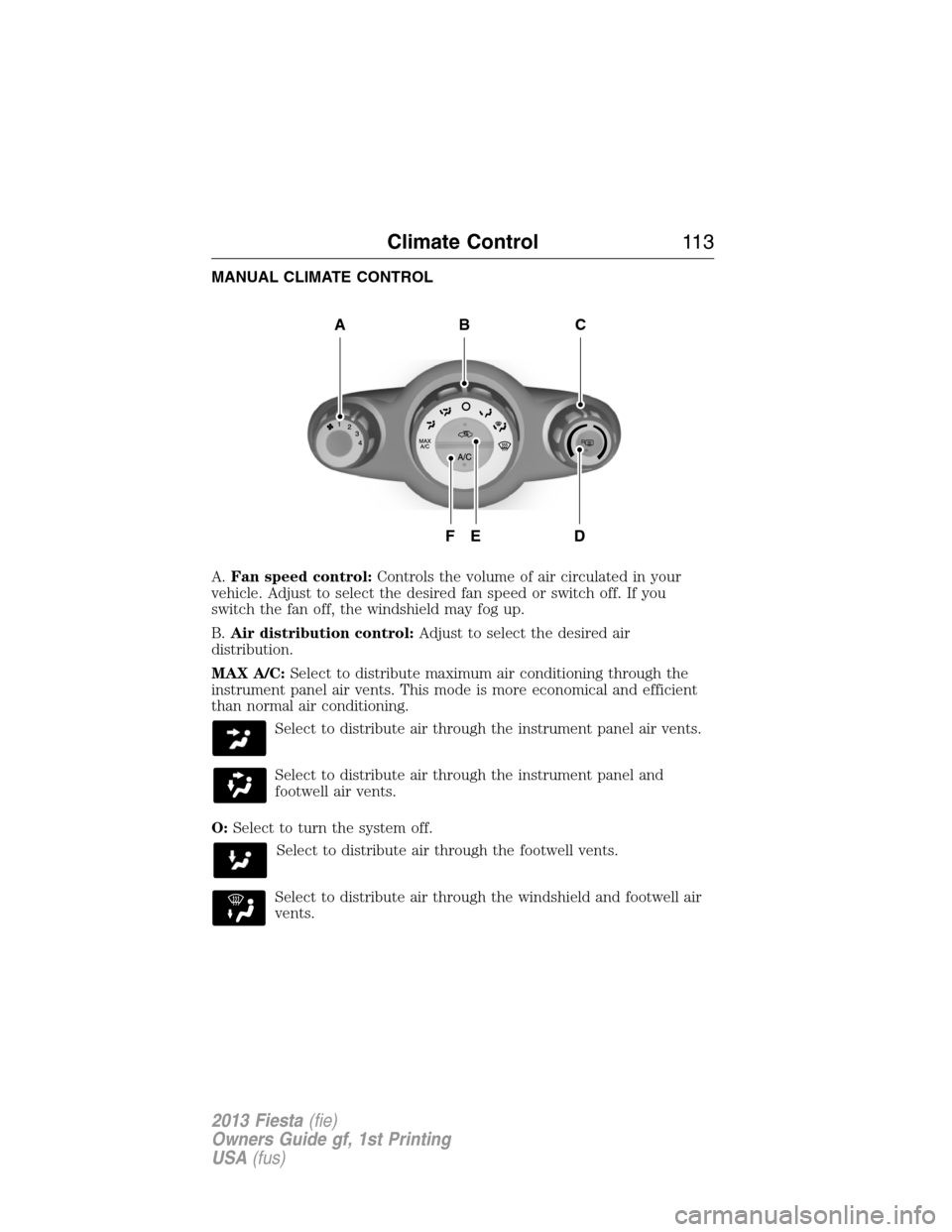
MANUAL CLIMATE CONTROL
A.Fan speed control:Controls the volume of air circulated in your
vehicle. Adjust to select the desired fan speed or switch off. If you
switch the fan off, the windshield may fog up.
B.Air distribution control:Adjust to select the desired air
distribution.
MAX A/C:Select to distribute maximum air conditioning through the
instrument panel air vents. This mode is more economical and efficient
than normal air conditioning.
Select to distribute air through the instrument panel air vents.
Select to distribute air through the instrument panel and
footwell air vents.
O:Select to turn the system off.
Select to distribute air through the footwell vents.
Select to distribute air through the windshield and footwell air
vents.
R
A
DFE
BC
Climate Control11 3
2013 Fiesta(fie)
Owners Guide gf, 1st Printing
USA(fus)
Page 114 of 341

Select to distribute air through the windshield air vents. You
can also use this setting to defog and clear the windshield of a
thin covering of ice. You can also increase the temperature and
fan speed to improve clearing.
C.Temperature control:Controls the temperature of the air circulated
in your vehicle. Adjust to select the desired temperature. If you select
MAX A/C, the system distributes recirculated air through the instrument
panel air vents. This mode is more economical and efficient than normal
air conditioning.
D.Rear defroster:Press to switch the rear defroster on. Refer to
Heated windows and mirrorslater in this chapter for more
information.
E.Recirculated air:Press the button to switch between outside air and
recirculated air. When you select recirculated air, the button illuminates
and the air currently in the passenger compartment recirculates. This
can reduce the time needed to cool the interior and reduce unwanted
odors from entering your vehicle.
F.Air conditioning:Press the button to switch the air conditioning on
or off. Air conditioning cools your vehicle using outside air. To improve
air conditioning when starting your vehicle, drive with the windows
slightly open for two to three minutes.
HINTS ON CONTROLLING THE INTERIOR CLIMATE
General Hints
Note:Prolonged use of recirculated air may cause the windows to fog
up.
Note:A small amount of air may be felt from the footwell air vents
regardless of the air distribution setting.
Note:To reduce humidity build-up inside your vehicle, do not drive with
the system switched off or with recirculated air always switched on.
Note:Do not place objects under the front seats as this may interfere
with the airflow to the rear seats.
Note:Remove any snow, ice or leaves from the air intake area at the
base of the windshield.
Note:To reduce fogging of the windshield during humid weather, adjust
the air distribution control to the windshield air vents position. Increase
the temperature and fan speed to improve clearing if required.
11 4Climate Control
2013 Fiesta(fie)
Owners Guide gf, 1st Printing
USA(fus)
Page 115 of 341
Heating the Interior Quickly
1 Adjust the fan speed to the highest speed setting.
2 Adjust the temperature control to the highest setting.
3 Adjust the air distribution control to the footwell air vents
position.
Recommended Settings for Heating
1 Adjust the fan speed to the second speed setting.
2 Adjust the temperature control to the midway point of the hot
settings.
3 Adjust the air distribution control to the footwell and
windshield air vents position.
Cooling the Interior Quickly
1 Adjust the fan speed to the highest speed setting.
2 Adjust the temperature control to the MAX A/C position.
3 Adjust the air distribution control to the instrument panel air
vents position.
Recommended Settings for Cooling
1 Adjust the fan speed to the second speed setting.
2 Adjust the temperature control to the midway point of the
cold settings.
3 Adjust the air distribution control to the instrument panel air
vents position.
Vehicle Stationary for Extended Periods During Extreme High
Ambient Temperatures
1 Apply the parking brake.
2 Move the transmission selector lever to position P.
3 Adjust the temperature control to the MAX A/C position.
4 Adjust the fan speed to the lowest speed setting.
Climate Control11 5
2013 Fiesta(fie)
Owners Guide gf, 1st Printing
USA(fus)
Page 116 of 341

Side Window Defogging in Cold Weather
1 Adjust the air distribution control to the instrument panel and
footwell air vents positions.
2 Press the A/C button.
3 Adjust the temperature control to the desired setting.
4 Adjust the fan speed to the highest setting.
5 Direct the instrument panel side air vents toward the side
windows.
6 Close the instrument panel vents.
Maximum Cooling Performance in Instrument Panel or Instrument
Panel and Footwell Positions
1 Adjust the temperature control to the lowest setting.
2 Press the A/C and recirculated air buttons.
3 Adjust the fan speed to the highest setting initially and then
adjust it to suit the desired comfort level.
HEATED WINDOWS AND MIRRORS (IF EQUIPPED)
Heated Rear Window
Note:The ignition must be switched on to use this feature.
Note:The heated rear window switches on automatically when the
outside temperature is below 41°F (5°C).
Press the button to clear the rear window of thin ice and fog. Press the
button again to switch it off. It switches off automatically after a
predetermined time, or when you switch the ignition off.
Do not use razor blades or other sharp objects to clean the inside
of the rear window or to remove decals from the inside of the
rear window. This may cause damage to the heated grid lines and
will not be covered by your warranty.
11 6Climate Control
2013 Fiesta(fie)
Owners Guide gf, 1st Printing
USA(fus)
Page 117 of 341
Heated Exterior Mirror (If Equipped)
Note:Do not remove ice from the mirrors with a scraper or attempt to
readjust the mirror glass if it is frozen in place. These actions could
cause damage to the glass and mirrors.
Note:Do not clean the housing or glass of any mirror with harsh
abrasives, fuel or other petroleum-based cleaning products.
Both mirrors are heated to remove ice, mist and fog when the rear
window defroster is activated.
CABIN AIR FILTER
Note:A screen or filter must be installed at all times to prevent foreign
objects from entering the system. Running the system without a screen
or filter in place could result in degradation or damage to the system.
Your vehicle is equipped with either a screen or filter; it is located
behind the instrument panel.
The particulate air filtration system is designed to reduce the
concentration of airborne particles such as dust, spores and pollen in the
air being supplied to the interior of the vehicle. The particulate filtration
system gives the following benefits to customers:
•Improves the customer’s driving comfort by reducing particle
concentration
•Improves the interior compartment cleanliness
•Protects the climate control components from particle deposits
Vehicles without a cabin air filter have a screen which can be washed
clean at periodic intervals.
Vehicles with a cabin air filter should have the filter replaced at regular
intervals. Refer to theScheduled Maintenancechapter.
For additional information, or to replace the filter, see an authorized
dealer.
Climate Control11 7
2013 Fiesta(fie)
Owners Guide gf, 1st Printing
USA(fus)
Page 132 of 341
Guarding against Exhaust Fumes
WARNING:If you smell exhaust fumes inside your vehicle, have
this checked immediately. Do not drive your vehicle if you smell
exhaust fumes. Carbon monoxide is present in exhaust fumes. Take
precautions to avoid its dangerous effects.
Important Ventilating Information
If you stop your vehicle and leave the engine idling for long periods of
time, we recommend that you do one of the following:
•Open the windows at least one inch (2.5 centimeters).
•Set your climate control to outside air.
ENGINE BLOCK HEATER (IF EQUIPPED)
WARNING:Failure to follow engine block heater instructions
could result in property damage or physical injury.
WARNING:Do not use your heater with ungrounded electrical
systems or two-pronged (cheater) adapters. There is a risk of
electrical shock.
Note:The heater is most effective when outdoor temperatures are below
0°F (-18°C).
The heater acts as a starting aid by warming the engine coolant. This
allows the climate control system to respond quickly. The equipment
includes a heater element (installed in the engine block) and a wire
harness. You can connect the system to a grounded 120 volt A/C
electrical source.
We recommend that you do the following for safe and correct operation:
•Use a 16-gauge outdoor extension cord that is product certified by
Underwriter’s Laboratory or Canadian Standards Association. This
extension cord must be able to be used outdoors, in cold
temperatures, and be clearly markedSuitable for Use with Outdoor
Appliances. Never use an indoor extension cord outdoors; it could
result in an electric shock or become a fire hazard.
•Use as short an extension cord as possible.
•Do not use multiple extension cords.
132Starting and Stopping the Engine
2013 Fiesta(fie)
Owners Guide gf, 1st Printing
USA(fus)