Page 178 of 341
Connecting the Jumper Cables
WARNING:Do not connect the end of the second cable to the
negative (-) terminal of the battery to be jumped. A spark may
cause an explosion of the gases that surround the battery.
Note:Do not attach the negative (-) cable to fuel lines, engine rocker
covers, the intake manifold or electrical components as grounding points.
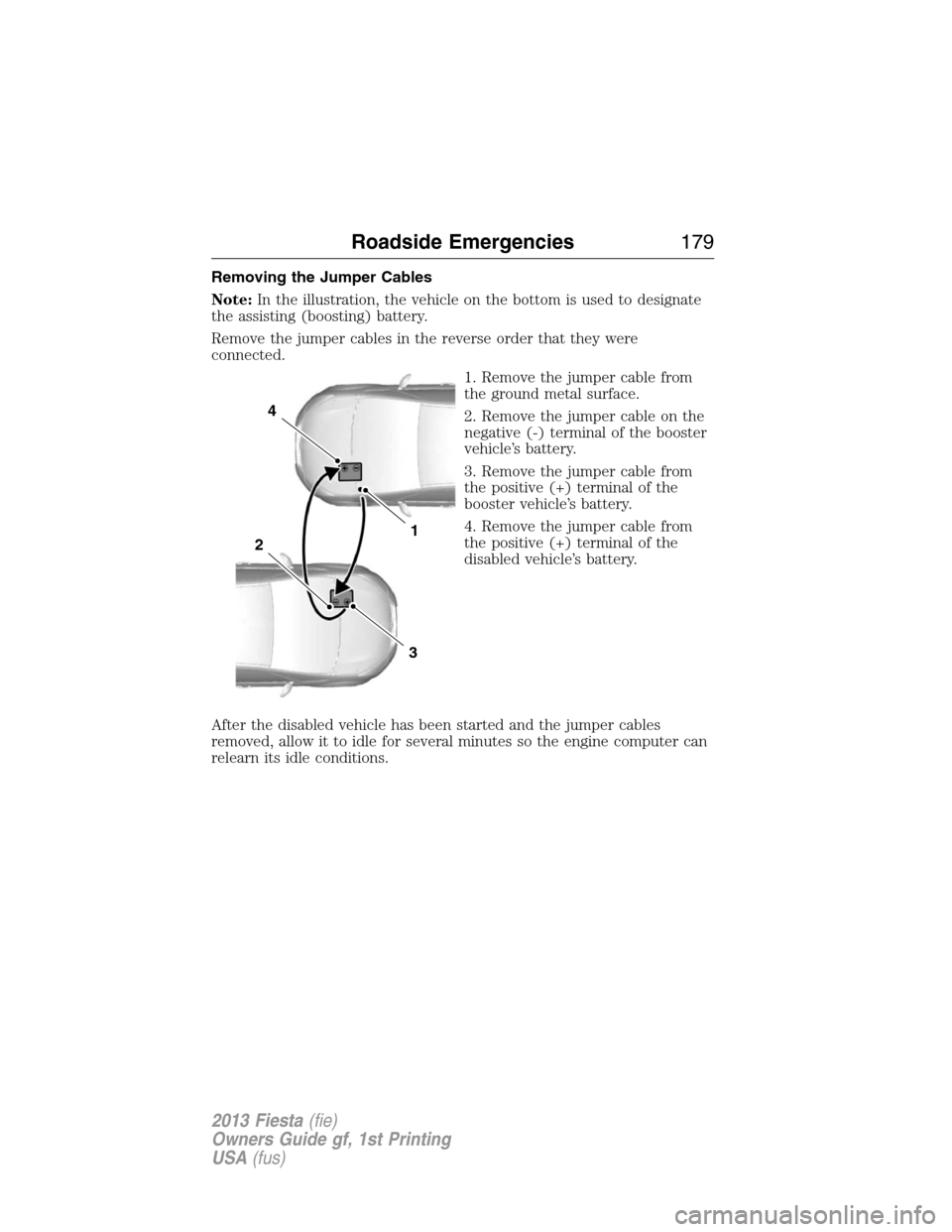
Note:In the illustration, the vehicle on the bottom is used to designate
the assisting (boosting) battery.
1. Connect the positive (+) jumper
cable to the positive (+) terminal of
the discharged battery.
2. Connect the other end of the
positive (+) cable to the positive
(+) terminal of the assisting battery.
3. Connect the negative (-) cable to
the negative (-) terminal of the
assisting battery.
4. Make the final connection of the
negative (-) cable to an exposed
metal part of the stalled vehicle’s
engine, away from the battery and
the carburetor/fuel injection system.
Ensure that the cables are clear of fan blades, belts, moving parts of both
engines, or any fuel delivery system parts.
Jump Starting
1. Start the engine of the booster vehicle and run the engine at
moderately increased speed.
2. Start the engine of the disabled vehicle.
3. Once the disabled vehicle has been started, run both engines for an
additional three minutes before disconnecting the jumper cables.
4
2
1
3
178Roadside Emergencies
2013 Fiesta(fie)
Owners Guide gf, 1st Printing
USA(fus)
Page 179 of 341
Removing the Jumper Cables
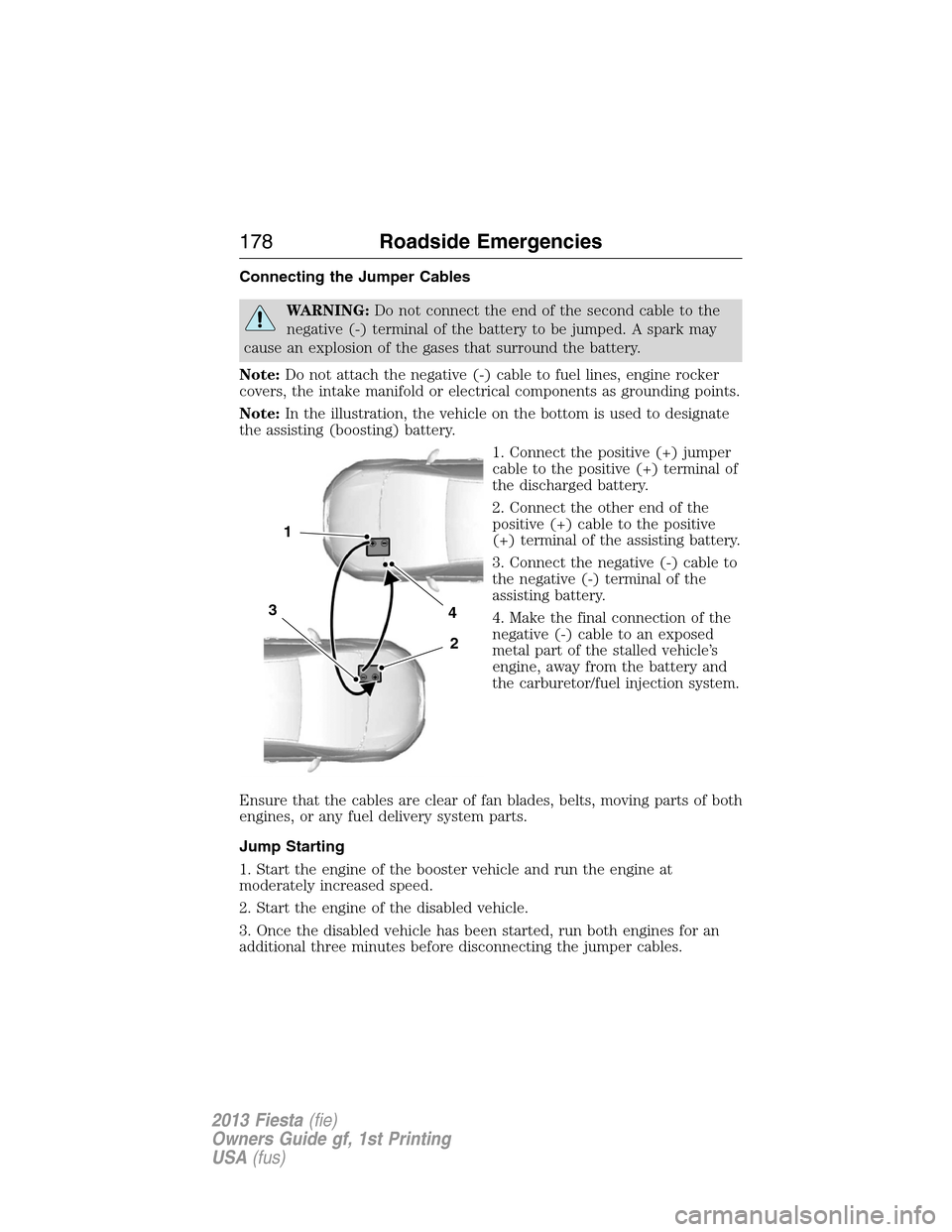
Note:In the illustration, the vehicle on the bottom is used to designate
the assisting (boosting) battery.
Remove the jumper cables in the reverse order that they were
connected.
1. Remove the jumper cable from
the ground metal surface.
2. Remove the jumper cable on the
negative (-) terminal of the booster
vehicle’s battery.
3. Remove the jumper cable from
the positive (+) terminal of the
booster vehicle’s battery.
4. Remove the jumper cable from
the positive (+) terminal of the
disabled vehicle’s battery.
After the disabled vehicle has been started and the jumper cables
removed, allow it to idle for several minutes so the engine computer can
relearn its idle conditions.
4
1
3
2
Roadside Emergencies179
2013 Fiesta(fie)
Owners Guide gf, 1st Printing
USA(fus)
Page 184 of 341
UTILIZING THE MEDIATION/ARBITRATION PROGRAM
(CANADA ONLY)
For vehicles delivered to authorized Canadian dealers. In those cases
where you continue to feel that the efforts by Ford of Canada and the
authorized dealer to resolve a factory-related vehicle service concern
have been unsatisfactory, Ford of Canada participates in an impartial
third party mediation/arbitration program administered by the Canadian
Motor Vehicle Arbitration Plan (CAMVAP).
The CAMVAP program is a straight forward and relatively speedy
alternative to resolve a disagreement when all other efforts to produce a
settlement have failed. This procedure is without cost to you and is
designed to eliminate the need for lengthy and expensive legal
proceedings.
In the CAMVAP program, impartial third-party arbitrators conduct
hearings at mutually convenient times and places in an informal
environment. These impartial arbitrators review the positions of the
parties, make decisions and, when appropriate, render awards to resolve
disputes. CAMVAP decisions are fast, fair, and final as the arbitrator’s
award is binding on both you and Ford of Canada.
CAMVAP services are available in all Canadian territories and provinces.
For more information, without charge or obligation, call your CAMVAP
Provincial Administrator directly at 1-800-207-0685 or visit
www.camvap.ca.
GETTING ASSISTANCE OUTSIDE THE U.S. AND CANADA
Before exporting your vehicle to a foreign country, contact the
appropriate foreign embassy or consulate. These officials can inform you
of local vehicle registration regulations and where to find unleaded fuel.
If you cannot find unleaded fuel or can only get fuel with an anti-knock
index lower than is recommended for your vehicle, contact a regional
office or owner relations/customer relationship office.
The use of leaded fuel in your vehicle without proper conversion may
damage the effectiveness of your emission control system and may cause
engine knocking or serious engine damage. Ford Motor Company/Ford of
Canada is not responsible for any damage caused by use of improper
fuel. Using leaded fuel may also result in difficulty importing your vehicle
back into the U.S.
184Customer Assistance
2013 Fiesta(fie)
Owners Guide gf, 1st Printing
USA(fus)
Page 189 of 341
FUSE SPECIFICATION CHART
Power Distribution Box
WARNING:Always disconnect the battery before servicing high
current fuses.
WARNING:To reduce risk of electrical shock, always replace the
cover to the power distribution box before reconnecting the
battery or refilling fluid reservoirs.
The power distribution box is located in the engine compartment. It has
high-current fuses that protect your vehicle’s main electrical systems
from overloads.
If the battery has been disconnected and reconnected, refer to
Changing the vehicle batteryin theMaintenancechapter.
R11R8
R12R9
R5R3
R6R4
R13R10
R2R1
R15R14
R7
F41F35
F26F17F27F18F28F19F29F20F30F21F31F22F32F23F33F24F34F25
F42F36
F43F37
F44F38
F45F39
F40
F6F1
F7F2
F8F3
F9F4
F10F5
F14F11
F15F12
F16F13
F46
Fuses189
2013 Fiesta(fie)
Owners Guide gf, 1st Printing
USA(fus)
Page 190 of 341
The high-current fuses are coded as follows:
Fuse/Relay
NumberFuse Amp
RatingProtected Components
F1 40A* Anti-lock brake system pump
F2 50A* Transmission control module
F3 40A* Engine cooling fan relay and
motor
F4 40A* Heater blower relay and motor
F5 60A* Passenger compartment fuse
panel
F6 30A* Body control module – door locks
F7 60A* Passenger compartment fuse
panel (ignition relay)
F8 40A* Powertrain control module, Power
distribution box
F9 20A* Anti-lock brake system module
valve
F10 30A* Starter inhibit relay, Starter motor
F11 30A* Electronic fuel pump relay, Fuel
tank, Ignition coil
F12 — Not used
F13 — Not used
F14 — Not used
F15 — Not used
F16 — Not used
F17 20A** High beam relay
F18 — Not used
F19 20A** Low beam relay
F20 15A** Heated exhaust gas oxygen
sensor, Catalyst module sensor
F21 7.5A** Low and High beams coil relay
control
190Fuses
2013 Fiesta(fie)
Owners Guide gf, 1st Printing
USA(fus)
Page 192 of 341
Fuse/Relay
NumberFuse Amp
RatingProtected Components
F46 — Not used
R1 — Not used
R2 — Not used
R3 — Powertrain control module relay
R4 — Heater blower relay
R5 — Engine cooling fan relay
R6 — Air condition clutch relay
R7 — Not used
R8 — Daytime running lamp
R9 — Starter inhibit relay
R10 — High beam relay
R11 — Low beam relay
R12 — Reverse lamp relay (automatic
transmission only)
R13 — Coil pack relay (Mexico only)
R14 — Not used
R15 — Not used
*Cartridge fuses **Mini fuses
192Fuses
2013 Fiesta(fie)
Owners Guide gf, 1st Printing
USA(fus)
Page 193 of 341
Passenger Compartment Fuse Panel
The fuse panel is located behind the glove box. Open the glove box,
press the sides inward and swing the glove box down.
The fuses are coded as follows:
Fuse/Relay
NumberFuse Amp
RatingProtected Components
F1 15A Ignition switch, Keyless entry
ignition and accessory relays
F2 10A Electronic mirror, Air conditioning
clutch, Engine compartment fuse
panel
F3 7.5A Instrument cluster
F4 7.5A Passenger airbag deactivation
indicator, Occupant classification
system
F5 15A Diagnostic connector
F6 10A Backup lamp
F25 F19
F10 F1
F11
F13
F15
F17F2
F4
F6
F8 F12
F14
F16
F18
F34
F35
F36F31
F32
F33F3
F5
F7
F9 F20
F21
F22
F23
F24 F26
F27
F28
F29
F30
R1
R7 R4
R3 R2
R5
R6 R8
R9
Fuses193
2013 Fiesta(fie)
Owners Guide gf, 1st Printing
USA(fus)
Page 194 of 341

Fuse/Relay
NumberFuse Amp
RatingProtected Components
F7 7.5A Instrument panel display,
Intelligent access antenna, Manual
climate controls
F8 7.5A Front dome lamp, Moonroof
F9 20A Keyless vehicle module
F10 15A Radio, SYNC�module, Global
positioning system module
F11 20A Body control module – front
wipers
F12 20A Tire pressure monitoring system
F13 15A Body control module – rear wiper
F14 20A Intelligent access module
F15 15A Wiper switch
F16 7.5A Power mirror switch, Driver
window switch
F17 15A Heated seats
F18 10A Stop lamps, Turn signals
F19 7.5A Instrument cluster
F20 10A Airbag module
F21 10A Body control module – ignition
switch, Climate control, Passive
anti-theft system transceiver,
Electronic power steering module,
Instrument cluster, Engine
compartment fuse panel
F22 7.5A Accelerator pedal position sensor,
Powertrain control module, Gear
shifter, Anti-lock brake system
ignition feed
F23 10A Transmission control unit ignition
feed, Tire pressure monitoring
system ignition feed
194Fuses
2013 Fiesta(fie)
Owners Guide gf, 1st Printing
USA(fus)