2013 FORD F650 light
[x] Cancel search: lightPage 135 of 378

If the transmission is equipped with a ceramic clutch, you must start the
vehicle moving in first gear and engage the clutch before pressing the
accelerator at idle. Also, do not try to slip the clutch by raising engine
RPM and riding or feathering the clutch pedal since this causes erratic
engagement which can cause engine stalling and potential serious
damage to driveline components.
Clutch Brake (Non-Synchronized Transmissions) - Vehicle
Stationary
A clutch brake is used to stop transmission input shaft rotation so that
the initial first gear or reverse gear selection can be accomplished when
the vehicle is stationary and the engine is at idle speed. Clutch brake
application occurs in the last inch (25 millimeters) of clutch pedal travel.
When using the clutch brake, fully press the clutch pedal and shift the
transmission into first gear or reverse. If the transmission won’t go into
one of these gears, slowly release the clutch pedal while applying light
pressure on the transmission shift lever until it shifts into gear.
Note:After engagement of first gear,do notuse the clutch brake for
upshifting or downshifting. If you do, clutch brake life shortens and gear
selection shift efforts may increase.
Double-Clutch Procedures - Non-Synchronized Transmissions
In order to properly upshift or downshift:
1. Press the clutch pedal to disengage the clutch.
2. Shift the transmission into neutral.
3. Release the clutch pedal.
If upshifting,wait until the engine speed matches the transmission
speed of the gear you are selecting.
If downshifting,accelerate the engine until the engine speed matches
the input speed of the gear you are selecting. Press the clutch pedal
immediately and shift into the desired gear, then release the clutch
pedal.
134Transmission
2013 F-650/750(f67)
Owners Guide gf, 2nd Printing, March 2013
USA(fus)
Page 142 of 378

Allison 3000 Series Push-Button Shifter
To shift to Reverse or Drive:
1. Press the brake pedal.
2. Press R or D on the shifter.
3. Release the brake pedal.
To select a higher range when in
Drive, press the up arrow button.
To select a lower range when in
Drive, press the down arrow button.
To place the transmission in Neutral,
press N.
Allison 3000 Prognostics
This transmission is equipped with the Allison Prognostics feature that
can alert the driver to needed transmission maintenance and
transmission fluid and filter life. See the separate Allison transmission
manual for complete details.
POWER TAKE-OFF (PTO) OPERATION (IF EQUIPPED)
A PTO unit allows the transmission to power auxiliary equipment to run
devices such as snowplows, aerial lifts, tow truck lifts, cement mixers or
dump trucks.
Vehicles Equipped with an Allison Automatic Transmission
(Except 3000 Series)
The PTO can be operated while the vehicle is standing or moving.
To engage the PTO, apply the brakes and shift to any gear other than
positionN,then engage the PTO.
If engagement is prevented by the gear teeth not meshing properly,
release the brakes and allow the vehicle to creep slightly or shift the
Transmission141
2013 F-650/750(f67)
Owners Guide gf, 2nd Printing, March 2013
USA(fus)
Page 145 of 378

The differential can be locked or unlocked when the vehicle is moving at
a constant speed of under 25 mph (40 km/h) and while the wheels are
not slipping. The differential must not be locked when the vehicle is
traveling down steep grades and traction is minimal.
The differential lock and differential lock light automatically disengage at
speeds above 25 mph (40 km/h). The differential lock remains off until
either the vehicle is restarted or the differential lock switch is turned off
then back on.
Turn the engine off and raise all drive wheels of the locker differential
axle in order to prevent the vehicle from moving when servicing the
wheels, tires or brakes. Axles equipped with a NoSPIN Detroit Locker
differential deliver power to both wheels even when only one wheel is on
the ground.
WARNING:Failure to raise all drive wheels with this type of
differential could cause the vehicle to move unexpectedly,
resulting in property damage, personal injury or death.
Care should be taken to avoid sudden accelerations when both drive
wheels are on a slippery surface.
WARNING:Sudden accelerations on slippery surfaces could
cause the wheels to spin, the vehicle to turn sideways on a
crowned road surface or in a turn, possibly resulting in loss of vehicle
control and personal injury.
Fluid Temperature
Axle operating temperatures normally do not exceed 100°F (38°C).
If the operating temperature exceeds 230°F (110°C), the rate of axle
lubrication oxidation increases and shortens the life of the lubricant and
seals, requiring axle lubrication changes to become more frequent to
preserve the axle. Extreme Pressure (EP) lubricants should not be run
consistently above 230°F (110°C).
Axle Conversions
WARNING:When operating a loaded vehicle, the driver must
keep all adjustable axles on the ground at all times, supporting
their share of the vehicle’s load. Failure to do so can overload other
axles, tires, wheels, springs, steering components, brakes and frames,
resulting in early component failure, loss of vehicle control, possible
property damage and personal injury.
144Transmission
2013 F-650/750(f67)
Owners Guide gf, 2nd Printing, March 2013
USA(fus)
Page 146 of 378
It is not recommended, or approved, for axle conversions to be
performed. However, it is understood that, on occasion, aftermarket
add-on axles are installed by others on the truck chassis which allow
operator control for weight transfer from other axles (i.e., air lift axles).
TWO-SPEED REAR AXLE (IF EQUIPPED)
WARNING:Never shift a two-speed axle when descending a
steep grade as this may cause loss of vehicle control and result in
personal injury.
Note:Do not shift between ranges when the speed control is on.
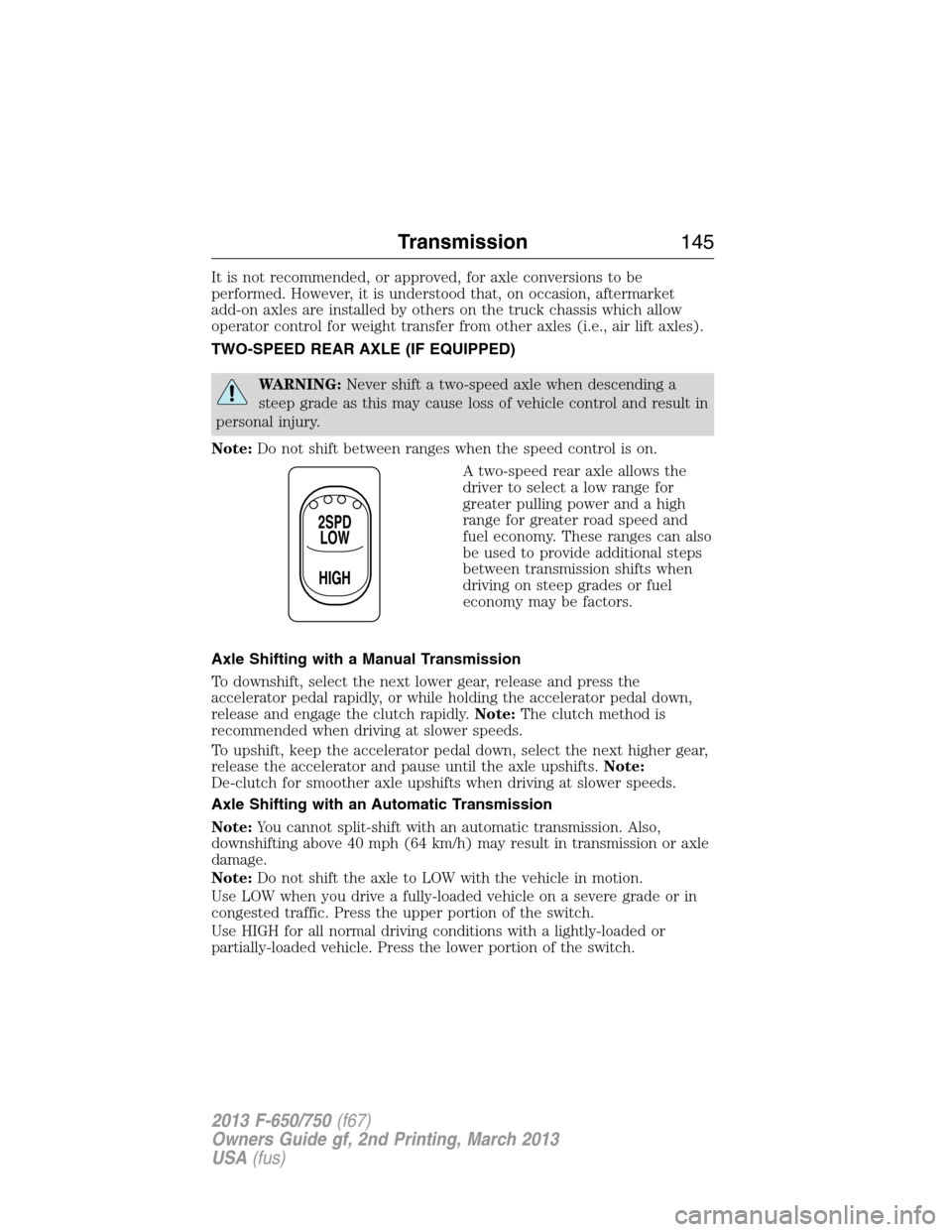
A two-speed rear axle allows the
driver to select a low range for
greater pulling power and a high
range for greater road speed and
fuel economy. These ranges can also
be used to provide additional steps
between transmission shifts when
driving on steep grades or fuel
economy may be factors.
Axle Shifting with a Manual Transmission
To downshift, select the next lower gear, release and press the
accelerator pedal rapidly, or while holding the accelerator pedal down,
release and engage the clutch rapidly.Note:The clutch method is
recommended when driving at slower speeds.
To upshift, keep the accelerator pedal down, select the next higher gear,
release the accelerator and pause until the axle upshifts.Note:
De-clutch for smoother axle upshifts when driving at slower speeds.
Axle Shifting with an Automatic Transmission
Note:You cannot split-shift with an automatic transmission. Also,
downshifting above 40 mph (64 km/h) may result in transmission or axle
damage.
Note:Do not shift the axle to LOW with the vehicle in motion.
Use LOW when you drive a fully-loaded vehicle on a severe grade or in
congested traffic. Press the upper portion of the switch.
Use HIGH for all normal driving conditions with a lightly-loaded or
partially-loaded vehicle. Press the lower portion of the switch.
2SPD
LOW
HIGH
Transmission145
2013 F-650/750(f67)
Owners Guide gf, 2nd Printing, March 2013
USA(fus)
Page 148 of 378

GENERAL INFORMATION
All standard equipment brakes are designed to be self-adjusting.
Automatic adjustment, when required, occurs whenever the brakes are
applied and released during forward or reverse operation.
Note:Occasional brake noise is normal. If a metal-to-metal, continuous
grinding or continuous squeal sound is present, the brake linings may be
worn out and should be inspected by an authorized dealer. If the vehicle
has continuous vibration or shudder in the steering wheel while braking,
the vehicle should be inspected by an authorized dealer.
Know the required stopping distances for all driving conditions that may
be encountered. For longer brake lining life, take full advantage of engine
braking power when coming to a stop.
WARNING:Do not drive with your foot resting on the brake
pedal. This results in abnormally high brake temperatures,
excessive lining wear and increased stopping distances.
Before descending a long or steep hill, shift to a lower gear and avoid
continuous application of the brakes. Normally, choose the same gear to
descend the hill that you use to ascend the hill.
WARNING:Continuous application of the brakes causes the
brakes to overheat, resulting in a temporary loss of braking.
See theInstrument Clusterchapter for information on the
brake system warning light.
Wet brakes result in reduced braking efficiency. Gently press the brake
pedal a few times when driving from a car wash or standing water to dry
the brakes.
If Brakes Do Not Grip Well
•If you have been driving through deep water, gently apply the brakes
several times while the vehicle is moving slowly.
•Let the brakes cool if you have been using them excessively, as in
mountain driving or after several fast, high-speed stops.
•Check brake adjustment.
•Check brake linings for excessive wear.
•Check system air pressure on vehicles equipped with air brakes.
Brakes147
2013 F-650/750(f67)
Owners Guide gf, 2nd Printing, March 2013
USA(fus)
Page 149 of 378

Anti-lock Brake System (ABS)
This system helps you maintain steering control during emergency stops
by keeping the brakes from locking.
The ABS lamp momentarily illuminates when the ignition is
turned on. If the light does not illuminate during start-up,
remains on or flashes, the ABS may be disabled and may need
to be serviced.
If the ABS is disabled, normal braking is still effective. If the
brake warning lamp illuminates, have your brake system
serviced immediately.
If a PLC trailer is connected when the ignition is switched on,
the trailer ABS light also illuminates. If the light fails to
illuminate, remains on after the vehicle is started or continues
to flash, have the system serviced immediately.
FULL POWER BRAKE SYSTEM
WARNING:If the red BRAKE warning lamp in the instrument
cluster remains illuminated after engine start up, this indicates a
system failure in the Full Power Brake System. Stop the vehicle safely
as soon as possible and seek service immediately.
This system incorporates standard braking, an anti-lock braking system
(ABS) and optional Power Park Brake into one fully-integrated hydraulic
brake system. With the Full Power Brake System, braking energy is
stored, similar to an air brake system, resulting in faster response times
and shorter stopping distances. This is accomplished using motor and
pump assemblies that pressurize the system by pumping brake fluid into
accumulators. This is similar to the air compressor of an air brake system
pressurizing the air tanks. The system includes a master cylinder that
provides the normal pedal feel and transfers the pedal force, via brake
fluid, to the main components of the system.
Note:The motor and pumps run momentarily with the ignition switch in
the on or run position, or in the off position with the brake pedal
pressed.
Note:During normal driving, the pump and motors may be heard
replenishing the accumulators. This is a normal function of the system.
148Brakes
2013 F-650/750(f67)
Owners Guide gf, 2nd Printing, March 2013
USA(fus)
Page 150 of 378

AIR BRAKES
After starting the engine, give the air compressor time to build up the air
pressure to 60 psi (414 kPa) before moving the vehicle.
WARNING:Do not drive or continue to drive if the low air
pressure buzzer is sounding or the brake warning light is lit.
These warnings indicate that air pressure is not to normal operating
level. Continued use of the vehicle could result in loss of braking ability.
WARNING:Avoid repeated light application of the brake pedal.
This depletes air pressure faster and could result in loss of
braking capability.
Periodically check the air pressure
gauge while driving. Pressure should
range between approximately
100–125 psi (690–862 kPa). The air
compressor governor cut-in and
cut-out pressure settings are set at
the factory and are not adjustable.
When air pressure is insufficient (below 60 psi [414 kPa]), a
warning light illuminates and a buzzer sounds when the ignition
is in the on position.
This condition may be caused by excessive brake applications depleting
the system air pressure. If this condition occurs, stop driving the vehicle
until the compressor has fully recharged the air system.
WARNING:Do not move the vehicle when the air pressure is
insufficient because the brake system may be inoperative.
Select a gear ratio to help slow your vehicle before descending grades.
Supplement with brakes as required to safely slow the vehicle and avoid
overspeeding the engine.
Brakes149
2013 F-650/750(f67)
Owners Guide gf, 2nd Printing, March 2013
USA(fus)
Page 154 of 378

Exhaust Brake Operating Characteristics
When you remove your feet from both the accelerator and clutch pedals
and the exhaust brake switch is in the on position, the exhaust brake is
activated. The following conditions exist if the brake is operating properly:
•A slight change in engine sound when the exhaust brake is activated.
•A smooth braking effect. Do not expect a retarding effect similar to
sudden, hard application of the service brakes.
•The retarding force possibly felt acting against your body when the
brake is applied (depending on the grade and vehicle load). This force
is actually preventing the vehicle from going much faster.
•Engine temperature remaining in the normal operating range.
•The tachometer showing a drop in engine RPM (depending on grade
and vehicle load) during a descent.
•A decrease in road speed when the exhaust brake is applied during a
descent, except when the vehicle is carrying a heavy load or the grade
is extremely steep. In these instances, you may need to apply the
service brakes occasionally.
TRAILER BRAKES
Trailer Brake Hand Control (If Equipped)
WARNING:The hand control should never be used to apply
the brakes when the tractor and trailer are parked unattended.
Air may leak from the system and the vehicle could possibly move,
resulting in possible property damage, personal injury or death.
The hand control is located on the
right-hand side of the instrument
panel. It is used to apply the
trailer service brakes which are
independent of the truck or tractor
service brakes.
It operates a valve that provides gradual control of air pressure applied.
When the valve is only partially applied, the trailer brakes can be
overridden by pressing fully on the brake pedal.
To apply the trailer brakes using the hand control, move the lever
downward. The further the lever is pushed down, the greater the air
pressure is applied to the brakes. The lever remains in place until
manually moved.
To release the trailer brakes, move the lever up completely.
Brakes153
2013 F-650/750(f67)
Owners Guide gf, 2nd Printing, March 2013
USA(fus)