Page 297 of 576
![FORD EXPLORER 2013 5.G Owners Manual •Drive a heavily loaded vehicle or tow a trailer.
•Carry unnecessary weight (approximately 1 mpg [0.4 km/L] is lost for
every 400 lb [180 kg] of weight carried).
•Add particular accessories to y](/manual-img/11/4943/w960_4943-296.png "FORD EXPLORER 2013 5.G Owners Manual •Drive a heavily loaded vehicle or tow a trailer.
•Carry unnecessary weight (approximately 1 mpg [0.4 km/L] is lost for
every 400 lb [180 kg] of weight carried).
•Add particular accessories to y")
•Drive a heavily loaded vehicle or tow a trailer.
•Carry unnecessary weight (approximately 1 mpg [0.4 km/L] is lost for
every 400 lb [180 kg] of weight carried).
•Add particular accessories to your vehicle (e.g. bug deflectors,
rollbars/light bars, running boards, ski racks).
•Drive with the wheels out of alignment.
DRIVING THROUGH WATER
If driving through deep or standing
water is unavoidable, proceed very
slowly. Never drive through water
that is higher than the bottom of
the wheel rims (for cars) or the
bottom of the hubs (for trucks).
When driving through water, traction or brake capability may be limited.
Also, water may enter your engine’s air intake and severely damage your
engine or your vehicle may stall.
Note:Driving through deep water where the transmission vent tube is
submerged may allow water into the transmission and cause internal
transmission damage.
Note:Once through the water, always dry the brakes by moving your
vehicle slowly while applying light pressure on the brake pedal. Wet
brakes do not stop the vehicle as quickly as dry brakes.
Driving Hints297
2013 Explorer(exp)
Owners Guide gf, 1st Printing
USA(fus)
Page 317 of 576
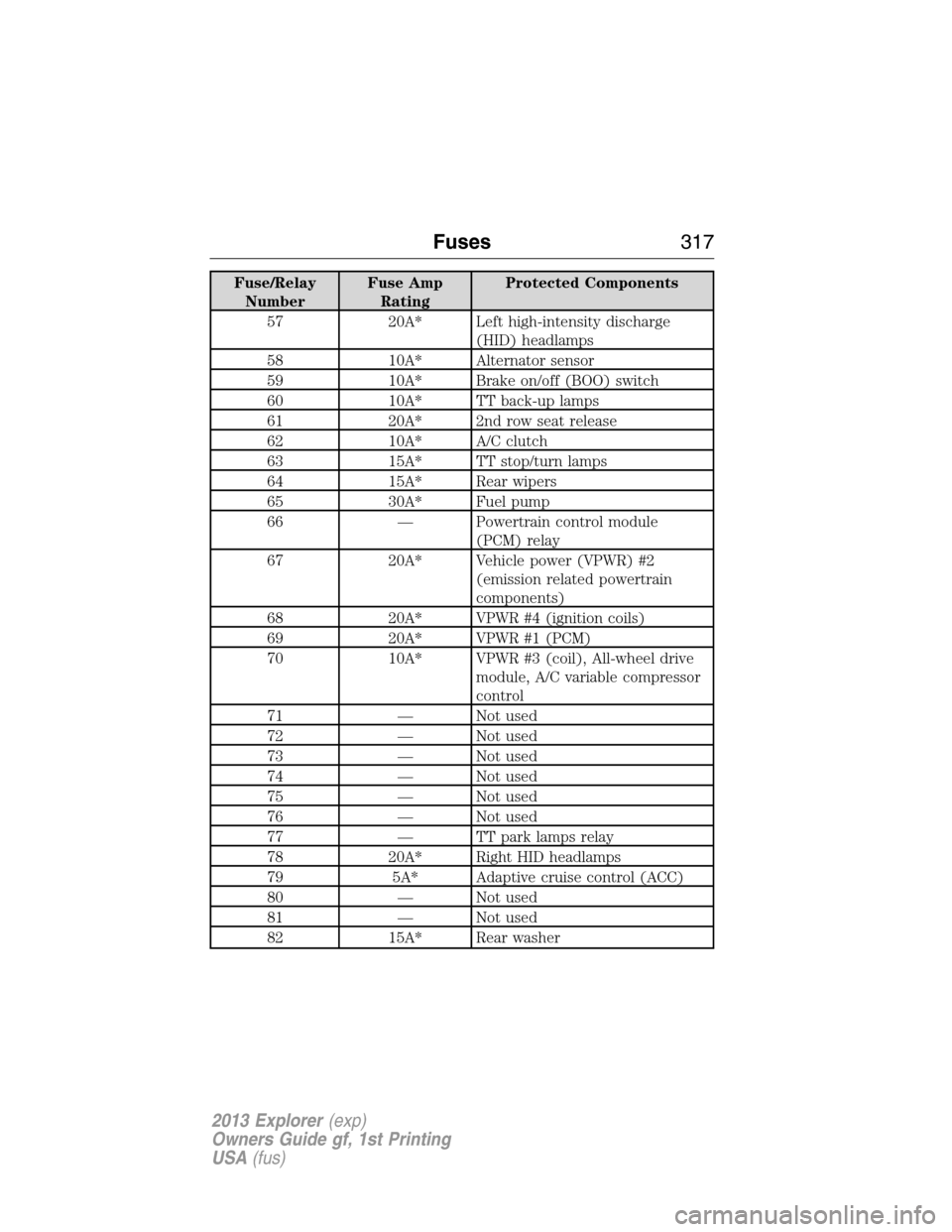
Fuse/Relay
NumberFuse Amp
RatingProtected Components
57 20A* Left high-intensity discharge
(HID) headlamps
58 10A* Alternator sensor
59 10A* Brake on/off (BOO) switch
60 10A* TT back-up lamps
61 20A* 2nd row seat release
62 10A* A/C clutch
63 15A* TT stop/turn lamps
64 15A* Rear wipers
65 30A* Fuel pump
66 — Powertrain control module
(PCM) relay
67 20A* Vehicle power (VPWR) #2
(emission related powertrain
components)
68 20A* VPWR #4 (ignition coils)
69 20A* VPWR #1 (PCM)
70 10A* VPWR #3 (coil), All-wheel drive
module, A/C variable compressor
control
71 — Not used
72 — Not used
73 — Not used
74 — Not used
75 — Not used
76 — Not used
77 — TT park lamps relay
78 20A* Right HID headlamps
79 5A* Adaptive cruise control (ACC)
80 — Not used
81 — Not used
82 15A* Rear washer
Fuses317
2013 Explorer(exp)
Owners Guide gf, 1st Printing
USA(fus)
Page 319 of 576
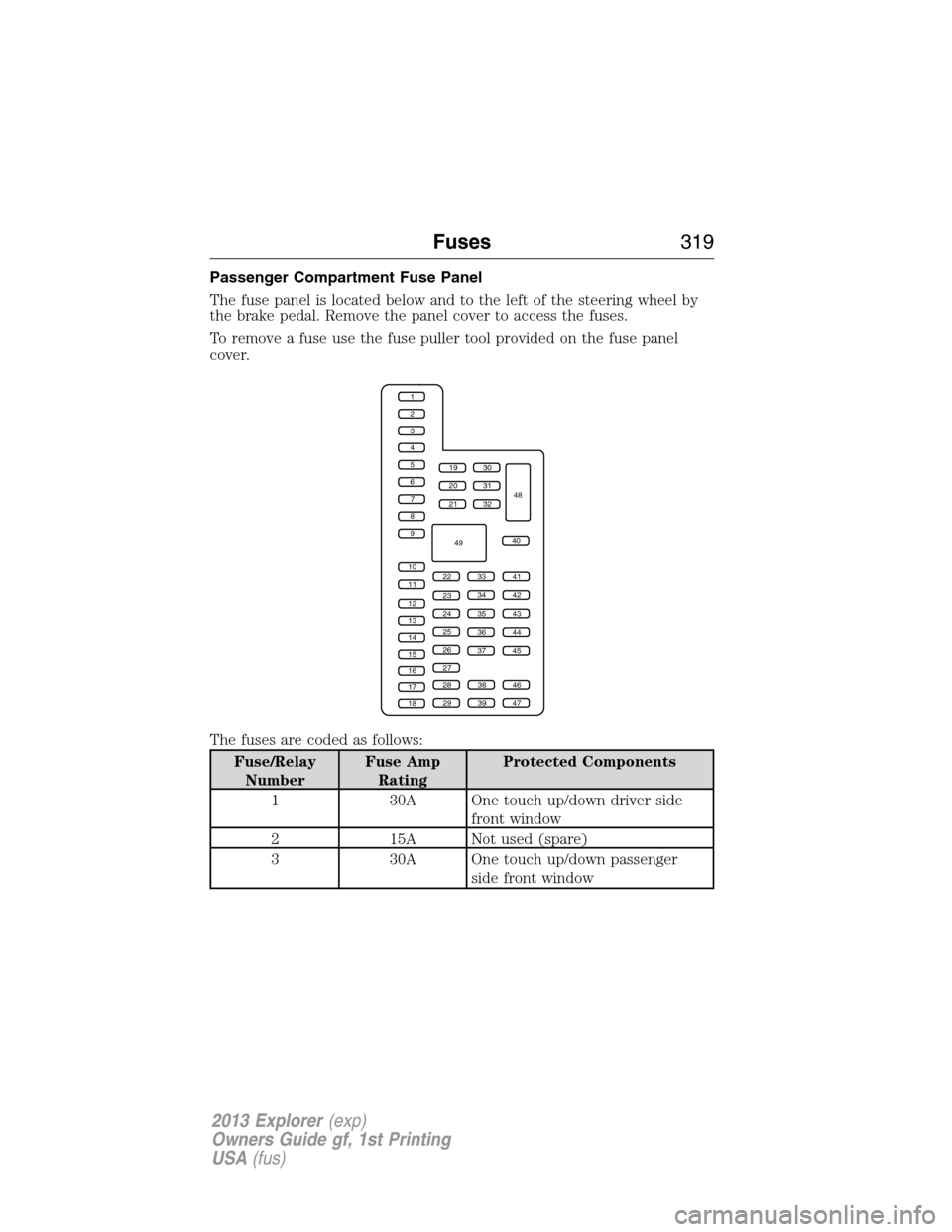
Passenger Compartment Fuse Panel
The fuse panel is located below and to the left of the steering wheel by
the brake pedal. Remove the panel cover to access the fuses.
To remove a fuse use the fuse puller tool provided on the fuse panel
cover.
The fuses are coded as follows:
Fuse/Relay
NumberFuse Amp
RatingProtected Components
1 30A One touch up/down driver side
front window
2 15A Not used (spare)
3 30A One touch up/down passenger
side front window
1
2
3
4
5
6
7
8
9
10
11
12
13
14
15
16
17
18
19
20
21
223341
42
43
44
45
34
35
36
37
23
24
25
26
27
283846
394729
32
40
31
30
48
49
Fuses319
2013 Explorer(exp)
Owners Guide gf, 1st Printing
USA(fus)
Page 321 of 576

Fuse/Relay
NumberFuse Amp
RatingProtected Components
19 20A Memory seat power
20 20A Locks
21 10A Intelligent access (IA), Keypad
22 20A Horn relay
23 15A Steering wheel control module,
IA, Headlamp switch
24 15A Datalink connector, Steering
wheel control module
25 15A Liftgate release
26 5A Radio frequency module
27 20A IA module
28 15A Ignition switch, Push button start
switch
29 20A Radio, Global positioning system
module
30 15A Front park lamps
31 5A Trailer tow brake controller
32 15A 110V AC power point, Power
folding mirror, Power mirrors, One
touch up/down front windows,
Door lock illumination, Memory
switch illumination
33 10A Occupant classification sensor
34 10A Blind spot monitor, Rearview
camera, Reverse sensing system,
Lane departure warning module
35 5A Heads-up display, Climate control
humidity sensor, Terrain
management system, Hill descent
switch, Headlamp switch IGN
sense
36 10A Heated steering wheel
Fuses321
2013 Explorer(exp)
Owners Guide gf, 1st Printing
USA(fus)
Page 323 of 576
GENERAL INFORMATION
Have your vehicle serviced regularly to help maintain its roadworthiness
and resale value. There is a large network of Ford authorized dealers that
are there to help you with their professional servicing expertise. We
believe that their specially trained technicians are best qualified to
service your vehicle properly and expertly. They are supported by a wide
range of highly specialized tools developed specifically for servicing your
vehicle.
To help you service your vehicle, we providescheduled maintenance
informationwhich makes tracking routine service easy.
If your vehicle requires professional service, your authorized dealer can
provide the necessary parts and service. Check yourWarranty Guideto
find out which parts and services are covered.
Use only recommended fuels, lubricants, fluids and service parts
conforming to specifications. Motorcraft�parts are designed and built to
provide the best performance in your vehicle.
Precautions
•Do not work on a hot engine.
•Make sure that nothing gets caught in moving parts.
•Do not work on a vehicle with the engine running in an enclosed
space, unless you are sure you have enough ventilation.
•Keep all open flames and other burning material (such as cigarettes)
away from the battery and all fuel related parts.
Working with the engine off
1. Set the parking brake and shift to P (Park).
2. Turn off the engine and remove the key (if equipped).
3. Block the wheels.
Working with the engine on
WARNING:To reduce the risk of vehicle damage and/or personal
burn injuries, do not start your engine with the air cleaner
removed and do not remove it while the engine is running.
1. Set the parking brake and shift to P (Park).
2. Block the wheels.
Maintenance323
2013 Explorer(exp)
Owners Guide gf, 1st Printing
USA(fus)
Page 338 of 576

Battery relearn
Because your vehicle’s engine is electronically controlled by a computer,
some control conditions are maintained by power from the battery. When
the battery is disconnected or a new battery is installed, the engine must
relearn its idle and fuel trim strategy for optimum driveability and
performance. To begin this process:
1. With the vehicle at a complete stop, set the parking brake.
2. Put the gearshift lever in P (Park), turn off all accessories and start
the engine.
3. Run the engine until it reaches normal operating temperature.
4. Allow the engine to idle for at least one minute.
5. Turn the A/C on and allow the engine to idle for at least one minute.
6. Drive the vehicle to complete the relearning process.
•The vehicle may need to be driven to relearn the idle and fuel trim
strategy.
•Note:If you do not allow the engine to relearn its idle trim, the idle
quality of your vehicle may be adversely affected until the idle trim is
eventually relearned.
When the battery is disconnected or a new battery installed, the
transmission must relearn its adaptive strategy. As a result of this, the
transmission may shift firmly. This operation is considered normal and
will not affect function or durability of the transmission. Over time the
adaptive learning process will fully update transmission operation to its
optimum shift feel.
If the battery has been disconnected or a new battery has been installed,
the clock and the preset radio stations must be reset once the battery is
reconnected.
Always dispose of automotive batteries in a responsible manner. Follow
your local authorized standards for disposal. Call your local authorized
recycling center to find out more about recycling automotive batteries.
Battery management system
The battery management system (BMS) monitors battery conditions and
takes actions to extend battery life. If excessive battery drain is detected,
the system may temporarily disable certain electrical features to protect
the battery. Those electrical accessories affected include rear defrost,
heated /cooled seats, climate control fan, heated steering wheel, audio
and navigation system. A message may be displayed on the instrument
338Maintenance
2013 Explorer(exp)
Owners Guide gf, 1st Printing
USA(fus)
Page 350 of 576
GENERAL INFORMATION
Your Ford or Lincoln authorized dealer has many quality products
available to clean your vehicle and protect its finishes.
CLEANING PRODUCTS
For best results, use the following products or products of equivalent
quality:
Motorcraft�Bug and Tar Remover (ZC-42)
Motorcraft�Custom Bright Metal Cleaner (ZC-15)
Motorcraft�Detail Wash (ZC-3-A)
Motorcraft�Dusting Cloth (ZC-24)
Motorcraft�Engine Shampoo and Degreaser (U.S. only) (ZC-20)
Motorcraft�Engine Shampoo (Canada only) (CXC-66-A)
Motorcraft�Multi-Purpose Cleaner (Canada only) (CXC-101)
Motorcraft�Premium Glass Cleaner (Canada only) (CXC-100)
Motorcraft�Premium Quality Windshield Washer Fluid (Canada only)
[CXC-37-(A, B, D or F)]
Motorcraft�Premium Windshield Washer Concentrate (U.S. only)
(ZC-32-A)
Motorcraft�Professional Strength Carpet & Upholstery Cleaner (ZC-54)
Motorcraft�Spot and Stain Remover (U.S. only) (ZC-14)
Motorcraft�Ultra-Clear Spray Glass Cleaner (ZC-23)
Motorcraft�Vinyl Cleaner (Canada only) (CXC-93)
Motorcraft�Wheel and Tire Cleaner (ZC-37-A)
CLEANING THE EXTERIOR
Wash your vehicle regularly with cool or lukewarm water and a neutral
pH shampoo, such as Motorcraft�Detail Wash.
•Never use strong household detergents or soap, such as dish washing
or laundry liquid. These products can discolor and spot painted
surfaces.
•Never wash a vehicle that is “hot to the touch” or during exposure to
strong, direct sunlight.
•Dry the vehicle with a chamois or soft terry cloth towel in order to
eliminate water spotting.
350Vehicle Care
2013 Explorer(exp)
Owners Guide gf, 1st Printing
USA(fus)
Page 351 of 576
•Immediately remove items such as gasoline, diesel fuel, bird droppings
and insect deposits because they can cause damage to the vehicle’s
paintwork and trim over time. Use Motorcraft�Bug and Tar Remover.
•Remove any exterior accessories, such as antennas, before entering a
car wash.
•Note:Suntan lotions and insect repellents can damage any painted
surface; if these substances come in contact with your vehicle, wash
off as soon as possible.
Exterior chrome
Note:Never use abrasive materials such as steel wool or plastic pads as
they can scratch the chrome surface.
Note:Do not use chrome cleaner, metal cleaner or polish on wheels and
wheel covers.
•Wash the vehicle first, using cool or lukewarm water and a neutral pH
shampoo, such as Motorcraft�Detail Wash.
•Use Motorcraft�Custom Bright Metal Cleaner. Apply the product as
you would a wax to clean bumpers and other chrome parts; allow the
cleaner to dry for a few minutes, then wipe off the haze with a clean,
dry rag.
•Do not apply cleaning product to hot surfaces and do not leave
cleaning product on chrome surfaces for a period of time exceeding
that which is recommended.
•Using other non-recommended cleaners can result in severe and
permanent cosmetic damage.
Underbody
Flush the complete underside of your vehicle frequently. Keep body and
door drain holes free from packed dirt.
Cleaning plastic exterior parts
Use only approved products to clean plastic parts.
•For routine cleaning, use Motorcraft�Detail Wash.
•If tar or grease spots are present, use Motorcraft�Bug and Tar
Remover.
Vehicle Care351
2013 Explorer(exp)
Owners Guide gf, 1st Printing
USA(fus)