2013 FORD EXPEDITION service indicator
[x] Cancel search: service indicatorPage 227 of 497
PRINCIPLES OF OPERATION
The traction control system helps avoid drive wheel spin and loss of
traction.
If your vehicle begins to slide, the system applies the brakes to individual
wheels and, when needed, reduces engine power at the same time. If the
wheels spin when accelerating on slippery or loose surfaces, the system
reduces engine power in order to increase traction.
USING TRACTION CONTROL (IF EQUIPPED)
In certain situations (e.g. stuck in snow or mud), turning the traction
control off may be beneficial as this allows the wheels to spin with full
engine power. Turn off the traction control system using the TCS OFF
button located on the center of the instrument panel.
System indicator lights and messages
WARNING:If a failure has been detected within the Traction
Control System, the stability control light will illuminate steadily.
Verify that the Traction Control System was not manually disabled. If
the stability control light still illuminates steadily, have the system
serviced by an authorized dealer immediately. Operating your vehicle
with Traction Control disabled could lead to an increased risk of loss of
vehicle control, vehicle rollover, personal injury and death.
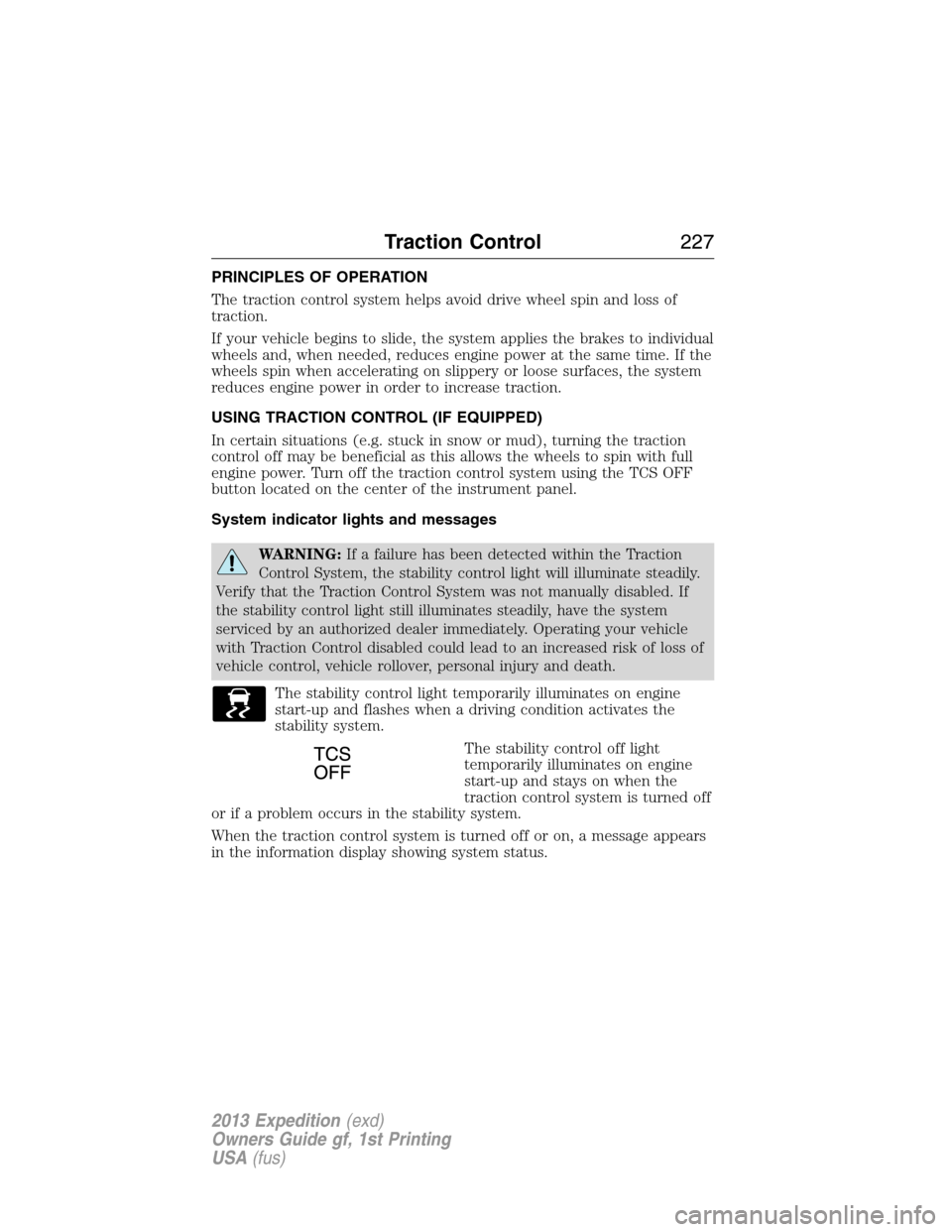
The stability control light temporarily illuminates on engine
start-up and flashes when a driving condition activates the
stability system.
The stability control off light
temporarily illuminates on engine
start-up and stays on when the
traction control system is turned off
or if a problem occurs in the stability system.
When the traction control system is turned off or on, a message appears
in the information display showing system status.
Traction Control227
2013 Expedition(exd)
Owners Guide gf, 1st Printing
USA(fus)
Page 297 of 497

What You Should Know About Fail-Safe Cooling
If the engine coolant supply is depleted, this feature allows the vehicle to
be driven temporarily before incremental component damage is incurred.
The “fail-safe” distance depends on ambient temperatures, vehicle load
and terrain.
How Fail-Safe Cooling Works
If the engine begins to overheat, the engine coolant temperature gauge
will move to the red (hot) area and:
The coolant temperature warning light will illuminate.
The service engine soon indicator will illuminate.
If the engine reaches a preset over-temperature condition, the engine
will automatically switch to alternating cylinder operation. Each disabled
cylinder acts as an air pump and cools the engine.
When this occurs the vehicle will still operate. However:
•The engine power will be limited.
•The air conditioning system will be disabled.
Continued operation will increase the engine temperature and the engine
will completely shut down, causing steering and braking effort to
increase.
Once the engine temperature cools, the engine can be restarted. Take
your vehicle to an authorized dealer as soon as possible to minimize
engine damage.
When Fail-Safe Mode is Activated
WARNING:Fail-safe mode is for use during emergencies only.
Operate the vehicle in fail-safe mode only as long as necessary to
bring the vehicle to rest in a safe location and seek immediate repairs.
When in fail-safe mode, the vehicle will have limited power, will not be
able to maintain high-speed operation, and may completely shut down
without warning, potentially losing engine power, power steering assist,
and power brake assist, which may increase the possibility of a crash
resulting in serious injury.
Maintenance297
2013 Expedition(exd)
Owners Guide gf, 1st Printing
USA(fus)
Page 346 of 497
CHANGING A ROAD WHEEL
WARNING:The use of tire sealants may damage your tire
pressure monitoring system (TPMS) and should not be used.
However, if you must use a sealant, the TPMS sensor and valve stem on
the wheel must be replaced by an authorized Ford dealer.
WARNING:SeeTire Pressure Monitoring Systemin this
chapter for important information. If the tire pressure monitor
sensor becomes damaged, it will no longer function.
Note:The tire pressure monitoring system indicator light will illuminate
when the spare tire is in use. To restore the full functionality of the
monitoring system, all road wheels equipped with tire pressure
monitoring sensors must be mounted on the vehicle.
If you get a flat tire while driving, do not apply the brake heavily.
Instead, gradually decrease your speed. Hold the steering wheel firmly
and slowly move to a safe place on the side of the road.
Have a flat serviced by an authorized dealer in order to prevent damage
to the TPMS sensors. SeeTire Pressure Monitoring Systemearlier in
the chapter. Replace the spare tire with a road tire as soon as possible.
During repairing or replacing of the flat tire, have the authorized dealer
inspect the TPMS sensor for damage.
Dissimilar Spare Tire and Wheel Assembly Information
WARNING:Failure to follow these guidelines could result in an
increased risk of loss of vehicle control, injury or death.
If you have a dissimilar spare tire and wheel assembly, then it is intended
for temporary use only. This means that if you need to use it, you should
replace it as soon as possible with a road tire and wheel assembly that is
the same size and type as the road tires and wheels that were originally
provided by Ford. If the dissimilar spare tire or wheel is damaged, it
should be replaced rather than repaired.
A dissimilar spare tire and wheel assembly is defined as a spare tire or
wheel that is different in brand, size or appearance from the road tires
and wheels and can be one of three types:
1.T-type mini-spare:This spare tire begins with the letter T for tire
size and may have Temporary Use Only molded in the sidewall.
346Wheels and Tires
2013 Expedition(exd)
Owners Guide gf, 1st Printing
USA(fus)
Page 492 of 497
D
Defrost ...............146, 148, 150, 152
rear window ............................157
Dipstick
automatic transmission
fluid ..........................................298
engine oil .................................293
Driving under special
conditions ..................215, 220, 222
sand .........................................221
snow and ice ...........................223
through water .................221, 265
Dual automatic temperature
control (DATC) .................150, 152
DVD (if equipped) ....................128
DVD region coding ...................136
DVD system ...............................128
E
Electronic message center .......101
Electronic stability control ......229
Emergencies, roadside
jump-starting ..........................270
running out of fuel .................201
Emission control system ..........206
End user license agreement ....473
Engine ........................................355
cleaning ...................................315
coolant .....................................294
fail-safe cooling .......................297
idle speed control ...................300
lubrication specifications .......356
refill capacities ........................356
service points ..........................292
Engine block heater .................197Engine oil
checking and adding ..............293
dipstick ....................................293
filter, specifications ................360
refill capacities ........................356
specifications ..........................356
Event data recording ..................12
Exhaust fumes ..........................197
F
Fail safe cooling ........................297
Fleet MyKey programming ........56
Flexible Fuel Vehicle (FFV) ....199
Floor mats .................................266
Fluid capacities .........................356
Fog lamps ....................................84
Forward and reverse sensing
system ........................................231
Four-Wheel Drive vehicles .......216
description ..............................217
driving off road .......................219
indicator light .........................216
Fuel
cap ...........................................203
capacity ...................................356
choosing the right fuel ...........200
filler funnel .............................201
filling your vehicle with fuel ..203
filter, specifications ................299
fuel pump shut-off ..................269
octane rating ...................201, 355
quality ......................................200
running out of fuel .................201
safety information relating to
automotive fuels .....................199
Fuel - flex fuel vehicle
(FFV) .................................199–200
492Index
2013 Expedition(exd)
Owners Guide gf, 1st Printing
USA(fus)