Page 247 of 526

TOWING THE VEHICLE ON FOUR WHEELS
Emergency Towing
In the event your vehicle becomes disabled (without access to wheel
dollies, car-hauling trailer, or flatbed transport vehicle), it can be
flat-towed (all wheels on the ground, regardless of the
powertrain/transmission configuration) under the following conditions:
•The vehicle is facing forward so that it is towed in a forward direction.
•The transmission is placed in N (Neutral). Refer toAutomatic
transmissionin theTransmissionchapter if you cannot move the
transmission into N (Neutral).
•Maximum speed is 35 mph (56 km/h).
•Maximum distance is 50 miles (80 kilometers).
Recreational Towing
Vehicles Equipped with a 2.0L Engine
Follow these guidelines if you have a need for recreational (RV) towing.
An example of recreational towing would be towing your vehicle behind a
motorhome. These guidelines are designed to ensure that your
transmission is not damaged.
Do not tow your vehicle with any wheels on the ground, as vehicle or
transmission damage may occur. It is recommended to tow your vehicle
with all four (4) wheels off the ground such as when using a car-hauling
trailer. Otherwise, no recreational towing is permitted.
In case of a roadside emergency with a disabled vehicle, seeWrecker
towingearlier in this section.
Vehicles Not Equipped with a 2.0L Engine
Note:Put your climate control system in recirculated air mode to
prevent exhaust fumes from entering the vehicle. Refer to theClimate
Controlchapter.
Follow these guidelines for your specific powertrain combination to tow
your vehicle for personal travel (such as behind a motor home or a
truck). These guidelines are designed to prevent damage to your vehicle
after it is hooked-up to the RV or tow dolly.
Front-wheel drive (FWD) vehicles can be towed with all four wheels on
the ground or with the front wheels off the ground by using a tow dolly.
If you are using a tow dolly follow the instructions specified by the
equipment provider. If you are towing with all four wheels on the ground,
refer to the towing instructions found at the end of this section.
Towing247
2013 Edge(edg)
Owners Guide gf, 1st Printing
USA(fus)
Page 248 of 526

All-wheel drive (AWD) vehicles can be towed with all four wheels on the
ground or with all four wheels off the ground using a vehicle transport
trailer. Do not tow your AWD vehicle with the front wheels off the
ground (by using a tow dolly) and the rear wheels on the ground; this
will cause damage to your AWD system. If you are using a vehicle
transport trailer, follow the instruction specified by the equipment
provider. If you are towing with all four wheels on the ground, refer to
the towing instructions found at the end of this section.
If you tow your vehicle with all four wheels on the ground:
•Tow only in the forward direction.
•Release the parking brake.
•Place the transmission in N (Neutral).
•Place the ignition in the accessory position. Refer toIgnition switch
in theStarting and Stopping the Enginechapter.
•Do not exceed 65 mph (105 km/h).
•Start the engine and allow it to run for five minutes at the beginning
of each day and every six hours thereafter. With the engine running
and your foot on the brake, shift into D (Drive) and then into R
(Reverse) before shifting back into N (Neutral).
248Towing
2013 Edge(edg)
Owners Guide gf, 1st Printing
USA(fus)
Page 250 of 526
![FORD EDGE 2013 1.G Owners Manual •Drive a heavily loaded vehicle or tow a trailer.
•Carry unnecessary weight (approximately 1 mpg [0.4 km/L] is lost for
every 400 lb [180 kg] of weight carried).
•Add particular accessories to y](/manual-img/11/4843/w960_4843-249.png "FORD EDGE 2013 1.G Owners Manual •Drive a heavily loaded vehicle or tow a trailer.
•Carry unnecessary weight (approximately 1 mpg [0.4 km/L] is lost for
every 400 lb [180 kg] of weight carried).
•Add particular accessories to y")
•Drive a heavily loaded vehicle or tow a trailer.
•Carry unnecessary weight (approximately 1 mpg [0.4 km/L] is lost for
every 400 lb [180 kg] of weight carried).
•Add particular accessories to your vehicle (e.g. bug deflectors,
rollbars/light bars, running boards, ski racks).
•Drive with the wheels out of alignment.
DRIVING THROUGH WATER
WARNING:Drive through water in an emergency only, and not
as part of normal driving.
WARNING:Engine damage can occur if water enters the air
filter.
Note:Driving through deep water may allow water into the transmission
or air intake and can cause internal vehicle damage or cause it to stall.
Note:Once through the water, always dry the brakes by moving your
vehicle slowly while applying light pressure on the brake pedal.
If driving through deep or standing water is unavoidable, proceed very
slowly. Never drive through water that is higher than the bottom of the
wheel rims (for cars) or the bottom
of the hubs (for trucks).
When driving through water,
traction or brake capability may be
limited. Also, water may enter your
engine’s air intake and severely
damage your engine or your vehicle
may stall.
Wet brakes do not stop the vehicle
as quickly as dry brakes.
250Driving Hints
2013 Edge(edg)
Owners Guide gf, 1st Printing
USA(fus)
Page 255 of 526

FUEL CUT-OFF SWITCH
WARNING:Failure to inspect and if necessary repair fuel leaks
after a collision may increase the risk of fire and serious injury.
Ford Motor Company recommends that the fuel system be inspected by
an authorized dealer after any collision.
In the event of a moderate to severe collision, this vehicle is equipped
with a fuel pump shut-off feature that stops the flow of fuel to the
engine. Not every impact will cause a shut-off.
Should your vehicle shut off after a collision, you may restart your
vehicle by doing the following:
1. Turn the ignition off.
2. Turn the ignition on.
3. Repeat steps 1 and 2 to re-enable fuel pump.
Note:If your vehicle has the push button start system, press the
stop/start button twice to reactivate the fuel system.
JUMP-STARTING THE VEHICLE
WARNING:The gases around the battery can explode if exposed
to flames, sparks, or lit cigarettes. An explosion could result in
injury or vehicle damage.
WARNING:Batteries contain sulfuric acid which can burn skin,
eyes and clothing, if contacted.
Do not attempt to push-start your automatic transmission vehicle.
Automatic transmissions do not have push-start capability. Attempting to
push-start a vehicle with an automatic transmission may cause
transmission damage.
Roadside Emergencies255
2013 Edge(edg)
Owners Guide gf, 1st Printing
USA(fus)
Page 256 of 526

Preparing Your Vehicle
When the battery is disconnected or a new battery is installed, the
automatic transmission must relearn its shift strategy. As a result, the
transmission may have firm soft shifts, firm shifts or both. This operation
is considered normal and will not affect function or durability of the
transmission. Over time, the adaptive learning process will fully update
transmission operation.
1. Use only a 12–volt supply to start your vehicle.
2. Do not disconnect the battery of the disabled vehicle as this could
damage the vehicle’s electrical system.
3. Park the booster vehicle close to the hood of the disabled vehicle
making sure the two vehicles do not touch. Set the parking brake on
both vehicles and stay clear of the engine cooling fan and other moving
parts.
4. Check all battery terminals and remove any excessive corrosion before
you attach the battery cables. Ensure that vent caps are tight and level.
5. Turn the heater fan on in both vehicles to protect from any electrical
surges. Turn all other accessories off.
Connecting the Jumper Cables
WARNING:Do not connect the end of the second cable to the
negative (-) terminal of the battery to be jumped. A spark may
cause an explosion of the gases that surround the battery.
Note:Do not attach the negative (-) cable to fuel lines, engine rocker
covers, the intake manifold or electrical components as grounding points.
Note:In the illustration, the vehicle on the bottom is used to designate
the assisting (boosting) battery.
256Roadside Emergencies
2013 Edge(edg)
Owners Guide gf, 1st Printing
USA(fus)
Page 270 of 526
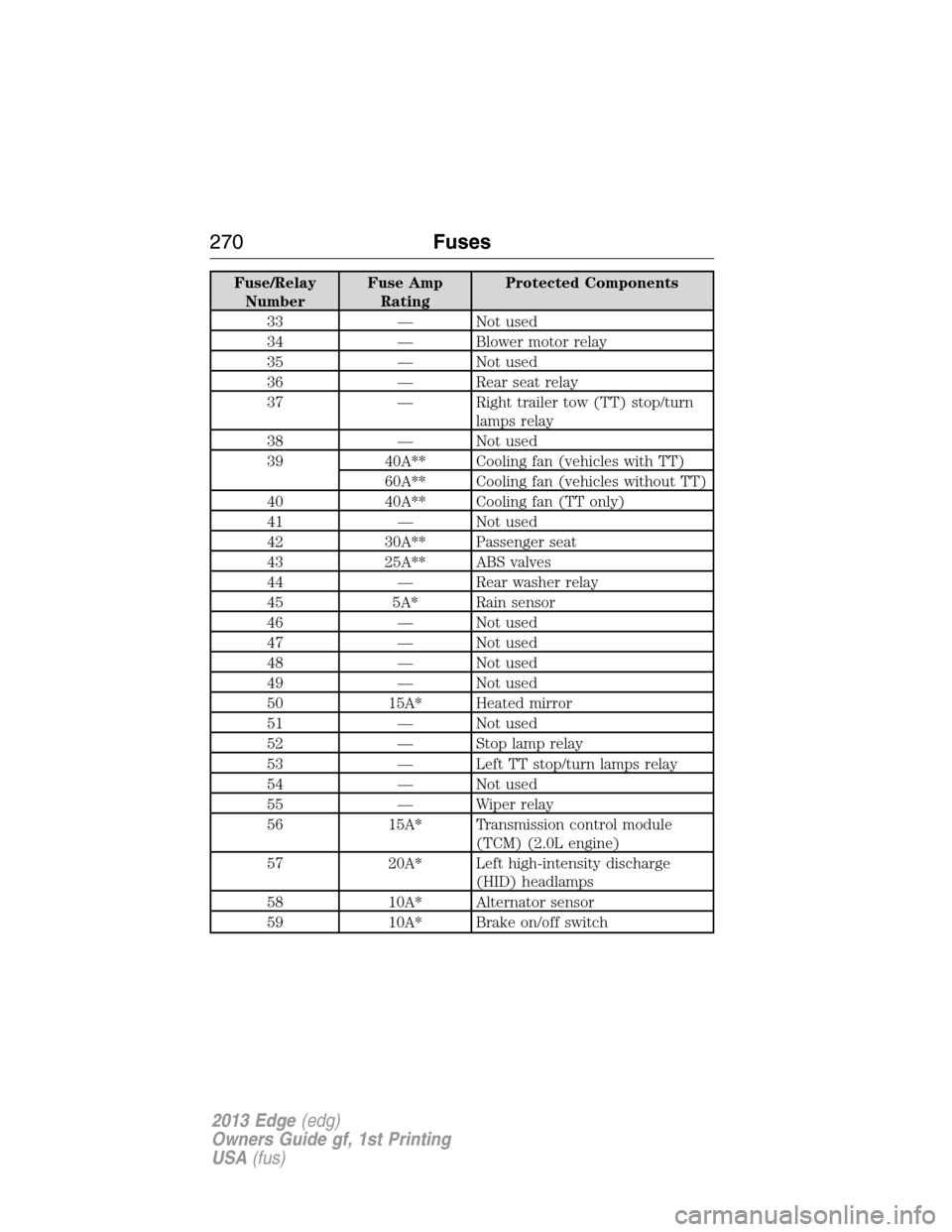
Fuse/Relay
NumberFuse Amp
RatingProtected Components
33 — Not used
34 — Blower motor relay
35 — Not used
36 — Rear seat relay
37 — Right trailer tow (TT) stop/turn
lamps relay
38 — Not used
39 40A** Cooling fan (vehicles with TT)
60A** Cooling fan (vehicles without TT)
40 40A** Cooling fan (TT only)
41 — Not used
42 30A** Passenger seat
43 25A** ABS valves
44 — Rear washer relay
45 5A* Rain sensor
46 — Not used
47 — Not used
48 — Not used
49 — Not used
50 15A* Heated mirror
51 — Not used
52 — Stop lamp relay
53 — Left TT stop/turn lamps relay
54 — Not used
55 — Wiper relay
56 15A* Transmission control module
(TCM) (2.0L engine)
57 20A* Left high-intensity discharge
(HID) headlamps
58 10A* Alternator sensor
59 10A* Brake on/off switch
270Fuses
2013 Edge(edg)
Owners Guide gf, 1st Printing
USA(fus)
Page 272 of 526

Fuse/Relay
NumberFuse Amp
RatingProtected Components
86 7.5A* PCM relay, PCM keep-alive
(3.5/3.7L engines)
87 5A* Run/start relay
88 — Run/start relay
89 — Not used
5A* Headlamp leveling motors (China
only)
90 10A* PCM, Transmission Control
Module (TCM) (2.0L engine)
91 10A* Adaptive cruise control (3.5/3.7L
engines)
5A* Automatic transmission warm-up
(2.0L engine)
92 10A* ABS module
93 5A* Blower motor/rear defroster relay
94 30A** Passenger compartment fuse
panel run/start
95 — Not used
96 — Canister purge solenoid (CPS)
diode (2.0L engine)
97 — Auto trans warm-up diode (2.0L
engine)
98 — A/C clutch relay
* Mini Fuses ** Cartridge Fuses
Passenger Compartment Fuse Panel
The fuse panel is located behind a trim panel on the left side of the
driver’s footwell near the parking brake. To remove the trim panel, slide
the release lever to the right then pull the trim panel out.
To remove the fuse panel cover, press in the tabs on both sides of the
cover, then pull the cover off.
To reinstall the fuse panel cover, place the top part of the cover on the
fuse panel, then push the bottom part of the cover until it clicks into
place. Gently pull on the cover to make sure it is secure.
272Fuses
2013 Edge(edg)
Owners Guide gf, 1st Printing
USA(fus)
Page 280 of 526
3.5L V6 engine shown, 3.7L V6 engine similar
A. Engine coolant reservoir
B. Power steering fluid reservoir
C. Brake fluid reservoir
D. Battery
E. Power distribution box
F. Air filter assembly
G. Transmission fluid dipstick
H. Engine oil dipstick
I. Engine oil filler cap
J. Windshield washer fluid reservoir
280Maintenance
2013 Edge(edg)
Owners Guide gf, 1st Printing
USA(fus)