Page 174 of 416

•If your vehicle goes off the edge of the pavement, slow down, but
avoid severe brake application, ease the vehicle back onto the
pavement only after reducing your speed. Do not turn the steering
wheel too sharply while returning to the road surface.
•It may be safer to stay on the apron or shoulder of the road and slow
down gradually before returning to the pavement. You may lose
control if you do not slow down or if you turn the steering wheel too
sharply or abruptly.
•It often may be less risky to strike small objects, such as highway
reflectors, with minor damage to your vehicle rather than attempt a
sudden return to the pavement which could cause the vehicle to slide
sideways out of control or roll over. Remember, your safety and the
safety of others should be your primary concern.
BREAKING-IN
You need to break in new tires for approximately 1000 miles
(1600 kilometers). During this time, your vehicle may exhibit some
unique driving characteristics. Avoid driving too fast during the first
1000 miles (1600 kilometers). Vary your speed frequently and change up
through the gears early. Do not labor the engine. Do not tow during the
first 1000 miles (1600 kilometers).
ECONOMICAL DRIVING
Fuel economy is affected by several things, such as how you drive, the
conditions you drive under and how you maintain your vehicle.
There are some things to keep in mind that may improve your fuel
economy:
•Accelerate and slow down in a smooth, moderate fashion.
•Drive at steady speeds without stopping.
•Anticipate stops; slowing down may eliminate the need to stop.
•Combine errands and minimize stop-and-go driving.
•Close the windows for high-speed driving.
•Drive at reasonable speeds (traveling at 55 mph [88 km/h] uses 15%
less fuel than traveling at 65 mph [105 km/h]).
•Keep the tires properly inflated and use only the recommended size.
•Use the recommended engine oil.
•Perform all regularly scheduled maintenance.
174Driving Hints
2013 Econoline(eco)
Owners Guide gf, 1st Printing
USA(fus)
Page 175 of 416

There are also some things you may not want to do because they may
reduce your fuel economy:
•Sudden or hard accelerations.
•Rev the engine before turning it off.
•Idle for periods longer than one minute.
•Warm up your vehicle on cold mornings.
•Use the air conditioner or front defroster.
•Use the speed control in hilly terrain.
•Rest your foot on the brake pedal while driving.
•Drive a heavily loaded vehicle or tow a trailer.
•Carry unnecessary weight (approximately 1 mpg [0.4 km/L] is lost for
every 400 lb [180 kg] of weight carried).
•Add particular accessories to your vehicle (e.g.; bug deflectors,
rollbars or light bars, running boards, ski racks).
•Drive with the wheels out of alignment.
DRIVING THROUGH WATER
Note:Driving through deep water may allow water into the transmission
and engine causing internal damage. Have the fluid checked and, if water
is found, replace the fluid.
Do not drive quickly through standing water, especially if the depth is
unknown. Traction or brake capability may be limited and if the ignition
system gets wet, your engine may stall. Water may also enter your
engine’s air intake and severely damage your engine.
If driving through deep or standing
water is unavoidable, proceed very
slowly. Never drive through water
that is higher than the bottom of
the hubs (for trucks) or the bottom
of the wheel rims (for cars).
Once through the water, always try the brakes. Wet brakes do not stop the
vehicle as effectively as dry brakes. Drying can be improved by moving
your vehicle slowly while applying light pressure on the brake pedal.
Driving Hints175
2013 Econoline(eco)
Owners Guide gf, 1st Printing
USA(fus)
Page 181 of 416

JUMP-STARTING THE VEHICLE
WARNING:The gases around the battery can explode if exposed
to flames, sparks, or lit cigarettes. An explosion could result in
injury or vehicle damage.
WARNING:Batteries contain sulfuric acid which can burn skin,
eyes and clothing, if contacted.
Do not attempt to push-start your automatic transmission vehicle.
Automatic transmissions do not have push-start capability. Attempting to
push-start a vehicle with an automatic transmission may cause
transmission damage.
When the battery is disconnected or a new battery is installed, the
automatic transmission must relearn its shift strategy. As a result, the
transmission may exhibit a combination of firm and soft shifts. This
operation is considered normal and will not affect function or durability
of the transmission. Over time, the adaptive learning process will fully
update transmission operation.
Preparing Your Vehicle
Note:Use only a 12 volt supply to start your vehicle.
Note:Do not disconnect the battery of the disabled vehicle as this could
damage the vehicle’s electrical system.
1. Park the booster vehicle close to the hood of the disabled vehicle
making sure the two vehicles do not touch. Set the parking brake on
both vehicles and stay clear of the engine cooling fan and other moving
parts.
2. Check all battery terminals and remove any excessive corrosion before
you attach the battery cables. Ensure that vent caps are tight and level.
3. Turn the heater fan on in both vehicles to protect from any electrical
surges. Turn all other accessories off.
Roadside Emergencies181
2013 Econoline(eco)
Owners Guide gf, 1st Printing
USA(fus)
Page 194 of 416
Fuse/relay
locationFuse amp
ratingProtected components
4 HC micro relay Trailer tow battery charge
5 HC micro relay Fuel pump
6 HC micro relay Trailer tow park lamp
7 HC micro relay Upfitter #4
8 HC micro relay Upfitter #3
9 HC micro relay Modified vehicle and stripped chassis
run/start
10 — Not used
11 — Not used
12 40A** Modified vehicle and stripped chassis
run/start
13 30A** Starter solenoid relay
14 40A** Run start relay
15 40A** Modified vehicle and stripped chassis
battery
16 50A** Auxiliary A/C blower
17 50A** Trailer tow battery charge, Trailer tow
park feed
18 30A** Electric trailer brake, Trailer brake
controller
19 30A** Upfitter #1
20 30A** Upfitter #2
21 — Not used
22 — Not used
23 G8VA relay A/C clutch
24 G8VA relay Horn relay (stripped chassis)
25 HC micro relay Run/start
26 — Not used
27 — Not used
28 20A* Back up lamp
29 10A* A/C clutch
30 10A* Brake on/off switch
194Fuses
2013 Econoline(eco)
Owners Guide gf, 1st Printing
USA(fus)
Page 195 of 416

Fuse/relay
locationFuse amp
ratingProtected components
31 10A* Cluster battery (stripped chassis)
32 50A** Blower motor
33 40A** Anti-lock brake system pump
34 20A** Stripped chassis horn
35 40A** Powertrain control module relay
36 20A** Ignition switch (stripped chassis)
37 G8VA relay Trailer tow stop — left turn signal
38 G8VA relay Trailer tow stop — right turn signal
39 G8VA relay Back up lamp
40 ISO relay Blower motor
41 — Not used
42 15A* Diagnostic connector (stripped chassis)
43 20A* Fuel pump
44 10A* Upfitter #3
45 15A* Upfitter #4
46 10A* Powertrain control module keep alive
power, Canister vent, Powertrain
control module relay coil
47 40A** Anti-lock brake system coil
48 20A** Trailer tow stop lamp/turn signal
49 30A** Wiper motor
50 — Not used
51 20A** Cutaway
52 10A* Stripped chassis and modified vehicle
run/start relay coil
53 10A* Anti-lock brake system run/start feed
54 10A* Fuel pump relay coil
55 — Not used
56 — Not used
57 20A* Trailer tow park lamp
58 15A* Trailer tow backup lamp
59 — Not used
Fuses195
2013 Econoline(eco)
Owners Guide gf, 1st Printing
USA(fus)
Page 197 of 416
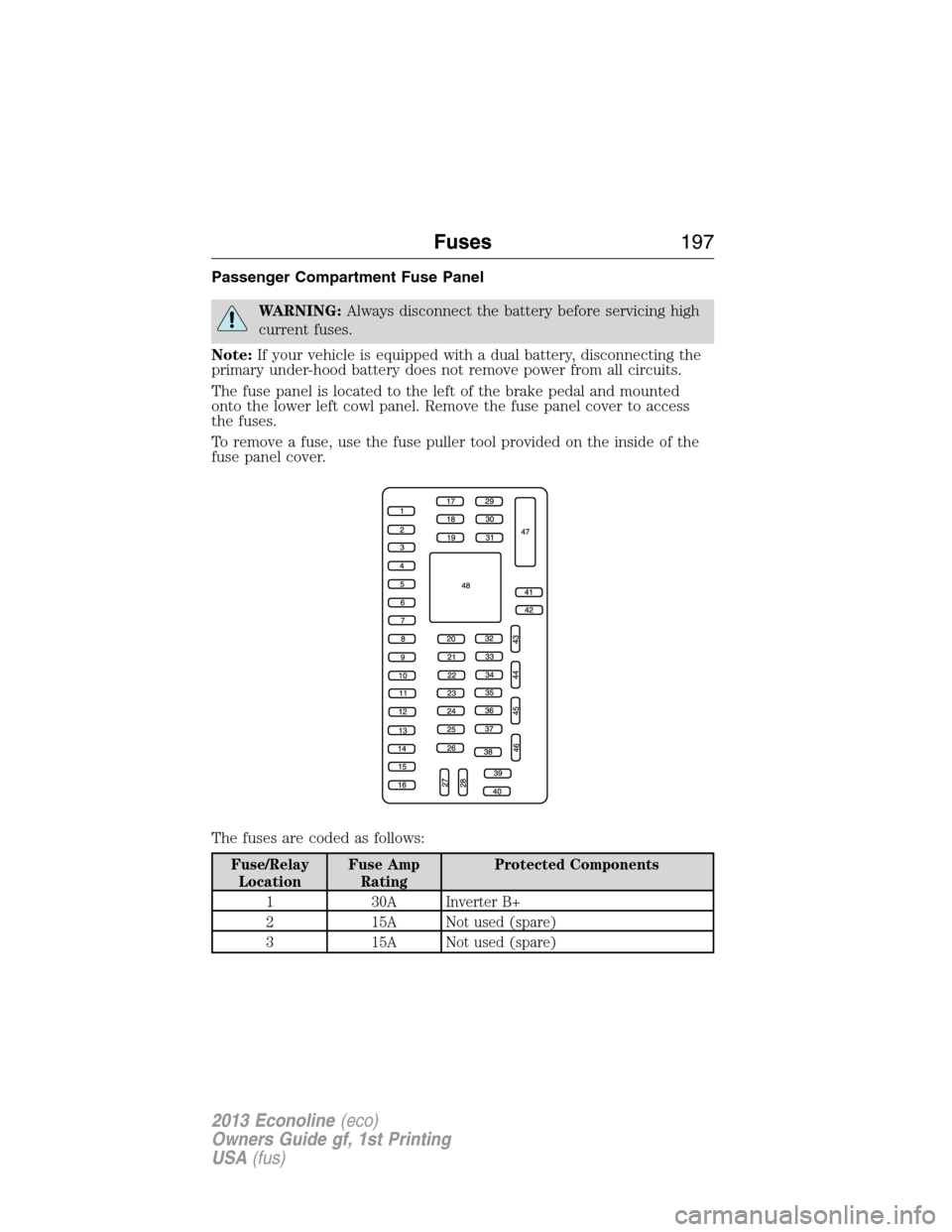
Passenger Compartment Fuse Panel
WARNING:Always disconnect the battery before servicing high
current fuses.
Note:If your vehicle is equipped with a dual battery, disconnecting the
primary under-hood battery does not remove power from all circuits.
The fuse panel is located to the left of the brake pedal and mounted
onto the lower left cowl panel. Remove the fuse panel cover to access
the fuses.
To remove a fuse, use the fuse puller tool provided on the inside of the
fuse panel cover.
The fuses are coded as follows:
Fuse/Relay
LocationFuse Amp
RatingProtected Components
1 30A Inverter B+
2 15A Not used (spare)
3 15A Not used (spare)
Fuses197
2013 Econoline(eco)
Owners Guide gf, 1st Printing
USA(fus)
Page 198 of 416
Fuse/Relay
LocationFuse Amp
RatingProtected Components
4 30A Not used (spare)
5 10A Passenger compartment fuse panel,
Brake-shift interlock
6 20A Turn signal, Hazard, Stop lamps
7 10A Left low beam
8 10A Right low beam
9 15A Courtesy lamps
10 15A Switch illumination
11 10A Not used (spare)
12 7.5A Not used (spare)
13 5A Mirrors
14 10A SYNC�, Global positioning system
module
15 10A Not used (spare)
16 15A Not used (spare)
17 20A Door locks
18 20A Not used (spare)
19 25A Not used (spare)
20 15A Diagnostic connector (except stripped
chassis)
21 15A Not used (spare)
22 15A Park lamps, License plate lamps
23 15A High beams
24 20A Horn (except stripped chassis)
25 10A Demand lighting
26 10A Cluster (except stripped chassis)
27 20A Ignition switch feed
28 5A Audio mute (start)
29 5A Cluster (except stripped chassis)
30 5A Not used (spare)
31 10A Not used (spare)
32 10A Restraints module
198Fuses
2013 Econoline(eco)
Owners Guide gf, 1st Printing
USA(fus)
Page 199 of 416
Fuse/Relay
LocationFuse Amp
RatingProtected Components
33 10A Trailer brake controller
34 5A Not used (spare)
35 10A Reverse park aid, Rear video camera,
Cutaway run/start
36 5A Passive anti-theft system radio
frequency module
37 10A Climate control, Stripped chassis
instrument panel #1 run/start
38 20A Not used (spare)
39 20A Radio, Navigation
40 20A Amplifier
41 15A Radio, Switch illumination, Reverse
camera mirror, Automatic dimming rear
view mirror, Inverter
42 10A Upfitter switch
43 10A Stripped chassis instrument panel
connector #1
44 10A Trailer tow battery charge relay
45 5A Wipers, Stripped chassis Engine
connector 3
46 7.5A Passenger airbag deactivation indicator
47 30A circuit
breakerWindows accessory delay
48 Relay Delayed accessory
Fuses199
2013 Econoline(eco)
Owners Guide gf, 1st Printing
USA(fus)