2013 FORD B MAX Eco
[x] Cancel search: EcoPage 20 of 298

Downloaded from www.Manualslib.com manuals search engine CHILD SEAT POSITIONING
WARNINGS
See an authorized dealer for thelatest details relating to ourrecommended child seats.
Extreme Hazard! Do not use arearward facing child seat on a seatprotected by an air bag in front of it!
When using a child seat with asupport leg, the support leg mustrest securely on the floor.
When using a child seat with a safetybelt, make sure that the safety beltis not slack or twisted.
WARNINGS
The child seat must rest tightlyagainst the vehicle seat. It may benecessary to lift or remove the headrestraint. See Head Restraints (page 83).
Note:When using a child seat on a frontseat, always adjust the front passenger'sseat to its fully rearward position. If it provesdifficult to tighten the lap section of thesafety belt without slack remaining, adjustthe seatback to the fully upright positionand raise the height of the seat. See Seats(page 83).
Mass group categories
Seating positions3210+0
46 - 79 lbs(22 - 36 kg)33 - 55 lbs(15 - 25 kg)20 - 40 lbs(9 - 18 kg)Up to 29lbs (13 kg)Up to 22lbs (10 kg)
UF¹UF¹UF¹XXFront passenger's seatwith airbag ON
U¹U¹U¹U¹U¹Front passenger's seatwith airbag OFF
UUUUURear seats
X Not suitable for children in this mass group.
U Suitable for universal category child seats approved for use in this mass group.
U¹ Suitable for universal category child seats approved for use in this mass group. However,we recommend that you secure children in a government approved child seat, on the rearseat.
UF¹ Suitable for universal category forward facing child seats approved for use in thismass group. However, we recommend that you secure children in a government approvedchild seat, on the rear seat.
18B-MAX (CB2) Vehicles Built From: 25-06-2012, Vehicles Built Up To: 31-12-2013Child Safety
Page 21 of 298

Downloaded from www.Manualslib.com manuals search engine ISOFIX Child Seats
Mass group categories
Seating positions10+
Forward facingRear facing
20 - 40 lbs (9 - 18 kg)Up to 29 lbs (13 kg)
Not ISOFIX equippedSize classFront seat
Seat type
A, B, B11C, D, E1Size classRear outboard seat ISOFIX
IL, IUF3IL2Seat type
Not ISOFIX equippedSize classRear center seat
Seat type
IL Suitable for particular ISOFIX child seat systems of the semi-universal category. Pleasesee child seat systems suppliers' vehicle recommendation lists.
IUF Suitable for ISOFIX forward facing child seat systems of universal category approvedfor use in this mass group and ISOFIX size class.1The ISOFIX size class for both universal and semi-universal child seat systems is definedby the capital letters A to G. These identification letters are displayed on the ISOFIX childseat.2At time of publishing the recommended Group O+ ISOFIX baby safety seat is the BritaxRomer Baby Safe. See an authorized dealer for the latest details relating to ourrecommended child seats.3At time of publishing the recommended Group 1 ISOFIX child seat is the Britax RomerDuo. See an authorized dealer for the latest details relating to our recommended childseats.
19B-MAX (CB2) Vehicles Built From: 25-06-2012, Vehicles Built Up To: 31-12-2013Child Safety
Page 25 of 298
Downloaded from www.Manualslib.com manuals search engine PRINCIPLE OF OPERATION
WARNINGS
Extreme Hazard! Never use arearward facing child restraint on aseat protected by an active airbag infront of it. Death or serious injury to thechild can occur.
Do not modify the front of yourvehicle in any way. This couldadversely affect deployment of theairbags. Failure to adhere to this warningcould result in serious personal injury ordeath.
Wear a safety belt and keepsufficient distance between yourselfand the steering wheel. Only whenyou use the safety belt correctly, can it holdyou in a position that allows the airbag toachieve its optimum effect. See Sittingin the Correct Position (page 83). Failureto adhere to this warning could result inserious personal injury or death.
Repairs to the steering wheel,steering column, seats, airbags andsafety belts must be carried out byan authorized dealer. Failure to adhere tothis warning could result in seriouspersonal injury or death.
Keep the areas in front of the airbagsfree from obstruction. Do not affixanything to or over the airbag covers.In the event of a crash, hard objects couldcause serious personal injury or death.
Do not puncture the seat with sharpobjects. This could damage andadversely affect deployment of theairbags. Failure to adhere to this warningcould result in serious personal injury ordeath.
Use seat covers designed for seatswith side airbags. Have these fittedby an authorized dealer. Failure toadhere to this warning could result inserious personal injury or death.
Note:You will hear a loud bang and see acloud of harmless powdery residue if anairbag deploys. This is normal.
Note:Only wipe airbag covers with a dampcloth.
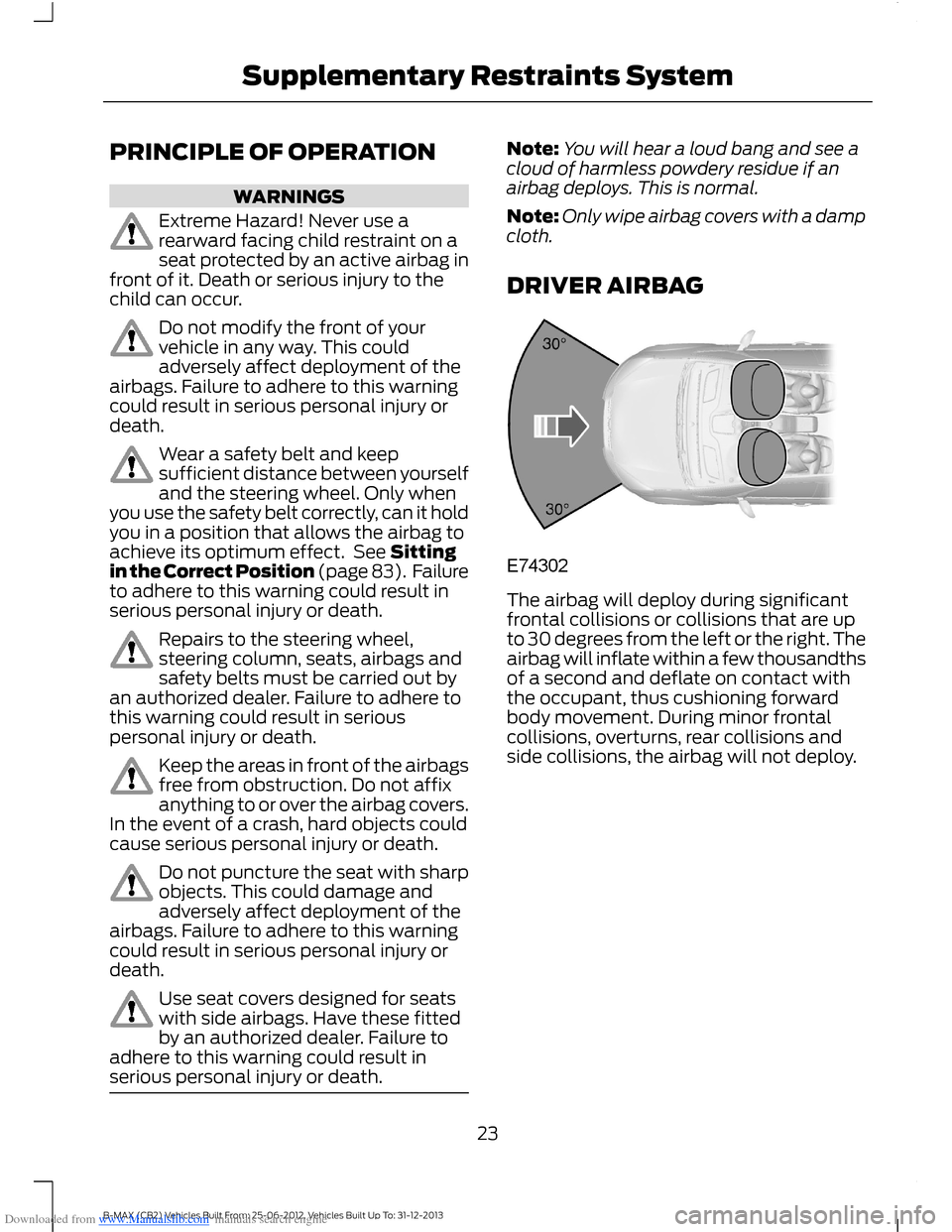
DRIVER AIRBAG
The airbag will deploy during significantfrontal collisions or collisions that are upto 30 degrees from the left or the right. Theairbag will inflate within a few thousandthsof a second and deflate on contact withthe occupant, thus cushioning forwardbody movement. During minor frontalcollisions, overturns, rear collisions andside collisions, the airbag will not deploy.
23B-MAX (CB2) Vehicles Built From: 25-06-2012, Vehicles Built Up To: 31-12-2013Supplementary Restraints System
Page 26 of 298

Downloaded from www.Manualslib.com manuals search engine PASSENGER AIRBAG
The airbag will deploy during significantfrontal collisions or collisions that are upto 30 degrees from the left or the right. Theairbag will inflate within a few thousandthsof a second and deflate on contact withthe occupant, thus cushioning forwardbody movement. During minor frontalcollisions, overturns, rear collisions andside collisions, the airbag will not deploy.
Switching the Passenger AirbagOff
WARNING
You must switch the airbag off whenusing a rearward facing child seat onthe front seat.
Switch offA
Switch onB
Turn the switch to position A.
When you switch the ignition on, check thatthe airbag deactivation warning lampilluminates.
Switching the Passenger AirbagOn
WARNING
You must switch the airbag on whenyou are not using a child seat on thefront seat.
Turn the switch to position B.
SIDE AIRBAGS
WARNING
Use seat covers designed for seatswith side airbags. Have these fittedby an authorized dealer.
24B-MAX (CB2) Vehicles Built From: 25-06-2012, Vehicles Built Up To: 31-12-2013Supplementary Restraints System
Page 27 of 298

Downloaded from www.Manualslib.com manuals search engine The airbags are located inside theseatback of the front seats. There is a labelattached to the side of the seatback toindicate this.
The airbag will deploy during significantlateral collisions. The airbag will not deployin minor lateral and frontal collisions, rearcollisions, or overturns.
DRIVER KNEE AIRBAG
WARNING
Do not attempt to open the airbagcover.
The airbag will deploy during frontalcollisions or collisions that are up to 30degrees from the left or the right. Theairbag will inflate within a few thousandthsof a second and deflate on contact withthe occupants, thus providing a cushionbetween the driver’s knees and the steeringcolumn. During overturns, rear collisionsand side collisions, the knee airbag will notdeploy.
For item location: See At a Glance (page9).
Note:The airbag has a lower deploymentthreshold than the front airbags. During aminor collision, it is possible that only theknee airbag will deploy.
SIDE CURTAIN AIRBAGS
The airbags are located over the front andrear side windows.
The airbag will deploy during significantlateral collisions. It will also deploy duringsignificant frontal angled collisions. Thecurtain airbag will not deploy in minorlateral and frontal collisions, rear collisions,or overturns.
25B-MAX (CB2) Vehicles Built From: 25-06-2012, Vehicles Built Up To: 31-12-2013Supplementary Restraints System
Page 28 of 298

Downloaded from www.Manualslib.com manuals search engine GENERAL INFORMATION ON
RADIO FREQUENCIES
Note:Changes or modifications notexpressly approved by the party responsiblefor compliance could void the user’sauthority to operate the equipment.
The typical operating range for yourtransmitter is approximately 33 ft (10 m).
A decrease in operating range could becaused by:
•weather conditions
•nearby radio towers
•structures around your vehicle
•other vehicles parked next to yourvehicle.
The radio frequency used by your remotecontrol can also be used by other shortdistance radio transmissions (e.g. amateurradios, medical equipment, wirelessheadphones, remote controls and alarmsystems). If the frequencies are jammed,you will not be able to use your remotecontrol. You can lock and unlock the doorswith the key.
Note:Make sure your vehicle is lockedbefore leaving it unattended.
Note:If you are in range, the remote controlwill operate if you press any buttonunintentionally.
REMOTE CONTROL
You can program a maximum of eightremote controls to your vehicle. Thisincludes any that were supplied with yourvehicle. The remote controls must remaininside your vehicle during the programmingprocedure. Fasten the front safety beltsand close all doors to make sure thatconflicting chimes do not sound duringprogramming.
Programming a New RemoteControl
1.Turn the ignition key from position 0 toposition II four times within sixseconds.
2.Turn the ignition to position 0. A tonesounds to indicate that it is nowpossible to program a remote control.
3.Press any button on a new remotecontrol within 10 seconds. A tone willsound as confirmation.
4.Repeat step three within 10 secondsfor each new remote control. Do notremove the key from the ignition whenpressing the button on the remotecontrol.
5.Switch the ignition back on (positionII) or wait for 10 seconds withoutprogramming another remote controlto end the key programming. Only theremote controls which you have justprogrammed are now able to lock andunlock your vehicle.
Reprogramming the UnlockingFunction
Note:When you press the unlock buttoneither all the doors are unlocked or only thedriver’s door and the liftgate are unlocked.Pressing the unlock button again unlocksall the doors.
Press and hold the unlock and lock buttonson the remote control simultaneously forat least four seconds with the ignition off.The direction indicators will flash twice toconfirm the change.
To return to the original unlocking function,repeat the process.
26B-MAX (CB2) Vehicles Built From: 25-06-2012, Vehicles Built Up To: 31-12-2013Keys and Remote Controls
Page 29 of 298

Downloaded from www.Manualslib.com manuals search engine Changing the Remote ControlBattery
Make sure that you dispose ofold batteries in anenvironmentally friendly way.Seek advice from your local authorityregarding recycling.
Remote Control With a Folding KeyBlade
1.Insert a screwdriver as far as possibleinto the slot on the side of the remotecontrol, push it toward the key bladeand remove the key blade.
2.Twist the screwdriver in the positionshown to start separating the twohalves of the remote control.
3.Twist the screwdriver in the positionshown to separate the two halves ofthe remote control.
Note:Do not touch the battery contacts orthe printed circuit board with thescrewdriver.
4.Carefully remove the battery with thescrewdriver.
5.Install a new battery (3V CR 2032) withthe + facing downwards.
6.Assemble the two halves of the remotecontrol.
7.Install the key blade.
27B-MAX (CB2) Vehicles Built From: 25-06-2012, Vehicles Built Up To: 31-12-2013Keys and Remote Controls
Page 30 of 298

Downloaded from www.Manualslib.com manuals search engine Remote Control Without a FoldingKey Blade
1.Press and hold the buttons on theedges to release the cover. Carefullyremove the cover.
2.Remove the key blade.
3.Twist the screwdriver in the positionshown to start separating the twohalves of the remote control.
4.Twist the screwdriver in the positionshown to separate the two halves ofthe remote control.
Note:Do not touch the battery contacts orthe printed circuit board with thescrewdriver.
5.Carefully remove the battery with thescrewdriver.
6.Install a new battery (3V CR 2032) withthe + facing downwards.
7.Assemble the two halves of the remotecontrol.
8.Install the key blade.
28B-MAX (CB2) Vehicles Built From: 25-06-2012, Vehicles Built Up To: 31-12-2013Keys and Remote Controls