2013 FIAT BRAVO ECU
[x] Cancel search: ECUPage 149 of 299

Secure the upper belt (provided with the child seat)
to specific ring B fig. 130 located between the rear
backrest at the child seat level.
Remember that, in the case of Universal Isofix child
seats, you can use all seats bearing the marking
ECE R44/03 Universal Isofix.
The Universal Isofix “Duo Plus” child seat and the
special "G 0/1" seat are available from Lineaccessori
Fiat.For any further details on installation/use, refer to
the instruction manual for the child seat.
WARNING
Fit the child seat when the car is
stationary.The child seat is correctly
anchored to the brackets when you hear the
click. Follow the instructions for assembly,
disassembly and positioning that the
manufacturer must supply with the child seat .
fig. 130
F0Q0699
145GETTING TO KNOW
YOUR CARSAFETYSTARTING AND
DRIVING
WARNING LIGHTS
AND MESSAGES
IN AN EMERGENCY
SERVICING AND
MAINTENANCE
TECHNICAL
SPECIFICATIONS
INDEX
Page 166 of 299

WARNING
The ABS with which the car may be
equipped will not control the braking
system of the trailer. Particular caution is
required on slippery roads.
WARNING
Never modify the braking system of the
car to control the trailer brake.The
trailer braking system must be fully
independent of the car ’s hydraulic system.
INSTALLING THE TOW HOOK
The towing device should be fastened to the
bodywork by specialised personnel according to any
additional and/or integrative information supplied
by the Manufacturer of the device. The towing
device must meet current regulations with
reference to Directive 94/20/EEC and subsequent
amendments. For any version the towing device
used must be right for the towable weight of the
car on which it is to be installed.
IMPORTANT The use of auxiliary loads other than
external lights (electric brake, winch, etc.) must
be used with engine running.For the electric connection a unified connector
should be used, which is generally placed on a
special bracket fastened to the towing device, and a
special ECU should be installed on the car to
control the trailer's exterior lights.
7 or 13-pole 12 V DC connections should be used
(CUNA/UNI and ISO/DIN Standards). Follow
any instructions provided by the car manufacturer
and/or the towing device manufacturer.
An electric brake or winch should be powered
directly by the battery through a cable with a
cross-section of no less than 2.5 mm
2.
IMPORTANT Electric brakes or other devices must
be used with engine running.
In addition to the electrical branches, the vehicle's
electrical system can be connected only to the
supply cable for an electric brake and to the cable
for an internal trailer light, though not more than
15 W. For connections use the preset control unit
with battery cable no less than 2.5 mm2.
162GETTING TO KNOW
YOUR CAR
SAFETYSTARTING AND
DRIVINGWARNING LIGHTS
AND MESSAGES
IN AN EMERGENCY
SERVICING AND
MAINTENANCE
TECHNICAL
SPECIFICATIONS
INDEX
Page 192 of 299

At the end of operation
❒arrange the space-saver wheel G fig. 149 in the
specific compartment in the luggage
compartment;
❒insert the partially open jack into container F and
force it slightly into its housing so that it does
not vibrate when the car is moving;
❒put the tools back into their places in the
container;
❒stow the container complete with tools on the
space-saver wheel and secure everything with
clamping device E;
❒correctly reposition the rigid preformed cover in
the luggage compartment.
QUICK TYRE REPAIR KIT - FIX & GO
AutomaticThe Fix&Go Automatic quick tyre repair kit is
located in a special container in the luggage
compartment.
fig. 150
F0Q0510
fig. 151
F0Q0511
188GETTING TO KNOW
YOUR CAR
SAFETY
STARTING AND
DRIVING
WARNING LIGHTS
AND MESSAGES
IN AN
EMERGENCY
SERVICING AND
MAINTENANCE
TECHNICAL
SPECIFICATIONS
INDEX
Page 193 of 299

The quick tyre repair kit contains fig. 150:
❒a cylinder A containing sealing fluid and fitted
with: filling tube B and adhesive label C with
the wording “max. 80 km/h” to be placed in a
clearly visible position (e.g. on the dashboard)
after repairing the tyre;
❒instruction booklet fig. 151, to be used for
prompt and correct use of the quick repair kit
and then to be handed to the personnel charged
with handling the tyre treated with the tyre
repair kit;
❒a compressor D including a pressure gauge and
connections, found in the compartment;
❒a pair of protective gloves located in the side
compartment of the compressor;
❒adapters for inflating different elements.
WARNING
Give the instruction booklet to the
personnel charged with handling the
treated tyre.In the event of a puncture caused by
foreign bodies, the kit may be used
to repair tyres showing damages on the
track or shoulder up to max 4 mm diameter.
WARNING
Holes and damage on the tyre side
walls cannot be repaired. Do not use
the quick repair kit if the tyre is damaged as a
result of driving with it deflated.
WARNING
If the wheel rim has been damaged
(bent so as to cause air to leak), the
tyre may not be repaired. Do not remove
foreign bodies (screws or nails) from the tyre.
IMPORTANT INFORMATION:
The sealing fluid of the quick tyre repair kit is
effective at external temperatures of between -20
°C and +50 °C.
WARNING
Never operate the compressor for
longer than 20 consecutive minutes.
Risk of overheating.Tyres repaired with the
quick tyre repair kit must only be used
temporarily.
189GETTING TO KNOW
YOUR CAR
SAFETY
STARTING AND
DRIVING
WARNING LIGHTS
AND MESSAGESIN AN
EMERGENCYSERVICING AND
MAINTENANCE
TECHNICAL
SPECIFICATIONS
INDEX
Page 208 of 299
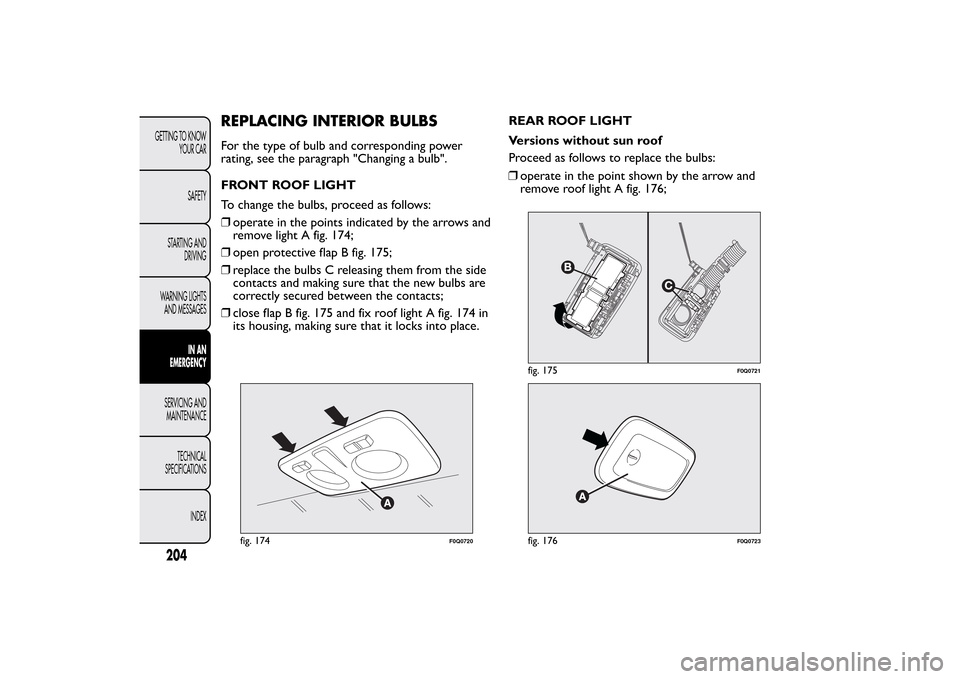
REPLACING INTERIOR BULBSFor the type of bulb and corresponding power
rating, see the paragraph "Changing a bulb".
FRONT ROOF LIGHT
To change the bulbs, proceed as follows:
❒operate in the points indicated by the arrows and
remove light A fig. 174;
❒open protective flap B fig. 175;
❒replace the bulbs C releasing them from the side
contacts and making sure that the new bulbs are
correctly secured between the contacts;
❒close flap B fig. 175 and fix roof light A fig. 174 in
its housing, making sure that it locks into place.REAR ROOF LIGHT
Versions without sun roof
Proceed as follows to replace the bulbs:
fig. 174
F0Q0720
fig. 175
F0Q0721
fig. 176
F0Q0723
204GETTING TO KNOW
YOUR CAR
SAFETY
STARTING AND
DRIVING
WARNING LIGHTS
AND MESSAGES
IN AN
EMERGENCY
SERVICING AND
MAINTENANCE
TECHNICAL
SPECIFICATIONS
INDEX
❒operate in the point shown by the arrow and
remove roof light A fig. 176;
Page 249 of 299

WINDSCREEN/REAR WINDOW
WIPERBLADES
Periodically clean the rubber part using special
products; TUTELA PROFESSIONAL SC 35 is
recommended.
Replace the blades if the rubber edge is deformed
or worn. In any case, it is advisable to replace them
approximately once a year. A few simple
precautions can reduce the possibility of damage to
the blades:
❒if the temperature falls below zero, make sure
that ice has not frozen the rubber against the
glass. Use an antifreeze product to release it
if required;
❒remove any snow from the glass: in addition to
protecting the blades, this prevents effort on
the motor and overheating;
❒do not operate the windscreen/rear window
wipers on dry glass.
WARNING
Driving with worn windscreen/rear
window wiper blades is a serious
hazard, because visibility is reduced in bad
weather.Replacing the wiper blades
Proceed as follows:
❒lift up the windscreen wiper arm and position the
blade so that it forms a 90° angle with the arm;
❒press tab A fig. 212 of the coupling spring and
remove the blade to be replaced from the arm;
❒fit the new blade by inserting the tab into the
special slot in the arm. Make sure that the new
blade is secured in position.
fig. 212
F0Q0662
245GETTING TO KNOW
YOUR CAR
SAFETY
STARTING AND
DRIVING
WARNING LIGHTS
AND MESSAGES
IN AN EMERGENCYSERVICING AND
MAINTENANCETECHNICAL
SPECIFICATIONS
INDEX
Page 254 of 299

INTERIORSPeriodically check for water puddles under the mats
that could cause the panels to rust.
Replace the worn carpet mats, if present, with
genuine products and make sure they remain
securely fastened to the passenger compartment
carpet. It is not advisable to use non genuine mats
that could move whilst driving.
WARNING
Never use flammable products, such as
petrol ether or rectified petrol to
clean the inside of the car.The electrostatic
charges which are generated by rubbing during
the cleaning operation may cause a fire.
WARNING
Do not keep aerosol cans in the car:
they might explode. Aerosol cans must
not be exposed to a temperature exceeding
50°C .When the car is exposed to sunlight ,
internal temperature can greatly exceed this
value.SEATS AND FABRIC PARTS
Remove dust with a soft brush or a vacuum cleaner.
Rub the seats with a sponge and a solution of
water and mild soap.
LEATHER SEATS
Remove the dry dirt with a buckskin or slightly
damp cloth, without exercising too much pressure.
Remove any liquid or grease stains using an
absorbent dry cloth, without rubbing. Then clean
with a soft cloth or buckskin cloth dampened with
water and neutral soap.
If the stain persists, use specific products and
observe the instructions carefully.
IMPORTANT Never use alcohol. Make sure that
the cleaning products used contain no alcohol
or alcohol derivatives, even in small quantities.
The fabric upholstery of your car has
been designed to withstand wear
deriving from common use of the car.You
are however recommended to avoid strong
and/or continuous scratching with clothing
accessories such as metal buckles, studs,Velcro
fastenings and the like, as these items cause
stress of the cover fabric that could lead to yarn
breaking and damage the upholstery.
250GETTING TO KNOW
YOUR CAR
SAFETY
STARTING AND
DRIVING
WARNING LIGHTS
AND MESSAGES
IN AN EMERGENCYSERVICING AND
MAINTENANCE
TECHNICAL
SPECIFICATIONS
INDEX
Page 295 of 299

Fuse boxes (location)................. 209
Fuses
– dashboard fuse box............... 210
– engine compartment fuse
box next to
211-212
– fuse list..................................... 214
– luggage compartment
fuse box ................................... 213
– replacing fuses ........................ 208G
ear Shift Indicator.................... 33
GLASS HOLDER ......................... 88
Glove compartment light
– bulb replacement ................... 206
H
andbrake ................................... 157
Hazard warning lights ................. 82
Headlights ..................................... 105
– bulb replacement ................... 197
Headlight washers ....................... 77
Head restraints............................. 48
Heated rear window and
door mirrors
demisting/defrosting ....... 58-63-67
Heating and ventilation .............. 56
Hill Holder (system)................... 109
Hill Holder system...................... 109
Identification data– bodywork paint plate ........... 253
– chassis marking ...................... 253
– engine marking ....................... 253
– identification data plate ....... 252
Ignition switch .............................. 21
Initialisation procedure ............... 92
Installing the tow hook.............. 162
Instrument panel lighting
adjustment................................... 23
Interior fittings ............................. 84
Interiors (cleaning) ..................... 250
Internal air recirculation
activation................................. 59-63
Internal mirror.............................. 51
"Isofix" child seat assembly
setup ............................................ 144Jack ................................................ 184Key without remote control.... 10
Key with remote control ........... 10
– Luggage compartment
(capacity) ................................. 269Light clusters
– front light clusters
(changing a bulb).................... 197
– rear light clusters
(changing a bulb).................... 200Lights off ........................................ 71
Load limiters ................................ 135
Lubricants
275-276
Luggage compartment ................ 97
– Closing ...................................... 98
– Extending ................................. 98
– Opening .................................... 97
– Securing your load ................ 101
Luggage compartment roof
light
– bulb replacement ................... 205
M
ain beam headlights ................ 71
– bulb replacement ................... 198
Maintenance and care ................ 224
– Scheduled servicing............... 224
– scheduled servicing plan ...... 225
Manual climate control
system .......................................... 60
MSR (system) ............................... 110
Multifunction display ................... 26
N
umber plate lights
– bulb replacement ................... 203
O
n-board instruments............... 4
On-board instruments................ 23
291GETTING TO KNOW
YOUR CAR
SAFETY
STARTING AND
DRIVING
WARNING LIGHTS
AND MESSAGES
IN AN EMERGENCY
SERVICING AND
MAINTENANCE
TECHNICAL
SPECIFICATIONSINDEX
the battery.....................(specifications) ....................