2013 FIAT 500 ABARTH brake
[x] Cancel search: brakePage 57 of 84

JUMP-STARTING PROCEDURE
• If your vehicle has a discharged battery, it can be jump-started using a set of
jumper cables and a battery in another vehicle or by using a portable battery
booster pack. Jump-starting can be dangerous if done improperly so please fol-
low the procedures in this section carefully.
NOTE:When using a portable battery booster pack, follow the manufacturer’s operating instruc-tions and precautions.
Preparations For Jump-Start
• The battery in your vehicle is located on the left side of the engine compartment.
1. Set the parking brake, shift the trans-
mission into gear and turn the ignition
to OFF/LOCK.
2. Turn off the heater, radio, and all un-
necessary electrical accessories.
3. If using another vehicle to jump-start
the battery, park the vehicle within
the jumper cables reach, set the
parking brake and make sure the ig-
nition is OFF.
Jump-Starting Procedure
1. Connect the positive(+)end of the jumper cable to the positive(+)post of the
discharged vehicle.
2. Connect the opposite end of the positive(+)jumper cable to the positive(+)post
of the booster battery.
3. Connect the negative end(-)of the jumper cable to the negative(-)post of the
booster battery.
4. Connect the opposite end of the negative(-)jumper cable to a good engine
ground (exposed metal part of the discharged vehicles engine) away from the
battery and the fuel injection system.
5. Start the engine in the vehicle that has the booster battery, let the engine idle a
few minutes, and then start the engine in the vehicle with the discharged battery.
WHAT TO DO IN EMERGENCIES
55
Page 62 of 84

EVENT DATA RECORDER (EDR)
• This vehicle is equipped with an Event Data Recorder (EDR). The main purpose of
an EDR is to record, in certain crash or near crash-like situations, such as an air
bag deployment or hitting a road obstacle, data that assists in understanding
how a vehicle’s systems performed. The EDR is designed to record data related
to vehicle dynamics and safety systems for a short period of time, typically 30
seconds or less. The EDR in this vehicle is designed to record such data as:
• How various systems in your vehicle were operating.
• Whether or not the driver and passenger safety belts were buckled/fastened.
• How far (if at all) the driver was depressing the accelerator and/or brake pedal.
• How fast the vehicle was traveling.
• These data can help provide a better understanding of the circumstances in
which crashes and injuries occur.
NOTE:EDR data are recorded by your vehicle only if a non-trivial crash situation occurs; no dataare recorded by the EDR under normal driving conditions and no personal data (e.g.name, gender, age, and crash location) are recorded. However, other parties, such aslaw enforcement, could combine the EDR data with the type of personally identifyingdata routinely acquired during a crash investigation.
• To read data recorded by an EDR, special equipment is required, and access to
the vehicle or the EDR is needed. In addition to the vehicle manufacturer, other
parties such as law enforcement, that have the special equipment, can read the
information if they have access to the vehicle or the EDR.
WHAT TO DO IN EMERGENCIES
60
Page 65 of 84

FLUIDS AND CAPACITIES
Component Fluid, Lubricant, or Genuine Part Capacities
Engine Coolant1.4L Turbo
We recommend you use MOPAR®Antifreeze/Engine Coolant 10 Year/150,000 Mile Formula OAT (OrganicAdditive Technology).
4.6 Quarts(4.4 Liters)
Engine Oil withFilter 1.4L TurboWe recommend you use API CertifiedSAE 5W-40 Full Synthetic Engine Oil.4 Quarts(3.8 Liters)
Engine Oil FilterWe recommend you use MOPAR®Engine Oil Filters.—
Fuel Selection1.4L Turbo91 Octane Recommended – 87 OctaneAcceptable
10.5 Gallons(40 Liters)(Approximate)
ManualTransmissionWe recommend you use MOPAR®C635 DDCT/MTX Transmission Fluid—
Brake MasterCylinder
We recommend you use MOPAR®DOT 3, SAE J1703. If DOT 3, SAEJ1703 brake fluid is not available, thenDOT 4 is acceptable.
—
Spark PlugsWe recommend you use MOPAR®Spark Plugs - Gap 0.026 in (0.65 mm)—
CAUTION!
• Mixing of engine coolant (antifreeze) other than specified Organic Additive
Technology (OAT) engine coolant (antifreeze), may result in engine damage
and may decrease corrosion protection. Organic Additive Technology (OAT)
engine coolant is different and should not be mixed with Hybrid Organic Ad-
ditive Technology (HOAT) engine coolant (antifreeze) or any “globally com-
patible” coolant (antifreeze). If a non-OAT engine coolant (antifreeze) is intro-
duced into the cooling system in an emergency, the cooling system will need
to be drained, flushed, and refilled with fresh OAT coolant (conforming to
MS-12106), by an authorized studio as soon as possible.
•Do not use water alone or alcohol-based engine coolant (antifreeze) products.
Do not use additional rust inhibitors or antirust products, as they may not be
compatible with the radiator engine coolant and may plug the radiator.
• This vehicle has not been designed for use with propylene glycol-based en-
gine coolant (antifreeze). Use of propylene glycol-based engine coolant (anti-
freeze) is not recommended.
MAINTAINING YOUR VEHICLE
63
Page 66 of 84

MAINTENANCE SCHEDULE
Your vehicle is equipped with an automatic oil change indicator system. The oil
change indicator system will remind you that it is time to take your vehicle in for
scheduled maintenance.
Based on engine operation conditions, the oil change indicator message will illumi-
nate. This means that service is required for your vehicle. Operating conditions such
as frequent short-trips, trailer tow, extremely hot or cold ambient temperatures, and
E85 fuel usage will influence when the “Change Oil” message is displayed. Severe
Operating Conditions can cause the change oil message to illuminate as early as
3,500 miles (5,600 km) since last reset. Have your vehicle serviced as soon as pos-
sible, within the next 500 miles (805 km).
NOTE:Under no circumstances should oil change intervals exceed 10,000 miles (16,000 km) ortwelve months, whichever comes first.
Once A Month Or Before A Long Trip:
• Check engine oil level
• Check windshield washer fluid level
• Check the tire inflation pressures and look for unusual wear or damage
• Check the fluid levels of the coolant reservoir, brake master cylinder, and trans-
mission as needed
• Check function of all interior and exterior lights
Required Maintenance Intervals.
Refer to the Maintenance Schedules on the following pages for required mainte-
nance.
At Every Oil Change Interval As Indicated By Oil Change Indicator System:
•Change oil and filter.
• Rotate the tires. Rotate at the first sign of irregular wear, even if it occurs before theoil indicator system turns on.
•Inspect battery and clean and tighten terminals as required.
•Inspect brake pads, shoes, rotors, drums, hoses and park brake.
•Inspect engine cooling system protection and hoses.
•Inspect exhaust system.
•Inspect engine air cleaner if using in dusty or off-road conditions.
MAINTAINING YOUR VEHICLE
64
Page 67 of 84
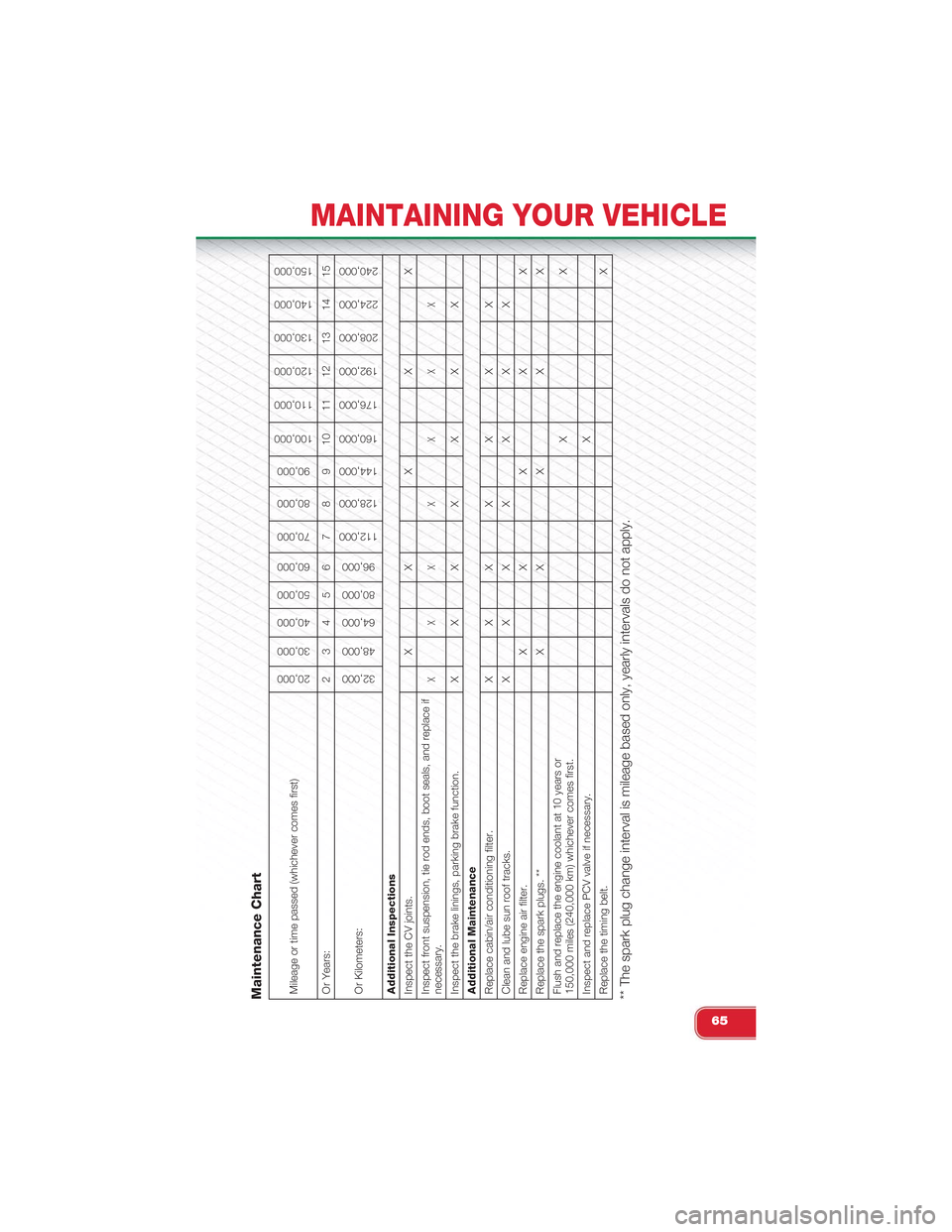
Maintenance ChartMileage or time passed (whichever comes first)
20,000
30,000
40,000
50,000
60,000
70,000
80,000
90,000
100,000
110,000
120,000
130,000
140,000
150,000
Or Years: 2 3 4 5 6 7 8 9 10 11 12 13 14 15Or Kilometers:
32,000
48,000
64,000
80,000
96,000
112,000
128,000
144,000
160,000
176,000
192,000
208,000
224,000
240,000
Additional InspectionsInspect the CV joints. X X X X XInspect front suspension, tie rod ends, boot seals, and replace ifnecessary.
XXX X X X X
Inspect the brake linings, parking brake function. X X X X X X XAdditional MaintenanceReplace cabin/air conditioning filter. X X X X X X XClean and lube sun roof tracks. X X X X X X XReplace engine air filter. X X X X XReplace the spark plugs. ** X X X X XFlush and replace the engine coolant at 10 years or150,000 miles (240,000 km) whichever comes first.
XX
Inspect and replace PCV valve if necessary.
X
Replace the timing belt.
X
** The spark plug change interval is mileage based only, yearly intervals do not apply.
MAINTAINING YOUR VEHICLE
65
Page 71 of 84

Underhood Fuses
•A second fuse panel is located on the drivers side of the engine compartment, next to
the battery. To access the fuses, press the release tabs and remove the cover.
• The ID number of the electrical component corresponding to each fuse can be
found on the back of the cover.
Cavity Maxi Fuse Mini Fuse Description
F01 60 Amp Blue Body Controller
F02 20 Amp Yellow Audio Amplifier
F03 20 Amp Yellow Ignition Switch
F04 40 Amp Orange Anti-Lock Brake Pump
F05 70 Amp Tan Electric Power Steering
F06 20 Amp Yellow Radiator Fan - Single Speed
F06 30 Amp Green Radiator Fan - Low Speed
F07 40 Amp Orange Radiator Fan - High Speed
F08 30 Amp Green Blower Motor
F09 10 Amp Red Powertrain
F10 10 Amp Red Horn
F11 15 Amp Blue Powertrain
F11 10 Amp Red Powertrain (Multiair – If Equipped)
F14 5 Amp Tan High beam (Shutter)
F15 15 Amp Blue Cigar Lighter
F16 7.5 Amp Brown Transmission
F17 25 Amp White Powertrain (Multiair – If Equipped)
F17 15 Amp Blue Powertrain
F18 15 Amp Blue Powertrain
F18 5 Amp Tan Powertrain (Multiair – If Equipped)
F19 7.5 Amp Brown Air Conditioning
F20 15 Amp Blue Heated Seats – If Equipped
F21 15 Amp Blue Fuel Pump
F23 20 Amp Yellow Anti-Lock Brake Valves
F24 7.5 Amp Brown Stability Control System
F30 15 Amp Blue Fog Lamps
F82 30 Amp Green Sunroof/Convertible Top
F84 10 Amp Red Transmission
F85 15 Amp Blue Rear Defroster, Heated Mirrors
F87 5 Amp Tan Lights
F90 5 Amp Tan Heated Mirrors
MAINTAINING YOUR VEHICLE
69
Page 73 of 84

SUMMER/THREE-SEASON TIRES
• This vehicle may be equipped with wheels and tires to enhance traction in both
wet and dry conditions.
• Summer tires are not intended to be driven in snow or on ice.
• Use summer tires only in sets of four.
NOTE:
Summer tires will not contain the “all season” designation or mountain/snowflake
symbol on the sidewall of the tire.
WARNING!
Do not use summer tires in snow/ice conditions. You could lose control, resulting
in severe injury or death.
WHEEL AND WHEEL TRIM CARE
• All wheels and wheel trim, especially aluminum and chrome plated wheels,
should be cleaned regularly with a mild soap and water to prevent corrosion.
• To remove heavy soil and/or excessive brake dust, use a wheel cleaner or
equivalent or select a non-abrasive, non-acidic cleaner.
CAUTION!
Do not use scouring pads, steel wool, a bristle brush, or metal polishes. Do not
use oven cleaner. These products may damage the wheel's protective finish.
Avoid automatic car washes that use acidic solutions or harsh brushes that may
damage the wheel's protective finish.
MAINTAINING YOUR VEHICLE
71
Page 79 of 84

Alarm (Security Alarm). . . . . . . . . . .9
Arming Theft System (Security Alarm) . . .9
Automatic Temperature Control (ATC) . .24
Automatic Transmission
Fluid Type. . . . . . . . . . . . . . .63
Belts, Seat. . . . . . . . . . . . . . . . .10
BLUE&ME™ Hands-Free
Communication. . . . . . . . . . . .34
Brake Fluid. . . . . . . . . . . . . . . . .63Break-In Recommendations, NewVehicle. . . . . . . . . . . . . . . . .17Bulb Replacement. . . . . . . . . . . . .72
Child Restraint. . . . . . . . . . . . . . .12Child Restraint Tether Anchors. . . . . .12Clock Setting. . . . . . . . . . . . . . . .33Cooling SystemCoolant Capacity. . . . . . . . . . .63Cruise Control (Speed Control). . . . . .21Cruise Light. . . . . . . . . . . . . . . .21Customer Assistance. . . . . . . . . . .73
Defects, Reporting. . . . . . . . . . . .74Disarming, Theft System. . . . . . . . . .9Driver Cockpit. . . . . . . . . . . . . . . .4
ElectronicsYour Vehicle's Sound System. . . .30Electronic Speed Control(Cruise Control). . . . . . . . . . . . .21Electronic Throttle Control WarningLight. . . . . . . . . . . . . . . . . . .45Electronic Vehicle InformationCenter (EVIC). . . . . . . . . . . . . .40Emergency, In Case ofBrake Warning Light . .. . . . . . .47Towing. . . . . . . . . . . . . . . . .57EngineBreak-In Recommendations. . . . .17Compartment. . . . . . . . . . . . .62Oil Selection. . . . . . . . . . . . . .63Overheating. . . . . . . . . . . . . .48Enhanced Accident ResponseFeature. . . . . . . . . . . . . . . . .57Event Data Recorder. . . . . . . . . . .60Exterior Lights. . . . . . . . . . . . . . .72
Flash-To-Pass .. . . . . . . . . . . . . .18Fluid Capacities . . . . . . .. . . . . . .63Fluids . . . . . .. . . . . . . . . . . . . .63Folding Rear Seat. . . . . . . . . . . . .15Freeing A Stuck Vehicle . . .. . . . . . .59FuelSpecifications. . . . . . . . . . . . .63Fuse. . . . . . . . . . . . . . . . . . . .68Fuses. . . . . . . . . . . . . . . . . . . .68
Hands-Free Communication —BLUE&ME™. . . . . . . . . . . . . .34Hood Release .. . . . . . . . . . . . . .61
Instrument Cluster Warning Lights . .6, 44Introduction. . . . . . . . . . . . . . . . .2iPod®/USB/MP3 Control. . . . . . . . .39
Key Fob . . . . . . . . . . . . . . . . . . .8
Lane Change Assist. . . . . . . . . . . .18Lap/Shoulder Belts . . . . .. . . . . . .10LATCH (Lower Anchors and Tether forCHildren) . . .. . . . . . . . . . . . .12LightsTurn Signal. . . . . . . . . . . . . .18Warning (Instrument ClusterDescription) . . .. . . . . . . . . . . .6
Maintenance Record. . . . . . . . . . .67Maintenance Schedule . . .. . . . . . .64Malfunction Indicator Light(Check Engine) . . . . . . . . . . . . .47Manual Transmission . . . .. . . . . . .25MOPAR® Accessories . .. . . . . . . .75
New Vehicle Break-In Period. . . . . . .17
Oil, EngineCapacity. . . . . . . . . . . . . . . .63OutletPower .. . . . . . . . . . . . . . . .42Overheating, Engine. . . . . . . . . . . .48
Placard, Tire and Loading Information . .70PowerOutlet (Auxiliary Electrical Outlet) . .42Programmable Electronic Features . . .40
INDEX
77