Page 53 of 683
WARNING!
Avoid trapping anyone in the vehicle in a collision.
Remember that the sliding doors can only be opened
from the outside door handle or the switches located
on the trim panel just in front of the power sliding
door when the Child Protection Door Locks are
engaged.
To Disengage the Child Protection Door Lock
1. Open the sliding side door.
2. Slide the Child Protection Door Lock control outward
(away from the vehicle) to disengage the Child Pro-
tection Door Lock.
3. Repeat Steps 1 and 2 on the opposite sliding door
(if equipped).NOTE:
•After setting the Child Protection Door Lock system,
always test the door from the inside to make certain it
is in the desired position.
•The power sliding side door switches will not open the
power sliding doors if the vehicle is in gear or the
vehicle speed is above 0 mph (0 km/h).
•The power sliding door will operate from the outside
door handle, the RKE transmitter, the switches on the
overhead console, or the switches located on the
b-pillar trim panel, just in front of the power sliding
door when the shift lever is in PARK, regardless of the
child lock lever position.
2
THINGS TO KNOW BEFORE STARTING YOUR VEHICLE 51
Page 54 of 683
LIFTGATE
On vehicles equipped with power locks, the liftgate can
be unlocked using the Remote Keyless Entry (RKE)
transmitter button, or by activating the power door lock
switches located on the front doors.
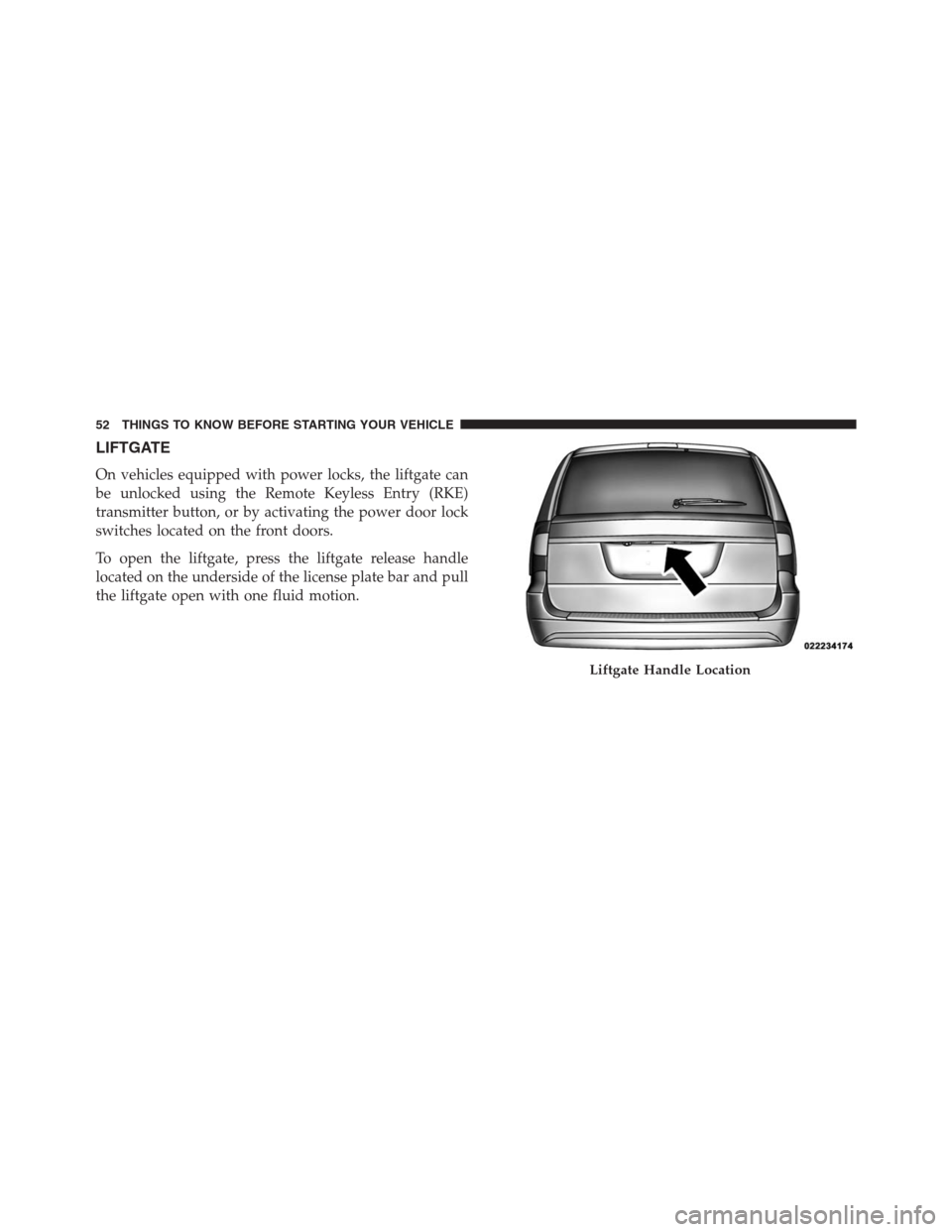
To open the liftgate, press the liftgate release handle
located on the underside of the license plate bar and pull
the liftgate open with one fluid motion.
Liftgate Handle Location
52 THINGS TO KNOW BEFORE STARTING YOUR VEHICLE
Page 55 of 683
Power Liftgate — If Equipped
The power liftgate may be opened manually or by using
the button on the Remote Keyless Entry (RKE) transmit-
ter. Press the button on the transmitter twice within
five seconds, to open the power liftgate. When the liftgate
is fully open, pressing the button twice within five sec-
onds, a second time, will close the liftgate.
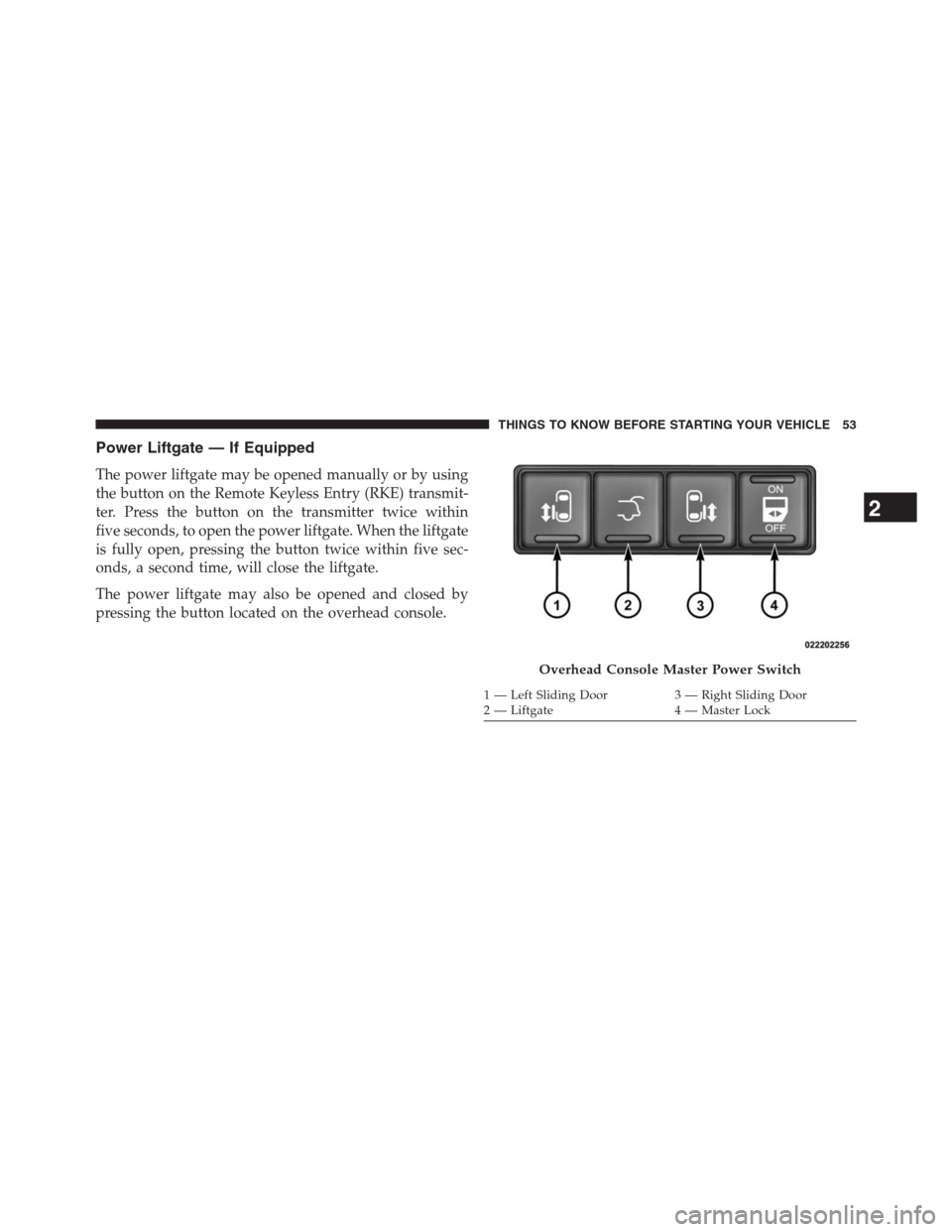
The power liftgate may also be opened and closed by
pressing the button located on the overhead console.
Overhead Console Master Power Switch
1 — Left Sliding Door 3 — Right Sliding Door
2 — Liftgate 4 — Master Lock
2
THINGS TO KNOW BEFORE STARTING YOUR VEHICLE 53
Page 58 of 683

OCCUPANT RESTRAINTS
Some of the most important safety features in your
vehicle are the restraint systems:
•Three-point lap and shoulder belts for all seating
positions
•Advanced Front Air Bags for driver and front
passenger
•Supplemental Active Head Restraints (AHR) located
on top of the front seats (integrated into the head
restraint) — if equipped
•Supplemental Driver Side Knee Air Bag
•Supplemental Side Air Bag Inflatable Curtains (SABIC)
that span the front, second, and third row seating for
the driver and passengers seated next to a window
•Supplemental Seat-Mounted Side Air Bags (SAB)•An energy-absorbing steering column and steering
wheel
•Knee bolster for front passenger seat occupant
•Front seat belts incorporate pretensioners that may
enhance occupant protection by managing occupant
energy during an impact event
•All seat belt systems (except the driver ’s and third row
center) include Automatic Locking Retractors (ALRs),
which lock the seat belt webbing into position by
extending the belt all the way out and then adjusting
the belt to the desired length to restrain a child seat or
secure a large item in a seat
Please pay close attention to the information in this
section. It tells you how to use your restraint system
properly, to keep you and your passengers as safe as
possible.
56 THINGS TO KNOW BEFORE STARTING YOUR VEHICLE
Page 62 of 683
Lap/Shoulder Belts
All seats in your vehicle are equipped with lap/shoulder
belts.
The belt webbing in the retractor is designed to lock
during very sudden stops or collisions. This feature
allows the shoulder part of the belt to move freely with
you under normal conditions. However, in a collision the
belt will lock and reduce the risk of you striking the
inside of the vehicle or being thrown out.
WARNING!
•It is dangerous to ride in a cargo area, inside or
outside of a vehicle. In a collision, people riding in
these areas are more likely to be seriously injured
or killed.
(Continued)
WARNING!(Continued)
•Do not allow people to ride in any area of your
vehicle that is not equipped with seats and seat belts.
•Be sure everyone in your vehicle is in a seat and
using a seat belt properly.
•Wearing a seat belt incorrectly is dangerous. Seat
belts are designed to go around the large bones of
your body. These are the strongest parts of your
body and can take the forces of a collision the best.
•Wearing your belt in the wrong place could make
your injuries in a collision much worse. You might
suffer internal injuries, or you could even slide out
of part of the belt. Follow these instructions to wear
your seat belt safely and to keep your passengers
safe, too.
(Continued)
60 THINGS TO KNOW BEFORE STARTING YOUR VEHICLE
Page 67 of 683

Position the shoulder belt on your chest so that it is
comfortable and not resting on your neck. When the belt
is long enough to fit , insert the large latch plate into the
buckle until you hear a “click.” The retractor should
withdraw any slack in the belt.
To release the small latch plate, position the end of the
large latch plate against the red button on the small latch
plate and push upward. Reinstall the latch plates into the
headliner.
Adjustable Upper Shoulder Belt Anchorage
In the front seats and the second row outboard seats, the
shoulder belt anchorage can be adjusted upward or down-
ward to help position the belt away from your neck. The
upper anchorage can be adjusted upward by pushing
anywhere on the anchorage. To move the anchorage down-
ward, squeeze the actuation buttons while simultaneously
pushing down on the anchorage assembly.
As a guide, if you are shorter than average you will
prefer a lower position, and if you are taller than average
you will prefer a higher position. When you release the
anchorage, try to move it up or down to make sure that
it is locked in position.
Adjustable Anchorage
2
THINGS TO KNOW BEFORE STARTING YOUR VEHICLE 65
Page 68 of 683

Seat Belts In Passenger Seating Positions
The seat belts in the passenger seating positions are
equipped with an Automatic Locking Retractor (ALR) or
a cinching latch plate which are used to secure a child
restraint system. For additional information refer to
“Installing Child Restraints Using the Vehicle Seat Belt”
under the “Child Restraint” section. The chart below
defines the type of feature for each seating position.
Driver Center Passenger
First Row N/A N/A ALR
Second Row ALR N/A ALR
Third Row ALR Cinch ALR
•N/A — Not Applicable
•ALR — Automatic Locking RetractorIf the passenger seating position is equipped with an
ALR and is being used for normal usage:
Only pull the belt webbing out far enough to comfortably
wrap around the occupant’s mid-section so as to not
activate the ALR. If the ALR is activated, you will hear a
ratcheting sound as the belt retracts. Allow the webbing
to retract completely in this case and then carefully pull
out only the amount of webbing necessary to comfort-
ably wrap around the occupant’s mid-section. Slide the
latch plate into the buckle until you hear a�click.�
66 THINGS TO KNOW BEFORE STARTING YOUR VEHICLE
Page 69 of 683
Automatic Locking Retractor Mode (ALR) — If
Equipped
In this mode, the shoulder belt is automatically pre-locked.
The belt will still retract to remove any slack in the
shoulder belt. The Automatic Locking Mode is available on
all passenger-seating positions with a combination lap/
shoulder belt. Use the Automatic Locking Mode anytime a
child safety seat is installed in a seating position that has a
belt with this feature. Children 12 years old and under
should always be properly restrained in the rear seat.
How To Engage The Automatic Locking Mode
1. Buckle the combination lap and shoulder belt.
2. Grasp the shoulder portion and pull downward until
the entire belt is extracted.
3. Allow the belt to retract. As the belt retracts, you will
hear a clicking sound. This indicates the safety belt is
now in the Automatic Locking Mode.
How To Disengage The Automatic Locking Mode
Unbuckle the combination lap/shoulder belt and allow it
to retract completely to disengage the Automatic Locking
Mode and activate the vehicle sensitive (emergency)
locking mode.
WARNING!
•The belt and retractor assembly must be replaced if
the seat belt assembly Automatic Locking Retractor
(ALR) feature or any other seat belt function is not
working properly when checked according to the
procedures in the Service Manual.
•Failure to replace the belt and retractor assembly
could increase the risk of injury in collisions.
2
THINGS TO KNOW BEFORE STARTING YOUR VEHICLE 67