Page 521 of 683
These effects can be reduced by timely rotation of tires.
The benefits of rotation are especially worthwhile with
aggressive tread designs such as those on all season type
tires. Rotation will increase tread life, help to maintain
mud, snow and wet traction levels, and contribute to a
smooth, quiet ride.
Refer to the “Maintenance Schedule” for the proper
maintenance intervals. The reasons for any rapid or
unusual wear should be corrected prior to rotation being
performed.
The suggested rotation method is the “rearward cross”
shown in the following diagram. This rotation pattern
does not apply to some directional tires that must not be
reversed.
Tire Rotation
5
STARTING AND OPERATING 519
Page 523 of 683

NOTE:The vehicle may need to be driven for up to
20 minutes above 15 mph (24 km/h) to receive this
information.
For example, your vehicle may have a recommended
cold (parked for more than three hours) tire placard
pressure of 35 psi (241 kPa). If the ambient temperature is
68°F (20°C) and the measured tire pressure is 30 psi
(207 kPa), a temperature drop to 20°F (-7°C) will decrease
the tire pressure to approximately 26 psi (179 kPa). This
tire pressure is sufficiently low enough to turn on the
“Tire Pressure Monitoring Telltale Light.” Driving the
vehicle may cause the tire pressure to rise to approxi-
mately 30 psi (207 kPa), but the “Tire Pressure Monitor-
ing Telltale Light” will still be on. In this situation, the
“Tire Pressure Monitoring Telltale Light” will turn off
only after the tires have been inflated to the vehicle’s
recommended cold tire placard pressure value.CAUTION!
•The TPMS has been optimized for the original
equipment tires and wheels. TPMS pressures have
been established for the tire size equipped on your
vehicle. Undesirable system operation or sensor
damage may result when using replacement equip-
ment that is not of the same size, type, and/or style.
Aftermarket wheels can cause sensor damage. Do
not use aftermarket sealants or balance beads if
your vehicle is equipped with a TPMS, as damage
to the sensors may result.
•After inspecting or adjusting the tire pressure al-
ways reinstall the valve stem cap. This will prevent
moisture and dirt from entering the valve stem,
which could damage the TPMS sensor.
5
STARTING AND OPERATING 521
Page 550 of 683
NOTE:The trailer tongue weight must be considered as
part of the combined weight of occupants and cargo, and
should never exceed the weight referenced on the Tire
and Loading Information placard. Refer to “Tire Safety
Information” in “Starting and Operating” for further
information.
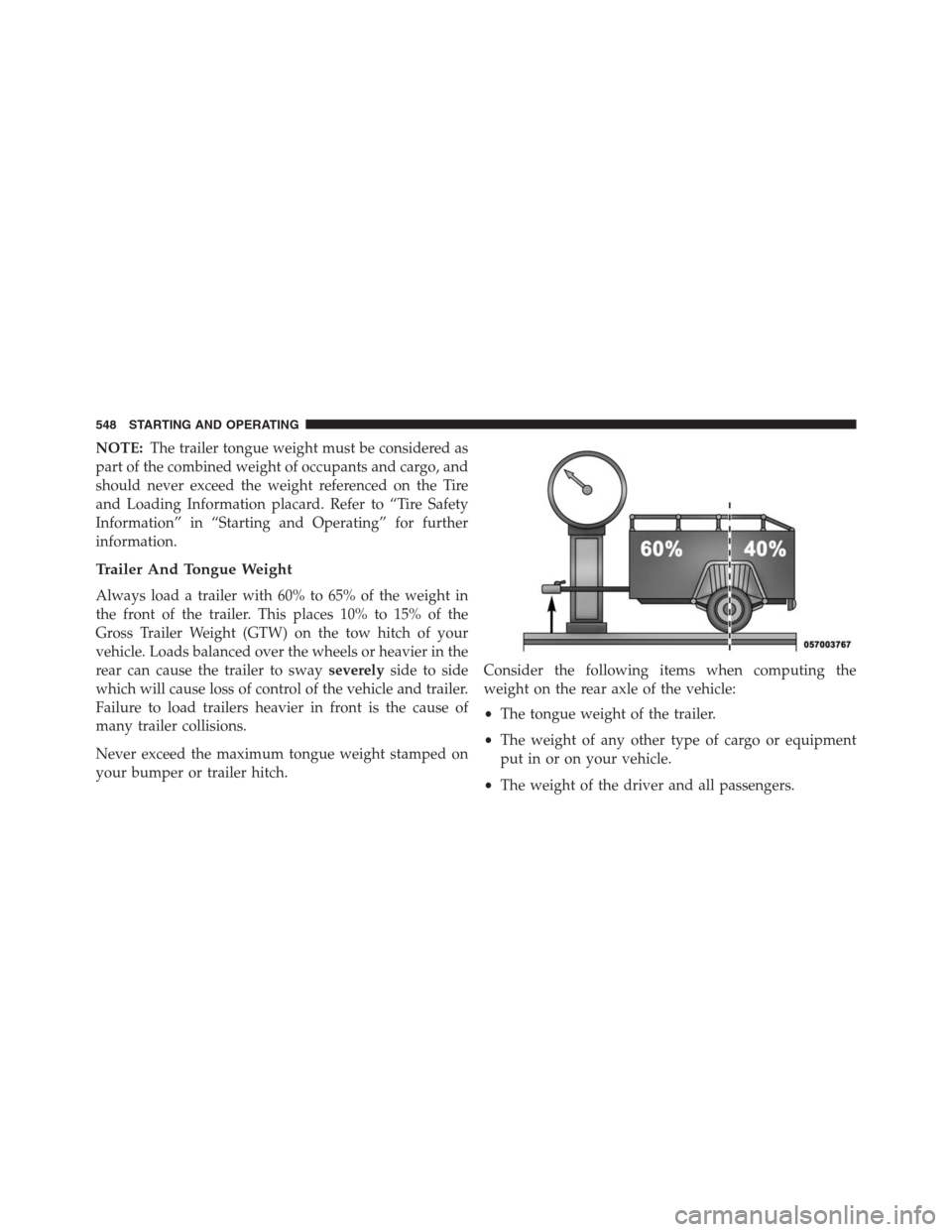
Trailer And Tongue Weight
Always load a trailer with 60% to 65% of the weight in
the front of the trailer. This places 10% to 15% of the
Gross Trailer Weight (GTW) on the tow hitch of your
vehicle. Loads balanced over the wheels or heavier in the
rear can cause the trailer to swayseverelyside to side
which will cause loss of control of the vehicle and trailer.
Failure to load trailers heavier in front is the cause of
many trailer collisions.
Never exceed the maximum tongue weight stamped on
your bumper or trailer hitch.Consider the following items when computing the
weight on the rear axle of the vehicle:
•The tongue weight of the trailer.
•The weight of any other type of cargo or equipment
put in or on your vehicle.
•The weight of the driver and all passengers.
548 STARTING AND OPERATING
