2013 DODGE CHARGER child restraint
[x] Cancel search: child restraintPage 96 of 631
5. If the child restraint has a top tether strap and theseating position has a top tether anchorage, connect
the tether strap to the anchorage and tighten the tether
strap. Refer to “Lower Anchors and Tethers for Chil-
dren (LATCH) Restraint System” for directions to
attach a tether anchor.
6. Test that the child restraint is installed tightly by pulling back and forth on the child seat at the belt
path. It should not move more than 1 inch (25.4 mm)
in any direction.
Any seat belt system will loosen with time, so check the
belt occasionally, and pull it tight if necessary. If the buckle or the cinching latch plate is too close to the
belt path opening of the child restraint, you may have
trouble tightening the seat belt. If this happens, discon-
nect the latch plate from the buckle and twist the short
buckle-end belt up to three full turns to shorten it. Insert
the latch plate into the buckle with the release button
facing out, away from the child restraint. Repeat steps 4
to 6, above, to complete the installation of the child
restraint.
If the belt still cannot be tightened after you shorten the
buckle, disconnect the latch plate from the buckle, turn
the buckle around one half turn, and insert the latch plate
into the buckle again. If you still cannot make the child
restraint installation tight, try a different seating position.
94 THINGS TO KNOW BEFORE STARTING YOUR VEHICLE
Page 97 of 631
Installing Child Restraints Using The Top Tether
Anchorage
1. Look behind the seating position where youplan to install the child restraint to find the
tether anchorage. You may need to move the
seat forward to provide better access to the
tether anchorage. If there is no top tether anchorage for
that seating position (see the charts above), move the
child restraint to another position in the vehicle if one is
available.
2. Rotate or lift the cover to access the anchor directly behind the seat where you are placing the child
restraint.
3. Route the tether strap to provide the most direct path for the strap between the anchor and the child seat. If
your vehicle is equipped with adjustable rear head
restraints, raise the head restraint, and where possible, route the tether strap under the head restraint and
between the two posts. If not possible, lower the head
restraint and pass the tether strap around the outboard
side of the head restraint.
Adjustable Headrest Release Push Button
2
THINGS TO KNOW BEFORE STARTING YOUR VEHICLE 95
Page 99 of 631
4. Attach the tether strap hook of the child restraint tothe top tether anchorage as shown in the diagram.
5. Remove slack in the tether strap according to the child restraint manufacturer ’s instructions.
Transporting Pets
Air Bags deploying in the front seat could harm your pet.
An unrestrained pet will be thrown about and possibly
injured, or injure a passenger during panic braking or in
a collision.
Pets should be restrained in the rear seat in pet harnesses
or pet carriers that are secured by seat belts.
ENGINE BREAK-IN RECOMMENDATIONS
A long break-in period is not required for the engine and
drivetrain (transmission and axle) in your vehicle.
Drive moderately during the first 300 miles (500 km).
After the initial 60 miles (100 km), speeds up to 50 or
55 mph (80 or 90 km/h) are desirable.
While cruising, brief full-throttle acceleration within the
limits of local traffic laws contributes to a good break-in.
Wide-open throttle acceleration in low gear can be detri-
mental and should be avoided.
The engine oil installed in the engine at the factory is a
high-quality energy conserving type lubricant. Oil changes
should be consistent with anticipated climate conditions
under which vehicle operations will occur. For the recom-
mended viscosity and quality grades, refer to “Mainte-
nance Procedures” in “Maintaining Your Vehicle”.
2
THINGS TO KNOW BEFORE STARTING YOUR VEHICLE 97
Page 215 of 631
WARNING!
•Be certain that the seatback is securely locked into
position. If the seatback is not securely locked into
position, the seat will not provide the proper sta-
bility for child seats and/or passengers. An improp-
erly latched seat could cause serious injury.
• The cargo area in the rear of the vehicle (with the
rear seatbacks in the locked-up or folded down
position) should not be used as a play area by
children when the vehicle is in motion. They could
be seriously injured in a collision. Children should
be seated and using the proper restraint system.
DRIVER MEMORY SEAT — IF EQUIPPED
This feature allows the driver to store up to two different
memory profiles for easy recall through a memory
switch. Each memory profile contains desired position
settings for the driver seat, side mirrors, adjustable
pedals (if equipped), and power tilt and telescopic steer-
ing column (if equipped) and a set of desired radio
station presets. Your Remote Keyless Entry (RKE) trans-
mitter can also be programmed to recall the same posi-
tions when the UNLOCK button is pressed.
NOTE:
• Only one RKE transmitter can be linked to each of the
memory positions.
• Passive Entry door handles cannot be linked to the
memory function. Use either the memory recall switch
or the RKE transmitter (if linked to the memory
feature) to recall memory positions 1 or 2.
3
UNDERSTANDING THE FEATURES OF YOUR VEHICLE 213
Page 309 of 631
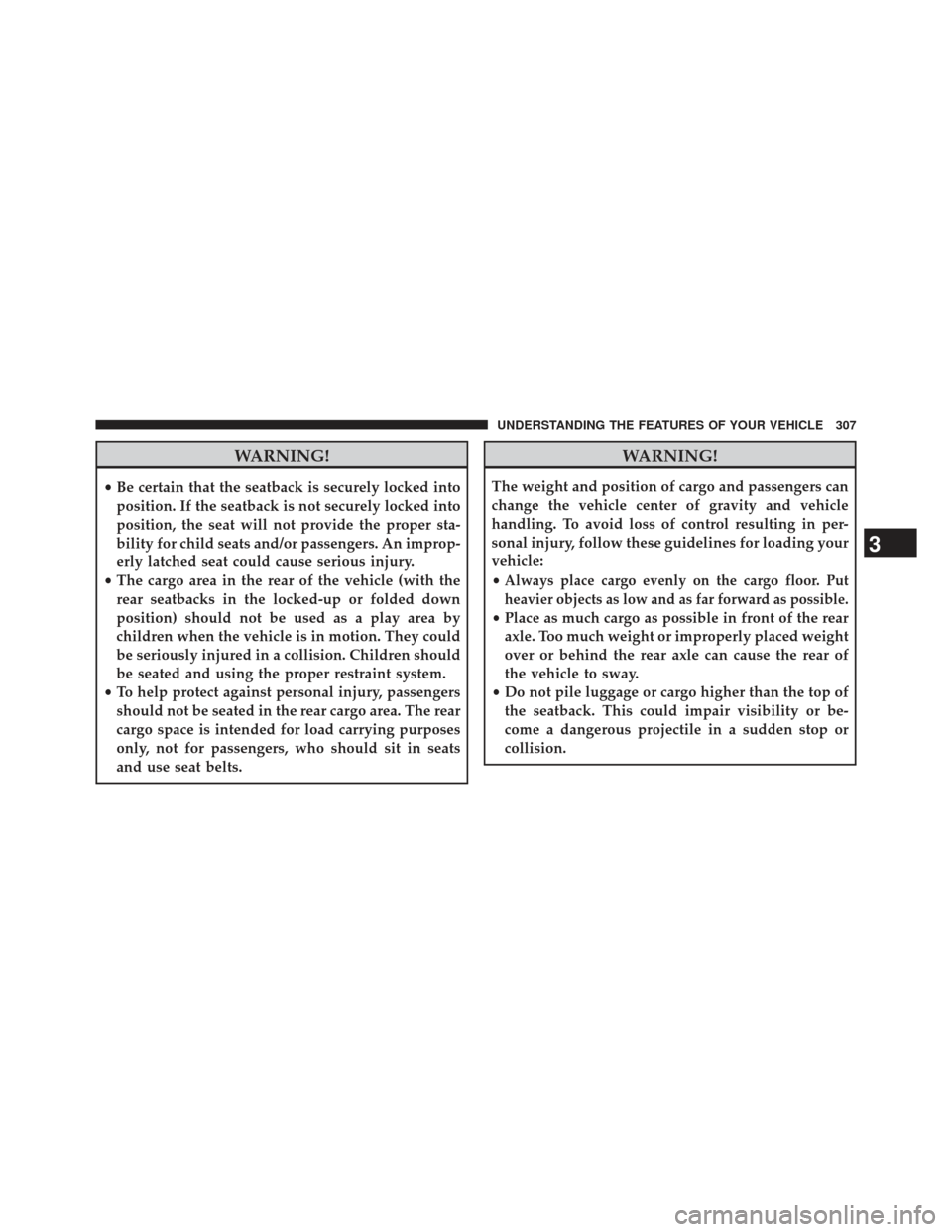
WARNING!
•Be certain that the seatback is securely locked into
position. If the seatback is not securely locked into
position, the seat will not provide the proper sta-
bility for child seats and/or passengers. An improp-
erly latched seat could cause serious injury.
• The cargo area in the rear of the vehicle (with the
rear seatbacks in the locked-up or folded down
position) should not be used as a play area by
children when the vehicle is in motion. They could
be seriously injured in a collision. Children should
be seated and using the proper restraint system.
• To help protect against personal injury, passengers
should not be seated in the rear cargo area. The rear
cargo space is intended for load carrying purposes
only, not for passengers, who should sit in seats
and use seat belts.
WARNING!
The weight and position of cargo and passengers can
change the vehicle center of gravity and vehicle
handling. To avoid loss of control resulting in per-
sonal injury, follow these guidelines for loading your
vehicle:
•
Always place cargo evenly on the cargo floor. Put
heavier objects as low and as far forward as possible.
• Place as much cargo as possible in front of the rear
axle. Too much weight or improperly placed weight
over or behind the rear axle can cause the rear of
the vehicle to sway.
• Do not pile luggage or cargo higher than the top of
the seatback. This could impair visibility or be-
come a dangerous projectile in a sudden stop or
collision.
3
UNDERSTANDING THE FEATURES OF YOUR VEHICLE 307
Page 612 of 631
Brightness, Interior Lights...................228
Bulb Replacement ........................ .579
Bulbs, Light ............................ .102
Camera, Rear ........................... .279
Capacities, Fluid ......................... .584
Caps, Filler Oil (Engine) .......................... .541
Radiator (Coolant Pressure) ................556
Carbon Monoxide Warning ...................99
Cargo (Vehicle Loading) ....................489
Car Washes ............................ .565
Cellular Phone .......................... .375
Certification Label ........................ .489
Chains, Tire ............................ .463
Changing A Flat Tire ...................... .509
Chart, Tire Sizing ........................ .443
Check Engine Light (Malfunction Indicator Light) . .319
Checking Your Vehicle For Safety ...............98Checks, Safety
............................98
Child Restraint ............................76
Child Safety Locks .........................33
Clean Air Gasoline ....................... .477
Cleaning Wheels .............................. .566
Climate Control ......................... .375
Coin Holder ............................ .304
Cold Weather Operation ....................397
Compact Disc (CD) Maintenance ..............374
Compact Spare Tire ....................... .458
Computer, Trip/Travel ..................... .338
Connector UCI................................ .371
Universal Consumer Interface (UCI) ..........371
Conserving Fuel ......................... .336
Console, Floor .......................... .304
Contract, Service ......................... .600
Coolant Pressure Cap (Radiator Cap) ...........556
610 INDEX
Page 623 of 631

PretensionersSeat Belts ..............................57
Programming Transmitters (Remote Keyless Entry) . .21
Radial Ply Tires ......................... .455
Radiator Cap (Coolant Pressure Cap) ...........556
Radio Operation ......................... .375
Radio Remote Controls .....................372
Rain Sensitive Wiper System .................232
Rear Axle (Differential) .....................563
Rear Camera ........................... .279
Rear Cupholder ......................... .303
Rear Park Sense System .....................271
Rear Seat, Folding ........................ .212
Rear Window Defroster .....................308
Rear Window Features .....................308
Recorder, Event Data .......................74
Recreational Towing ...................... .505
Reformulated Gasoline .....................477 Refrigerant
............................. .547
Reminder, Lights On ...................... .223
Reminder, Seat Belt .........................58
Remote Control Starting System .........................27
Remote Keyless Entry (RKE) ..................21
Remote Sound System (Radio) Controls .........372
Remote Starting System ......................27
Remote Trunk Release .......................44
Replacement Bulbs ....................... .579
Replacement Keys .........................17
Replacement Parts ........................ .537
Replacement Tires ........................ .461
Reporting Safety Defects ....................601
Resetting Oil Change Indicator ................317
Restraint, Head .......................... .209
Restraints, Child ...........................76
Restraints, Occupant ........................46
10
INDEX 621
Page 624 of 631
Rocking Vehicle When Stuck.................522
Rotation, Tires .......................... .465
Safety Checks Inside Vehicle .................100
Safety Checks Outside Vehicle ................102
Safety Defects, Reporting ....................601
Safety, Exhaust Gas .........................99
Safety Information, Tire .....................441
Safety Tips ...............................98
Schedule, Maintenance .....................588
Seat Belt Maintenance ..................... .569
Seat Belt Reminder .........................58
Seat Belts ................................46
Adjustable Upper Shoulder Anchorage .........54
And Pregnant Women .....................59
Child Restraint ..........................76
Extender ..............................59
Front Seat .............................49
Inspection ........................... .100Operating Instructions
....................50
Pretensioners ...........................57
Rear Seat ..............................49
Untwisting Procedure .....................55
Seats ................................. .199
Adjustment .......................... .199
Easy Entry ........................... .216
Head Restraints ....................... .209
Heated .............................. .202
Height Adjustment ..................... .199
Memory ............................. .213
Power .............................. .199
Rear Folding ......................... .212
Seatback Release ....................... .212
Tilting .............................. .199
Security Alarm (Theft Alarm) ..................18
Selection of Coolant (Antifreeze) ...............585
Sentry Key (Immobilizer) ....................16
Sentry Key Programming ....................18
622 INDEX