Page 439 of 520
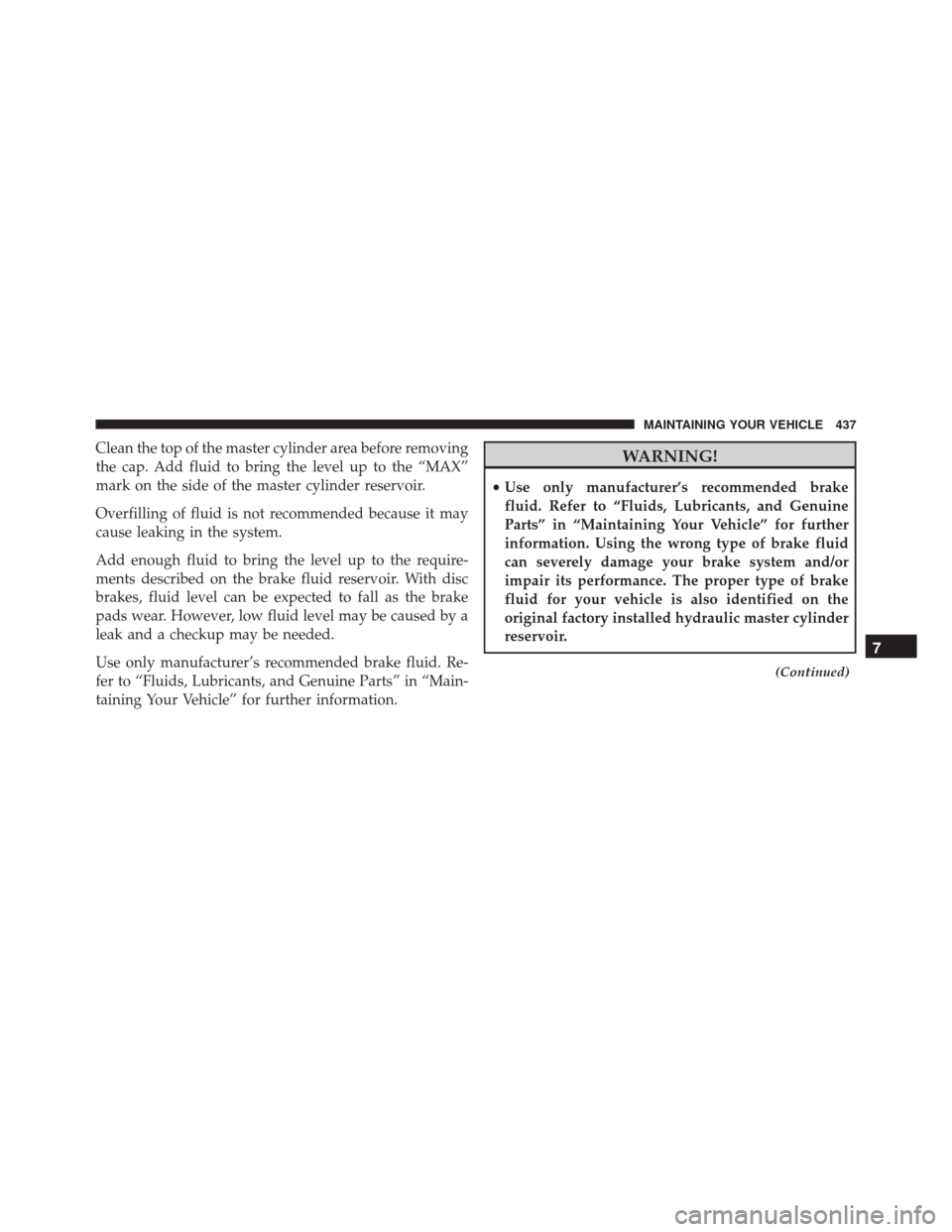
Clean the top of the master cylinder area before removing
the cap. Add fluid to bring the level up to the “MAX”
mark on the side of the master cylinder reservoir.
Overfilling of fluid is not recommended because it may
cause leaking in the system.
Add enough fluid to bring the level up to the require-
ments described on the brake fluid reservoir. With disc
brakes, fluid level can be expected to fall as the brake
pads wear. However, low fluid level may be caused by a
leak and a checkup may be needed.
Use only manufacturer’s recommended brake fluid. Re-
fer to “Fluids, Lubricants, and Genuine Parts” in “Main-
taining Your Vehicle” for further information.WARNING!
•Use only manufacturer’s recommended brake
fluid. Refer to “Fluids, Lubricants, and Genuine
Parts” in “Maintaining Your Vehicle” for further
information. Using the wrong type of brake fluid
can severely damage your brake system and/or
impair its performance. The proper type of brake
fluid for your vehicle is also identified on the
original factory installed hydraulic master cylinder
reservoir.
(Continued)
7
MAINTAINING YOUR VEHICLE 437
Page 440 of 520
WARNING!(Continued)
•To avoid contamination from foreign matter or
moisture, use only new brake fluid or fluid that has
been in a tightly closed container. Keep the master
cylinder reservoir cap secured at all times. Brake
fluid in a open container absorbs moisture from the
air resulting in a lower boiling point. This may
cause it to boil unexpectedly during hard or pro-
longed braking, resulting in sudden brake failure.
This could result in a collision.
• Overfilling the brake fluid reservoir can result in
spilling brake fluid on hot engine parts, causing
the brake fluid to catch fire. Brake fluid can also
damage painted and vinyl surfaces, care should be
taken to avoid its contact with these surfaces.
(Continued)
WARNING! (Continued)
•Do not allow petroleum based fluid to contaminate
the brake fluid. Brake seal components could be
damaged, causing partial or complete brake failure.
This could result in a collision.
Use only brake fluid that has been in a tightly closed
container to avoid contamination from foreign matter or
moisture.
Clutch Hydraulic System (Manual Transmission) –
If Equipped
The clutch hydraulic system is fed by a segregated
volume of fluid within the brake system master cylinder
reservoir. In the event of leakage or wear, use only the
manufacturer’s recommended brake fluid. Refer to “Flu-
ids, Lubricants, and Genuine Parts” in “Maintaining Your
Vehicle” for further information.
438 MAINTAINING YOUR VEHICLE
Page 446 of 520
•If you carry special cargo such as chemicals, fertilizers,
de-icer salt, etc., be sure that such materials are well
packaged and sealed.
• If a lot of driving is done on gravel roads, consider
mud or stone shields behind each wheel.
• Use MOPAR® Touch Up Paint on scratches as soon as
possible. Your authorized dealer has touch up paint to
match the color of your vehicle.
Wheel And Wheel Trim Care
• All wheels and wheel trim, especially aluminum and
chrome plated wheels, should be cleaned regularly
with a mild soap and water to prevent corrosion.
• To remove heavy soil and/or excessive brake dust, use
MOPAR® Wheel Cleaner.
CAUTION!
Do not use scouring pads, steel wool, a bristle brush,
or metal polishes. Do not use oven cleaner. These
products may damage the wheel’s protective finish.
Avoid automatic car washes that use acidic solutions
or harsh brushes that may damage the wheel’s pro-
tective finish. Only MOPAR® Wheel Cleaner or
equivalent is recommended.
Stain Repel Fabric Cleaning Procedure – If
Equipped
Stain Repel seats may be cleaned in the following man-
ner:
• Remove as much of the stain as possible by blotting
with a clean, dry towel.
• Blot any remaining stain with a clean, damp towel.
444 MAINTAINING YOUR VEHICLE
Page 451 of 520
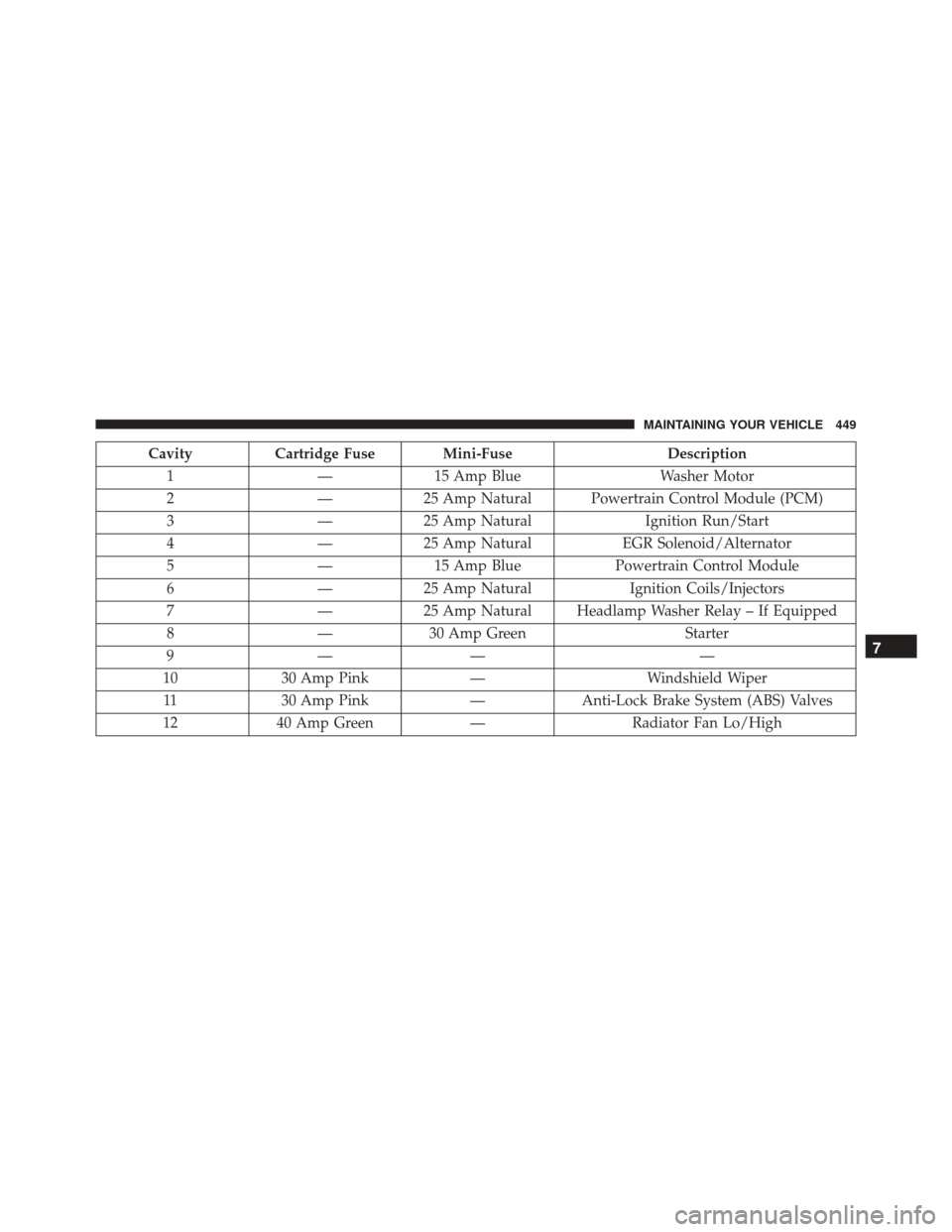
CavityCartridge Fuse Mini-Fuse Description
1 —15 Amp Blue Washer Motor
2 —25 Amp Natural Powertrain Control Module (PCM)
3 —25 Amp Natural Ignition Run/Start
4 —25 Amp Natural EGR Solenoid/Alternator
5 —15 Amp Blue Powertrain Control Module
6 —25 Amp Natural Ignition Coils/Injectors
7 —25 Amp Natural Headlamp Washer Relay – If Equipped
8 —30 Amp Green Starter
9—— —
10 30 Amp Pink —Windshield Wiper
11 30 Amp Pink —Anti-Lock Brake System (ABS) Valves
12 40 Amp Green —Radiator Fan Lo/High
7
MAINTAINING YOUR VEHICLE 449
Page 452 of 520
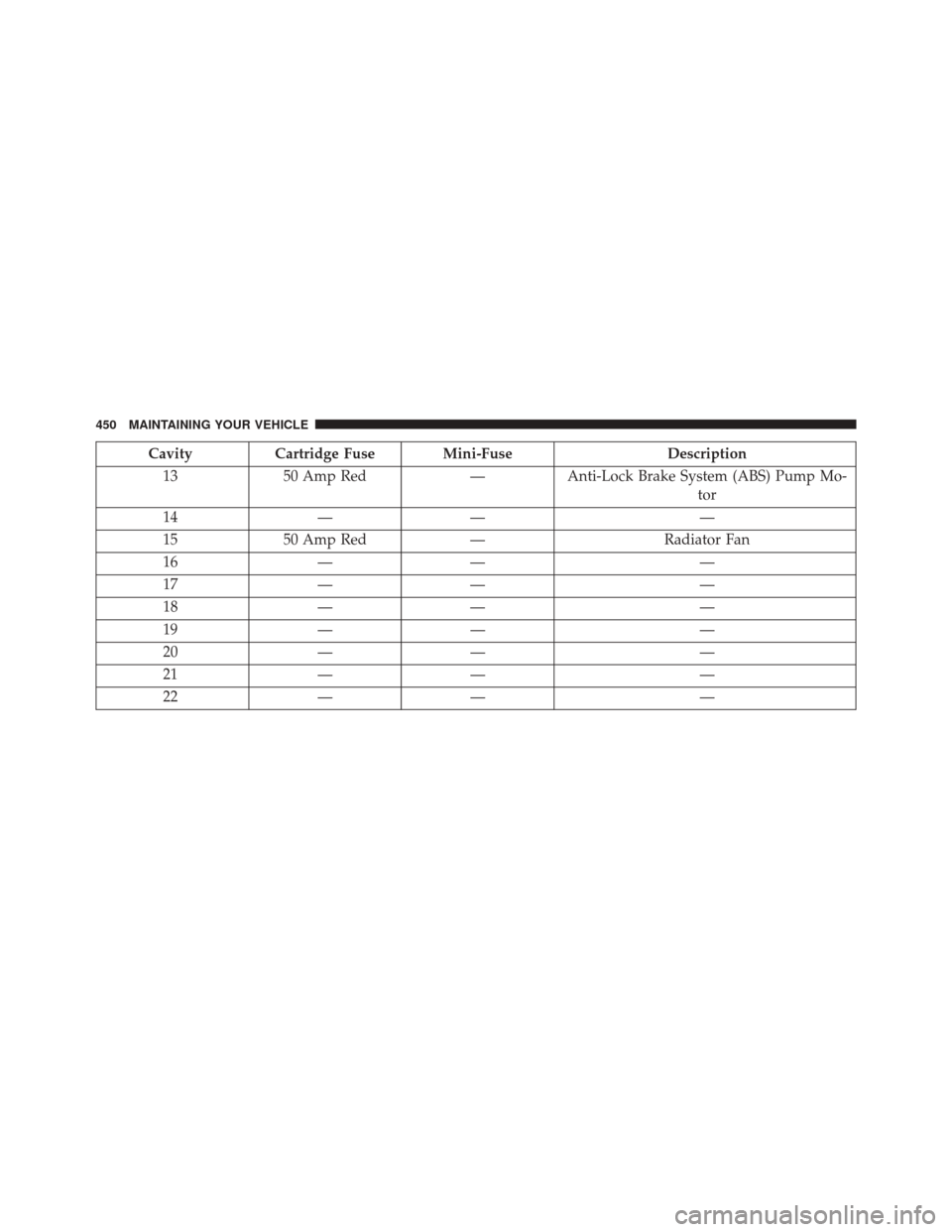
CavityCartridge Fuse Mini-Fuse Description
13 50 Amp Red —Anti-Lock Brake System (ABS) Pump Mo-
tor
14 —— —
15 50 Amp Red — Radiator Fan
16 —— —
17 —— —
18 —— —
19 —— —
20 —— —
21 —— —
22 —— —
450 MAINTAINING YOUR VEHICLE
Page 467 of 520
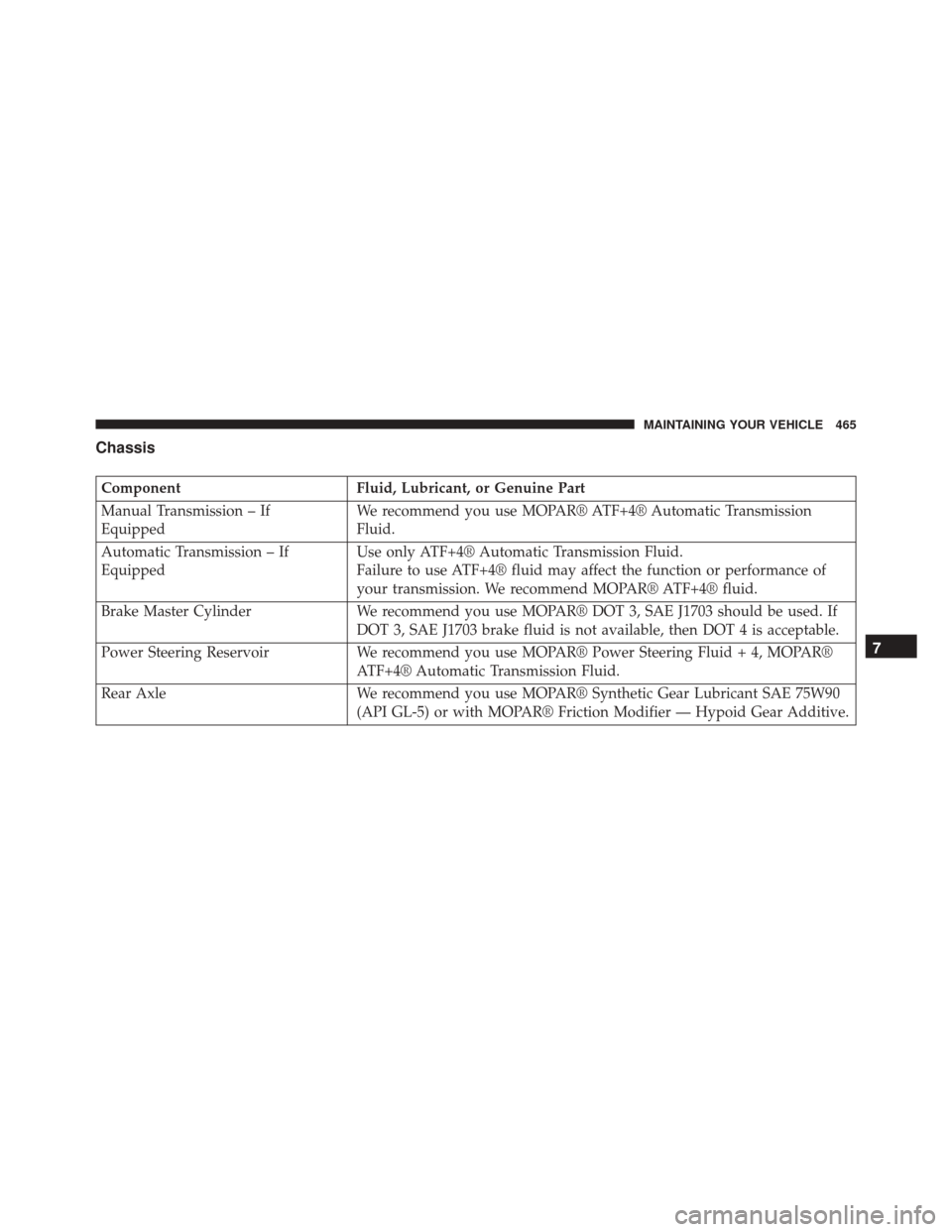
Chassis
ComponentFluid, Lubricant, or Genuine Part
Manual Transmission – If
Equipped We recommend you use MOPAR® ATF+4® Automatic Transmission
Fluid.
Automatic Transmission – If
Equipped Use only ATF+4® Automatic Transmission Fluid.
Failure to use ATF+4® fluid may affect the function or performance of
your transmission. We recommend MOPAR® ATF+4® fluid.
Brake Master Cylinder We recommend you use MOPAR® DOT 3, SAE J1703 should be used. If
DOT 3, SAE J1703 brake fluid is not available, then DOT 4 is acceptable.
Power Steering Reservoir We recommend you use MOPAR® Power Steering Fluid + 4, MOPAR®
ATF+4® Automatic Transmission Fluid.
Rear Axle We recommend you use MOPAR® Synthetic Gear Lubricant SAE 75W90
(API GL-5) or with MOPAR® Friction Modifier — Hypoid Gear Additive.
7
MAINTAINING YOUR VEHICLE 465
Page 471 of 520

referring to the steps described under “Electronic Vehicle
Information Center (EVIC)/Oil Change Required” in
“Understanding Your Instrument Panel” for further in-
formation.
At Each Stop For Fuel
•Check the engine oil level. Refer to “Maintenance
Procedures/Engine Oil” in “Maintaining Your Ve-
hicle” for further information.
• Check the windshield washer solvent and add if
required.
Once A Month
• Check tire pressure and look for unusual wear or
damage.
• Inspect the battery, and clean and tighten the terminals
as required. •
Check the fluid levels of the coolant reservoir, brake
master cylinder, and power steering, and add as
needed.
• Check all lights and other electrical items for correct
operation.
At Each Oil Change
• Change the engine oil filter.
• Inspect the brake hoses and lines.
CAUTION!
Failure to perform the required maintenance items
may result in damage to the vehicle.
Required Maintenance Intervals
Refer to the Maintenance Schedules on the following
pages for the required maintenance intervals.
8
MAINTENANCE SCHEDULES 469
Page 472 of 520
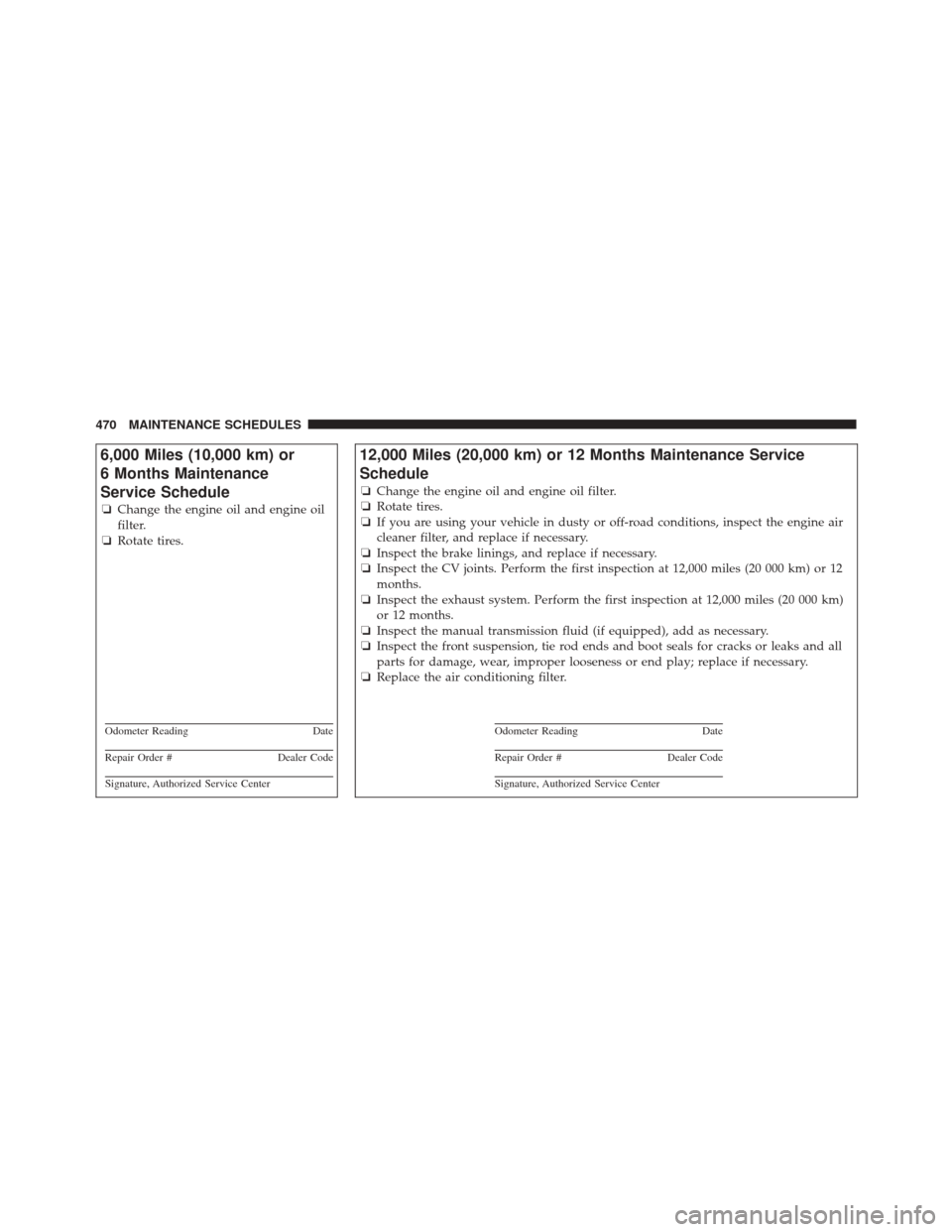
6,000 Miles (10,000 km) or
6 Months Maintenance
Service Schedule
❏Change the engine oil and engine oil
filter.
❏ Rotate tires.
Odometer Reading Date
Repair Order #Dealer Code
Signature, Authorized Service Center
12,000 Miles (20,000 km) or 12 Months Maintenance Service
Schedule
❏Change the engine oil and engine oil filter.
❏ Rotate tires.
❏ If you are using your vehicle in dusty or off-road conditions, inspect the engine air
cleaner filter, and replace if necessary.
❏ Inspect the brake linings, and replace if necessary.
❏ Inspect the CV joints. Perform the first inspection at 12,000 miles (20 000 km) or 12
months.
❏ Inspect the exhaust system. Perform the first inspection at 12,000 miles (20 000 km)
or 12 months.
❏ Inspect the manual transmission fluid (if equipped), add as necessary.
❏ Inspect the front suspension, tie rod ends and boot seals for cracks or leaks and all
parts for damage, wear, improper looseness or end play; replace if necessary.
❏ Replace the air conditioning filter.
Odometer Reading Date
Repair Order #Dealer Code
Signature, Authorized Service Center
470 MAINTENANCE SCHEDULES