Page 407 of 543
WHAT TO DO IN EMERGENCIES
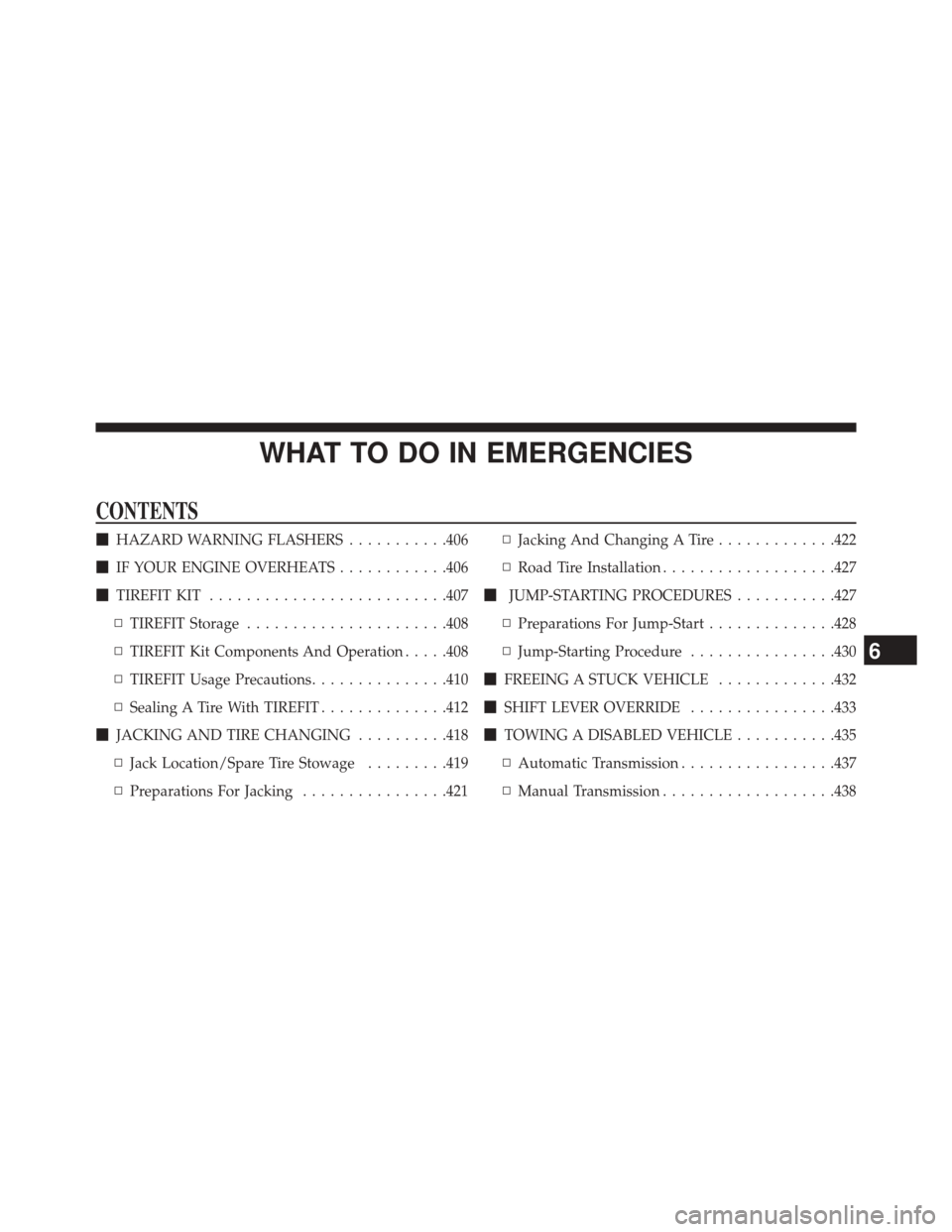
CONTENTS
�HAZARD WARNING FLASHERS ...........406
� IF YOUR ENGINE OVERHEATS ............406
� TIREFIT KIT ......................... .407
▫ TIREFIT Storage ..................... .408
▫ TIREFIT Kit Components And Operation .....408
▫ TIREFIT Usage Precautions ...............410
▫ Sealing A Tire With TIREFIT ..............412
� JACKING AND TIRE CHANGING ..........418
▫ Jack Location/Spare Tire Stowage .........419
▫ Preparations For Jacking ................421 ▫
Jacking And Changing A Tire .............422
▫ Road Tire Installation ...................427
� JUMP-STARTING PROCEDURES ...........427
▫ Preparations For Jump-Start ..............428
▫ Jump-Starting Procedure ................430
� FREEING A STUCK VEHICLE .............432
� SHIFT LEVER OVERRIDE ................433
� TOWING A DISABLED VEHICLE ...........435
▫ Automatic Transmission .................437
▫ Manual Transmission ...................438
6
Page 413 of 543
WARNING!
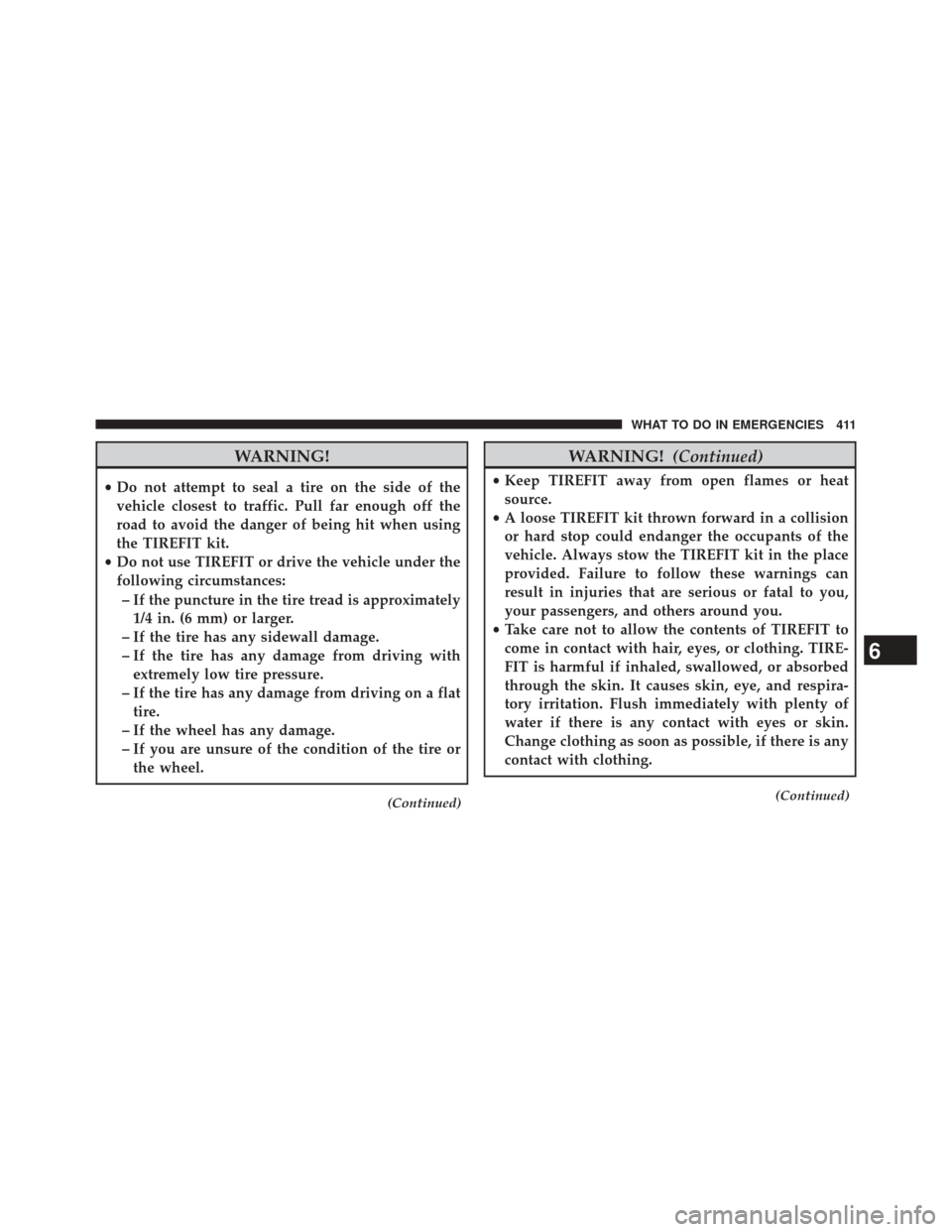
•Do not attempt to seal a tire on the side of the
vehicle closest to traffic. Pull far enough off the
road to avoid the danger of being hit when using
the TIREFIT kit.
• Do not use TIREFIT or drive the vehicle under the
following circumstances:
– If the puncture in the tire tread is approximately 1/4 in. (6 mm) or larger.
– If the tire has any sidewall damage.
– If the tire has any damage from driving with extremely low tire pressure.
– If the tire has any damage from driving on a flat tire.
– If the wheel has any damage.
– If you are unsure of the condition of the tire or the wheel.
(Continued)
WARNING! (Continued)
•Keep TIREFIT away from open flames or heat
source.
• A loose TIREFIT kit thrown forward in a collision
or hard stop could endanger the occupants of the
vehicle. Always stow the TIREFIT kit in the place
provided. Failure to follow these warnings can
result in injuries that are serious or fatal to you,
your passengers, and others around you.
• Take care not to allow the contents of TIREFIT to
come in contact with hair, eyes, or clothing. TIRE-
FIT is harmful if inhaled, swallowed, or absorbed
through the skin. It causes skin, eye, and respira-
tory irritation. Flush immediately with plenty of
water if there is any contact with eyes or skin.
Change clothing as soon as possible, if there is any
contact with clothing.
(Continued)
6
WHAT TO DO IN EMERGENCIES 411
Page 421 of 543
WARNING!(Continued)
•The jack is designed to be used as a tool for
changing tires only. The jack should not be used to
lift the vehicle for service purposes. The vehicle
should be jacked on a firm level surface only.
Avoid ice or slippery areas.
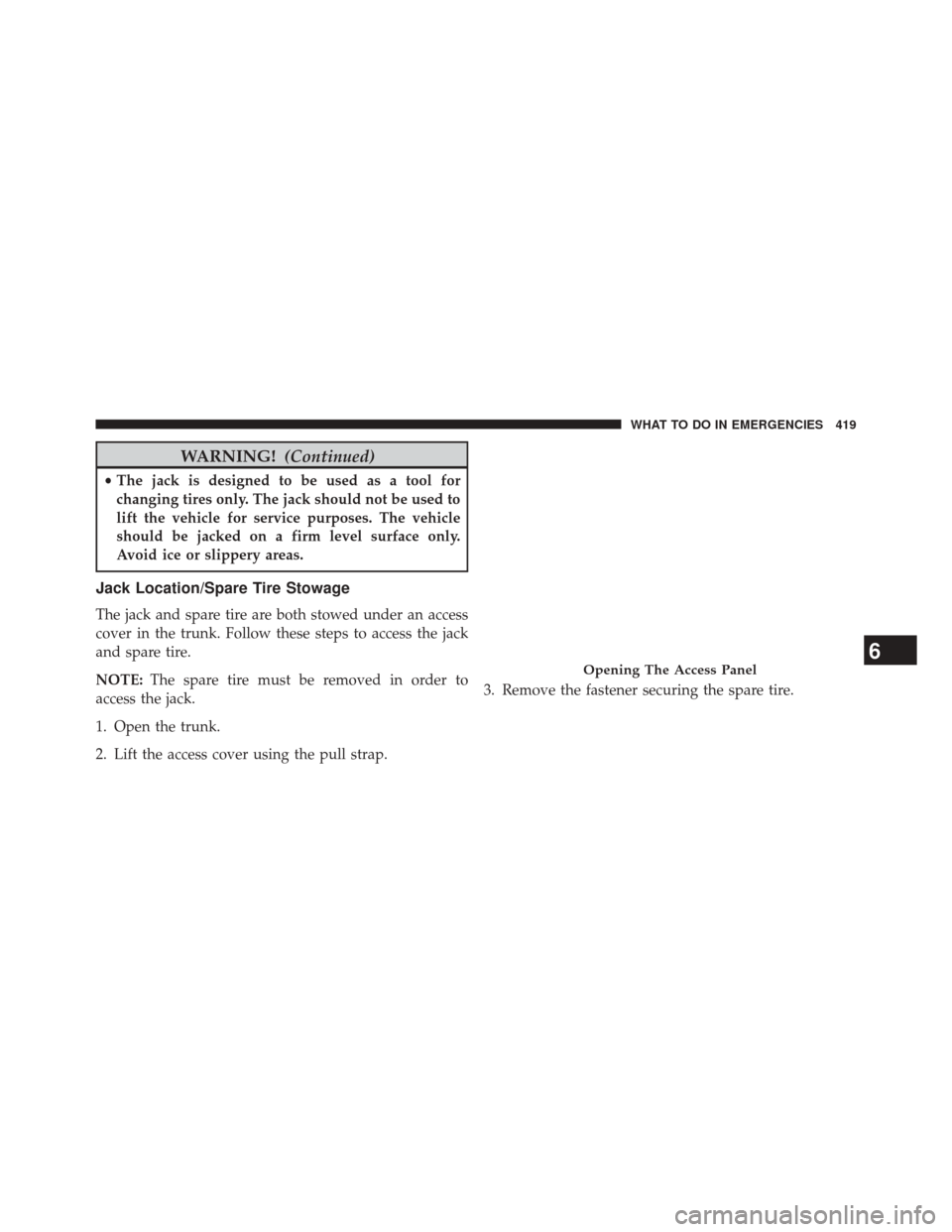
Jack Location/Spare Tire Stowage
The jack and spare tire are both stowed under an access
cover in the trunk. Follow these steps to access the jack
and spare tire.
NOTE: The spare tire must be removed in order to
access the jack.
1. Open the trunk.
2. Lift the access cover using the pull strap. 3. Remove the fastener securing the spare tire.
Opening The Access Panel6
WHAT TO DO IN EMERGENCIES 419
Page 423 of 543
WARNING!
A loose tire or jack thrown forward in a collision or
hard stop could endanger the occupants of the ve-
hicle. Always stow the jack parts and the spare tire in
the places provided. Have the deflated (flat) tire
repaired or replaced immediately.
Preparations For Jacking
1. Park the vehicle on a firm, level surface as far from theedge of the roadway as possible. Avoid icy or slippery
areas.
WARNING!
Do not attempt to change a tire on the side of the
vehicle close to moving traffic, pull far enough off
the road to avoid being hit when operating the jack
or changing the wheel. 2. Turn on the Hazard Warning flasher.
3. Set the parking brake.
4. Place the shift lever into PARK (automatic transmis-
sion) or 1st gear (manual transmission).
5. Turn OFF the ignition. 6.
Block the front and rear of the wheel
diagonally opposite of the jacking
position. For example, if changing
the right front tire, block the left rear
wheel.
NOTE: Passengers should not remain in the vehicle
when the vehicle is being jacked.
6
WHAT TO DO IN EMERGENCIES 421
Page 428 of 543

•Refer to “Compact Spare Tire” and to “Limited-Use
Spare” under “Tires—General Information” in “Start-
ing and Operating” for additional warnings, cautions,
and information about the spare tire, its use, and
operation.
8. Install the lug nuts with the cone shaped end of the lug nut toward the wheel. Lightly tighten the lug nuts.
WARNING!
To avoid the risk of forcing the vehicle off the jack,
do not tighten the lug nuts fully until the vehicle has
been lowered. Failure to follow this warning may
result in personal injury.
9. Lower the vehicle to the ground by turning the jack handle counterclockwise. 10. Finish tightening the lug nuts. Push down on the
wrench while at the end of the handle for increased
leverage. Tighten the lug nuts in a star pattern until
each nut has been tightened twice. The correct tight-
ness of each lug nut is 110 ft-lb. (150 N·m). If in doubt
about the correct tightness, have them checked with
a torque wrench by your authorized dealer or at a
service station.
11. Stow the jack, tools and flat tire. Make sure the base of the jack faces the front of the vehicle before
tightening down the fastener.
WARNING!
A loose tire or jack thrown forward in a collision or
hard stop could endanger the occupants of the ve-
hicle. Always stow the jack parts and the spare tire in
the places provided. Have the deflated (flat) tire
repaired or replaced immediately.
426 WHAT TO DO IN EMERGENCIES
Page 429 of 543

Road Tire Installation
1. Mount the road tire on the axle.
2. Install the remaining lug nuts with the cone shapedend of the nut toward the wheel. Lightly tighten the
lug nuts.
WARNING!
To avoid the risk of forcing the vehicle off the jack,
do not tighten the lug nuts fully until the vehicle has
been lowered. Failure to follow this warning may
result in personal injury.
3. Lower the vehicle to the ground by turning the jack handle counterclockwise. 4. Finish tightening the lug nuts. Push down on the
wrench while at the end of the handle for increased
leverage. Tighten the lug nuts in a star pattern until
each nut has been tightened twice. The correct tight-
ness of each lug nut is 110 ft-lbs (150 N·m). If in doubt
about the correct tightness, have them checked with a
torque wrench by your authorized dealer or service
station.
5. After 25 miles (40 km) check the lug nut torque with a torque wrench to ensure that all lug nuts are properly
seated against the wheel.
JUMP-STARTING PROCEDURES
If your vehicle has a discharged battery it can be jump-
started using a set of jumper cables and a battery in
another vehicle or by using a portable battery booster
pack. Jump-starting can be dangerous if done improperly
so please follow the procedures in this section carefully.
6
WHAT TO DO IN EMERGENCIES 427
Page 437 of 543
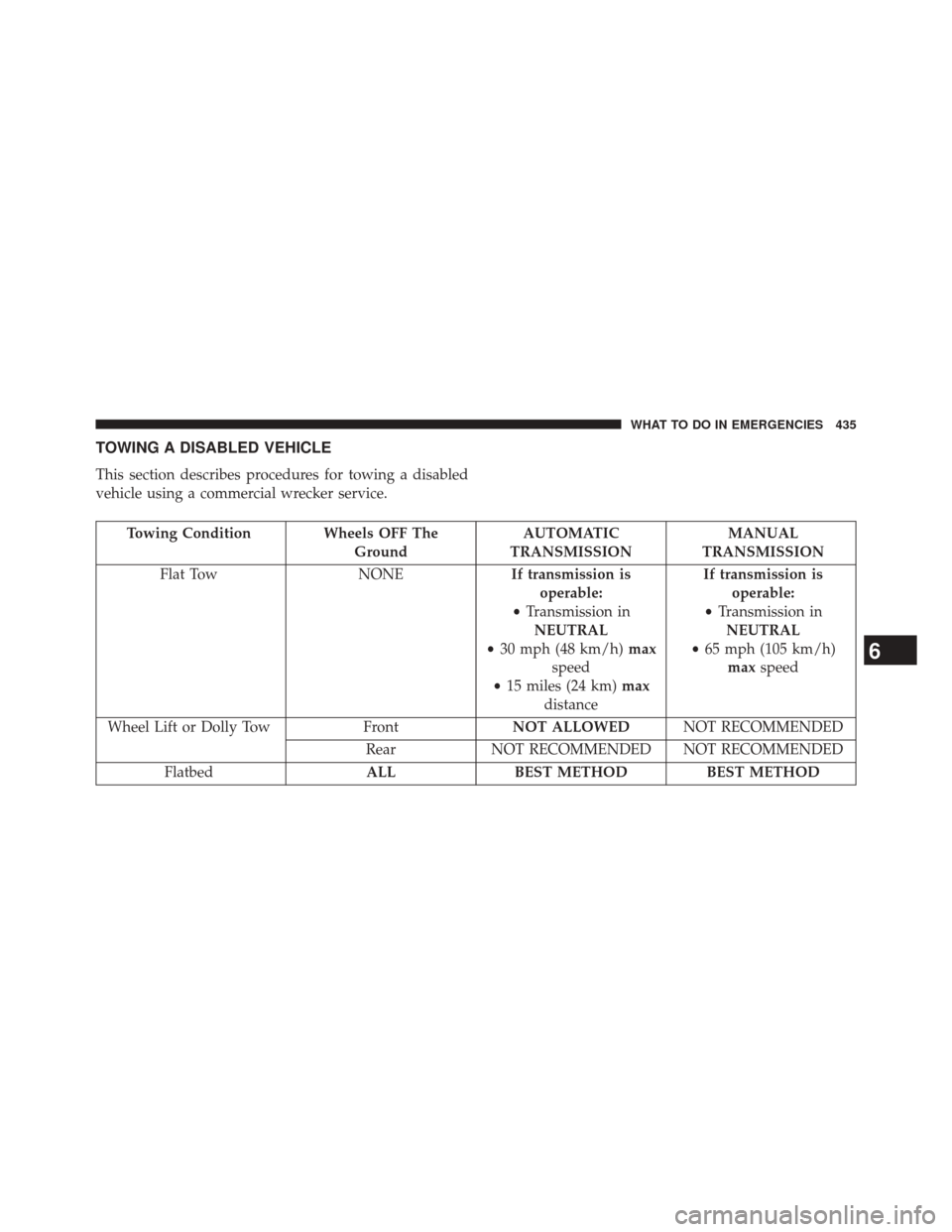
TOWING A DISABLED VEHICLE
This section describes procedures for towing a disabled
vehicle using a commercial wrecker service.
Towing Condition Wheels OFF TheGroundAUTOMATIC
TRANSMISSION MANUAL
TRANSMISSION
Flat Tow NONEIf transmission is
operable:
• Transmission in
NEUTRAL
• 30 mph (48 km/h) max
speed
• 15 miles (24 km) max
distance If transmission is
operable:
• Transmission in
NEUTRAL
• 65 mph (105 km/h)
max speed
Wheel Lift or Dolly Tow FrontNOT ALLOWED NOT RECOMMENDED
Rear NOT RECOMMENDED NOT RECOMMENDED
Flatbed ALLBEST METHOD BEST METHOD
6
WHAT TO DO IN EMERGENCIES 435
Page 438 of 543
Proper towing or lifting equipment is required to prevent
damage to your vehicle. Use only tow bars and other
equipment designed for this purpose, following equip-
ment manufacturer ’s instructions. Use of safety chains is
mandatory. Attach a tow bar or other towing device to
main structural members of the vehicle, not to bumpers
or associated brackets. State and local laws regarding
vehicles under tow must be observed.
If you must use the accessories (wipers, defrosters, etc.)
while being towed, the ignition must be in the ON/RUN
position, not the ACC position.If the key fob is unavailable, or the vehicle’s battery is
discharged, see “Shift Lever Override” in this section for
instructions on shifting the automatic transmission out of
PARK for towing.
CAUTION!
•
Do not use sling type equipment when towing.
When securing the vehicle to a flatbed truck, do not
attach to front or rear suspension components.
Damage to your vehicle may result from improper
towing.
• The manufacturer does not recommend towing this
vehicle using a tow dolly. Vehicle damage may
occur.
436 WHAT TO DO IN EMERGENCIES