Page 431 of 543
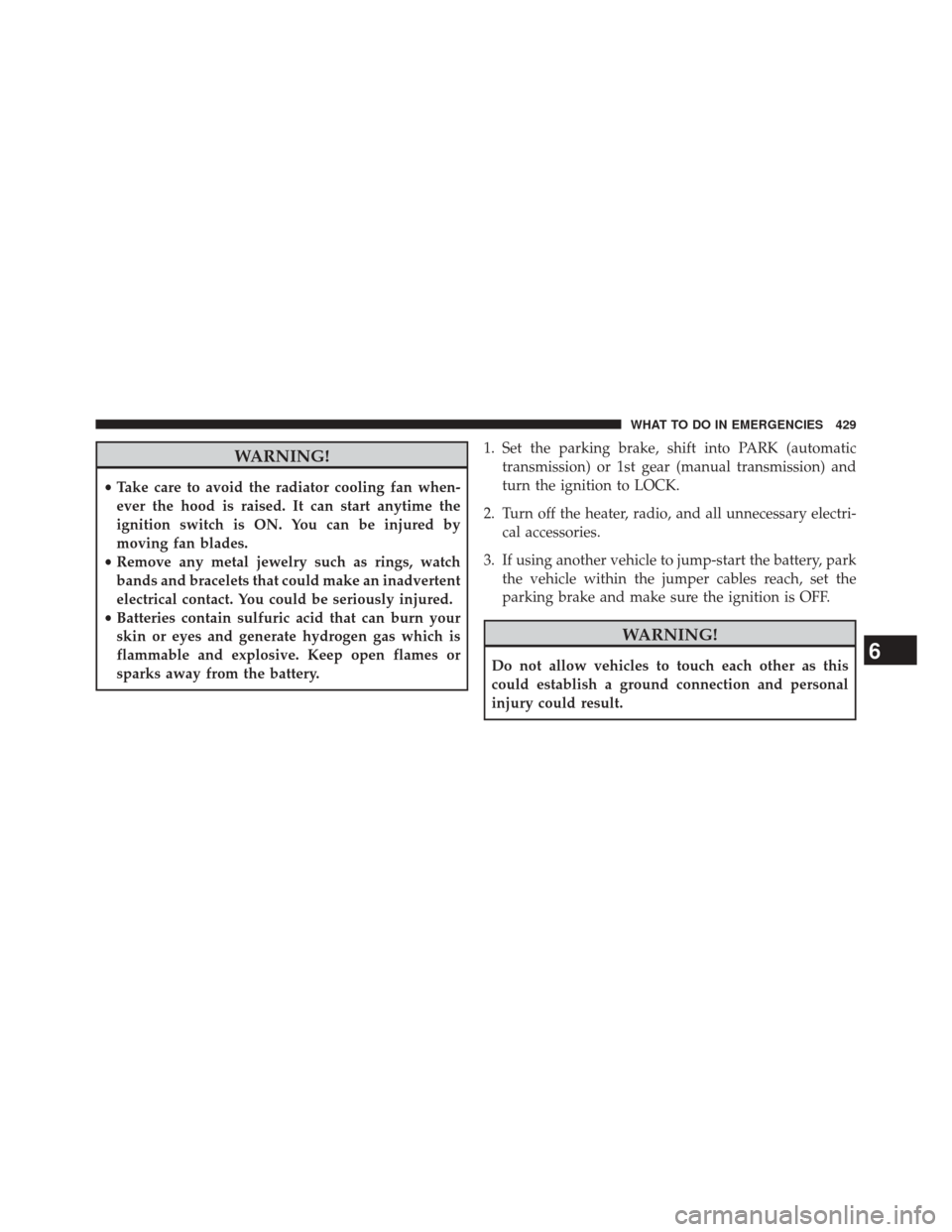
WARNING!
•Take care to avoid the radiator cooling fan when-
ever the hood is raised. It can start anytime the
ignition switch is ON. You can be injured by
moving fan blades.
• Remove any metal jewelry such as rings, watch
bands and bracelets that could make an inadvertent
electrical contact. You could be seriously injured.
• Batteries contain sulfuric acid that can burn your
skin or eyes and generate hydrogen gas which is
flammable and explosive. Keep open flames or
sparks away from the battery. 1. Set the parking brake, shift into PARK (automatic
transmission) or 1st gear (manual transmission) and
turn the ignition to LOCK.
2. Turn off the heater, radio, and all unnecessary electri- cal accessories.
3. If using another vehicle to jump-start the battery, park the vehicle within the jumper cables reach, set the
parking brake and make sure the ignition is OFF.
WARNING!
Do not allow vehicles to touch each other as this
could establish a ground connection and personal
injury could result.6
WHAT TO DO IN EMERGENCIES 429
Page 438 of 543
Proper towing or lifting equipment is required to prevent
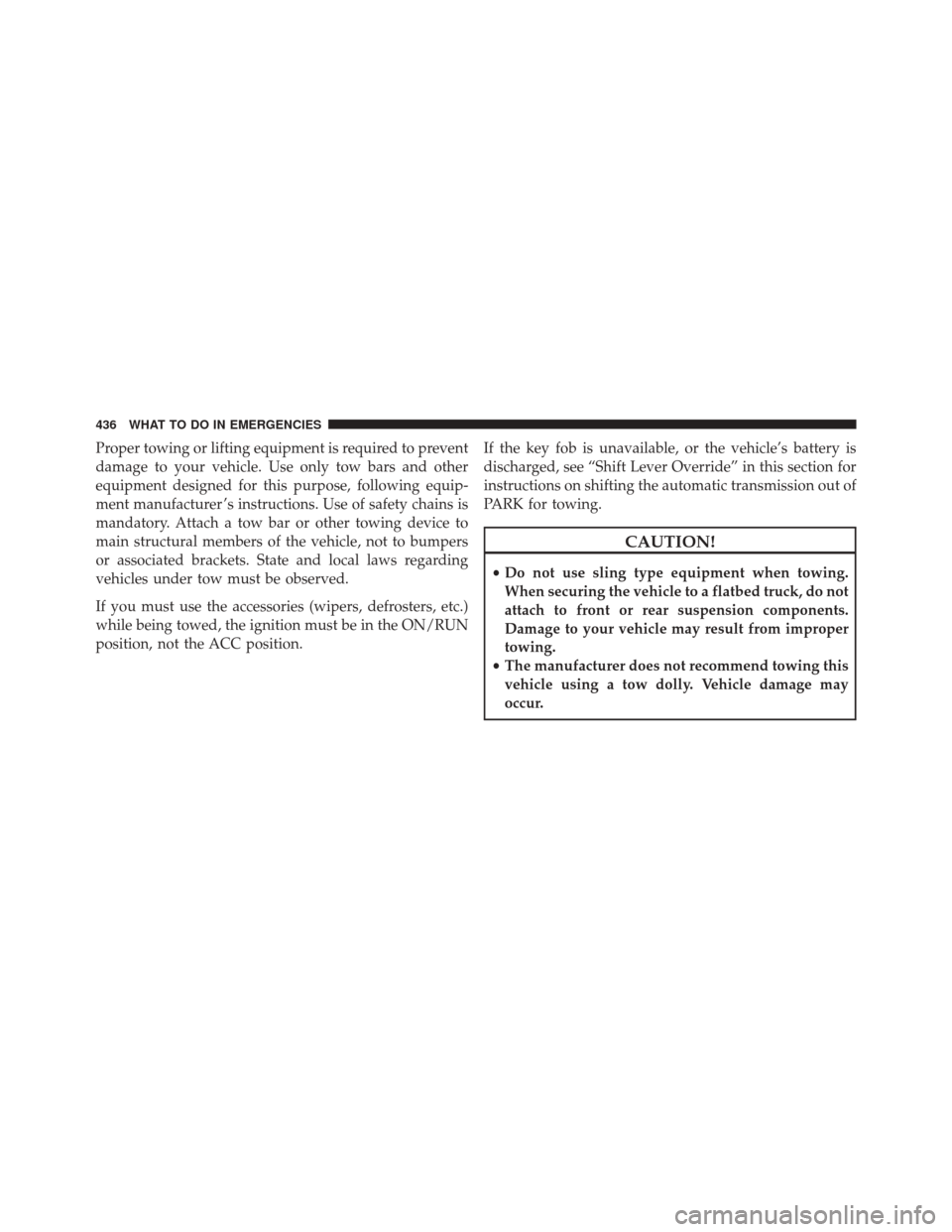
damage to your vehicle. Use only tow bars and other
equipment designed for this purpose, following equip-
ment manufacturer ’s instructions. Use of safety chains is
mandatory. Attach a tow bar or other towing device to
main structural members of the vehicle, not to bumpers
or associated brackets. State and local laws regarding
vehicles under tow must be observed.
If you must use the accessories (wipers, defrosters, etc.)
while being towed, the ignition must be in the ON/RUN
position, not the ACC position.If the key fob is unavailable, or the vehicle’s battery is
discharged, see “Shift Lever Override” in this section for
instructions on shifting the automatic transmission out of
PARK for towing.
CAUTION!
•
Do not use sling type equipment when towing.
When securing the vehicle to a flatbed truck, do not
attach to front or rear suspension components.
Damage to your vehicle may result from improper
towing.
• The manufacturer does not recommend towing this
vehicle using a tow dolly. Vehicle damage may
occur.
436 WHAT TO DO IN EMERGENCIES
Page 448 of 543

Normally, the OBD II system will be ready. The OBD II
system maynotbe ready if your vehicle was recently
serviced, recently had a dead battery or a battery replace-
ment. If the OBD II system should be determined not
ready for the I/M test, your vehicle may fail the test.
Your vehicle has a simple ignition key-actuated test,
which you can use prior to going to the test station. To
check if your vehicle’s OBD II system is ready, you must
do the following:
1. Cycle the ignition switch to the ON position, but do not crank or start the engine.
2. If you crank or start the engine, you will have to start this test over.
3. As soon as you cycle the ignition switch to the ON position, you will see the MIL symbol come on as part
of a normal bulb check. 4. Approximately 15 seconds later, one of two things will
happen:
• The MIL will flash for about 10 seconds and then
return to being fully illuminated until you turn OFF
the ignition or start the engine. This means that your
vehicle’s OBD II system is not readyand you should
not proceed to the I/M station.
• The MIL will not flash at all and will remain fully
illuminated until you turn OFF the ignition or start the
engine. This means that your vehicle’s OBD II system
is ready and you can proceed to the I/M station.
If your OBD II system is not ready,you should see your
authorized dealer or repair facility. If your vehicle was
recently serviced or had a battery failure or replacement,
you may need to do nothing more than drive your
vehicle as you normally would in order for your OBD II
system to update. A recheck with the above test routine
may then indicate that the system is now ready.
446 MAINTAINING YOUR VEHICLE
Page 464 of 543
NOTE:Intentional tampering with emissions control
systems can result in civil penalties being assessed
against you.
In unusual situations involving grossly malfunctioning
engine operation, a scorching odor may suggest severe
and abnormal catalyst overheating. If this occurs, stop
the vehicle, turn off the engine and allow it to cool.
Service, including a tune-up to manufacturer’s specifica-
tions, should be obtained immediately. To minimize the possibility of catalytic converter dam-
age:
•
Do not shut off the engine or interrupt the ignition,
when the transmission is in gear and the vehicle is in
motion.
• Do not try to start the engine by pushing or towing the
vehicle.
• Do not idle the engine with any spark plug wires
disconnected or removed, such as when diagnostic
testing, or for prolonged periods during very rough
idle or malfunctioning operating conditions.
462 MAINTAINING YOUR VEHICLE
Page 465 of 543

Cooling System
WARNING!
•When working near the radiator cooling fan, dis-
connect the fan motor lead or turn the ignition
switch to the LOCK position (OFF position for
Keyless Enter-N-Go™). The fan is temperature
controlled and can start at any time the ignition
switch is in the ON position (RUN position for
Keyless Enter-N-Go™).
• You or others can be badly burned by hot engine
coolant (antifreeze) or steam from your radiator. If
you see or hear steam coming from under the hood,
do not open the hood until the radiator has had
time to cool. Never try to open a cooling system
pressure cap when the radiator is hot.
Coolant Checks
Check engine coolant (antifreeze) protection every 12
months (before the onset of freezing weather, where
applicable). If coolant is dirty or rusty in appearance, the
system should be drained, flushed, and refilled with
fresh coolant. Check the front of the radiator for any
accumulation of bugs, leaves, etc. If dirty, clean by gently
spraying water from a garden hose vertically down the
face of the condenser.
Check the coolant recovery bottle tubing for brittle rub-
ber, cracking, tears, cuts, and tightness of the connection
at the bottle and radiator. Inspect the entire system for
leaks.
With the engine at normal operating temperature (but
not running), check the cooling system pressure cap for
proper vacuum sealing by draining a small amount of
coolant from the radiator drain cock. If the cap is sealing
properly, the engine coolant (antifreeze) will begin to
7
MAINTAINING YOUR VEHICLE 463
Page 484 of 543
Cavity Car-tridgeFuse Mini-
Fuse Description
1 — 15 Amp BlueWasher Motor
2 — 25 Amp NaturalPowertrain Control
Module (PCM)
3 — 25 Amp NaturalIgnition Run/Start
4 — 25 Amp NaturalEGR Solenoid/
Alternator
5 — 15 Amp BluePowertrain Control
Module
6 — 25 Amp NaturalIgnition Coils/
Injectors
7 — 25 Amp NaturalHeadlamp Washer
Relay – If EquippedCavity Car- tridgeFuse Mini-
Fuse Description
8 — 30 Amp GreenStarter
9—— —
10 30 Amp Pink — Windshield Wiper
11 30 Amp Pink — Anti-Lock Brake
System (ABS)Valves
12 40 Amp Green — Radiator Fan Lo/
High
13 50 Amp Red — Anti-Lock Brake
System (ABS)Pump Motor
14 — — —
482 MAINTAINING YOUR VEHICLE
Page 486 of 543
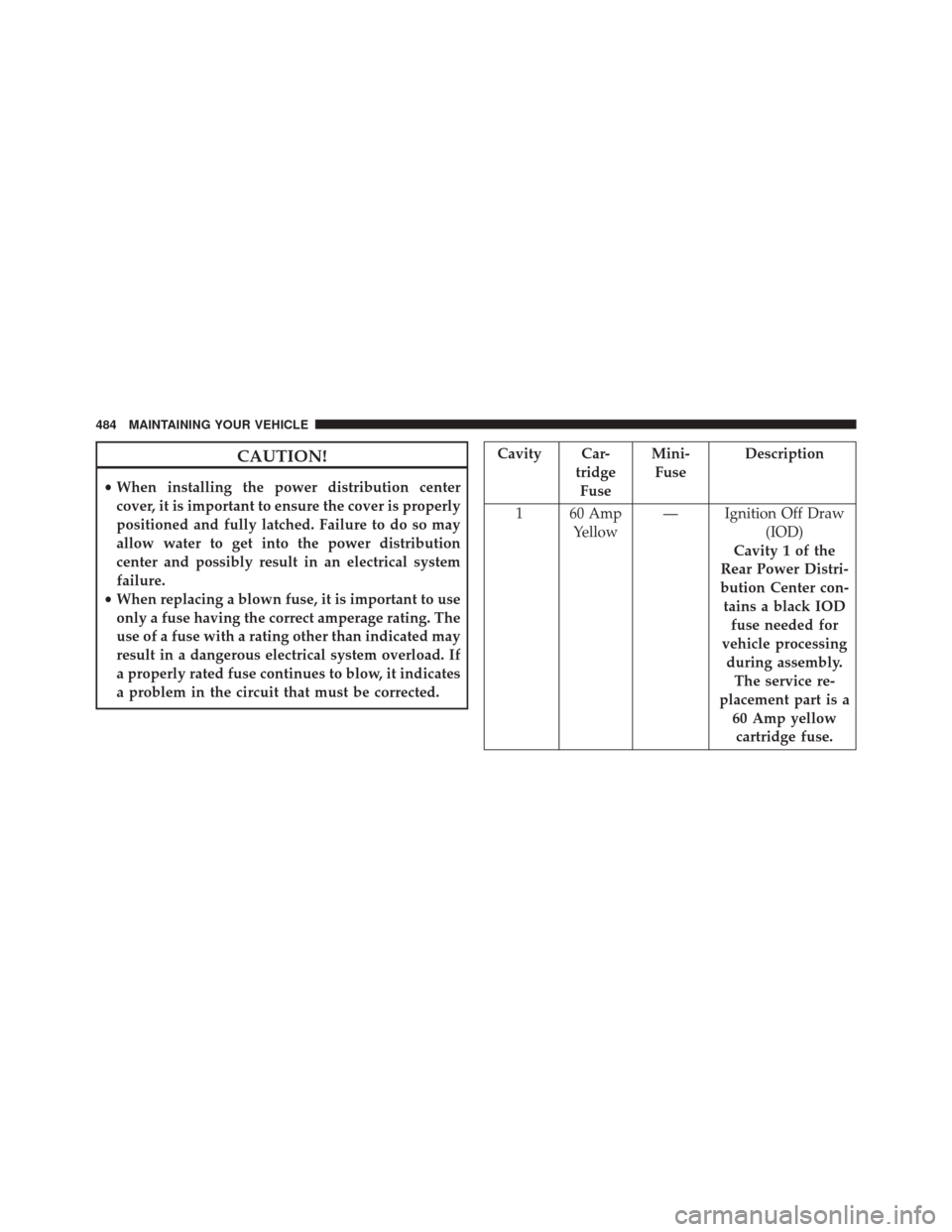
CAUTION!
•When installing the power distribution center
cover, it is important to ensure the cover is properly
positioned and fully latched. Failure to do so may
allow water to get into the power distribution
center and possibly result in an electrical system
failure.
• When replacing a blown fuse, it is important to use
only a fuse having the correct amperage rating. The
use of a fuse with a rating other than indicated may
result in a dangerous electrical system overload. If
a properly rated fuse continues to blow, it indicates
a problem in the circuit that must be corrected.
Cavity Car- tridgeFuse Mini-
Fuse Description
1 60 Amp Yellow — Ignition Off Draw
(IOD)
Cavity 1 of the
Rear Power Distri-
bution Center con- tains a black IOD fuse needed for
vehicle processing during assembly. The service re-
placement part is a 60 Amp yellowcartridge fuse.
484 MAINTAINING YOUR VEHICLE
Page 487 of 543
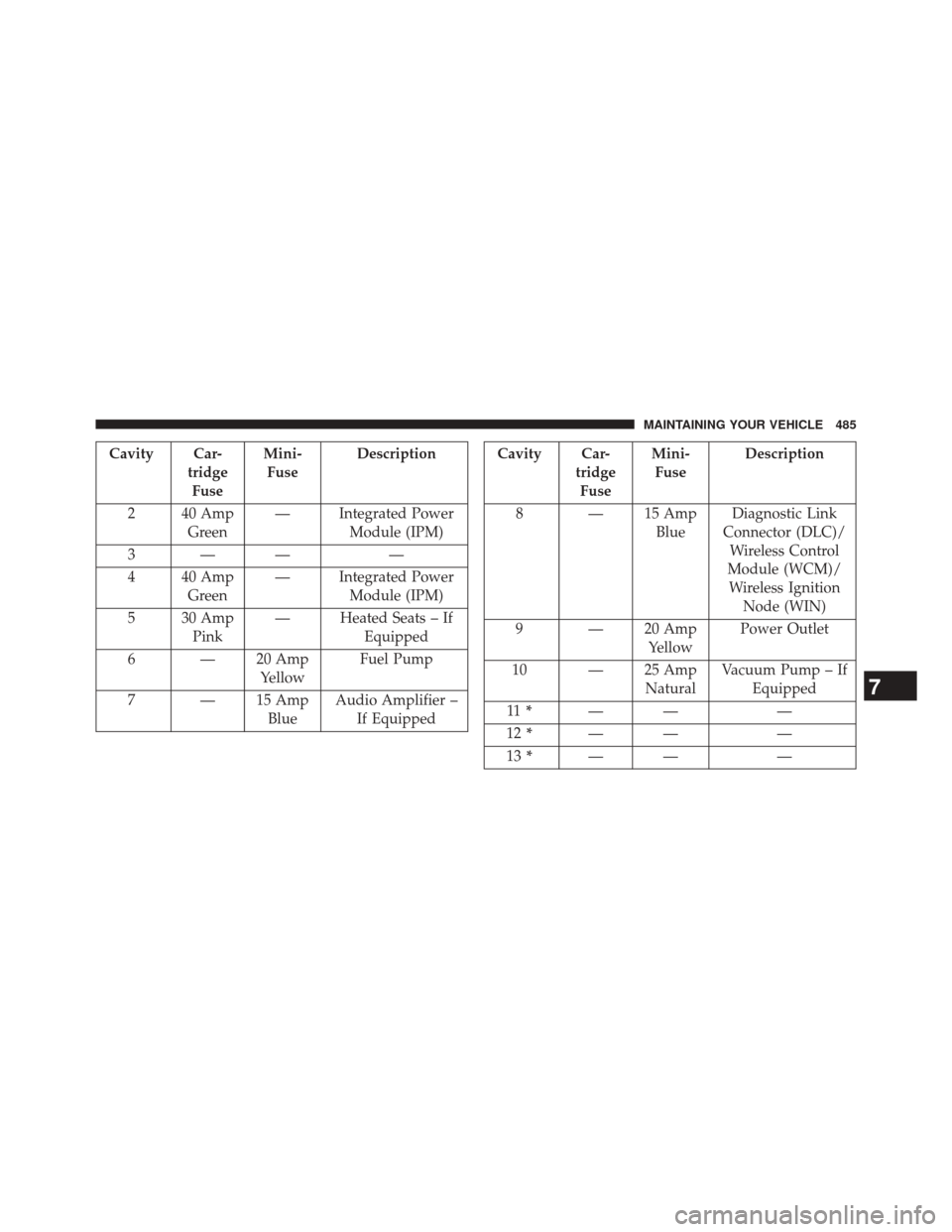
Cavity Car-tridgeFuse Mini-
Fuse Description
2 40 Amp Green — Integrated Power
Module (IPM)
3—— —
4 40 Amp Green — Integrated Power
Module (IPM)
5 30 Amp Pink — Heated Seats – If
Equipped
6 — 20 Amp YellowFuel Pump
7 — 15 Amp BlueAudio Amplifier –
If EquippedCavity Car- tridgeFuse Mini-
Fuse Description
8 — 15 Amp BlueDiagnostic Link
Connector (DLC)/ Wireless Control
Module (WCM)/ Wireless Ignition Node (WIN)
9 — 20 Amp YellowPower Outlet
10 — 25 Amp NaturalVacuum Pump – If
Equipped
11 * —— —
12 * —— —
13 * —— —
7
MAINTAINING YOUR VEHICLE 485