Page 456 of 519
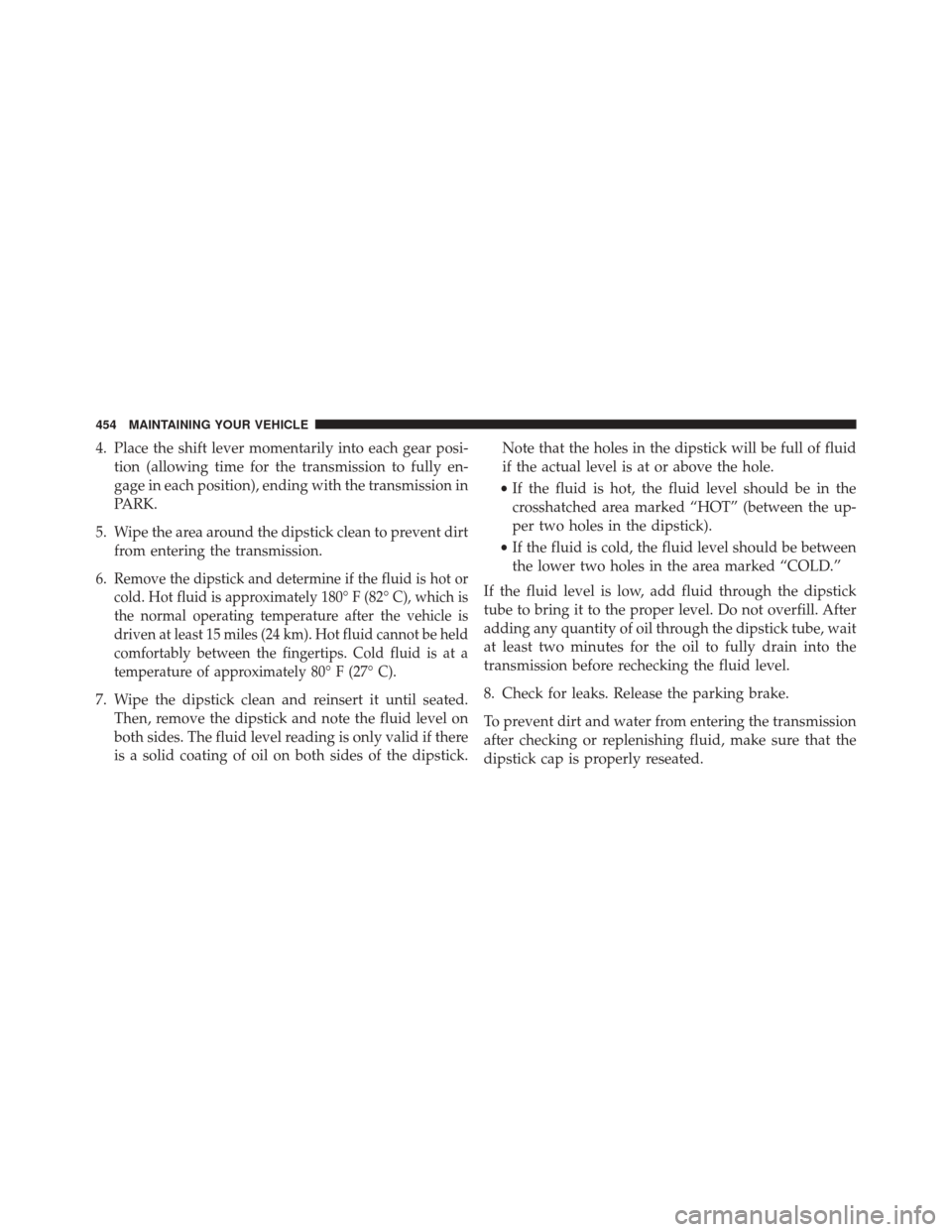
4. Place the shift lever momentarily into each gear posi-tion (allowing time for the transmission to fully en-
gage in each position), ending with the transmission in
PARK.
5. Wipe the area around the dipstick clean to prevent dirt from entering the transmission.
6.
Remove the dipstick and determine if the fluid is hot or
cold. Hot fluid is approximately 180° F (82° C), which is
the normal operating temperature after the vehicle is
driven at least 15 miles (24 km). Hot fluid cannot be held
comfortably between the fingertips. Cold fluid is at a
temperature of approximately 80° F (27° C).
7. Wipe the dipstick clean and reinsert it until seated. Then, remove the dipstick and note the fluid level on
both sides. The fluid level reading is only valid if there
is a solid coating of oil on both sides of the dipstick. Note that the holes in the dipstick will be full of fluid
if the actual level is at or above the hole.
• If the fluid is hot, the fluid level should be in the
crosshatched area marked “HOT” (between the up-
per two holes in the dipstick).
• If the fluid is cold, the fluid level should be between
the lower two holes in the area marked “COLD.”
If the fluid level is low, add fluid through the dipstick
tube to bring it to the proper level. Do not overfill. After
adding any quantity of oil through the dipstick tube, wait
at least two minutes for the oil to fully drain into the
transmission before rechecking the fluid level.
8. Check for leaks. Release the parking brake.
To prevent dirt and water from entering the transmission
after checking or replenishing fluid, make sure that the
dipstick cap is properly reseated.
454 MAINTAINING YOUR VEHICLE
Page 457 of 519
CAUTION!
•Using a transmission fluid other than the manufac-
turer’s recommended fluid may cause deterioration
in transmission shift quality and/or torque con-
verter shudder, and will require more frequent
fluid and filter changes. Refer to “Fluids, Lubri-
cants, and Genuine Parts” in this section for fluid
specifications.
• Dirt and water in the transmission can cause seri-
ous damage. To prevent dirt and water from enter-
ing the transmission after checking or replenishing
fluid, make sure that the dipstick cap is re-seated
properly.
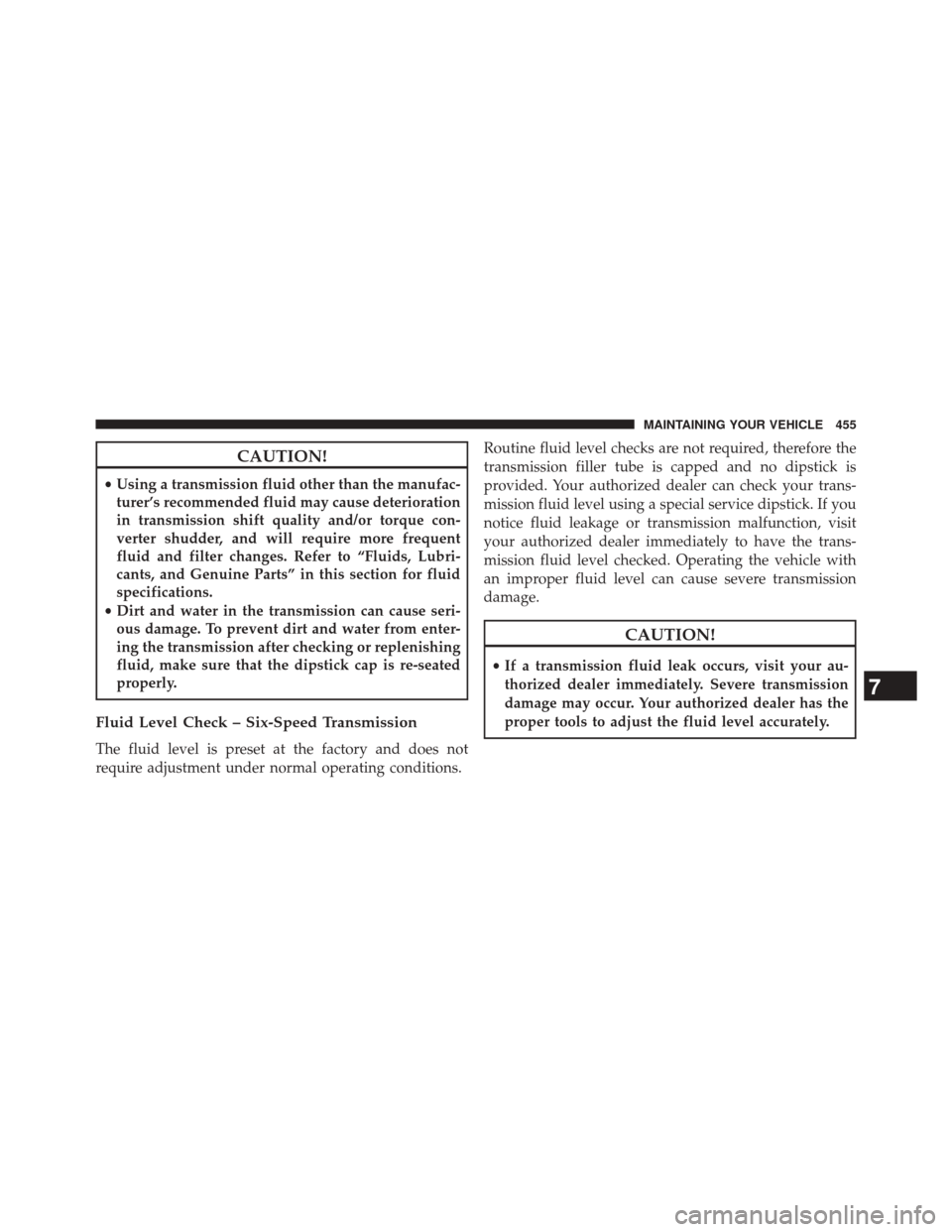
Fluid Level Check – Six-Speed Transmission
The fluid level is preset at the factory and does not
require adjustment under normal operating conditions. Routine fluid level checks are not required, therefore the
transmission filler tube is capped and no dipstick is
provided. Your authorized dealer can check your trans-
mission fluid level using a special service dipstick. If you
notice fluid leakage or transmission malfunction, visit
your authorized dealer immediately to have the trans-
mission fluid level checked. Operating the vehicle with
an improper fluid level can cause severe transmission
damage.
CAUTION!
•
If a transmission fluid leak occurs, visit your au-
thorized dealer immediately. Severe transmission
damage may occur. Your authorized dealer has the
proper tools to adjust the fluid level accurately.
7
MAINTAINING YOUR VEHICLE 455
Page 458 of 519
Fluid And Filter Changes
Refer to the�Maintenance Schedule� for the proper
maintenance intervals. In addition, change the fluid and
filter if the transmission is disassembled for any reason.
Appearance Care And Protection From Corrosion
Protection Of Body And Paint From Corrosion
Vehicle body care requirements vary according to geo-
graphic locations and usage. Chemicals that make roads
passable in snow and ice and those that are sprayed on
trees and road surfaces during other seasons are highly
corrosive to the metal in your vehicle. Outside parking,
which exposes your vehicle to airborne contaminants,
road surfaces on which the vehicle is operated, extreme
hot or cold weather and other extreme conditions will
have an adverse effect on paint, metal trim, and under-
body protection. The following maintenance recommendations will enable
you to obtain maximum benefit from the corrosion
resistance built into your vehicle.
What Causes Corrosion?
Corrosion is the result of deterioration or removal of
paint and protective coatings from your vehicle.
The most common causes are:
•
Road salt, dirt and moisture accumulation.
• Stone and gravel impact.
• Insects, tree sap and tar.
• Salt in the air near seacoast localities.
• Atmospheric fallout/industrial pollutants.
456 MAINTAINING YOUR VEHICLE
Page 478 of 519
ComponentFluid, Lubricant, or Genuine Part
Spark Plugs – 3.6L Engine We recommend you use MOPAR® Spark Plugs (Gap 0.043 in [1.1 mm]).
Fuel Selection 87 Octane
* PZEV = Partial Zero Emission Vehicle
Chassis
Component Fluid, Lubricant, or Genuine Part
Automatic Transmission Use only ATF+4® Automatic Transmission Fluid. Failure to use ATF+4® fluid
may affect the function or performance of your transmission. We recommend
MOPAR® ATF+4® fluid.
Brake Master Cylinder We recommend you use MOPAR® DOT 3 and SAE J1703. If DOT 3 brake
fluid is not available, then DOT 4 is acceptable.
Power Steering Reservoir We recommend you use MOPAR® Power Steering Fluid +4, MOPAR®
ATF+4® Automatic Transmission Fluid.
476 MAINTAINING YOUR VEHICLE
Page 481 of 519

•Check the fluid levels of the coolant reservoir, brake
master cylinder, power steering and transmission as
needed
• Check function of all interior and exterior lights
Required Maintenance Intervals.
Refer to the maintenance schedules on the following
page for the required maintenance intervals.
At Every Oil Change Interval As Indicated By Oil Change Indicator System:
•Change oil and filter.
• Rotate the tires. Rotate at the first sign of irregu-
lar wear, even if it occurs before the oil indicator
system turns on.
• Inspect battery and clean and tighten terminals as
required.
At Every Oil Change Interval As Indicated By Oil
Change Indicator System:
•Inspect automatic transmission fluid if equipped
with dipstick.
• Inspect brake pads, shoes, rotors, drums, hoses
and park brake.
• Inspect engine cooling system protection and
hoses.
• Inspect exhaust system.
• Inspect engine air cleaner if using in dusty or
off-road conditions.
8
M
A I
N T
E
N
A
N
C E
S
C
H E
D
U L
E
SMAINTENANCE SCHEDULES 479
Page 484 of 519
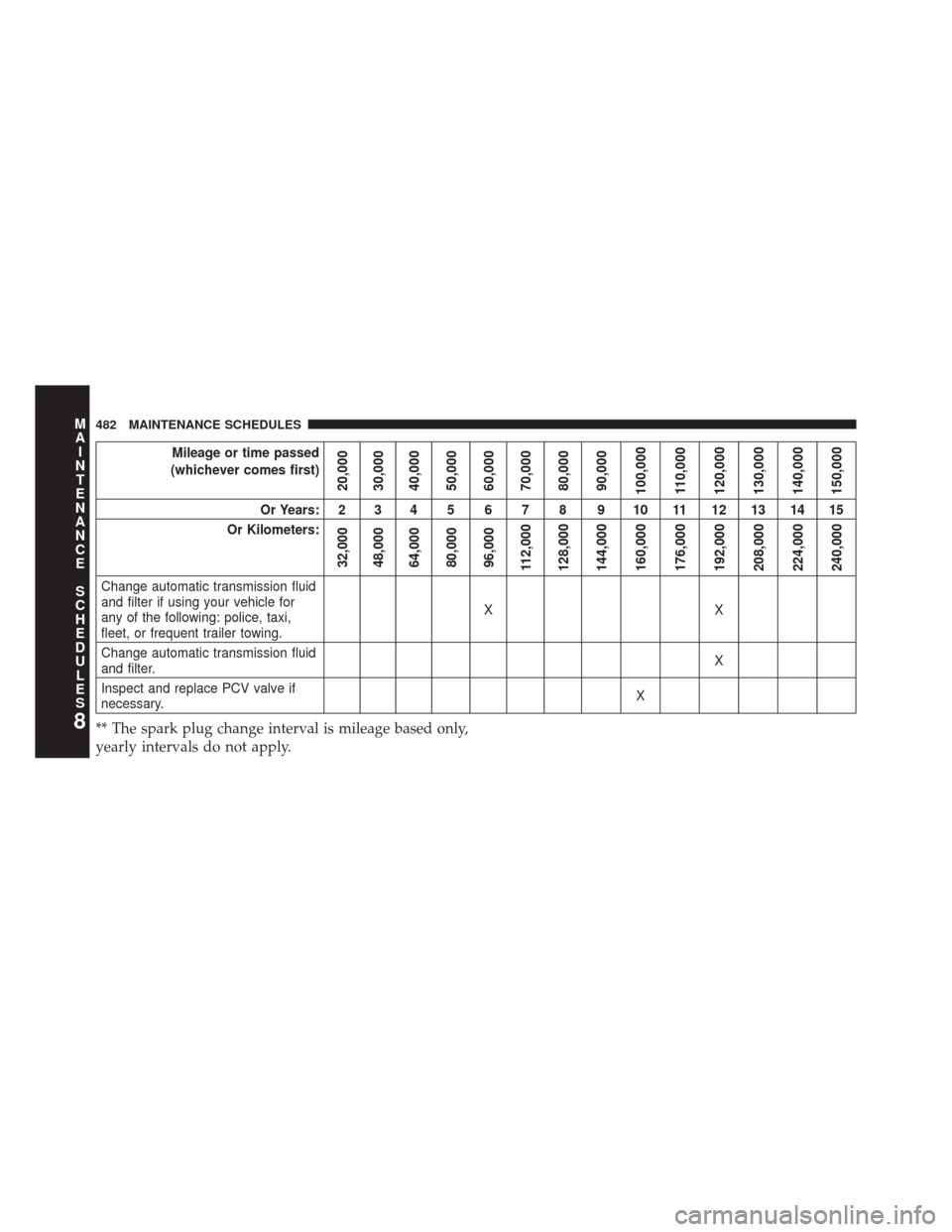
Mileage or time passed
(whichever comes first)
20,000
30,000
40,000
50,000
60,000
70,000
80,000
90,000
100,000 110,000
120,000
130,000
140,000
150,000
Or Years: 2 3 4 5 6 7 8 9 10 11 12 13 14 15
Or Kilometers:
32,000
48,000
64,000
80,000
96,000
112,000
128,000
144,000
160,000
176,000
192,000
208,000
224,000
240,000
Change automatic transmission fluid
and filter if using your vehicle for
any of the following: police, taxi,
fleet, or frequent trailer towing. XX
Change automatic transmission fluid
and filter. X
Inspect and replace PCV valve if
necessary. X
** The spark plug change interval is mileage based only,
yearly intervals do not apply.8
M
A I
N T
E
N
A
N
C E
S
C
H E
D
U L
E
S482 MAINTENANCE SCHEDULES
Page 501 of 519

Automatic Transmission....................303
Adding Fluid ......................... .453
Fluid and Filter Changes ..................456
Fluid Level Check ...................... .453
Fluid Type ........................... .452
Gear Ranges .......................... .306
Special Additives ...................... .453
Autostick .............................. .321
Auto Unlock, Doors ........................34
Auto Up Power Windows ....................38
Battery ................................ .435
Keyless Transmitter Replacement (RKE) ........27
Location ............................. .435
Belts, Seat ...............................98
Body Mechanism Lubrication .................440
B-Pillar Location ......................... .345
Brake Assist System ...................... .334
Brake, Parking .......................... .328Brake System
........................... .450
Anti-Lock (ABS) ....................... .330
Fluid Check .......................... .450
Master Cylinder ....................... .450
Parking ............................. .328
Warning Light ........................ .216
Brake/Transmission Interlock .................305
Bulb Replacement ........................ .468
Bulbs, Light ............................ .101
Calibration, Compass ..................... .235
Capacities, Antifreeze (Engine Coolant) ...........22
Capacities, Fluid ......................... .474
Caps, Filler Fuel ................................ .379
Oil (Engine) .......................... .425
Power Steering ........................ .327
Radiator (Coolant Pressure) ................447
Carbon Monoxide Warning ...................97
10
INDEX 499
Page 503 of 519
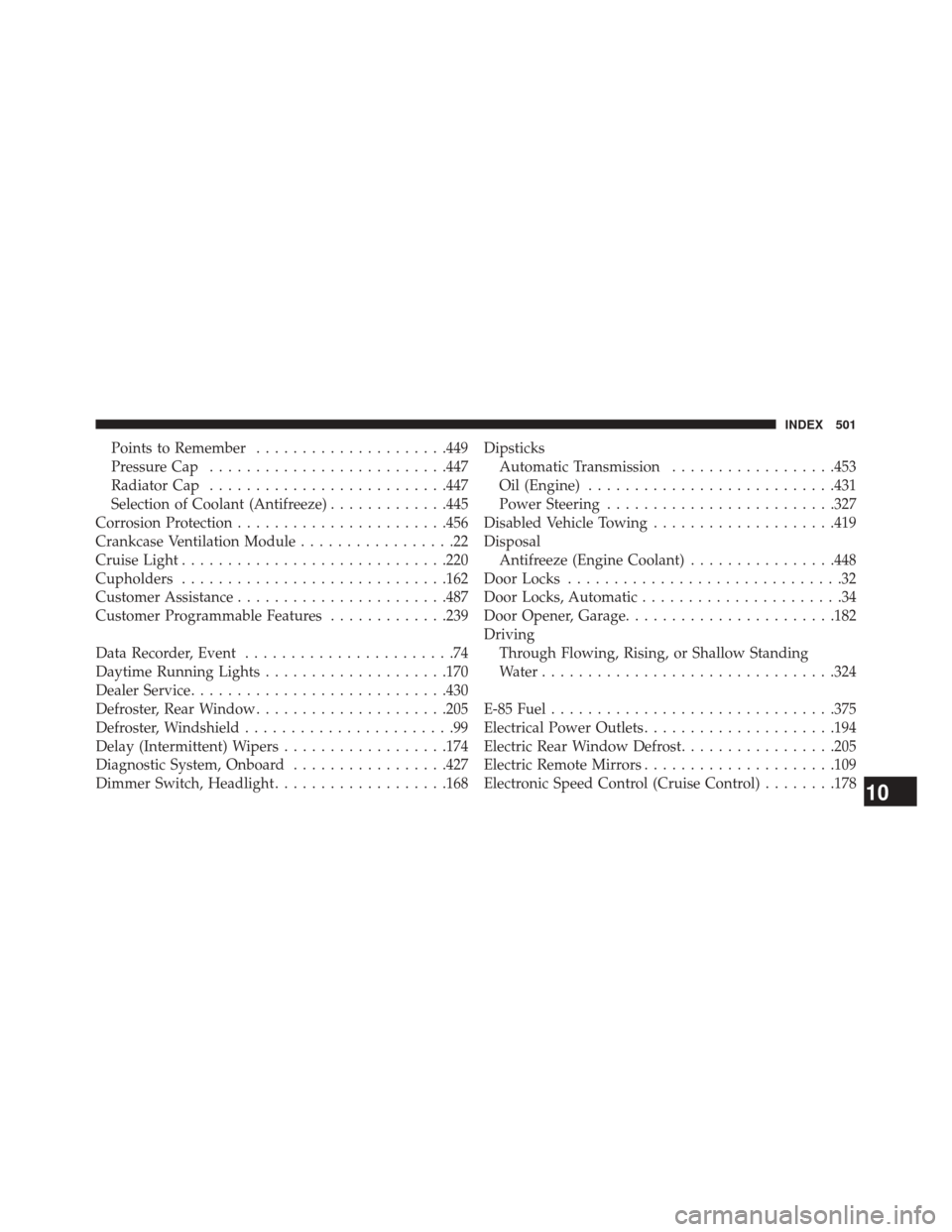
Points to Remember.....................449
Pressure Cap ......................... .447
Radiator Cap ......................... .447
Selection of Coolant (Antifreeze) .............445
Corrosion Protection ...................... .456
Crankcase Ventilation Module .................22
Cruise Light ............................ .220
Cupholders ............................ .162
Customer Assistance ...................... .487
Customer Programmable Features .............239
Data Recorder, Event .......................74
Daytime Running Lights ....................170
Dealer Service ........................... .430
Defroster, Rear Window .....................205
Defroster, Windshield .......................99
Delay (Intermittent) Wipers ..................174
Diagnostic System, Onboard .................427
Dimmer Switch, Headlight ...................168 Dipsticks
Automatic Transmission ..................453
Oil (Engine) .......................... .431
Power Steering ........................ .327
Disabled Vehicle Towing ....................419
Disposal Antifreeze (Engine Coolant) ................448
Door Locks ..............................32
Door Locks, Automatic ......................34
Door Opener, Garage ...................... .182
Driving Through Flowing, Rising, or Shallow Standing
Water ............................... .324
E-85 Fuel .............................. .375
Electrical Power Outlets .....................194
Electric Rear Window Defrost .................205
Electric Remote Mirrors .....................109
Electronic Speed Control (Cruise Control) ........178
10
INDEX 501
![DODGE AVENGER 2013 2.G Owners Manual ComponentFluid, Lubricant, or Genuine Part
Spark Plugs – 3.6L Engine We recommend you use MOPAR® Spark Plugs (Gap 0.043 in [1.1 mm]).
Fuel Selection 87 Octane
* PZEV = Partial Zero Emission Vehicle](/manual-img/12/5513/w960_5513-477.png "DODGE AVENGER 2013 2.G Owners Manual ComponentFluid, Lubricant, or Genuine Part
Spark Plugs – 3.6L Engine We recommend you use MOPAR® Spark Plugs (Gap 0.043 in [1.1 mm]).
Fuel Selection 87 Octane
* PZEV = Partial Zero Emission Vehicle")