Page 425 of 519
MAINTAINING YOUR VEHICLE
CONTENTS
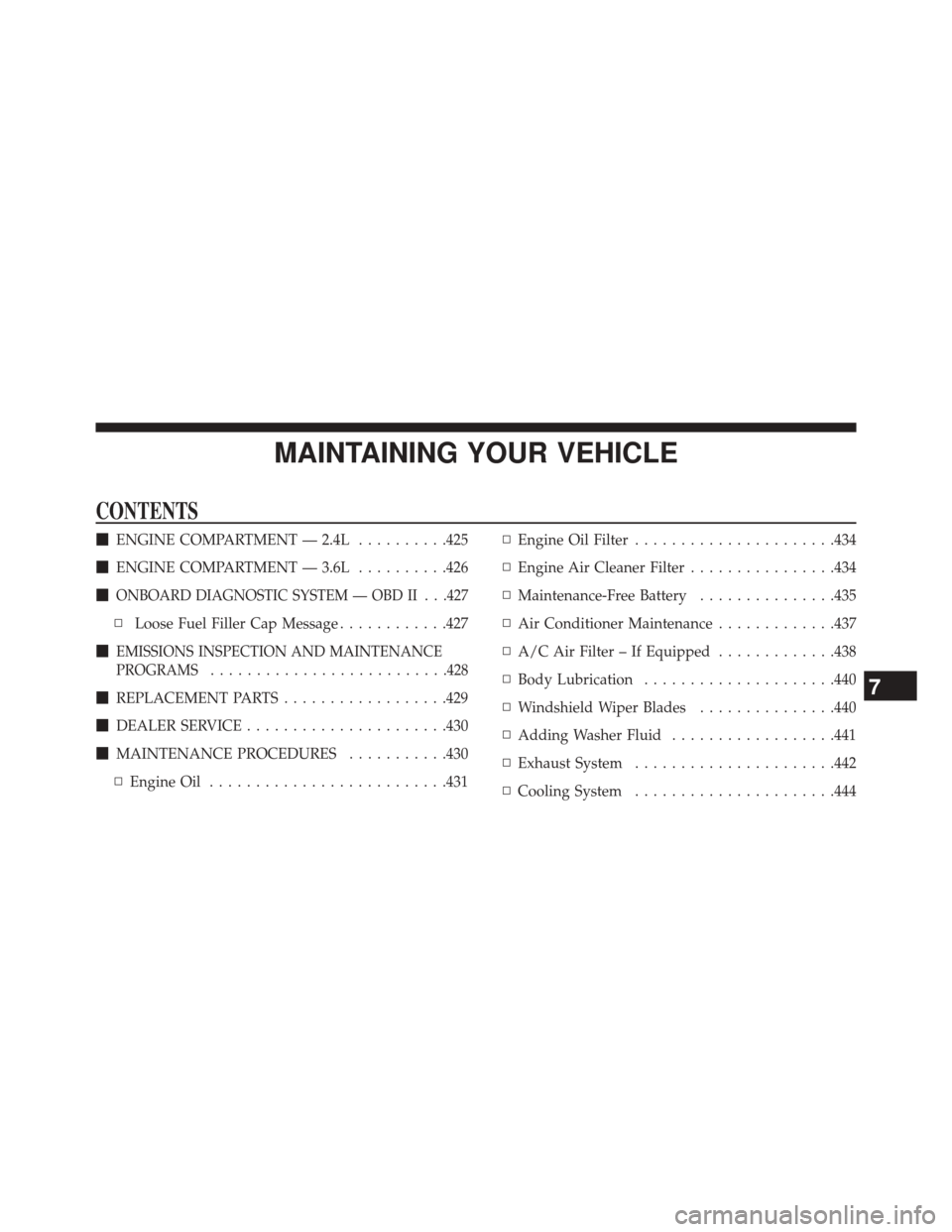
�ENGINE COMPARTMENT — 2.4L ..........425
� ENGINE COMPARTMENT — 3.6L ..........426
�
ONBOARD DIAGNOSTIC SYSTEM — OBD II . . .427
▫ Loose Fuel Filler Cap Message ............427
�
EMISSIONS INSPECTION AND MAINTENANCE
PROGRAMS ......................... .428
�REPLACEMENT PARTS ..................429
� DEALER SERVICE ..................... .430
� MAINTENANCE PROCEDURES ...........430
▫ Engine Oil ......................... .431▫
Engine Oil Filter ..................... .434
▫ Engine Air Cleaner Filter ................434
▫ Maintenance-Free Battery ...............435
▫ Air Conditioner Maintenance .............437
▫ A/C Air Filter – If Equipped .............438
▫ Body Lubrication .....................440
▫ Windshield Wiper Blades ...............440
▫ Adding Washer Fluid ..................441
▫ Exhaust System ..................... .442
▫ Cooling System ..................... .4447
Page 429 of 519

ONBOARD DIAGNOSTIC SYSTEM — OBD II
Your vehicle is equipped with a sophisticated onboard
diagnostic system called OBD II. This system monitors
the performance of the emissions, engine, and automatic
transmission control systems. When these systems are
operating properly, your vehicle will provide excellent
performance and fuel economy, as well as engine emis-
sions well within current government regulations.
If any of these systems require service, the OBD II system
will turn on the “Malfunction Indicator Light” (MIL).
It will also store diagnostic codes and other information
to assist your service technician in making repairs. Al-
though your vehicle will usually be drivable and not
need towing, see your authorized dealer for service as
soon as possible.
CAUTION!
•Prolonged driving with the MIL on could cause
further damage to the emission control system. It
could also affect fuel economy and driveability.
The vehicle must be serviced before any emissions
tests can be performed.
• If the MIL is flashing while the engine is running,
severe catalytic converter damage and power loss
will soon occur. Immediate service is required.
Loose Fuel Filler Cap Message
After fuel is added, the vehicle diagnostic system can
determine if the fuel filler cap is possibly loose or
improperly installed. A “GASCAP” message will be
displayed in the instrument cluster. Tighten the gas cap
until a �clicking� sound is heard. This is an indication that7
MAINTAINING YOUR VEHICLE 427
Page 433 of 519

CAUTION!(Continued)
•Your vehicle has been built with improved fluids
that protect the performance and durability of your
vehicle and also allow extended maintenance inter-
vals. Do not use chemical flushes in these compo-
nents as the chemicals can damage your engine,
transmission, power steering or air conditioning.
Such damage is not covered by the New Vehicle
Limited Warranty. If a flush is needed because of
component malfunction, use only the specified
fluid for the flushing procedure.
Engine Oil
Checking Oil Level
To assure proper engine lubrication, the engine oil must
be maintained at the correct level. Check the oil level at
regular intervals, such as every fuel stop. The best time to check the engine oil level is about five minutes after a
fully warmed engine is shut off. Do not check oil level
before starting the engine after it has sat overnight.
Checking engine oil level when the engine is cold will
give you an incorrect reading.
Checking the oil while the vehicle is on level ground and
only when the engine is hot, will improve the accuracy of
the oil level readings. Maintain the oil level between the
range markings on the dipstick. Either the range mark-
ings consist of a crosshatch zone marked SAFE or a
crosshatch zone marked with MIN at the low end of the
range and MAX at the high end of the range. Adding one
quart of oil when the reading is at the low end of the
range marking will raise the oil level to the high end of
the range marking.
7
MAINTAINING YOUR VEHICLE 431
Page 435 of 519
CAUTION!
Do not use chemical flushes in your engine oil as the
chemicals can damage your engine. Such damage is
not covered by the New Vehicle Limited Warranty.
Engine Oil Viscosity – 2.4L Engine
SAE 5W-20 engine oil is recommended for all operating
temperatures. This engine oil improves low temperature
starting and vehicle fuel economy.
The engine oil filler cap also shows the recommended
engine oil viscosity for your engine. For information on
the engine oil filler cap location, refer to “Engine Com-
partment” in “Maintaining Your Vehicle” for further
information.
Lubricants that do not have both, the engine oil certifi-
cation mark and the correct SAE viscosity grade number
should not be used.
Engine Oil Viscosity – 3.6L Engine
SAE 5W-20 engine oil is recommended for all operating
temperatures. This engine oil improves low temperature
starting and vehicle fuel economy.
The engine oil filler cap also shows the recommended
engine oil viscosity for your engine. For information on
engine oil filler cap location, refer to the “Engine Com-
partment” illustration in this section.
NOTE:SAE 5W-30 engine oil approved to Fiat 9.55535-S1
or Fiat 9.55535-S3 may be used when SAE 5W-20 engine
oil meeting MS- 6395 is not available.
Synthetic Engine Oils
You may use synthetic engine oils provided the recom-
mended oil quality requirements are met, and the recom-
mended maintenance intervals for oil and filter changes
are followed.
7
MAINTAINING YOUR VEHICLE 433
Page 445 of 519
CAUTION!
•The catalytic converter requires the use of un-
leaded fuel only. Leaded gasoline will destroy the
effectiveness of the catalyst as an emissions control
device and may seriously reduce engine perfor-
mance and cause serious damage to the engine.
• Damage to the catalytic converter can result if your
vehicle is not kept in proper operating condition.
In the event of engine malfunction, particularly
involving engine misfire or other apparent loss of
performance, have your vehicle serviced promptly.
Continued operation of your vehicle with a severe
malfunction could cause the converter to overheat,
resulting in possible damage to the converter and
vehicle. Under normal operating conditions, the catalytic con-
verter will not require maintenance. However, it is im-
portant to keep the engine properly tuned to assure
proper catalyst operation and prevent possible catalyst
damage.
NOTE:
Intentional tampering with emissions control
systems can result in civil penalties being assessed
against you.
In unusual situations involving grossly malfunctioning
engine operation, a scorching odor may suggest severe
and abnormal catalyst overheating. If this occurs, stop
the vehicle, turn off the engine and allow it to cool.
Service, including a tune-up to manufacturer’s specifica-
tions, should be obtained immediately.
7
MAINTAINING YOUR VEHICLE 443
Page 476 of 519
FLUID CAPACITIES
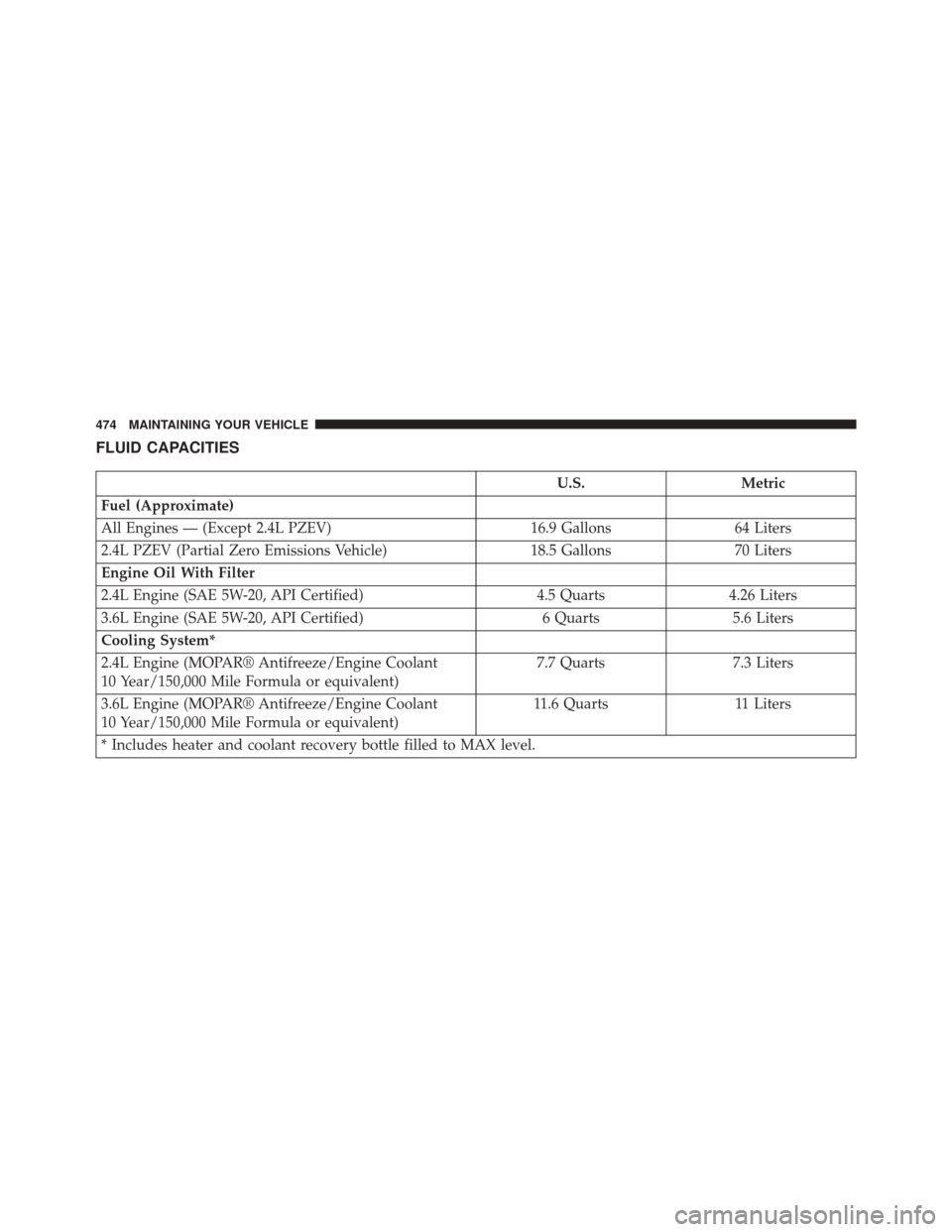
U.S.Metric
Fuel (Approximate)
All Engines — (Except 2.4L PZEV) 16.9 Gallons64 Liters
2.4L PZEV (Partial Zero Emissions Vehicle) 18.5 Gallons70 Liters
Engine Oil With Filter
2.4L Engine (SAE 5W-20, API Certified) 4.5 Quarts4.26 Liters
3.6L Engine (SAE 5W-20, API Certified) 6 Quarts5.6 Liters
Cooling System*
2.4L Engine (MOPAR® Antifreeze/Engine Coolant
10 Year/150,000 Mile Formula or equivalent) 7.7 Quarts
7.3 Liters
3.6L Engine (MOPAR® Antifreeze/Engine Coolant
10 Year/150,000 Mile Formula or equivalent) 11.6 Quarts
11 Liters
* Includes heater and coolant recovery bottle filled to MAX level.
474 MAINTAINING YOUR VEHICLE
Page 478 of 519
ComponentFluid, Lubricant, or Genuine Part
Spark Plugs – 3.6L Engine We recommend you use MOPAR® Spark Plugs (Gap 0.043 in [1.1 mm]).
Fuel Selection 87 Octane
* PZEV = Partial Zero Emission Vehicle
Chassis
Component Fluid, Lubricant, or Genuine Part
Automatic Transmission Use only ATF+4® Automatic Transmission Fluid. Failure to use ATF+4® fluid
may affect the function or performance of your transmission. We recommend
MOPAR® ATF+4® fluid.
Brake Master Cylinder We recommend you use MOPAR® DOT 3 and SAE J1703. If DOT 3 brake
fluid is not available, then DOT 4 is acceptable.
Power Steering Reservoir We recommend you use MOPAR® Power Steering Fluid +4, MOPAR®
ATF+4® Automatic Transmission Fluid.
476 MAINTAINING YOUR VEHICLE
Page 480 of 519

MAINTENANCE SCHEDULE
Your vehicle is equipped with an automatic oil change
indicator system. The oil change indicator system will
remind you that it is time to take your vehicle in for
scheduled maintenance.
Based on engine operation conditions, the oil change
indicator message will illuminate. This means that ser-
vice is required for your vehicle. Operating conditions
such as frequent short-trips, trailer tow, extremely hot or
cold ambient temperatures, and E85 fuel usage will
influence when the “Oil Change Required” message is
displayed. Severe Operating Conditions can cause the
change oil message to illuminate as early as 3,500 miles
(5,600 km) since last reset. Have your vehicle serviced as
soon as possible, within the next 500 miles (805 km).
Your authorized dealer will reset the oil change indicator
message after completing the scheduled oil change. If a
scheduled oil change is performed by someone other than
your authorized dealer, the message can be reset by refer-
ring to the steps described under “Electronic Vehicle Infor-
mation Center (EVIC)/Oil Change Required” in “Under-
standing Your Instrument Panel” for further information
NOTE:Under no circumstances should oil change inter-
vals exceed 10,000 miles (16,000 km) or twelve months,
whichever comes first.
Once A Month Or Before A Long Trip:
• Check engine oil level
• Check windshield washer fluid level
• Check the tire inflation pressures and look for unusual
wear or damage
8
M A I
N T
E
N
A
N
C E
S
C
H E
D
U L
E
S478 MAINTENANCE SCHEDULES
![DODGE AVENGER 2013 2.G Owners Manual ComponentFluid, Lubricant, or Genuine Part
Spark Plugs – 3.6L Engine We recommend you use MOPAR® Spark Plugs (Gap 0.043 in [1.1 mm]).
Fuel Selection 87 Octane
* PZEV = Partial Zero Emission Vehicle](/manual-img/12/5513/w960_5513-477.png "DODGE AVENGER 2013 2.G Owners Manual ComponentFluid, Lubricant, or Genuine Part
Spark Plugs – 3.6L Engine We recommend you use MOPAR® Spark Plugs (Gap 0.043 in [1.1 mm]).
Fuel Selection 87 Octane
* PZEV = Partial Zero Emission Vehicle")