Page 401 of 519
NOTE:There are steps that you can take to slow down
an impending overheat condition:
• If your air conditioner (A/C) is on, turn it off. The A/C
system adds heat to the engine cooling system and
turning the A/C off can help remove this heat.
• You can also turn the temperature control to maximum
heat, the mode control to floor and the blower control
to high. This allows the heater core to act as a
supplement to the radiator and aids in removing heat
from the engine cooling system.
WARNING!
You or others can be badly burned by hot engine
coolant (antifreeze) or steam from your radiator.
If you see or hear steam coming from under the hood,
(Continued)
WARNING! (Continued)
do not open the hood until the radiator has had time
to cool. Never try to open a cooling system pressure
cap when the radiator or coolant bottle is hot.
Engine Oil Overheating (2.4L Engine Only) —
If Equipped
During sustained high-speed driving or trailer tow up
long grades on a hot day, the engine oil temperature may
become too hot. If this happens, the “HOTOIL” message
flashes in the odometer and the vehicle speed will be
reduced to 53 mph (85 km/h) until the engine oil
temperature is reduced.
NOTE:The vehicle speed is reduced to a maximum of
53 mph (85 km/h). You may of course, reduce your
vehicle speed further if needed.
6
WHAT TO DO IN EMERGENCIES 399
Page 419 of 519
CAUTION!
Racing the engine or spinning the wheels may lead to
transmission overheating and failure. Allow the en-
gine to idle with the transmission in NEUTRAL for at
least one minute after every five rocking-motion
cycles. This will minimize overheating and reduce
the risk of transmission failure during prolonged
efforts to free a stuck vehicle.
NOTE: Press the �ESC Off� switch, to place the Electronic
Stability Control (ESC) system in �Partial Off�mode,
before rocking the vehicle. Refer to “Electronic Brake
Control” in “Starting And Operating” for further infor-
mation. Once the vehicle has been freed, press the �ESC
Off� switch again to restore �ESC On�mode.
CAUTION!
•When “rocking” a stuck vehicle by shifting between
DRIVE and REVERSE, do not spin the wheels faster
than 15 mph (24 km/h), or drivetrain damage may
result.
• Revving the engine or spinning the wheels too fast
may lead to transmission overheating and failure.
It can also damage the tires. Do not spin the wheels
above 30 mph (48 km/h) while in gear (no trans-
mission shifting occurring).
WARNING!
Fast spinning tires can be dangerous. Forces gener-
ated by excessive wheel speeds may cause damage, or
even failure, of the axle and tires. A tire could
(Continued)
6
WHAT TO DO IN EMERGENCIES 417
Page 445 of 519
CAUTION!
•The catalytic converter requires the use of un-
leaded fuel only. Leaded gasoline will destroy the
effectiveness of the catalyst as an emissions control
device and may seriously reduce engine perfor-
mance and cause serious damage to the engine.
• Damage to the catalytic converter can result if your
vehicle is not kept in proper operating condition.
In the event of engine malfunction, particularly
involving engine misfire or other apparent loss of
performance, have your vehicle serviced promptly.
Continued operation of your vehicle with a severe
malfunction could cause the converter to overheat,
resulting in possible damage to the converter and
vehicle. Under normal operating conditions, the catalytic con-
verter will not require maintenance. However, it is im-
portant to keep the engine properly tuned to assure
proper catalyst operation and prevent possible catalyst
damage.
NOTE:
Intentional tampering with emissions control
systems can result in civil penalties being assessed
against you.
In unusual situations involving grossly malfunctioning
engine operation, a scorching odor may suggest severe
and abnormal catalyst overheating. If this occurs, stop
the vehicle, turn off the engine and allow it to cool.
Service, including a tune-up to manufacturer’s specifica-
tions, should be obtained immediately.
7
MAINTAINING YOUR VEHICLE 443
Page 504 of 519
Electronic Stability Control (ESC)..............335
Electronic Vehicle Information Center (EVIC) ......229
Emergency, In Case of Jacking .............................. .400
Jump Starting ......................... .412
Towing ............................. .419
Emergency Trunk Release ....................42
Emission Control System Maintenance ..........428
Engine ................................ .425
Air Cleaner .......................... .434
Block Heater ......................... .302
Break-In Recommendations .................96
Checking Oil Level ..................... .431
Compartment ......................... .426
Compartment Identification ................426
Coolant (Antifreeze) .....................445
Cooling ............................. .444
Exhaust Gas Caution .....................97
Fails to Start .......................... .300Flooded, Starting
...................... .300
Fuel Requirements ..................... .370
Jump Starting ......................... .412
Oil................................. .431
Oil Change Interval ..................... .219
Oil Filler Cap ......................... .425
Oil Selection .......................... .432
Oil Synthetic ......................... .433
Overheating .......................... .398
Starting ............................. .298
Temperature Gauge ..................... .213
Engine Oil Viscosity ...................... .433
Engine Oil Viscosity Chart ...................433
Enhanced Accident Response Feature ............71
Entry System, Illuminated ....................22
Ethanol ............................... .371
Event Data Recorder ........................74
Exhaust Gas Caution ........................97
502 INDEX
Page 511 of 519
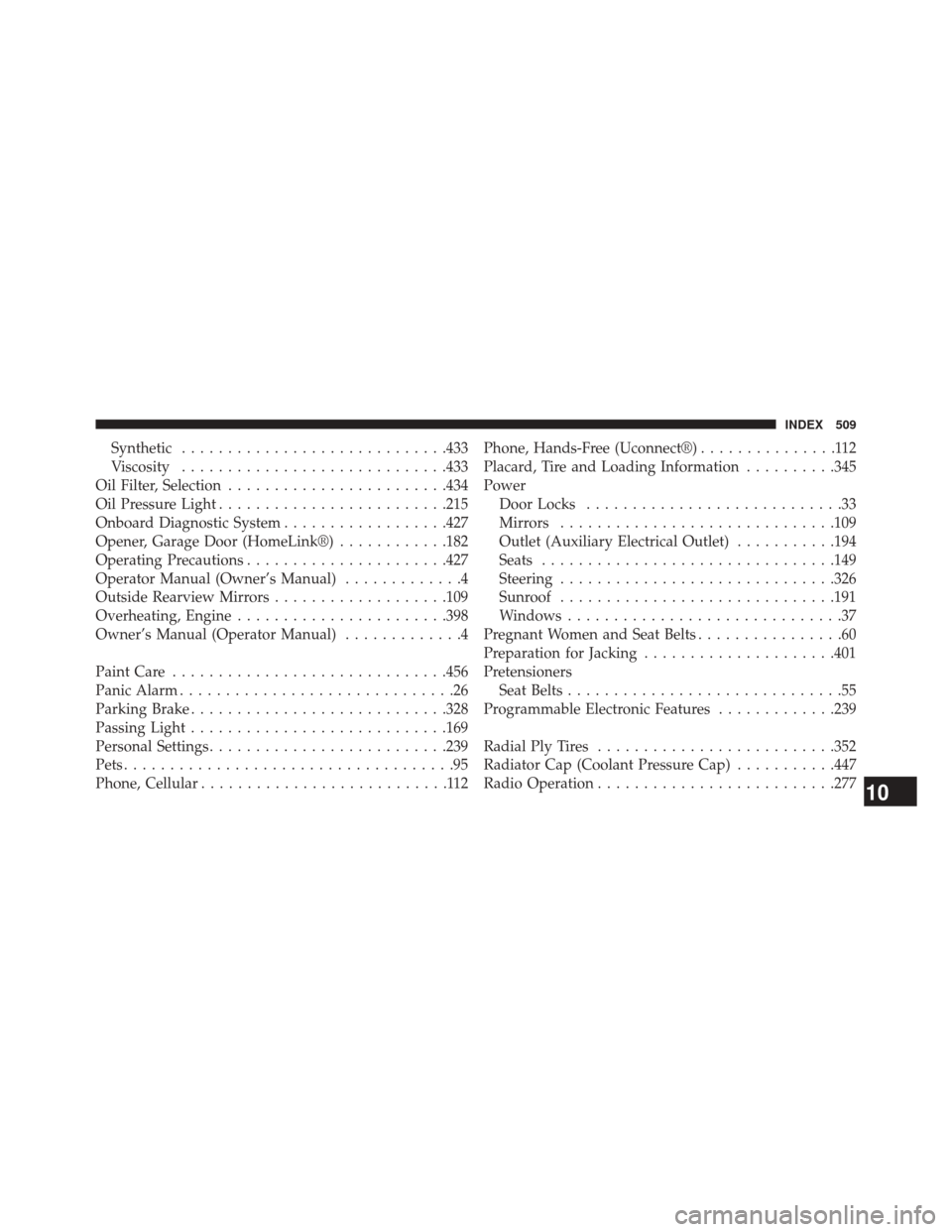
Synthetic............................ .433
Viscosity ............................ .433
Oil Filter, Selection ....................... .434
Oil Pressure Light ........................ .215
Onboard Diagnostic System ..................427
Opener, Garage Door (HomeLink®) ............182
Operating Precautions ..................... .427
Operator Manual (Owner’s Manual) .............4
Outside Rearview Mirrors ...................109
Overheating, Engine ...................... .398
Owner’s Manual (Operator Manual) .............4
Paint Care ............................. .456
Panic Alarm ..............................26
Parking Brake ........................... .328
Passing Light ........................... .169
Personal Settings ......................... .239
Pets ....................................95
Phone, Cellular ...........................112 Phone, Hands-Free (Uconnect®)
...............112
Placard, Tire and Loading Information ..........345
Power Door Locks ............................33
Mirrors ............................. .109
Outlet (Auxiliary Electrical Outlet) ...........194
Seats ............................... .149
Steering ............................. .326
Sunroof ............................. .191
Windows ..............................37
Pregnant Women and Seat Belts ................60
Preparation for Jacking .....................401
Pretensioners Seat Belts ..............................55
Programmable Electronic Features .............239
Radial Ply Tires ......................... .352
Radiator Cap (Coolant Pressure Cap) ...........447
Radio Operation ......................... .277
10
INDEX 509
Page:
< prev 1-8 9-16 17-24