Page 296 of 519
�DRIVING ON SLIPPERY SURFACES .........323
▫ Acceleration ........................ .323
▫ Traction ........................... .323
� DRIVING THROUGH WATER .............324
▫ Flowing/Rising Water ..................324
▫ Shallow Standing Water .................324
� POWER STEERING .....................326
▫ Power Steering Fluid Check ..............327
� PARKING BRAKE ..................... .328
� ANTI-LOCK BRAKE SYSTEM (ABS) .........330
� ELECTRONIC BRAKE CONTROL SYSTEM . . . .332
▫ Anti-Lock Brake System (ABS) ............333
▫ Traction Control System (TCS) ............333▫
Brake Assist System (BAS) ...............334
▫ Electronic Stability Control (ESC) ..........335
▫ ESC Activation/Malfunction Indicator Light
And ESC OFF Indicator Light ............337
� TIRE SAFETY INFORMATION .............339
▫ Tire Markings ....................... .339
▫ Tire Identification Number (TIN) ...........342
▫ Tire Terminology And Definitions ..........344
▫ Tire Loading And Tire Pressure ...........345
� TIRES — GENERAL INFORMATION ........349
▫ Tire Pressure ....................... .349
▫ Tire Inflation Pressures .................350
▫ Radial Ply Tires ..................... .352
294 STARTING AND OPERATING
Page 297 of 519
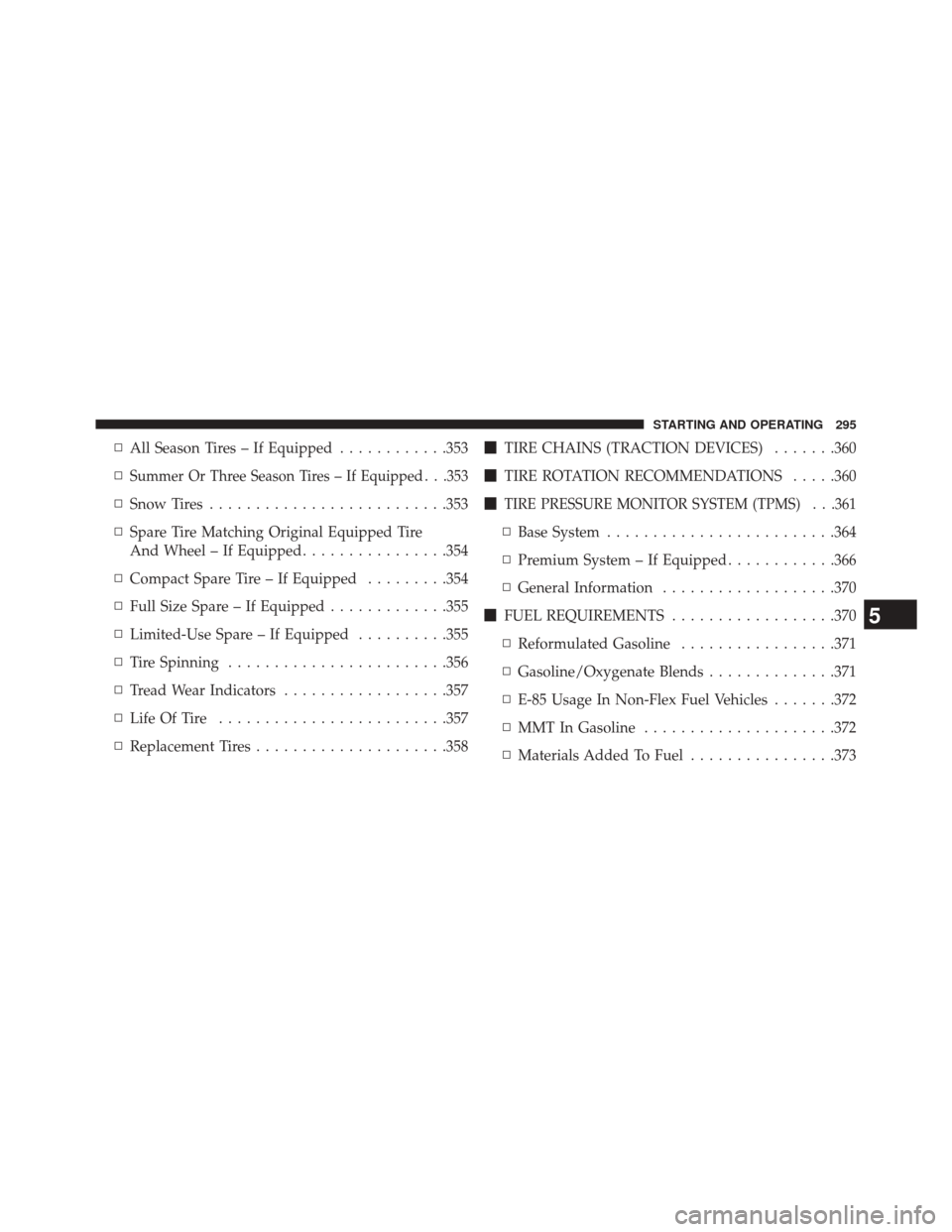
▫All Season Tires – If Equipped ............353
▫
Summer Or Three Season Tires – If Equipped . . .353
▫ Snow Tires ......................... .353
▫ Spare Tire Matching Original Equipped Tire
And Wheel – If Equipped ................354
▫ Compact Spare Tire – If Equipped .........354
▫ Full Size Spare – If Equipped .............355
▫ Limited-Use Spare – If Equipped ..........355
▫ Tire Spinning ....................... .356
▫ Tread Wear Indicators ..................357
▫ Life Of Tire ........................ .357
▫ Replacement Tires .....................358 �
TIRE CHAINS (TRACTION DEVICES) .......360
� TIRE ROTATION RECOMMENDATIONS .....360
�TIRE PRESSURE MONITOR SYSTEM (TPMS) . . .361
▫ Base System ........................ .364
▫ Premium System – If Equipped ............366
▫ General Information ...................370
� FUEL REQUIREMENTS ..................370
▫ Reformulated Gasoline .................371
▫ Gasoline/Oxygenate Blends ..............371
▫ E-85 Usage In Non-Flex Fuel Vehicles .......372
▫ MMT In Gasoline .....................372
▫ Materials Added To Fuel ................373
5
STARTING AND OPERATING 295
Page 332 of 519

WARNING!(Continued)
•Do not leave the key fob in or near the vehicle, or
in a location accessible to children. A child could
operate power windows, other controls, or move
the vehicle.
CAUTION!
If the “Brake Warning Light” remains on with the
parking brake released, a brake system malfunction
is indicated. Have the brake system serviced by an
authorized dealer immediately.
ANTI-LOCK BRAKE SYSTEM (ABS)
The Anti-Lock Brake System (ABS) provides increased
vehicle stability and brake performance under most
braking conditions. The system operates with a separate computer to modulate the hydraulic pressure to prevent
wheel lock-up and avoid skidding on slippery surfaces.
WARNING!
•
Pumping of the anti-lock brakes will diminish
their effectiveness and may lead to a collision.
Pumping makes the stopping distance longer. Just
press firmly on your brake pedal when you need to
slow down or stop.
• The ABS cannot prevent the natural laws of phys-
ics from acting on the vehicle, nor can it increase
braking or steering efficiency beyond that afforded
by the condition of the vehicle brakes and tires or
the traction afforded.
• The ABS cannot prevent collisions, including those
resulting from excessive speed in turns, following
another vehicle too closely, or hydroplaning.
(Continued)
330 STARTING AND OPERATING
Page 336 of 519

This feature remains active even if TCS and ESC are in
the “Partial Off” mode. Refer to “Electronic Stability
Control (ESC)” in this section of this manual.
Brake Assist System (BAS)
The BAS is designed to optimize the vehicle’s braking
capability during emergency braking maneuvers. The
system detects an emergency braking situation by sens-
ing the rate and amount of brake application and then
applies optimum pressure to the brakes. This can help
reduce braking distances. The BAS complements the
Anti-Lock Brake System (ABS). Applying the brakes very
quickly results in the best BAS assistance. To receive the
benefit of the system, you must apply continuous brak-
ing pressure during the stopping sequence. Do not
reduce brake pedal pressure unless braking is no longer
desired. Once the brake pedal is released, the BAS is
deactivated.
WARNING!
•The BAS cannot prevent the natural laws of phys-
ics from acting on the vehicle, nor can it increase
braking efficiency beyond that afforded by the
condition of the vehicle brakes and tires or the
traction afforded.
• The BAS cannot prevent collisions, including those
resulting from excessive speed in turns, following
another vehicle too closely, or hydroplaning.
• The capabilities of a BAS-equipped vehicle must
never be exploited in a reckless or dangerous
manner, which could jeopardize the user ’s safety or
the safety of others.
334 STARTING AND OPERATING
Page 341 of 519
TIRE SAFETY INFORMATION
Tire MarkingsNOTE:
•P (Passenger) - Metric tire sizing is based on U.S.
design standards. P-Metric tires have the letter “P”
molded into the sidewall preceding the size designa-
tion. Example: P215/65R15 95H.
• European-Metric tire sizing is based on European
design standards. Tires designed to this standard have
the tire size molded into the sidewall beginning with
the section width. The letter �P�is absent from this tire
size designation. Example: 215/65R15 96H.
• LT (Light Truck) - Metric tire sizing is based on U.S.
design standards. The size designation for LT-Metric
tires is the same as for P-Metric tires except for the
letters “LT” that are molded into the sidewall preced-
ing the size designation. Example: LT235/85R16.
1 — U.S. DOT Safety Standards
Code (TIN) 4 — Maximum Load
2 — Size Designation 5 — Maximum Pressure
3 — Service Description 6 — Treadwear, Traction and
Temperature Grades
5
STARTING AND OPERATING 339
Page 342 of 519
•Temporary spare tires are spares designed for tempo-
rary emergency use only. Temporary high pressure
compact spare tires have the letter “T” or “S” molded
into the sidewall preceding the size designation.
Example: T145/80D18 103M. •
High flotation tire sizing is based on U.S. design
standards and it begins with the tire diameter molded
into the sidewall. Example: 31x10.5 R15 LT.
Tre Sizing Chart
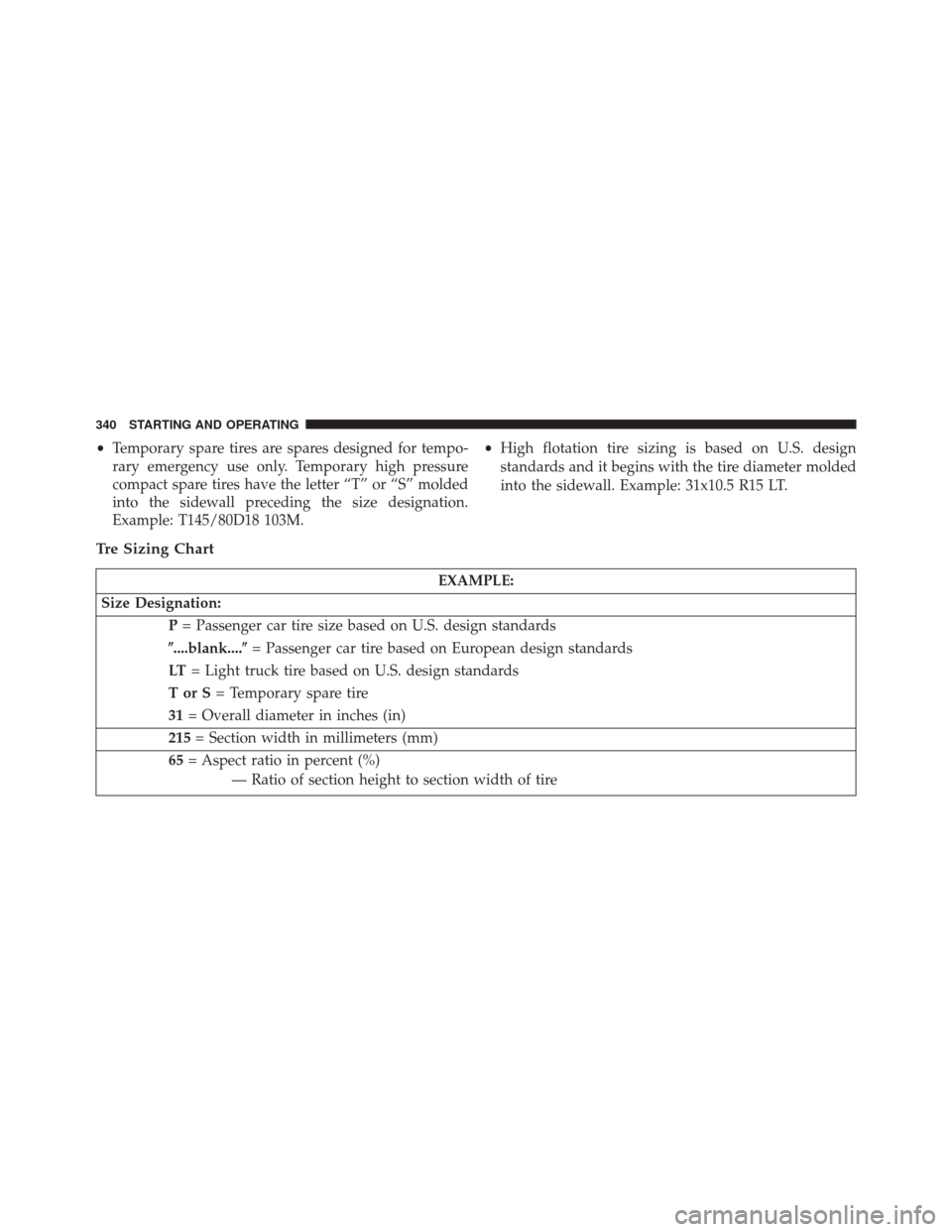
EXAMPLE:
Size Designation: P= Passenger car tire size based on U.S. design standards
�....blank....� = Passenger car tire based on European design standards
LT = Light truck tire based on U.S. design standards
TorS= Temporary spare tire
31 = Overall diameter in inches (in)
215 = Section width in millimeters (mm)
65 = Aspect ratio in percent (%)
— Ratio of section height to section width of tire
340 STARTING AND OPERATING
Page 343 of 519
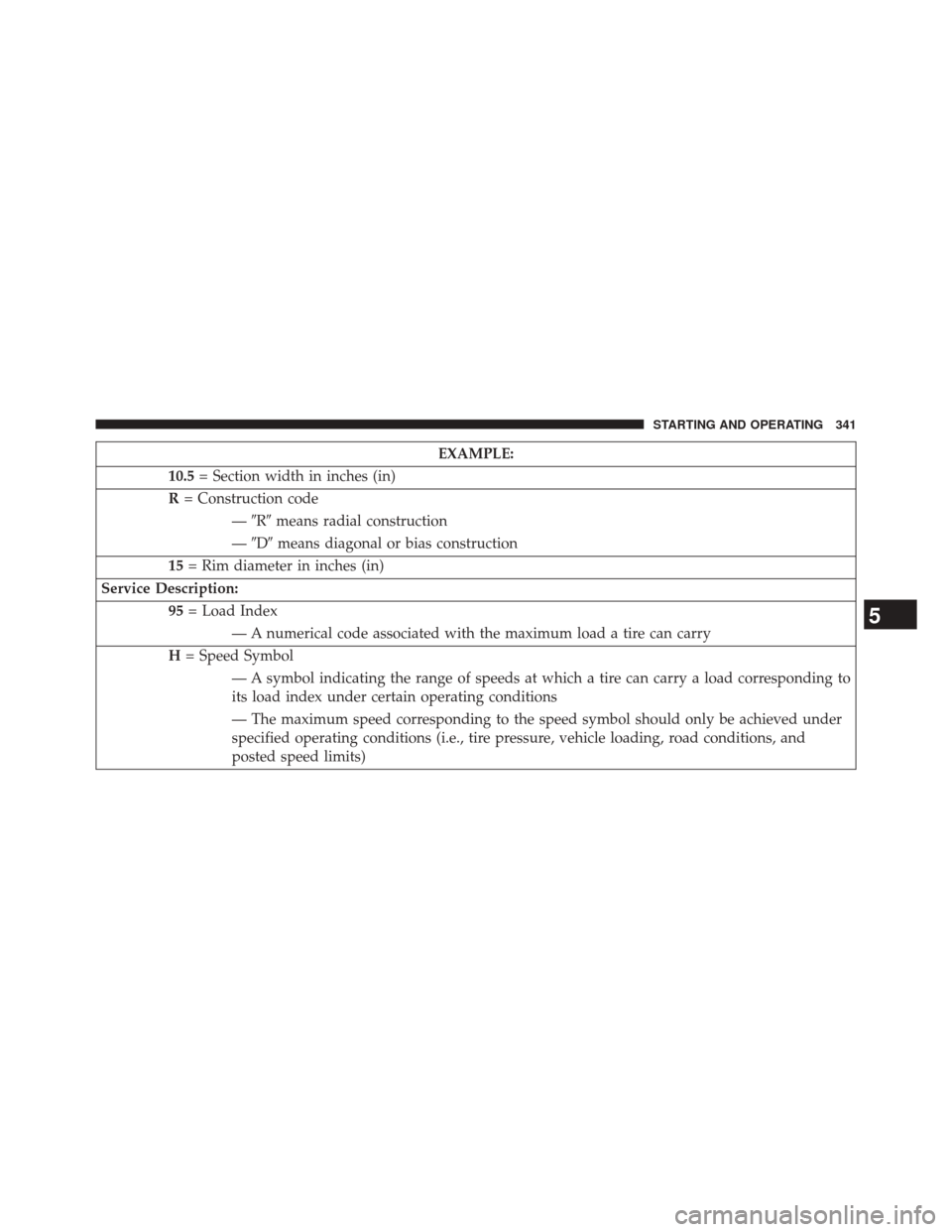
EXAMPLE:
10.5 = Section width in inches (in)
R = Construction code
—�R� means radial construction
— �D� means diagonal or bias construction
15 = Rim diameter in inches (in)
Service Description: 95= Load Index
— A numerical code associated with the maximum load a tire can carry
H = Speed Symbol
— A symbol indicating the range of speeds at which a tire can carry a load corresponding to
its load index under certain operating conditions
— The maximum speed corresponding to the speed symbol should only be achieved under
specified operating conditions (i.e., tire pressure, vehicle loading, road conditions, and
posted speed limits)
5
STARTING AND OPERATING 341
Page 344 of 519
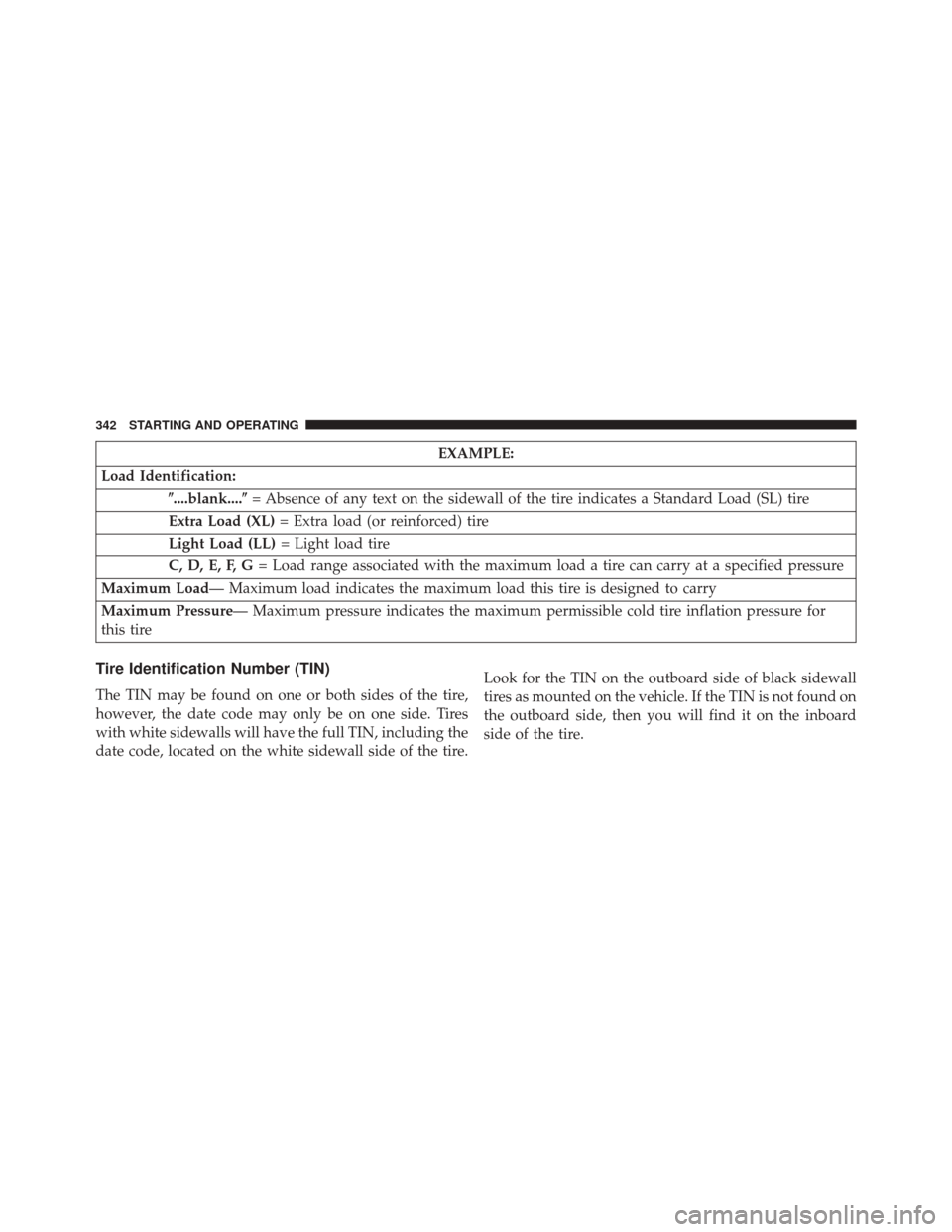
EXAMPLE:
Load Identification: �....blank....� = Absence of any text on the sidewall of the tire indicates a Standard Load (SL) tire
Extra Load (XL) = Extra load (or reinforced) tire
Light Load (LL) = Light load tire
C, D, E, F, G = Load range associated with the maximum load a tire can carry at a specified pressure
Maximum Load— Maximum load indicates the maximum load this tire is designed to carry
Maximum Pressure— Maximum pressure indicates the maximum permissible cold tire inflation pressure for
this tire
Tire Identification Number (TIN)
The TIN may be found on one or both sides of the tire,
however, the date code may only be on one side. Tires
with white sidewalls will have the full TIN, including the
date code, located on the white sidewall side of the tire. Look for the TIN on the outboard side of black sidewall
tires as mounted on the vehicle. If the TIN is not found on
the outboard side, then you will find it on the inboard
side of the tire.
342 STARTING AND OPERATING