2013 DODGE AVENGER oil temperature
[x] Cancel search: oil temperaturePage 435 of 519
CAUTION!
Do not use chemical flushes in your engine oil as the
chemicals can damage your engine. Such damage is
not covered by the New Vehicle Limited Warranty.
Engine Oil Viscosity – 2.4L Engine
SAE 5W-20 engine oil is recommended for all operating
temperatures. This engine oil improves low temperature
starting and vehicle fuel economy.
The engine oil filler cap also shows the recommended
engine oil viscosity for your engine. For information on
the engine oil filler cap location, refer to “Engine Com-
partment” in “Maintaining Your Vehicle” for further
information.
Lubricants that do not have both, the engine oil certifi-
cation mark and the correct SAE viscosity grade number
should not be used.
Engine Oil Viscosity – 3.6L Engine
SAE 5W-20 engine oil is recommended for all operating
temperatures. This engine oil improves low temperature
starting and vehicle fuel economy.
The engine oil filler cap also shows the recommended
engine oil viscosity for your engine. For information on
engine oil filler cap location, refer to the “Engine Com-
partment” illustration in this section.
NOTE:SAE 5W-30 engine oil approved to Fiat 9.55535-S1
or Fiat 9.55535-S3 may be used when SAE 5W-20 engine
oil meeting MS- 6395 is not available.
Synthetic Engine Oils
You may use synthetic engine oils provided the recom-
mended oil quality requirements are met, and the recom-
mended maintenance intervals for oil and filter changes
are followed.
7
MAINTAINING YOUR VEHICLE 433
Page 443 of 519

Operation of the wipers on dry glass for long periods
may cause deterioration of the wiper blades. Always use
washer fluid when using the wipers to remove salt or dirt
from a dry windshield.
Avoid using the wiper blades to remove frost or ice from
the windshield. Keep the blade rubber out of contact with
petroleum products such as engine oil, gasoline, etc.
NOTE:
Life expectancy of wiper blades varies depending
on geographical area and frequency of use. Poor perfor-
mance of blades may be present with chattering, marks,
water lines or wet spots. If any of these conditions are
present, clean the wiper blades or replace as necessary.
Adding Washer Fluid
The windshield washer and the rear window washer
share the same fluid reservoir. The fluid reservoir is
located in the engine compartment. Be sure to check the
fluid level in the reservoir at regular intervals. Fill the reservoir with windshield washer solvent (not radiator
antifreeze) and operate the system for a few seconds to
flush out the residual water.
When refilling the washer fluid reservoir, apply some
washer fluid to a cloth or towel and wipe the wiper
blades clean. This will help blade performance.
To prevent freeze-up of your windshield washer system
in cold weather, select a solution or mixture that meets or
exceeds the temperature range of your climate. This
rating information can be found on most washer fluid
containers.
WARNING!
Commercially available windshield washer solvents
are flammable. They could ignite and burn you. Care
must be exercised when filling or working around
the washer solution.
7
MAINTAINING YOUR VEHICLE 441
Page 456 of 519
4. Place the shift lever momentarily into each gear posi-tion (allowing time for the transmission to fully en-
gage in each position), ending with the transmission in
PARK.
5. Wipe the area around the dipstick clean to prevent dirt from entering the transmission.
6.
Remove the dipstick and determine if the fluid is hot or
cold. Hot fluid is approximately 180° F (82° C), which is
the normal operating temperature after the vehicle is
driven at least 15 miles (24 km). Hot fluid cannot be held
comfortably between the fingertips. Cold fluid is at a
temperature of approximately 80° F (27° C).
7. Wipe the dipstick clean and reinsert it until seated. Then, remove the dipstick and note the fluid level on
both sides. The fluid level reading is only valid if there
is a solid coating of oil on both sides of the dipstick. Note that the holes in the dipstick will be full of fluid
if the actual level is at or above the hole.
• If the fluid is hot, the fluid level should be in the
crosshatched area marked “HOT” (between the up-
per two holes in the dipstick).
• If the fluid is cold, the fluid level should be between
the lower two holes in the area marked “COLD.”
If the fluid level is low, add fluid through the dipstick
tube to bring it to the proper level. Do not overfill. After
adding any quantity of oil through the dipstick tube, wait
at least two minutes for the oil to fully drain into the
transmission before rechecking the fluid level.
8. Check for leaks. Release the parking brake.
To prevent dirt and water from entering the transmission
after checking or replenishing fluid, make sure that the
dipstick cap is properly reseated.
454 MAINTAINING YOUR VEHICLE
Page 480 of 519

MAINTENANCE SCHEDULE
Your vehicle is equipped with an automatic oil change
indicator system. The oil change indicator system will
remind you that it is time to take your vehicle in for
scheduled maintenance.
Based on engine operation conditions, the oil change
indicator message will illuminate. This means that ser-
vice is required for your vehicle. Operating conditions
such as frequent short-trips, trailer tow, extremely hot or
cold ambient temperatures, and E85 fuel usage will
influence when the “Oil Change Required” message is
displayed. Severe Operating Conditions can cause the
change oil message to illuminate as early as 3,500 miles
(5,600 km) since last reset. Have your vehicle serviced as
soon as possible, within the next 500 miles (805 km).
Your authorized dealer will reset the oil change indicator
message after completing the scheduled oil change. If a
scheduled oil change is performed by someone other than
your authorized dealer, the message can be reset by refer-
ring to the steps described under “Electronic Vehicle Infor-
mation Center (EVIC)/Oil Change Required” in “Under-
standing Your Instrument Panel” for further information
NOTE:Under no circumstances should oil change inter-
vals exceed 10,000 miles (16,000 km) or twelve months,
whichever comes first.
Once A Month Or Before A Long Trip:
• Check engine oil level
• Check windshield washer fluid level
• Check the tire inflation pressures and look for unusual
wear or damage
8
M A I
N T
E
N
A
N
C E
S
C
H E
D
U L
E
S478 MAINTENANCE SCHEDULES
Page 500 of 519
About Your Brakes....................... .328
ABS (Anti-Lock Brake System) ................330
Adding Engine Coolant (Antifreeze) ............446
Adding Fuel ............................ .379
Adding Washer Fluid ..................... .441
Additives, Fuel .......................... .373
Airbag ..................................61
Airbag Deployment ........................71
Airbag Light .............................68
Airbag Maintenance ........................73
Airbag, Side ..............................64
Airbag, Window (Side Curtain) ................65
Air Cleaner, Engine (Engine Air Cleaner Filter) . . . .434
Air Conditioner Maintenance .................437
Air Conditioning ......................... .278
Air Conditioning Controls ...................278
Air Conditioning Filter .....................290
Air Conditioning, Operating Tips ..............291
Air Conditioning Refrigerant .................437Air Conditioning System
....................278
Air Pressure, Tires ........................ .350
Alarm System (Security Alarm) ................19
Alterations/Modifications, Vehicle ...............7
Antenna, Satellite Radio .....................265
Antifreeze (Engine Coolant) ..................445
Disposal ............................. .448
Anti-Lock Brake System (ABS) ................330
Anti-Lock Warning Light ....................330
Anti-Theft Security Alarm (Theft Alarm) ..........19
Appearance Care ........................ .456
Ashtray ............................... .198
Assistance Towing ........................ .126
Auto Down Power Windows ..................38
Automatic Dimming Mirror ..................108
Automatic Door Locks ......................34
Automatic Oil Change Indicator ...............219
Automatic Temperature Control (ATC) ..........282
Automatic Transaxle ........................13
498 INDEX
Page 504 of 519
Electronic Stability Control (ESC)..............335
Electronic Vehicle Information Center (EVIC) ......229
Emergency, In Case of Jacking .............................. .400
Jump Starting ......................... .412
Towing ............................. .419
Emergency Trunk Release ....................42
Emission Control System Maintenance ..........428
Engine ................................ .425
Air Cleaner .......................... .434
Block Heater ......................... .302
Break-In Recommendations .................96
Checking Oil Level ..................... .431
Compartment ......................... .426
Compartment Identification ................426
Coolant (Antifreeze) .....................445
Cooling ............................. .444
Exhaust Gas Caution .....................97
Fails to Start .......................... .300Flooded, Starting
...................... .300
Fuel Requirements ..................... .370
Jump Starting ......................... .412
Oil................................. .431
Oil Change Interval ..................... .219
Oil Filler Cap ......................... .425
Oil Selection .......................... .432
Oil Synthetic ......................... .433
Overheating .......................... .398
Starting ............................. .298
Temperature Gauge ..................... .213
Engine Oil Viscosity ...................... .433
Engine Oil Viscosity Chart ...................433
Enhanced Accident Response Feature ............71
Entry System, Illuminated ....................22
Ethanol ............................... .371
Event Data Recorder ........................74
Exhaust Gas Caution ........................97
502 INDEX
Page 514 of 519
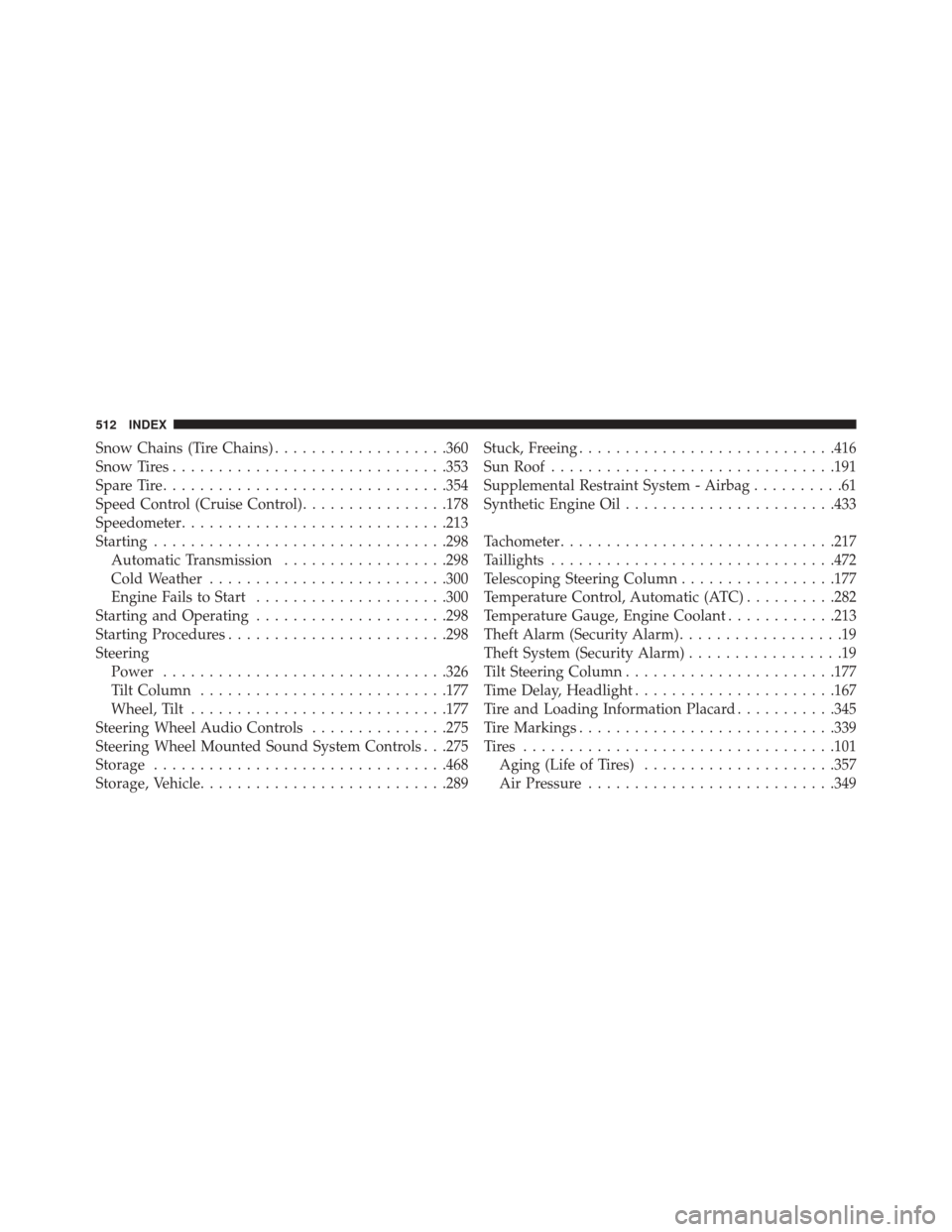
Snow Chains (Tire Chains)...................360
Snow Tires ............................. .353
Spare Tire .............................. .354
Speed Control (Cruise Control) ................178
Speedometer ............................ .213
Starting ............................... .298
Automatic Transmission ..................298
Cold Weather ......................... .300
Engine Fails to Start .....................300
Starting and Operating .....................298
Starting Procedures ....................... .298
Steering Power .............................. .326
Tilt Column .......................... .177
Wheel, Tilt ........................... .177
Steering Wheel Audio Controls ...............275
Steering Wheel Mounted Sound System Controls . . .275
Storage ............................... .468
Storage, Vehicle .......................... .289Stuck, Freeing
........................... .416
Sun Roof .............................. .191
Supplemental Restraint System - Airbag ..........61
Synthetic Engine Oil ...................... .433
Tachometer ............................. .217
Taillights .............................. .472
Telescoping Steering Column .................177
Temperature Control, Automatic (ATC) ..........282
Temperature Gauge, Engine Coolant ............213
Theft Alarm (Security Alarm) ..................19
Theft System (Security Alarm) .................19
Tilt Steering Column ...................... .177
Time Delay, Headlight ..................... .167
Tire and Loading Information Placard ...........345
Tire Markings ........................... .339
Tires ................................. .101
Aging (Life of Tires) .....................357
Air Pressure .......................... .349
512 INDEX