Page 69 of 519

Always sit upright as possible with your back against the
seat back, use the seat belts properly, and use the appro-
priate sized child restraint, infant restraint or booster seat
recommended for the size and weight of the child.
Knee Impact Bolsters
The Knee Impact Bolsters help protect the knees of the
driver and front passengers, and position front occupants
for the best interaction with the Advanced Front Air Bags.
Along with seat belts and pretensioners, Advanced Front
Air Bags work with the knee impact bolsters to provide
improved protection for the driver and front passenger.
Air Bag Deployment Sensors And Controls
Occupant Restraint Controller (ORC)
The ORC is part of a Federally regulated safety system
required for this vehicle.The ORC determines if deployment of the front and/or
side air bags in a frontal or side collision is required.
Based on the impact sensor’s signals, a central electronic
ORC deploys the Advanced Front Air Bags, SABIC air
bags, Supplemental Seat-Mounted Side Air Bags, and
front seat belt pretensioners, as required, depending on
the severity and type of impact.
Advanced Front Air Bags are designed to provide addi-
tional protection by supplementing the seat belts in
certain frontal collisions depending on several factors,
including the severity and type of collision. Advanced
Front Air Bags are not expected to reduce the risk of
injury in rear, side, or rollover collisions.
The Advanced Front Air Bags will not deploy in all
frontal collisions, including some that may produce
substantial vehicle damage — for example, some pole
collisions, truck underrides, and angle offset collisions.
2
THINGS TO KNOW BEFORE STARTING YOUR VEHICLE 67
Page 78 of 519
Child Restraints
Everyone in your vehicle needs to be buckled up at all
times, including babies and children. Every state in the
United States, and every Canadian province, requires
that small children ride in proper restraint systems. This
is the law, and you can be prosecuted for ignoring it.
Children 12 years or younger should ride properly
buckled up in a rear seat, if available. According to crash
statistics, children are safer when properly restrained in
the rear seats rather than in the front.
There are different sizes and types of restraints for
children from newborn size to the child almost large
enough for an adult safety belt. Always check the child
seat Owner ’s Manual to make sure you have the correct
seat for your child.Before buying any restraint system, make sure that it has
a label certifying that it meets all applicable Safety
Standards. You should also make sure that you can install
it in the vehicle where you will use it.
NOTE:
For additional information, refer to
www.seatcheck.org or call 1–866–SEATCHECK. Cana-
dian residents should refer to Transport Canada’s web-
site for additional information: http://www.tc.gc.ca/
eng/roadsafety/safedrivers-childsafety-index-53.htm
WARNING!
In a collision, an unrestrained child can become a
projectile inside the vehicle. The force required to
hold even an infant on your lap could become so
great that you could not hold the child, no matter
how strong you are. The child and others could be
badly injured. Any child riding in your vehicle
should be in a proper restraint for the child’s size.
76 THINGS TO KNOW BEFORE STARTING YOUR VEHICLE
Page 79 of 519
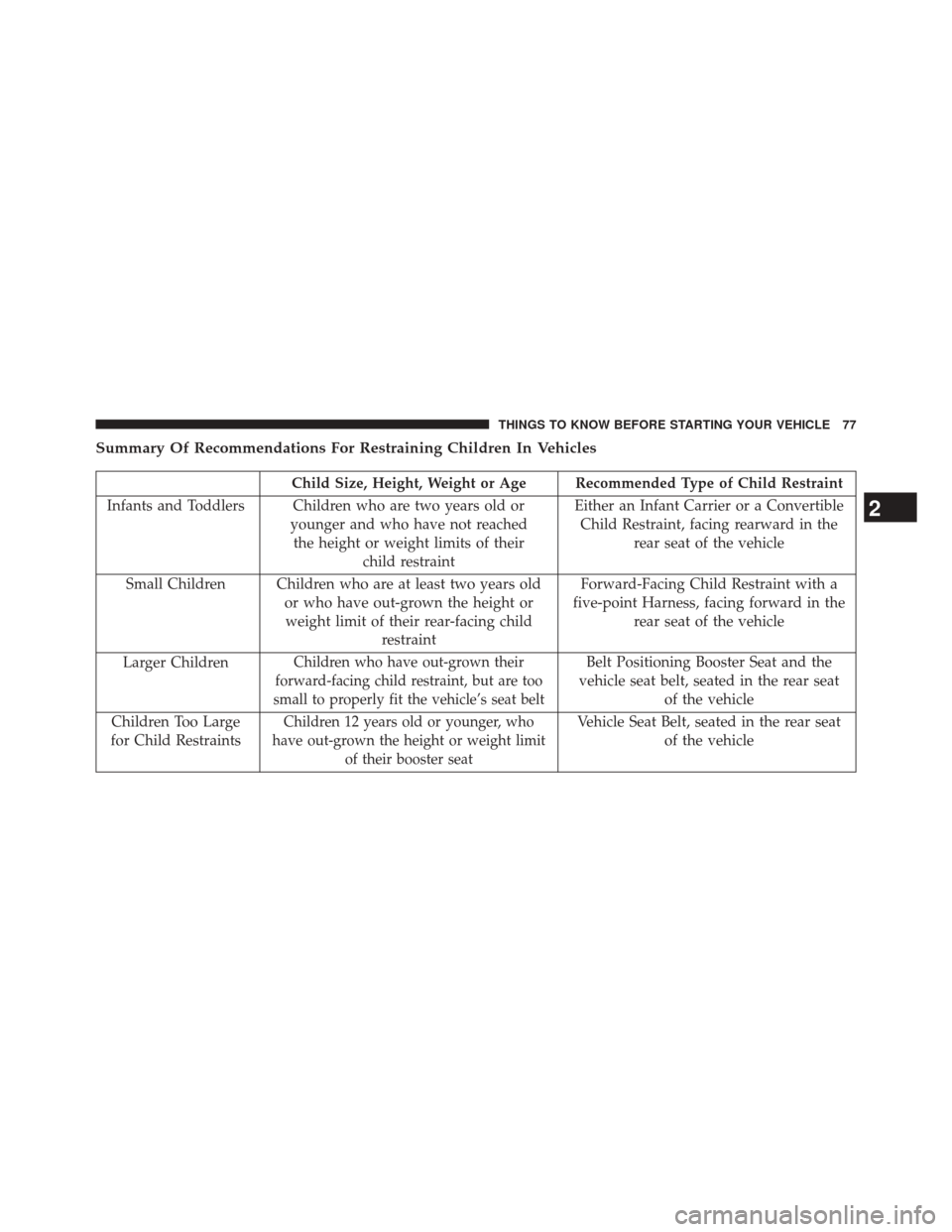
Summary Of Recommendations For Restraining Children In Vehicles
Child Size, Height, Weight or Age Recommended Type of Child Restraint
Infants and Toddlers Children who are two years old or younger and who have not reachedthe height or weight limits of their child restraint Either an Infant Carrier or a Convertible
Child Restraint, facing rearward in the rear seat of the vehicle
Small Children Children who are at least two years old or who have out-grown the height orweight limit of their rear-facing child restraint Forward-Facing Child Restraint with a
five-point Harness, facing forward in the rear seat of the vehicle
Larger Children
Children who have out-grown their
forward-facing child restraint, but are too
small to properly fit the vehicle’s seat beltBelt Positioning Booster Seat and the
vehicle seat belt, seated in the rear seat of the vehicle
Children Too Large
for Child Restraints
Children 12 years old or younger, who
have out-grown the height or weight limit of their booster seatVehicle Seat Belt, seated in the rear seat of the vehicle
2
THINGS TO KNOW BEFORE STARTING YOUR VEHICLE 77
Page 80 of 519
Infants And Child Restraints
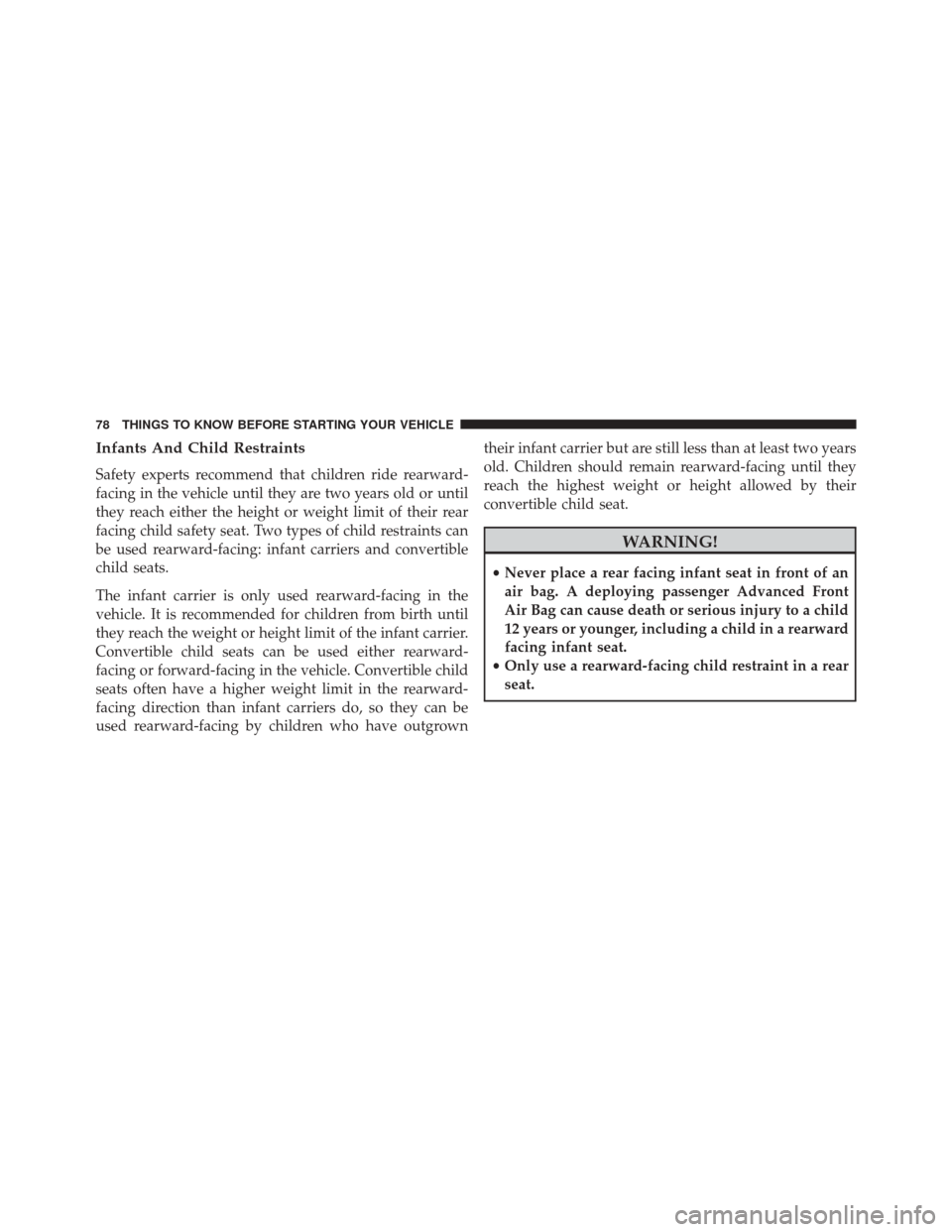
Safety experts recommend that children ride rearward-
facing in the vehicle until they are two years old or until
they reach either the height or weight limit of their rear
facing child safety seat. Two types of child restraints can
be used rearward-facing: infant carriers and convertible
child seats.
The infant carrier is only used rearward-facing in the
vehicle. It is recommended for children from birth until
they reach the weight or height limit of the infant carrier.
Convertible child seats can be used either rearward-
facing or forward-facing in the vehicle. Convertible child
seats often have a higher weight limit in the rearward-
facing direction than infant carriers do, so they can be
used rearward-facing by children who have outgrowntheir infant carrier but are still less than at least two years
old. Children should remain rearward-facing until they
reach the highest weight or height allowed by their
convertible child seat.
WARNING!
•
Never place a rear facing infant seat in front of an
air bag. A deploying passenger Advanced Front
Air Bag can cause death or serious injury to a child
12 years or younger, including a child in a rearward
facing infant seat.
• Only use a rearward-facing child restraint in a rear
seat.
78 THINGS TO KNOW BEFORE STARTING YOUR VEHICLE
Page 81 of 519

Older Children And Child Restraints
Children who are two years old or who have outgrown
their rear-facing convertible child seat can ride forward-
facing in the vehicle. Forward-facing child seats and
convertible child seats used in the forward-facing direc-
tion are for children who are over two years old or who
have outgrown the rear-facing weight or height limit of
their rear-facing convertible child seat. Children should
remain in a forward-facing child seat with a harness for
as long as possible, up to the highest weight or height
allowed by the child seat.
All children whose weight or height is above the
forward-facing limit for the child seat should use a
belt-positioning booster seat until the vehicle’s seat belts
fit properly. If the child cannot sit with knees bent over
the vehicle’s seat cushion while the child’s back is against
the seatback, they should use a belt-positioning boosterseat. The child and belt-positioning booster seat are held
in the vehicle by the seat belt.
WARNING!
•
Improper installation can lead to failure of an
infant or child restraint. It could come loose in a
collision. The child could be badly injured or
killed. Follow the child restraint manufacturer ’s
directions exactly when installing an infant or
child restraint.
• When your child restraint is not in use, secure it in
the vehicle with the seat belt or LATCH anchor-
ages, or remove it from the vehicle. Do not leave
it loose in the vehicle. In a sudden stop or accident,
it could strike the occupants or seatbacks and cause
serious personal injury.
2
THINGS TO KNOW BEFORE STARTING YOUR VEHICLE 79
Page 83 of 519
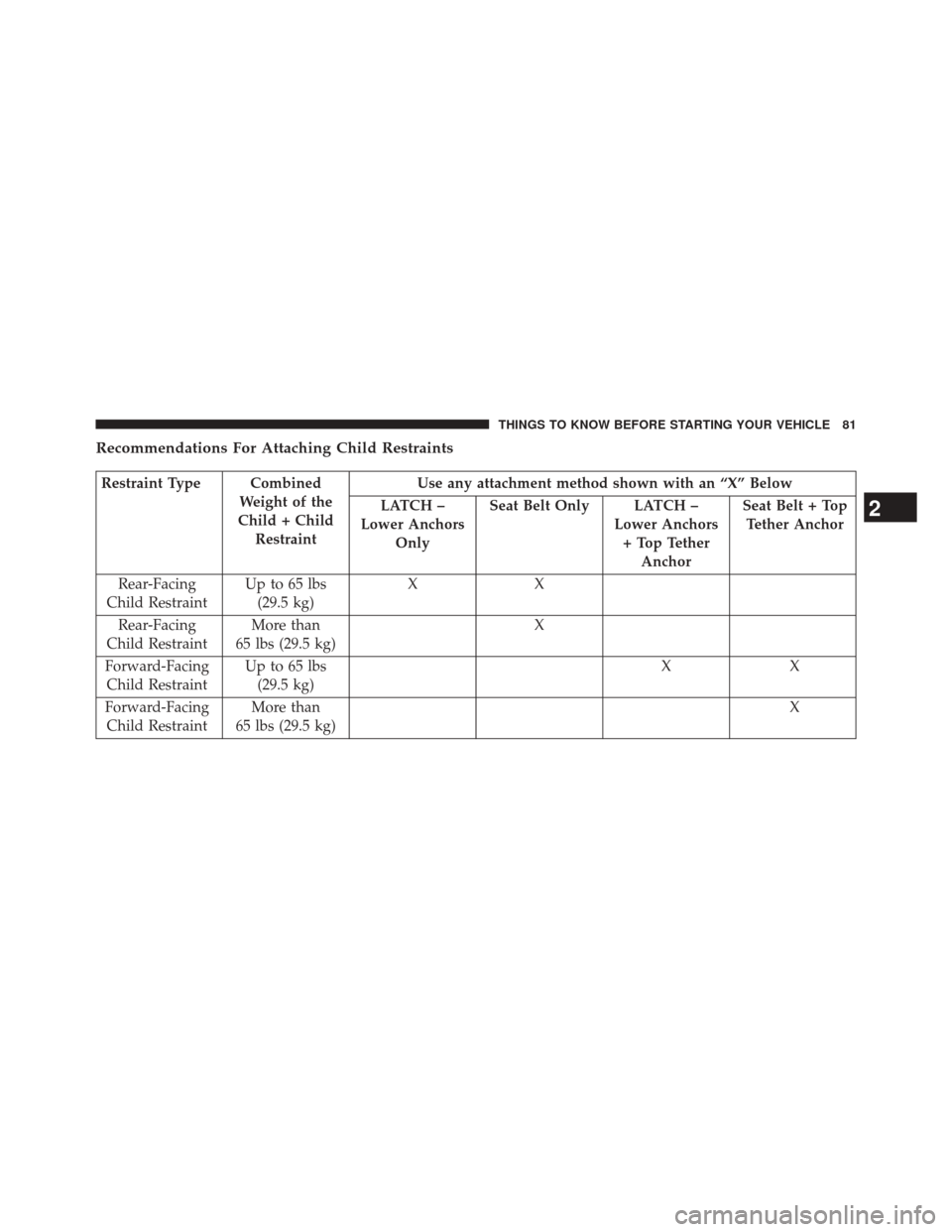
Recommendations For Attaching Child Restraints
Restraint Type CombinedWeight of the
Child + Child Restraint Use any attachment method shown with an “X” Below
LATCH –
Lower Anchors Only Seat Belt Only LATCH –
Lower Anchors+ Top Tether Anchor Seat Belt + Top
Tether Anchor
Rear-Facing
Child Restraint Up to 65 lbs
(29.5 kg) XX
Rear-Facing
Child Restraint More than
65 lbs (29.5 kg) X
Forward-Facing Child Restraint Up to 65 lbs
(29.5 kg) XX
Forward-Facing Child Restraint More than
65 lbs (29.5 kg) X
2
THINGS TO KNOW BEFORE STARTING YOUR VEHICLE 81
Page 84 of 519
Lower Anchors and Tethers for Children (LATCH)
Restraint SystemYour vehicle is equipped with the child restraint anchor-
age system called LATCH, which stands for Lower
Anchors and Tethers for CHildren. The LATCH system
has three vehicle anchor points for installing LATCH-
equipped child seats. There are two lower anchorages
located at the back of the seat cushion where it meets the
seatback and one top tether anchorage located behind the
seating position. These anchorages are used to install
LATCH-equipped child seats without using the vehicle’s
seat belts. Some seating positions may have a top tether
anchorage but no lower anchorages. In these seating
positions, the seat belt must be used with the top tether
anchorage to install the child restraint. Please see the
following table for more information.
82 THINGS TO KNOW BEFORE STARTING YOUR VEHICLE
Page 85 of 519
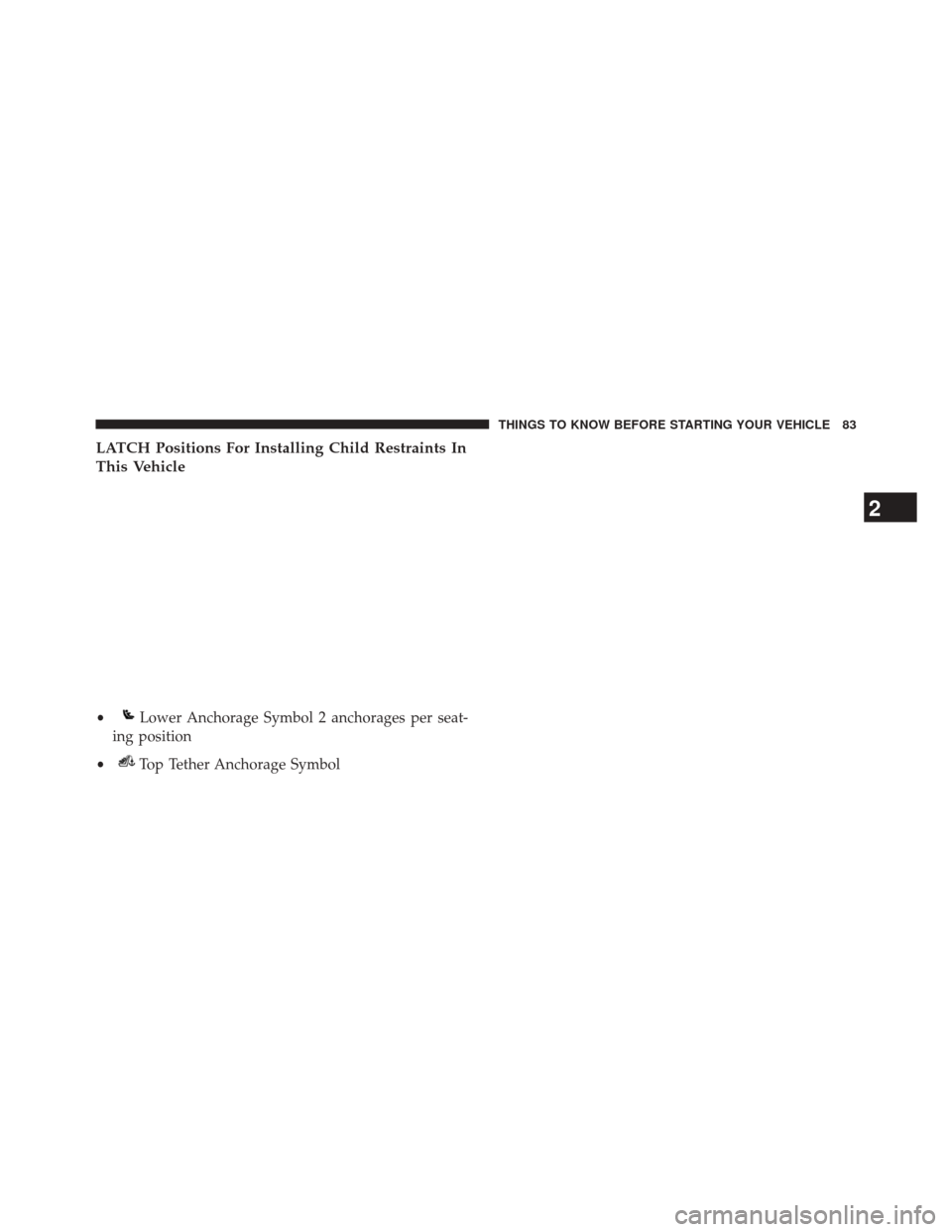
LATCH Positions For Installing Child Restraints In
This Vehicle
•Lower Anchorage Symbol 2 anchorages per seat-
ing position
•
Top Tether Anchorage Symbol
2
THINGS TO KNOW BEFORE STARTING YOUR VEHICLE 83