2013 DACIA SANDERO warning light
[x] Cancel search: warning lightPage 51 of 146

warning buzzer ......................................................(current page)fog lights ................................................................(current page)lights:fog lights ..........................................................(current page)
JauneNoirNoir texte
1.47
ENG_UD5563_1Éclairages et signalisations extérieures (B90 - Dacia)ENG_NU_817-2_NU_Dacia_1
EXTERIOR LIGHTING AND SIGNALS (continued)
When the exterior vehicle lights are ex- tinguished, the rear fog light is extin- guished or the equipment returns to the front lights position (if they are fitted).
Lights-on reminder buzzer
A warning buzzer will sound when a front door is opened and the lights are left on after the ignition has been switched off (to prevent discharge of the battery).
gFront fog lights
Turn the centre ring of stalk 3
until the symbol is opposite mark 4.
The fog lights only light up if the exterior lights have been switched on. An indi- cator light on the instrument panel then lights up.
Do not forget to switch off the fog lights when they are no longer needed, to avoid inconveniencing other road users.
hRear fog lights
Turn the centre ring of
stalk 3 until the symbol is opposite
mark 4.
The fog lights only light up if the exterior lights have been switched on. An indi- cator light on the instrument panel then lights up.
Remember to switch off the these lights when they are no longer required to avoid inconveniencing other road users.
343
Page 53 of 146
headlight flashers .................................(up to the end of the DU)horn ......................................................(up to the end of the DU)indicators ..............................................(up to the end of the DU)lights:direction indicators ..........................(up to the end of the DU)lights:hazard warning ...............................(up to the end of the DU)indicators:direction indicators ..........................(up to the end of the DU)hazard warning lights signal .................(up to the end of the DU)hazard warning lights signal .................(up to the end of the DU)
1.49
ENG_UD5565_1Avertisseurs sonore et lumineux (B90 - Dacia)ENG_NU_817-2_NU_Dacia_1
Avertisseurs sonores et lumineux
AUDIBLE AND vISUAL SIGNALS
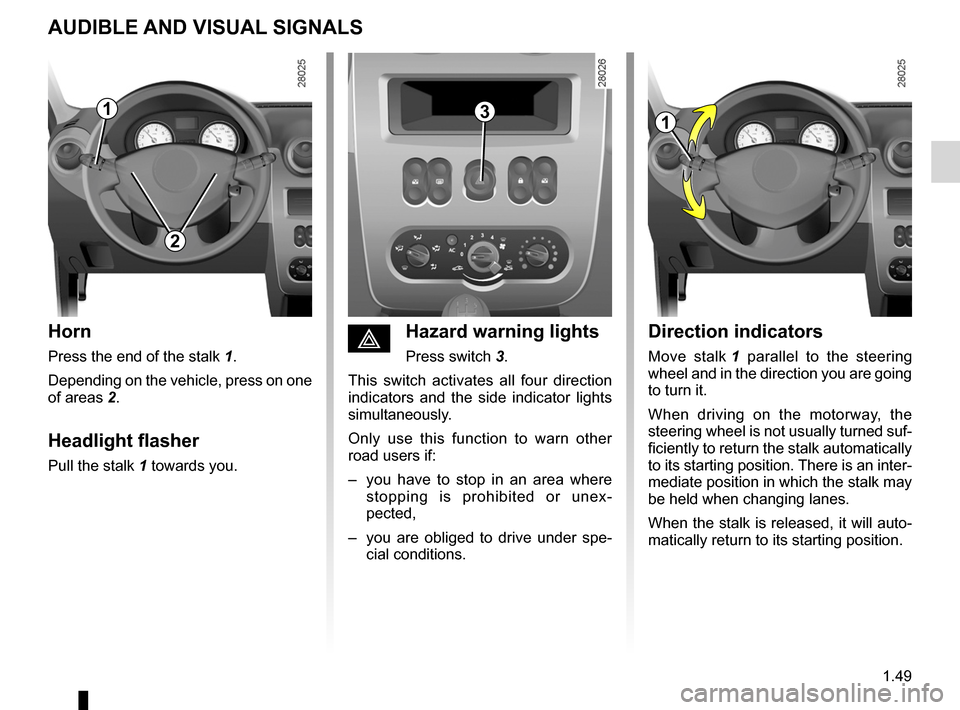
Horn
Press the end of the stalk 1.
Depending on the vehicle, press on one
of areas 2.
Headlight flasher
Pull the stalk 1 towards you.
Direction indicators
Move stalk 1 parallel to the steering wheel and in the direction you are going to turn it.
When driving on the motorway, the steering wheel is not usually turned suf- ficiently to return the stalk automatically to its starting position. There is an inter- mediate position in which the stalk may
be held when changing lanes.
When the stalk is released, it will auto- matically return to its starting position.
éHazard warning lights
Press switch 3.
This switch activates all four direction indicators and the side indicator lights simultaneously.
Only use this function to warn other road users if:
– you have to stop in an area where
stopping is prohibited or unex- pected,
– you are obliged to drive under spe
- cial conditions.
113
2
Page 57 of 146
fuelfilling .................................................................(current page)
JauneNoirNoir texte
1.53
ENG_UD5567_1Réservoir carburant (B90 - Dacia)ENG_NU_817-2_NU_Dacia_1
FUEL TANK (continued)
Diesel vehicle
When the vehicle is adapted (indicated
on the label A), you may use diesel containing a maximum of 30% bio ad- ditives (fatty acid methyl ester).Otherwise, use diesel containing a maximum of 10% bio additives.Special note: do not use fuel with more than 10% bio additives if the tempera- ture is below 0°C.
Filling with fuel
Petrol version
Only use unleaded petrol.
Using leaded petrol will damage the antipollution system and may lead to a loss of warranty.
To ensure the fuel tank is not filled with leaded petrol, the fuel tank filler neck contains a restrictor fitted with a valve which only allows the nozzle for unleaded petrol to be used (at the pump).
– Insert the nozzle as far as it will go so that the valve is opened.
– Keep the nozzle in this position throughout the entire filling opera- tion.
Petrol and diesel versions
When the pump cuts out automatically at the end of the filling procedure, a maximum of two further filling attempts may be made, as there must be suffi- cient space in the fuel tank to allow for expansion.
Persistent smell of fuel
If you notice a persistent smell of fuel you should:
– stop the vehicle as soon as traffic
conditions allow and switch off the ignition;
– switch on the hazard warning lights
and ask your passengers to leave the vehicle and stay clear of the traf- fic;
– refrain from working on or restart
-
ing the vehicle before it has been inspected by qualified staff from the approved dealer network.
No modifications what- soever are permitted on any part of the fuel supply system (computers, wiring, fuel circuit, injector, protection
covers, etc.) as this may be danger- ous (such work must be undertaken by qualified Network personnel).
Page 61 of 146

driving ...................................................(up to the end of the DU)starting ..................................................(up to the end of the DU)starting the engine ................................(up to the end of the DU)
2.3
ENG_UD5482_1Mise en route / Arrêt du moteur (U90 - Dacia)ENG_NU_817-2_NU_Dacia_2
Stopping the engine
With the engine idling, turn the key back to “Stop” position St.
ÉDiesel injection
Turn the ignition key to ignition “On” po- sition M, and hold this position until the preheating warning light goes out.
Turn the key to starter position D with- out depressing the accelerator pedal.
Release the key as soon as the engine starts.
Starting the engine
Special feature on vehicles equipped with an engine immobiliser system
In very cold conditions (temperatures below –20°C): so that it is easier to start the engine, switch on the ignition for several seconds before starting the engine.
Make sure the engine immobiliser is not activated. Refer to the information on the “Engine immobiliser” in Section 1.
Petrol injection
Engine warm or cold
– Turn the key to the start position
without depressing the accelera- tor.
– Release the key as soon as the
engine starts.
Mise en route / Arrêt du moteur
STARTING/STOPPING THE ENGINE
Never leave your vehicle with the keys inside when leaving a child (or \
animal) in the car, even for a short period.
The reason for this is that the child may endanger himself or others by starting the engine, activating equipment such
as the window winders for example, or locking the doors.
Risk of serious injury.
Never switch off the ignition before the vehicle has stopped completely. Once the engine has stopped, the brake servo, power assisted steering and passive safety equipment such as air bags wi\
ll no longer operate.
The steering is locked when the key is removed.
Page 62 of 146
driving ...................................................(up to the end of the DU)catalytic converter.................................(up to the end of the DU)catalytic converter.................................(up to the end of the DU)special features of petrol vehicles ........(up to the end of the DU)
2.4
ENG_UD5483_1Particularités des versions essence (U90 - Dacia)ENG_NU_817-2_NU_Dacia_2
Particularités des versions essence
SPECIAL FEATURES OF PETROL VERSIONS
The following operating conditions:
– driving for long periods when the low
fuel level warning light is lit up,
– using leaded petrol,
– using oil or fuel additives which are
not approved by the manufacturer.
Or operating faults such as:
– faulty ignition, running out of fuel or
spark plug disconnected resulting in engine misfiring and hesitation when driving,
– loss of power,
may cause the catalytic converter to overheat, reducing its efficiency which may irreparably damage it and cause heat damage to the vehicle.
If you notice any of the above operat- ing faults, have the necessary repairs carried out as soon as possible by your approved dealer.
These faults may be avoided by regularly taking your vehicle to your approved dealer at the intervals specified in your Maintenance Service Booklet.
Starting problems
To avoid damaging the catalytic con- verter, do not keep trying to start the engine (using the start button, or by pushing or towing the vehicle) without having identified and corrected the starting fault.
If the fault cannot be identified, do not continue to try and start the engine, but contact an approved dealer.
Do not park the vehicle or
run the engine in locations where combustible sub- stances or materials such as grass or leaves can come into contact with a hot exhaust system.
Page 65 of 146
ENG_NU_817-2_NU_Dacia_2
– Study the road ahead so that you are able to brake as l")
JauneNoirNoir texte
2.7
ENG_UD5485_1Conseils antipollution, économies de carburant, conduite (U90 - Daci\
a)ENG_NU_817-2_NU_Dacia_2
– Study the road ahead so that you are able to brake as little as possible, it can be sufficient just to lift off the ac- celerator.
– Avoid sudden acceleration.
– Do not overrev the engine in the in
- termediate gears. Always use the highest gear possible without labour- ing the engine.
– Do not try to maintain the same
speed up a hill, accelerate no more than you would on the level. Keep your foot in the same position on the accelerator pedal.
– Double declutching and accelerating
before switching off are unnecessary in modern vehicles.
– Bad weather, flooded roads.
Do not drive through floods if the water is above the lower edge of the wheel
rims.
Exhaust gas monitoring
system
The exhaust gas monitoring system will detect any operating faults in the vehicle’s antipollution system.
If this system malfunctions, toxic sub- stances may be released into the at- mosphere or damage may occur.
ÄThis warning light on the in- strument panel will indicate if there are any faults in the system:
T h i s c o m e s o n w h e n t h e i g n i- tion is switched on and goes out after three seconds.
– if it lights up continuously, consult
your approved dealer as soon as possible;
– if it flashes, reduce the engine speed
until the light stops flashing. Contact your approved dealer as soon as possible.
Driving
– Drive carefully for the first few miles until the engine reaches its normal operating temperature, rather than let it warm up while the vehicle is sta- tionary.
– Speed is expensive.
– Sporty driving uses a lot of fuel: drive
with a light right foot.
ADVICE ON ANTIPOLLUTION, FUEL ECONOMY AND DRIVING (continued)
Page 69 of 146

power-assisted steering.........................................(current page)driving ....................................................................(current page)power-assisted steering.........................................(current page)handbrake..............................................................(current page)
2.11
ENG_UD6871_1Frein à main / Direction assistée (B90 - Dacia)ENG_NU_817-2_NU_Dacia_2
Handbrake
To release
Gently pull the lever upwards, press
button 1 and move the lever to the floor.
The red warning light on the instrument panel will light up if you are driving with an incorrectly released handbrake.
Levier de vitesses - Frein à mainDirection assistée
HANDBRAKE/POWER-ASSISTED STEERING
1
To apply
Pull upwards, check that the vehicle is properly immobilised.
Depending on the gradient and/or vehicle load, it may be necessary to apply the brake by at least a further two notches and engage a gear (1st or reverse gear).
Never switch off the igni- tion when travelling down- hill, and avoid doing so in normal driving (assistance is not provided).
When driving, ensure that the handbrake has been completely released (red warning light off), risk of overheathing.
Power-assisted steering
If you have power-assisted steer- ing fitted, do not leave the steering wheel at full lock while stationary as this may damage the pump.
Page 70 of 146
driving ...................................................(up to the end of the DU)ABS ......................................................(up to the end of the DU)anti-lock braking system: ABS ..............(up to the end of the DU)
2.12
ENG_UD5488_1Système antiblocage des routes : ABS (U90 - Dacia)ENG_NU_817-2_NU_Dacia_2
Operating faults
Two possible situations may occur:
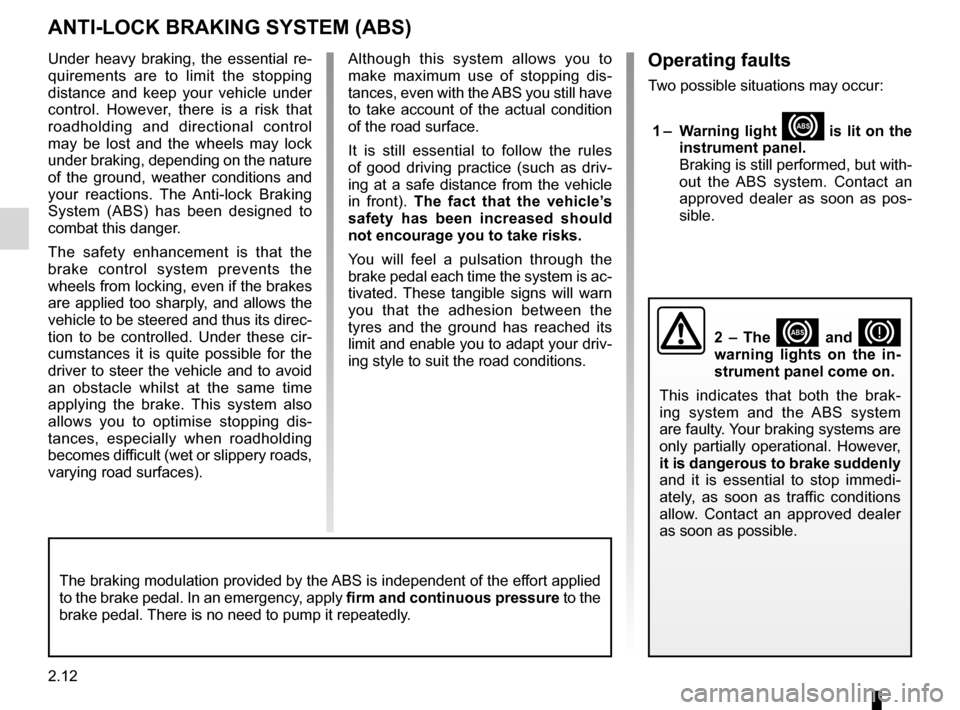
1 – Warning light x is lit on the instrument panel.Braking is still performed, but with- out the ABS system. Contact an approved dealer as soon as pos- sible.
Although this system allows you to make maximum use of stopping dis- tances, even with the ABS you still have to take account of the actual condition of the road surface.
It is still essential to follow the rules of good driving practice (such as driv- ing at a safe distance from the vehicle in front). The fact that the vehicle’s safety has been increased should not encourage you to take risks.
You will feel a pulsation through the brake pedal each time the system is ac- tivated. These tangible signs will warn you that the adhesion between the tyres and the ground has reached its limit and enable you to adapt your driv- ing style to suit the road conditions.
2 – The x and D warning lights on the in- strument panel come on.
This indicates that both the brak- ing system and the ABS system are faulty. Your braking systems are only partially operational. However, it is dangerous to brake suddenly and it is essential to stop immedi- ately, as soon as traffic conditions allow. Contact an approved dealer as soon as possible.
Système antiblocage des roues (ABS)
ANTI-LOCK BRAKING SYSTEM (ABS)
Under heavy braking, the essential re- quirements are to limit the stopping distance and keep your vehicle under control. However, there is a risk that roadholding and directional control may be lost and the wheels may lock under braking, depending on the nature of the ground, weather conditions and your reactions. The Anti-lock Braking System (ABS) has been designed to combat this danger.
The safety enhancement is that the brake control system prevents the wheels from locking, even if the brakes are applied too sharply, and allows the vehicle to be steered and thus its direc- tion to be controlled. Under these cir- cumstances it is quite possible for the driver to steer the vehicle and to avoid an obstacle whilst at the same time applying the brake. This system also allows you to optimise stopping dis- tances, especially when roadholding becomes difficult (wet or slippery roads, varying road surfaces).
The braking modulation provided by the ABS is independent of the effort applied to the brake pedal. In an emergency, apply firm and continuous pressure to the brake pedal. There is no need to pump it repeatedly.