2013 DACIA LODGY fuel consumption
[x] Cancel search: fuel consumptionPage 87 of 258

Downloaded from www.Manualslib.com manuals search engine JauneNoir Noir texte
2.17
ENG_UD38086_4
Conseils entretien et antipollution (X91 - B91 - K91 - D91 - X95 - E95 - J95 - R95 - H79 - X67 - X92 - X98 - X52 - X87 - H79 Ph2 - X07 - JFC - HFE - Renault) ENG_NU_975-8_X92_Dacia_2
MAINTENANCE AND ANTIPOLLUTION ADVICE
Your vehicle complies with criteria for
recycling and recovering vehicles at the
end of their service life which will come
into force in 2015.
Some parts of your vehicle have there-
fore been designed to facilitate future
recycling.
These parts are easy to remove so
that they can be recovered and reproc-
essed by recycling companies.
By virtue of its design, moderate fuel
consumption and initial settings, your
vehicle also conforms to current anti-
pollution regulations. The manufac-
turer is actively striving to reduce pol-
lutant exhaust gas emissions and to
save energy. But the fuel consumption
of your vehicle and the level of pollutant
exhaust gas emissions are also your
responsibility. Ensure that it is main-
tained and used correctly.
Maintenance
It is important to remember that fail-
ure to respect anti-pollution regulations
could lead to legal action being taken
against the vehicle owner.In addition, replacing engine, fuel
supply system and exhaust compo-
nents with parts other than those origi-
nally recommended by the manufac-
turer may alter your vehicle so that it
no longer complies with anti-pollution
regulations.
Have your vehicle adjusted and
checked by an authorised dealer, in ac-
cordance with the instructions given in
your maintenance schedule: they will
have all the equipment necessary for
ensuring that your vehicle is maintained
to its original standard.
Engine adjustments
– Spark plugs: for optimum condi-
tions of use, output and performance
the specifications laid down by our
Design Department must be strictly
applied.
If the spark plugs have to be changed,
use the make, type and gap specified
for your vehicle’s engine. Contact an
authorised dealer for this.
– Air filter, fuel filter: a choked ele-
ment will reduce efficiency. It must
be replaced.
– Ignition and idle speed: no adjust-
ment is needed.
Exhaust gas monitoring
system
The exhaust gas monitoring system will
detect any operating faults in the vehi-
cle’s antipollution system.
If this system malfunctions, toxic sub-
stances may be released into the at-
mosphere or damage may occur.
ÄThis warning light on the in-
strument panel will indicate if
there are any faults in the system:
This lights up when the ignition is
switched on and goes out when the
engine is started.
– If it lights up continuously, consult an
approved Dealer as soon as possi-
ble;
– if it flashes, reduce the engine speed
until the light stops flashing. Contact
an authorised dealer as soon as pos-
sible.
Page 88 of 258

Downloaded from www.Manualslib.com manuals search engine JauneNoir Noir texte
2.18
ENG_UD34481_2
Environnement (sans marque) (X35 - X44 - X45 - X77 - X81 - X85 - X90 - X91 - X83 - X61 - TEST - X95 - L90 Ph2 - F90 Ph2 - R90 Ph2 - X33 - X47 - X43 - X38 - H79 - ENG_NU_975-8_X92_Dacia_2
ENVIRONMENT
Emissions
Your vehicle has been designed to emit
fewer greenhouse gases (CO2) while in
use, and therefore to consume less fuel
(eg. 140 g/km, equivalent to 5.3 l/100
km for a diesel vehicle).
Our vehicles are also equipped with a
particle filter system including a cata-
lytic converter, an oxygen sensor and
an active carbon filter (the latter pre-
vents vapour from the fuel tank being
released into the open air).
For certain diesel vehicles, this system
also has a particle filter to reduce the
volume of soot particles emitted.
Please make your own
contribution towards
protecting the environment
too
– Worn parts replaced in the course of
routine vehicle maintenance (vehi-
cle battery, oil filter, air filter, batter-
ies, etc.) and oil containers (empty or
filled with used oil) must be disposed
of through specialist organisations.– At the end of the vehicle’s service
life, it should be sent to approved
centres to ensure that it is recycled.
– In all cases, comply with local legis-
lation.
Recycling
Your vehicle is 85% recyclable and
95% recoverable.
To achieve these objectives, many of
the vehicle components have been de-
signed to enable them to be recycled.
The materials and structures have
been carefully designed to allow these
components to be easily removed and
reprocessed by specialist companies.
In order to preserve raw material re-
sources, this vehicle incorporates nu-
merous parts made from recycled plas-
tics or renewable materials (vegetable
or animal-derived materials such as
cotton or wool). Your vehicle has been designed with
respect for the environment in mind for
its entire service life: during production,
use and at the end of its life.
This commitment is illustrated by the of
the manufacturer eco² signature.Manufacture
Your vehicle has been manufactured at
a factory which complies with a policy
to reduce the environmental impact
on the surrounding areas (reduction of
water and energy consumption, visual
and noise pollution, atmospheric emis-
sions and waste water; sorting and re-
using waste).
Page 116 of 258
Downloaded from www.Manualslib.com manuals search engine JauneNoir Noir texte
3.6
ENG_UD38154_2
Chauffage, Ventilation, Air Conditionné (X92 - Dacia) ENG_NU_975-8_X92_Dacia_3
HEATING, VENTILATION, AIR CONDITIONING (3/3)
Distribution of air in the
passenger compartment
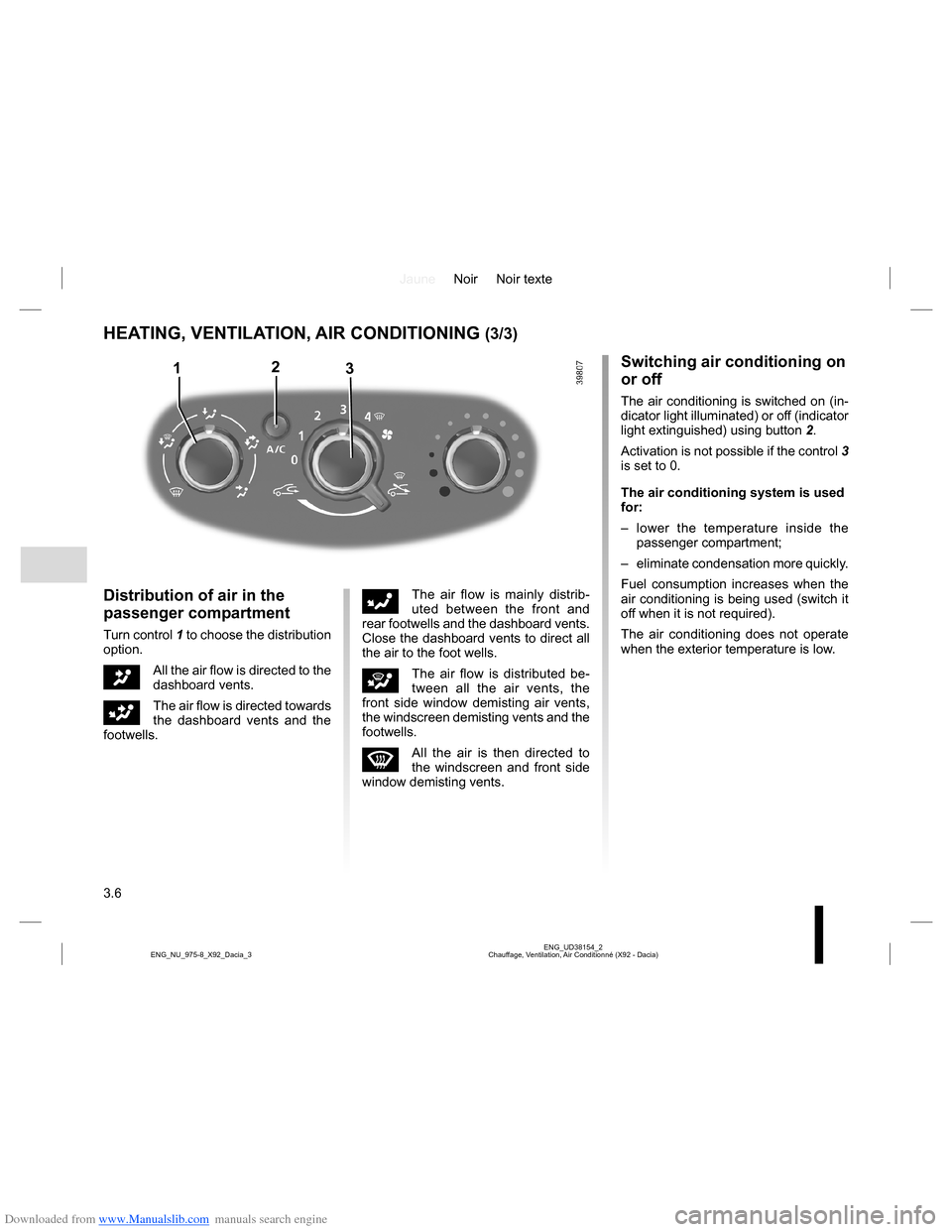
Turn control 1 to choose the distribution
option.
JAll the air flow is directed to the
dashboard vents.
GThe air flow is directed towards
the dashboard vents and the
footwells.
FThe air flow is mainly distrib-
uted between the front and
rear footwells and the dashboard vents.
Close the dashboard vents to direct all
the air to the foot wells.
iThe air flow is distributed be-
tween all the air vents, the
front side window demisting air vents,
the windscreen demisting vents and the
footwells.
WAll the air is then directed to
the windscreen and front side
window demisting vents.
Switching air conditioning on
or off
The air conditioning is switched on (in-
dicator light illuminated) or off (indicator
light extinguished) using button 2.
Activation is not possible if the control 3
is set to 0.
The air conditioning system is used
for:
– lower the temperature inside the
passenger compartment;
– eliminate condensation more quickly.
Fuel consumption increases when the
air conditioning is being used (switch it
off when it is not required).
The air conditioning does not operate
when the exterior temperature is low.
132
Page 117 of 258

Downloaded from www.Manualslib.com manuals search engine JauneNoir Noir texte
3.7
ENG_UD24441_1
Air conditionné : informations et conseils utilisation (X92 - Renault) ENG_NU_975-8_X92_Dacia_3
Fuel consumption
You will normally notice an increase in
fuel consumption (especially when driv-
ing in town) when the air conditioning is
operating.
For vehicles fitted with air conditioning
with no automatic mode, switch off the
system when it is not required.
Advice for reducing consumption
and helping to preserve the environ-
ment
Drive with the air vents open and the
windows closed.
If the vehicle has been parked in the
sun, open the doors for a few moments
to let the hot air escape before starting
the engine.
Maintenance
Refer to the Maintenance Document
for your vehicle for the inspection fre-
quency.
AIR CONDITIONING: information and advice on use
Operating faults
As a general rule, contact your ap-
proved dealer in the event of an oper-
ating fault.
– Reduction in de-icing, demisting
or air conditioning performance.
This may be caused by the passen-
ger compartment filter cartridge be-
coming clogged.
– No cold air is being produced.
Check that the controls are set cor-
rectly and that the fuses are sound.
Otherwise, switch off the system.
Presence of water under the
vehicle
After prolonged use of the air condi-
tioning system, it is normal for water
to be present under the vehicle. This is
caused by condensation.
Do not open the refriger-
ant fluid circuit. The fluid
may damage eyes or skin.
Page 228 of 258

Downloaded from www.Manualslib.com manuals search engine JauneNoir Noir texte
7.2
FRA_UD38226_8
Index (X92 - Renault) ENG_NU_975-8_X92_Dacia_7
ALPHABETICAL INDEX (2/5)
emergency braking ................................................2.24 → 2.26
emergency spare wheel ........................5.3 – 5.4, 5.14 → 5.16
engine
technical specifications .................................................. 6.4
engine coolant ..................................................................... 4.8
engine immobiliser (switch) ................................................. 2.2
engine oil ...................................................................4.4 → 4.6
engine oil level ............................................................ 4.5 – 4.6
engine specifications ........................................................... 6.4
engine standby ..........................................................2.5 → 2.7
environment ....................................................................... 2.18
ESC: electronic stability control .............................2.24 → 2.26
F
faults
operating faults ................................................5.36 → 5.40
filter
diesel filter .................................................................... 1.65
particle filter ................................................................... 2.9
fitting a radio ...................................................................... 5.34
fittings ....................................................................3.13 → 3.16
fog lights ............................................................................ 1.56
front passenger air bag deactivation ................................. 1.36
front seat adjustment ......................................................... 1.11
front seats .......................................................................... 1.11
adjustment ................................................................... 1.11
fuel
advice on fuel economy ...................................2.13 → 2.16
consumption ....................................................2.13 → 2.16
filling ............................................................................. 1.62
grade ..................................................................... 1.61, 6.4
fuel consumption ...................................................2.13 → 2.16
fuel economy .........................................................2.13 → 2.16
fuel filler cap ...................................................................... 1.61
fuel grade........................................................................... 1.61
fuel level ............................................................................ 1.48fuel priming bulb ................................................................ 1.65
fuel tank .................................................................1.61 → 1.65
fuel tank capacity ............................................................... 1.61
fuses ......................................................................5.24 → 5.27
G
gear lever........................................................................... 2.22
glove box ........................................................................... 3.13
grab handle........................................................................ 3.12
H
handbrake.......................................................................... 2.23
hands-free telephone integrated control ............................ 3.37
hazard warning lights signal .............................................. 1.58
headlight beam adjustment ............................................... 1.57
headlight flashers .............................................................. 1.58
headrest......................................................... 1.10, 3.19 – 3.20
heated seats ...................................................................... 1.11
heating and air conditioning system ..........................3.2 → 3.7
heating system ..........................................................3.2 → 3.7
horn ................................................................................... 1.58
hubcap tool .......................................................................... 5.2
I
ignition switch ...................................................................... 2.2
indicators .................................................................. 1.58, 5.17
indicators:
direction indicators ....................................................... 1.58
instrument panel ............................................... 1.47 – 1.48
instrument panel ....................................................1.42 → 1.53
instrument panel messages...................................1.49 → 1.53
interior trim
maintenance ..................................................... 4.16 – 4.17
Isofix ......................................................................1.26 → 1.35