Page 500 of 592

Indicator Light (MIL)” is functioning and is not on when
the engine is running, and that the OBD II system is
ready for testing.
Normally, the OBD II system will be ready. The OBD II
system maynotbe ready if your vehicle was recently
serviced, recently had a dead battery or a battery replace-
ment. If the OBD II system should be determined not
ready for the I/M test, your vehicle may fail the test.
Your vehicle has a simple ignition key-actuated test,
which you can use prior to going to the test station. To
check if your vehicle’s OBD II system is ready, you must
do the following:
1. Cycle the ignition switch to the ON position, but do not crank or start the engine.
2. If you crank or start the engine, you will have to start this test over. 3. As soon as you cycle the ignition switch to the ON
position, you will see the MIL symbol come on as part
of a normal bulb check.
4. Approximately 15 seconds later, one of two things will happen:
• The MIL will flash for about 10 seconds and then
return to being fully illuminated until you turn OFF
the ignition or start the engine. This means that your
vehicle’s OBD II system is not readyand you should
not proceed to the I/M station.
• The MIL will not flash at all and will remain fully
illuminated until you turn OFF the ignition or start the
engine. This means that your vehicle’s OBD II system
is ready and you can proceed to the I/M station.
If your OBD II system is not ready,you should see your
authorized dealer or repair facility. If your vehicle was
recently serviced or had a battery failure or replacement,
498 MAINTAINING YOUR VEHICLE
Page 515 of 592
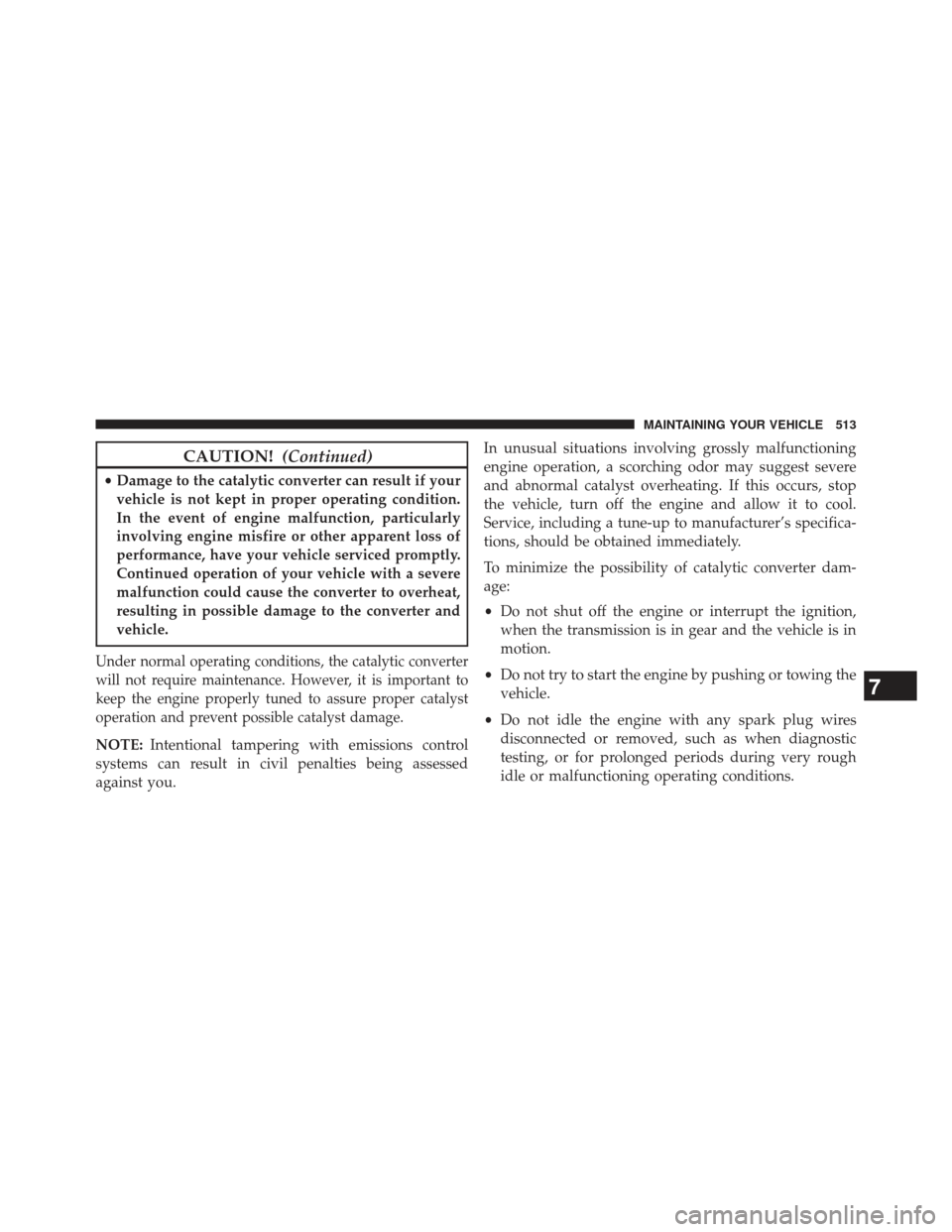
CAUTION!(Continued)
•Damage to the catalytic converter can result if your
vehicle is not kept in proper operating condition.
In the event of engine malfunction, particularly
involving engine misfire or other apparent loss of
performance, have your vehicle serviced promptly.
Continued operation of your vehicle with a severe
malfunction could cause the converter to overheat,
resulting in possible damage to the converter and
vehicle.
Under normal operating conditions, the catalytic converter
will not require maintenance. However, it is important to
keep the engine properly tuned to assure proper catalyst
operation and prevent possible catalyst damage.
NOTE: Intentional tampering with emissions control
systems can result in civil penalties being assessed
against you. In unusual situations involving grossly malfunctioning
engine operation, a scorching odor may suggest severe
and abnormal catalyst overheating. If this occurs, stop
the vehicle, turn off the engine and allow it to cool.
Service, including a tune-up to manufacturer’s specifica-
tions, should be obtained immediately.
To minimize the possibility of catalytic converter dam-
age:
•
Do not shut off the engine or interrupt the ignition,
when the transmission is in gear and the vehicle is in
motion.
• Do not try to start the engine by pushing or towing the
vehicle.
• Do not idle the engine with any spark plug wires
disconnected or removed, such as when diagnostic
testing, or for prolonged periods during very rough
idle or malfunctioning operating conditions.
7
MAINTAINING YOUR VEHICLE 513
Page 516 of 592
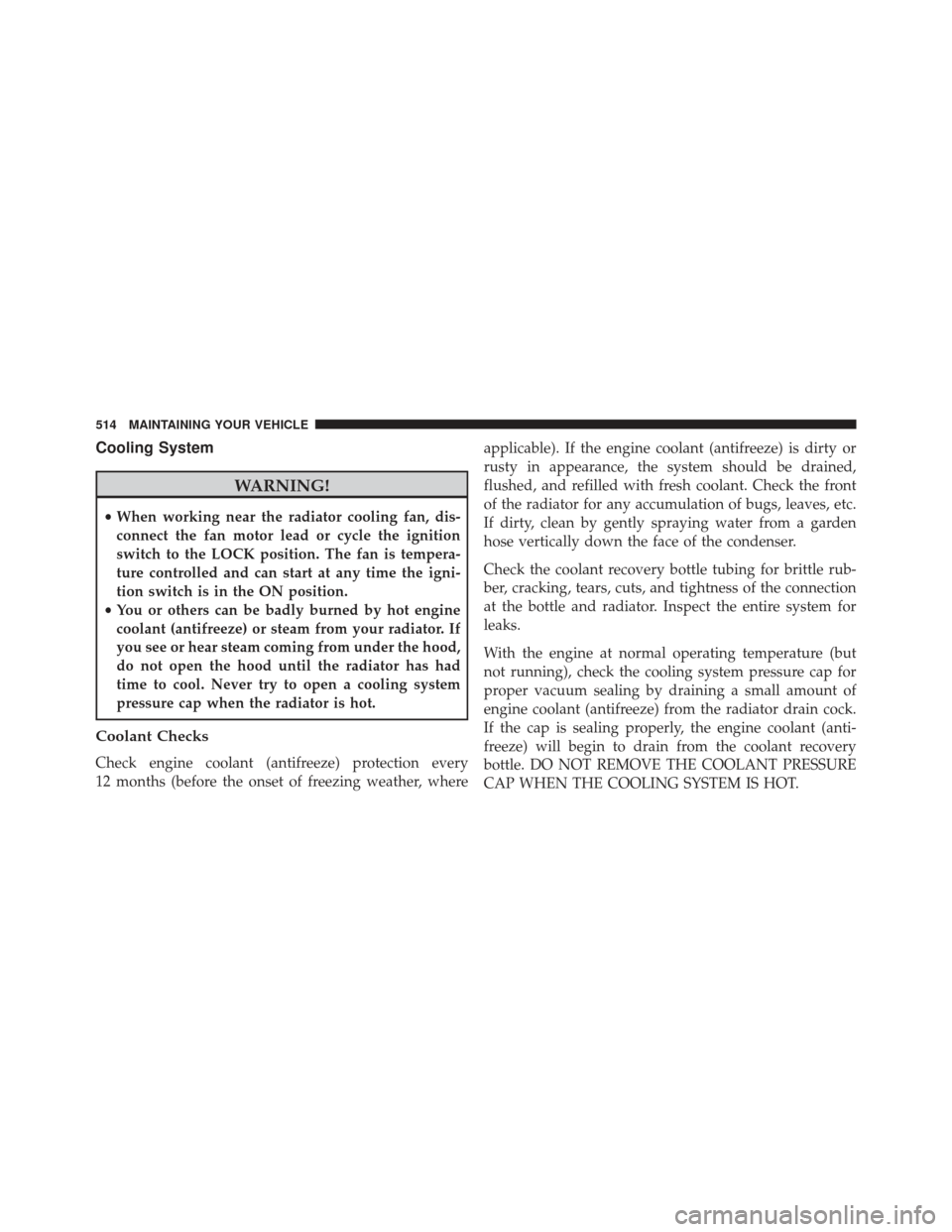
Cooling System
WARNING!
•When working near the radiator cooling fan, dis-
connect the fan motor lead or cycle the ignition
switch to the LOCK position. The fan is tempera-
ture controlled and can start at any time the igni-
tion switch is in the ON position.
• You or others can be badly burned by hot engine
coolant (antifreeze) or steam from your radiator. If
you see or hear steam coming from under the hood,
do not open the hood until the radiator has had
time to cool. Never try to open a cooling system
pressure cap when the radiator is hot.
Coolant Checks
Check engine coolant (antifreeze) protection every
12 months (before the onset of freezing weather, where applicable). If the engine coolant (antifreeze) is dirty or
rusty in appearance, the system should be drained,
flushed, and refilled with fresh coolant. Check the front
of the radiator for any accumulation of bugs, leaves, etc.
If dirty, clean by gently spraying water from a garden
hose vertically down the face of the condenser.
Check the coolant recovery bottle tubing for brittle rub-
ber, cracking, tears, cuts, and tightness of the connection
at the bottle and radiator. Inspect the entire system for
leaks.
With the engine at normal operating temperature (but
not running), check the cooling system pressure cap for
proper vacuum sealing by draining a small amount of
engine coolant (antifreeze) from the radiator drain cock.
If the cap is sealing properly, the engine coolant (anti-
freeze) will begin to drain from the coolant recovery
bottle. DO NOT REMOVE THE COOLANT PRESSURE
CAP WHEN THE COOLING SYSTEM IS HOT.
514 MAINTAINING YOUR VEHICLE
Page 540 of 592
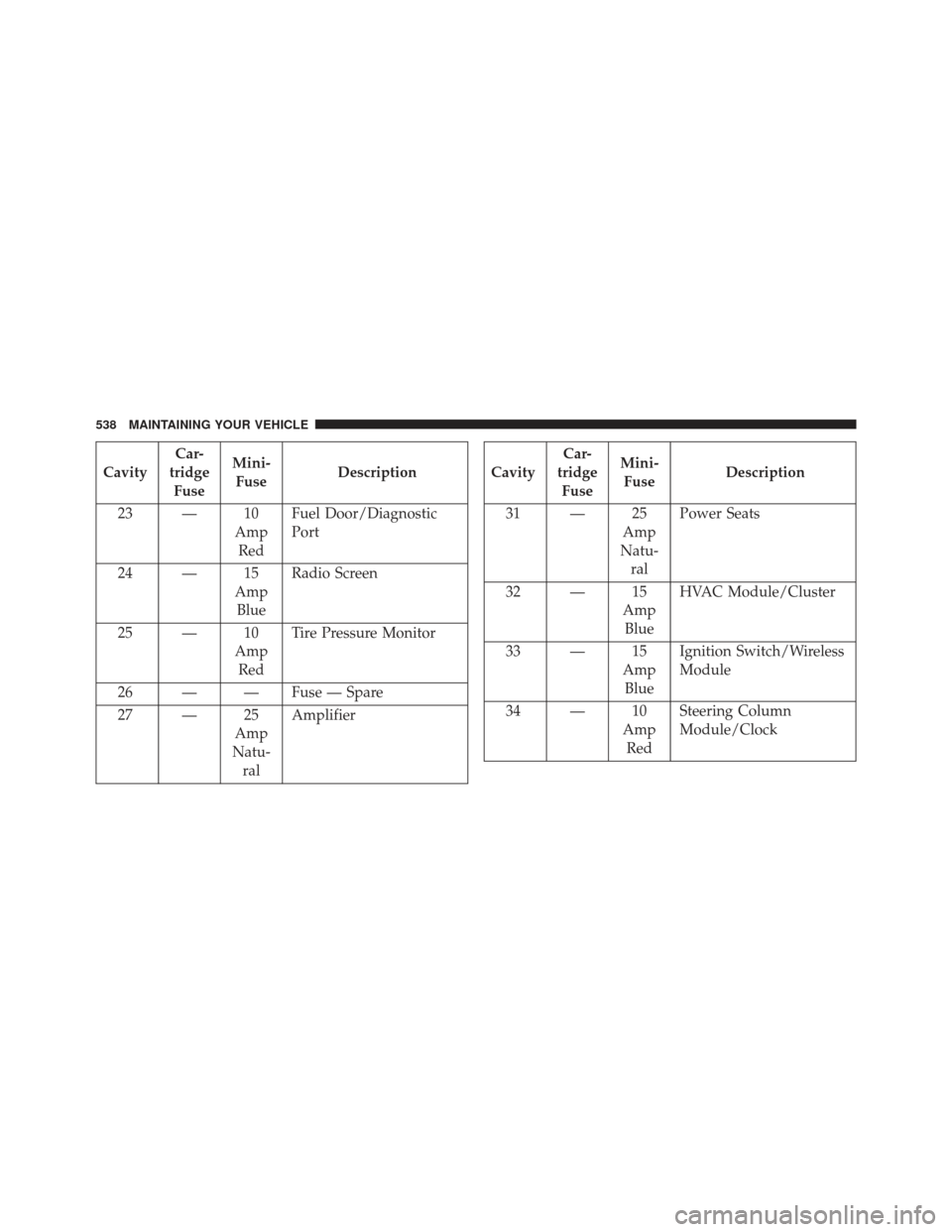
CavityCar-
tridge Fuse Mini-
Fuse Description
23 — 10 AmpRed Fuel Door/Diagnostic
Port
24 — 15 AmpBlue Radio Screen
25 — 10 AmpRed Tire Pressure Monitor
26 — — Fuse — Spare
27 — 25 Amp
Natu- ral AmplifierCavity
Car-
tridge Fuse Mini-
Fuse Description
31 — 25 Amp
Natu- ral Power Seats
32 — 15 AmpBlue HVAC Module/Cluster
33 — 15 AmpBlue Ignition Switch/Wireless
Module
34 — 10 AmpRed Steering Column
Module/Clock
538 MAINTAINING YOUR VEHICLE
Page 580 of 592
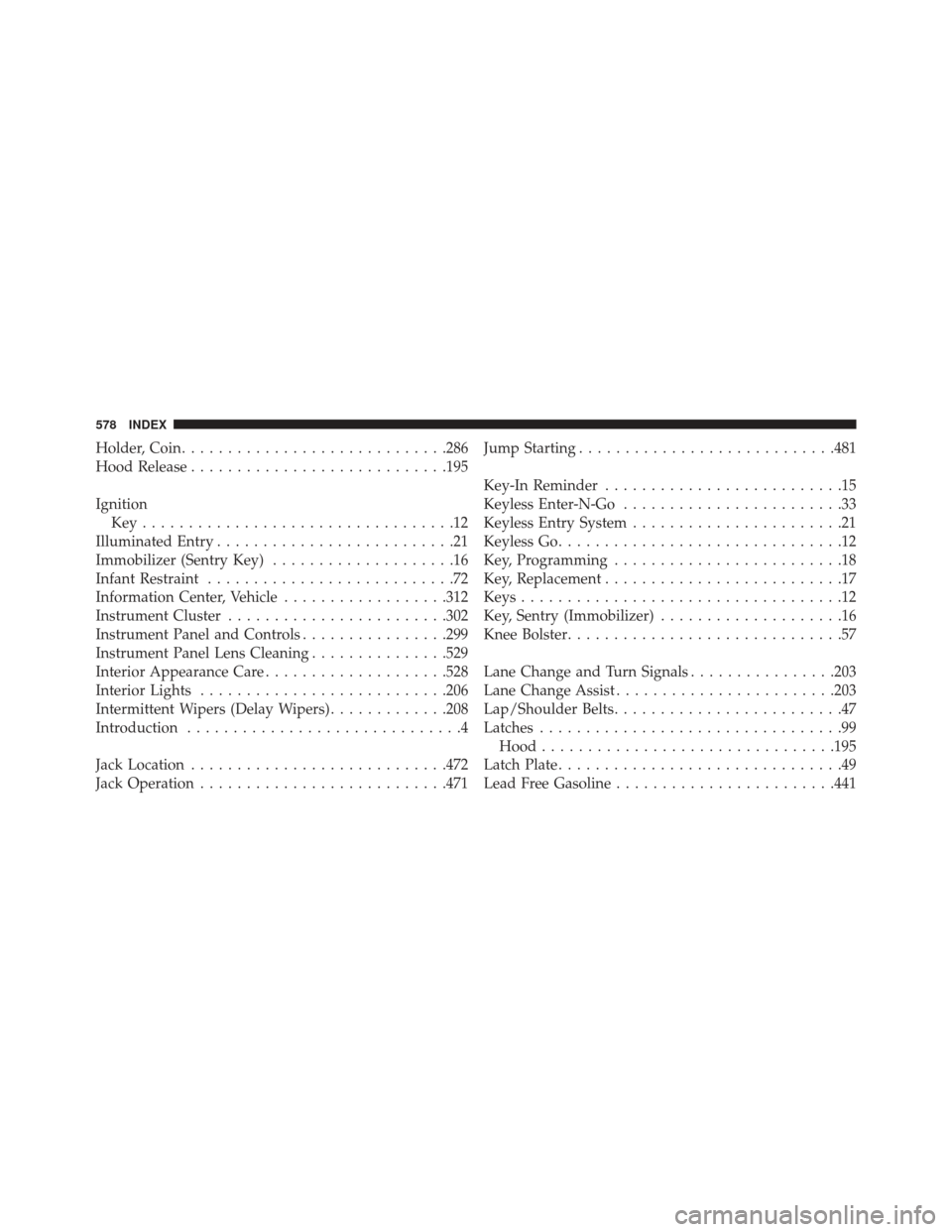
Holder, Coin............................ .286
Hood Release ........................... .195
Ignition Key..................................12
Illuminated Entry ..........................21
Immobilizer (Sentry Key) ....................16
Infant Restraint ...........................72
Information Center, Vehicle ..................312
Instrument Cluster ....................... .302
Instrument Panel and Controls ................299
Instrument Panel Lens Cleaning ...............529
Interior Appearance Care ....................528
Interior Lights .......................... .206
Intermittent Wipers (Delay Wipers) .............208
Introduction ..............................4
Jack Location ........................... .472
Jack Operation .......................... .471Jump Starting
........................... .481
Key-In Reminder ..........................15
Keyless Enter-N-Go ........................33
Keyless Entry System .......................21
Keyless Go ...............................12
Key, Programming .........................18
Key, Replacement ..........................17
Keys ...................................12
Key, Sentry (Immobilizer) ....................16
Knee Bolster ..............................57
Lane Change and Turn Signals ................203
Lane Change Assist ....................... .203
Lap/Shoulder Belts .........................47
Latches .................................99
Hood ............................... .195
Latch Plate ...............................49
Lead Free Gasoline ....................... .441
578 INDEX