Page 281 of 517

•Mix
Air is directed through the floor, defrost, and side
window demist outlets. This setting works best in
cold or snowy conditions that require extra heat to the
windshield. This setting is good for maintaining comfort
while reducing moisture on the windshield.
• Defrost
Air is directed through the windshield and side
window demist outlets. Use this mode with maxi-
mum blower and temperature settings for best wind-
shield and side window defrosting.
NOTE: The air conditioning compressor operates in Mix,
Defrost, or a blend of these modes, even if the Air
Conditioning (A/C) button is not pressed. This dehu-
midifies the air to help dry the windshield. To improve
fuel economy, use these modes only when necessary. •
Recirculation Control
Pressing the Recirculation Control button will
temporarily put the system in recirculation
mode. This can be used when outside condi-
tions such as smoke, odors, dust, or high
humidity are present. Activating recirculation will cause
the LED in the control button to illuminate.
NOTE:
• Continuous use of the Recirculation mode may make
the inside air stuffy and window fogging may occur.
Extended use of this mode is not recommended.
• The use of the Recirculation mode in cold or damp
weather will cause windows to fog on the inside,
because of moisture buildup inside the vehicle. Select
the outside air position for maximum defogging.
4
UNDERSTANDING YOUR INSTRUMENT PANEL 279
Page 295 of 517
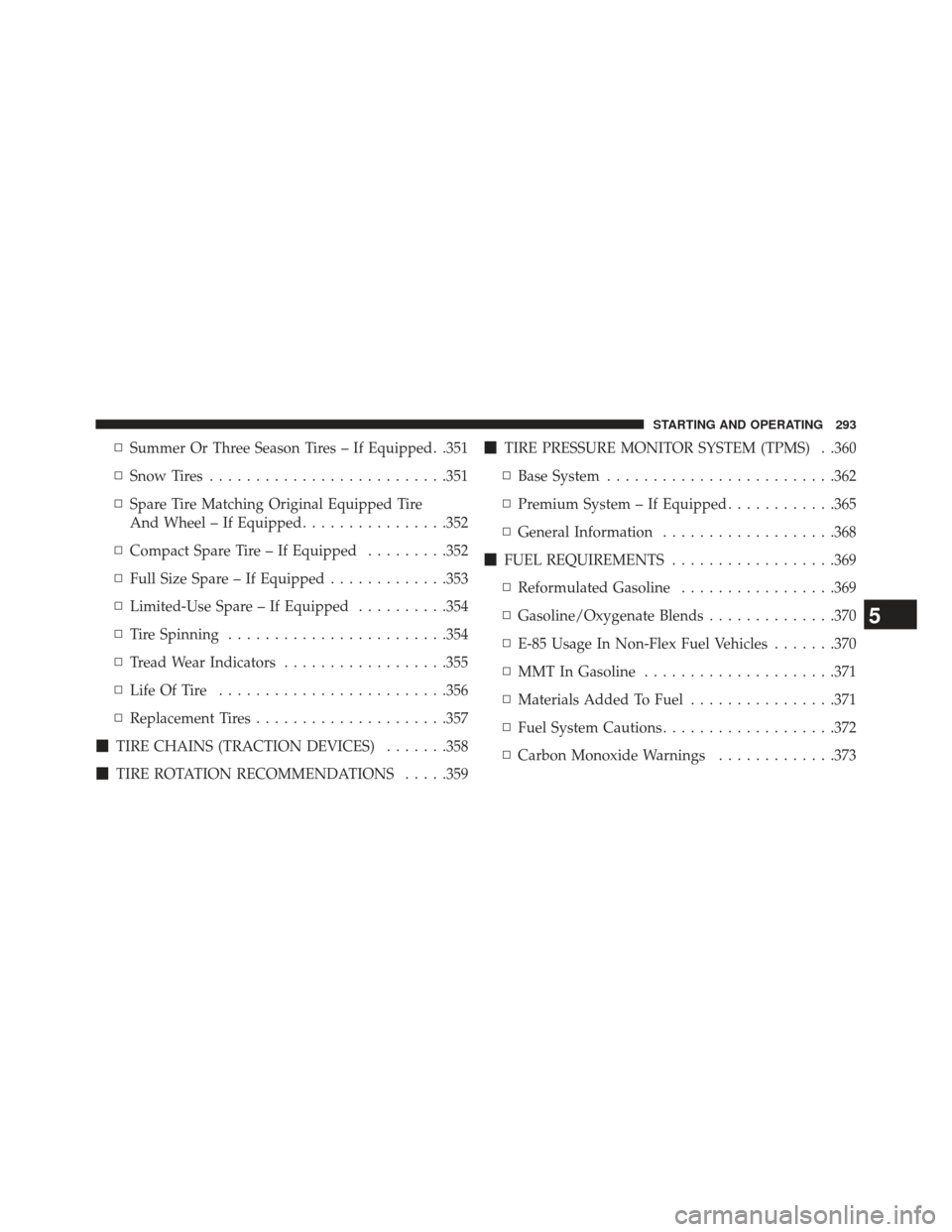
▫Summer Or Three Season Tires – If Equipped. .351
▫ Snow Tires ......................... .351
▫ Spare Tire Matching Original Equipped Tire
And Wheel – If Equipped ................352
▫ Compact Spare Tire – If Equipped .........352
▫ Full Size Spare – If Equipped .............353
▫ Limited-Use Spare – If Equipped ..........354
▫ Tire Spinning ....................... .354
▫ Tread Wear Indicators ..................355
▫ Life Of Tire ........................ .356
▫ Replacement Tires .....................357
� TIRE CHAINS (TRACTION DEVICES) .......358
� TIRE ROTATION RECOMMENDATIONS .....359�
TIRE PRESSURE MONITOR SYSTEM (TPMS) . .360
▫ Base System ........................ .362
▫ Premium System – If Equipped ............365
▫ General Information ...................368
� FUEL REQUIREMENTS ..................369
▫ Reformulated Gasoline .................369
▫ Gasoline/Oxygenate Blends ..............370
▫ E-85 Usage In Non-Flex Fuel Vehicles .......370
▫ MMT In Gasoline .....................371
▫ Materials Added To Fuel ................371
▫ Fuel System Cautions ...................372
▫ Carbon Monoxide Warnings .............373
5
STARTING AND OPERATING 293
Page 296 of 517

�FLEXIBLE FUEL (3.6L ENGINE ONLY) — IF
EQUIPPED .......................... .373
▫ E-85 General Information ...............373
▫ Ethanol Fuel (E-85) ....................375
▫ Fuel Requirements ....................375
▫ Selection Of Engine Oil For Flexible Fuel
Vehicles (E-85) And Gasoline Vehicles .......376
▫ Starting ........................... .376
▫ Cruising Range ...................... .376
▫ Replacement Parts ....................377
▫ Maintenance ....................... .377
� ADDING FUEL ....................... .377
▫ Fuel Filler Cap (Gas Cap) ...............377
▫ Loose Filler Cap Message ...............379�
VEHICLE LOADING ....................380
▫ Vehicle Certification Label ...............380
▫ Gross Vehicle Weight Rating (GVWR) .......380
▫ Gross Axle Weight Rating (GAWR) .........380
▫ Overloading ........................ .381
▫ Loading ........................... .381
� TRAILER TOWING .....................381
▫ Common Towing Definitions .............382
▫ Trailer Hitch Classification ...............384
▫ Trailer Towing Weights (Maximum Trailer
Weight Ratings) ..................... .385
▫ Trailer And Tongue Weight ..............386
▫ Towing Requirements ..................387
294 STARTING AND OPERATING
Page 300 of 517

Extreme Cold Weather (Below –20°F Or 29°C)
To ensure reliable starting at these temperatures, use of
an externally powered electric engine block heater (avail-
able from your authorized dealer) is recommended.
If Engine Fails To Start
WARNING!
•Never pour fuel or other flammable liquid into the
throttle body air inlet opening in an attempt to start
the vehicle. This could result in flash fire causing
serious personal injury.
•
Do not attempt to push or tow your vehicle to get it
started. Vehicles equipped with an automatic trans-
mission cannot be started this way. Unburned fuel
could enter the catalytic converter and once the engine
has started, ignite and damage the converter and
vehicle.
(Continued)
WARNING! (Continued)
•If the vehicle has a discharged battery, booster
cables may be used to obtain a start from a booster
battery or the battery in another vehicle. This type
of start can be dangerous if done improperly. Refer
to “Jump Starting” in “What To Do In Emergen-
cies” for further information.
Without Tip Start
If the engine fails to start after you have followed the
“Normal Starting” or “Extreme Cold Weather” proce-
dures, it may be flooded. Push the accelerator pedal all
the way to the floor and hold it there while cranking the
engine. This should clear any excess fuel in case the
engine is flooded.
298 STARTING AND OPERATING
Page 301 of 517

CAUTION!
To prevent damage to the starter, do not crank the
engine for more than 15 seconds at a time. Wait 10 to
15 seconds before trying again.
If the engine is flooded, it may start to run, but not have
enough power to continue running when the key is
released. If this occurs, continue cranking up to 15 sec-
onds with the accelerator pedal pushed all the way to the
floor.
If the engine shows no sign of starting after two 15-second
periods of cranking with the accelerator pedal held to the
floor, repeat the “Normal Starting” or “Extreme Cold
Weather” procedures.
With Tip Start
If the engine fails to start after you have followed the
“Normal Starting” or “Extreme Cold Weather” proce-
dures, it may be flooded. To clear any excess fuel, push
the accelerator pedal all the way to the floor and hold it.
Then, turn the ignition switch to the START position and
release it as soon as the starter engages. The starter motor
will disengage automatically in 10 seconds. Once this
occurs, release the accelerator pedal, turn the ignition
switch to the LOCK position, wait 10 to 15 seconds, then
repeat the “Normal Starting” procedure.
CAUTION!
To prevent damage to the starter, wait 10 to 15 sec-
onds before trying again.
5
STARTING AND OPERATING 299
Page 309 of 517

WARNING!
Do not coast in NEUTRAL and never turn off the
ignition to coast down a hill. These are unsafe
practices that limit your response to changing traffic
or road conditions. You might lose control of the
vehicle and have a collision.
CAUTION!
Towing the vehicle, coasting, or driving for any other
reason with the transmission in NEUTRAL can cause
severe transmission damage. Refer to “Recreational
Towing” in “Starting And Operating” and “Towing A
Disabled Vehicle” in “What To Do In Emergencies”
for further information.
DRIVE
This range should be used for most city and highway
driving. It provides the smoothest upshifts and down-
shifts, and the best fuel economy. The transmission
automatically upshifts through all forward gears. The
DRIVE position provides optimum driving characteris-
tics under all normal operating conditions.
When frequent transmission shifting occurs (such as
when operating the vehicle under heavy loading condi-
tions, in hilly terrain, traveling into strong head winds, or
while towing heavy trailers), select the�3�range. Under
these conditions, using the �3�range will improve perfor-
mance and extend transmission life by reducing exces-
sive shifting and heat buildup.
5
STARTING AND OPERATING 307
Page 312 of 517

Overdrive Operation
The automatic transmission includes an electronically
controlled Overdrive (fourth gear). The transmission will
automatically shift into Overdrive if the following con-
ditions are present:
•the shift lever is in the DRIVE position,
•
the transmission fluid has reached an adequate
temperature,
• the engine coolant has reached an adequate
temperature,
• vehicle speed is sufficiently high, and
• the driver is not heavily pressing the accelerator.
Torque Converter Clutch
A feature designed to improve fuel economy has been
included in the automatic transmission on your vehicle.
A clutch within the torque converter engages automati-
cally at calibrated speeds. This may result in a slightly
different feeling or response during normal operation in
the upper gears. When the vehicle speed drops or during
some accelerations, the clutch automatically disengages.
NOTE: The torque converter clutch will not engage until
the transmission fluid and engine coolant are warm
[usually after 1 to 3 miles (2 to 5 km) of driving]. Because
the engine speed is higher when the torque converter
clutch is not engaged, it may seem as if the transmission
is not shifting into Overdrive when cold. This is normal.
Shifting between the DRIVE and 3 ranges, when the
transmission is sufficiently warm, will demonstrate that
the transmission is able to shift into and out of Overdrive.
310 STARTING AND OPERATING
Page 318 of 517

DRIVE
This range should be used for most city and highway
driving. It provides the smoothest upshifts and down-
shifts, and the best fuel economy. The transmission
automatically upshifts through underdrive first, second,
third, and fourth gears, direct fifth gear and overdrive
sixth gear. The DRIVE position provides optimum driv-
ing characteristics under all normal operating conditions.
When frequent transmission shifting occurs (such as
when operating the vehicle under heavy loading condi-
tions, in hilly terrain, or traveling into strong head
winds), use the AutoStick® shift control (refer to
“AutoStick®” in this section) to select a lower gear.
Under these conditions, using a lower gear will improve
performance and extend transmission life by reducing
excessive shifting and heat buildup.
During cold temperatures, transmission operation may be
modified depending on engine and transmission tempera-
ture as well as vehicle speed. This feature improves warm
up time of the engine and transmission to achieve maxi-
mum efficiency. Engagement of the torque converter clutch
is inhibited until the transmission fluid is warm (refer to
the “Note” under “Torque Converter Clutch” in this sec-
tion). During extremely cold temperatures (-16°F [-27°C] or
below), operation may briefly be limited to third gear only.
Normal operation will resume once the transmission tem-
perature has risen to a suitable level.
Transmission Limp Home Mode
Transmission function is monitored electronically for
abnormal conditions. If a condition is detected that could
result in transmission damage, Transmission Limp Home
Mode is activated. In this mode, the transmission remains
in third gear regardless of which forward gear is selected.
316 STARTING AND OPERATING