2013 BMW X5 XDRIVE35D seat
[x] Cancel search: seatPage 151 of 345

1Brackets2Telescopic rail3Notch in the cargo area rail
Mounting brackets
The two brackets are connected with a tele‐
scopic rail.
1.Insert the brackets at the respective notch
in the rail on the cargo area floor.2.Press down the brackets to push them into
the desired position.3.Check the firm seating of the brackets.
They must be clearly heard to engage.
No cargo on brackets
Do not lay cargo on the brackets, as oth‐
erwise they could be unlocked.◀
Dividing up cargo area
The cargo can be positioned as follows:
▷Between the rear seat backrest and the
telescopic rail▷Between the telescopic rail and the retain‐
ing strapPositioning cargo between telescopic rail and
retaining strap:1.Lay the cargo on the telescopic rail. Press
the button, arrow 1, and route the retaining
strap around the cargo, arrow 2.2.Hook the retaining strap into the mount 3
on the telescopic rail.3.Press the button of the bracket, arrow 1.
The retaining strap is tensioned.
It is also possible to hook the two retaining
straps onto each other.
When the adaptive fixing system is no longer
needed, unhook the retaining strap and guide
it back into the bracket holding the hook to
prevent damage and injury.
Then slide the fastening system toward the
front in order to permit the best possible use of
the cargo area.
Removing brackets Press down the brackets, slide them up to the
notches of the rails and remove them.
Depending on the vehicle's equipment, the adaptive fixing system can be stored under thecargo floor panel in the cargo area.
Ski bag
The ski bag is designed for safe, clean trans‐
port of up to 4 pairs of standard skis or up to
2 snowboards.
Skis with a length of up to 6 ft/2.10 m can be
stowed using the ski bag. When stowing skis
with a length of 6 ft/2.10 m, the capacity of the
ski bag is reduced as the bag narrows.
Folding in display screen
Before loading the ski bag, fold in the
display screen of the DVD systems in the rear;
otherwise, the display screen could be dam‐
aged.◀
Seite 151Storage compartmentsControls151
Online Edition for Part no. 01 40 2 918 395 - III/13
Page 152 of 345
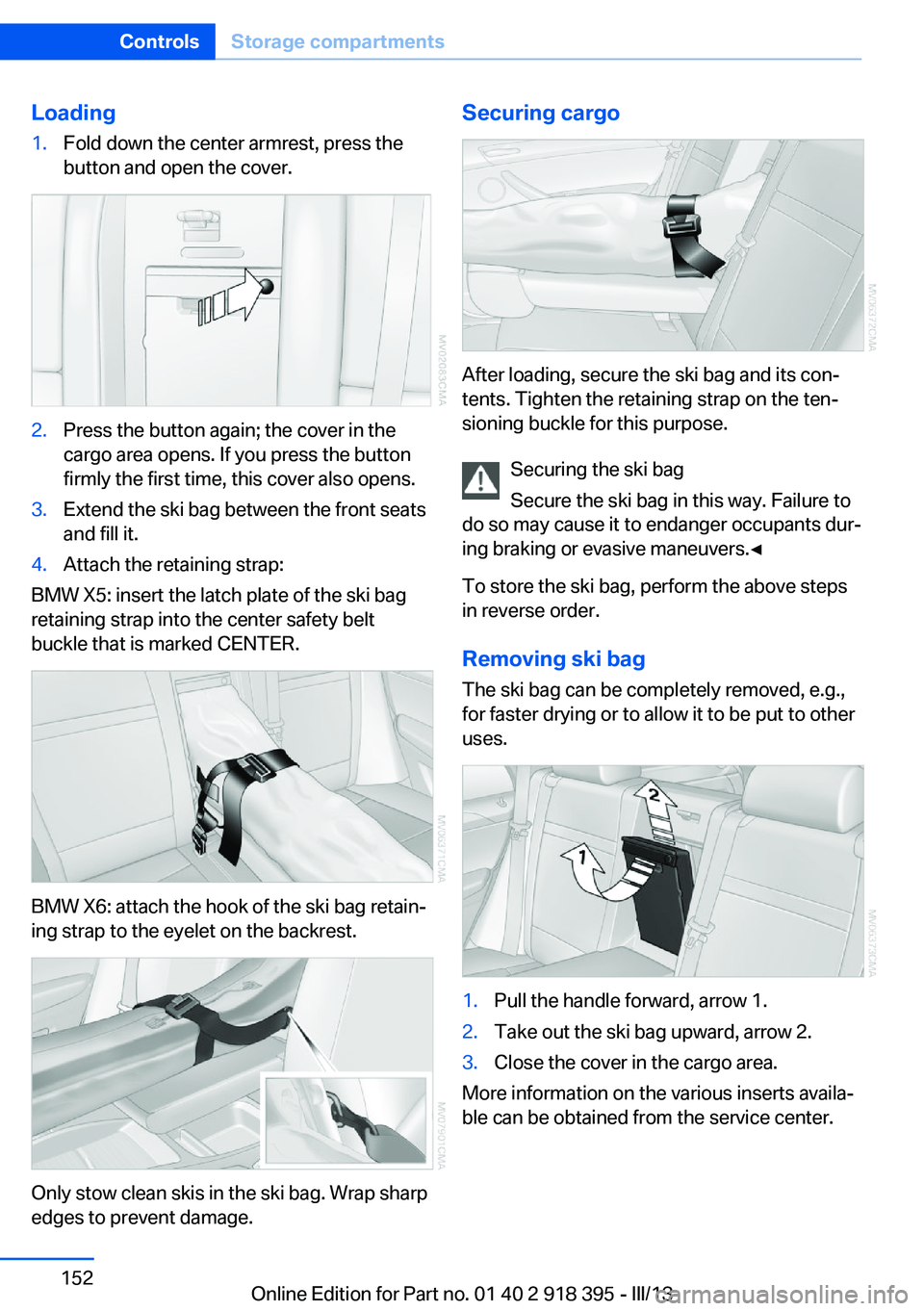
Loading1.Fold down the center armrest, press the
button and open the cover.2.Press the button again; the cover in the
cargo area opens. If you press the button
firmly the first time, this cover also opens.3.Extend the ski bag between the front seats
and fill it.4.Attach the retaining strap:
BMW X5: insert the latch plate of the ski bag
retaining strap into the center safety belt
buckle that is marked CENTER.
BMW X6: attach the hook of the ski bag retain‐
ing strap to the eyelet on the backrest.
Only stow clean skis in the ski bag. Wrap sharp
edges to prevent damage.
Securing cargo
After loading, secure the ski bag and its con‐
tents. Tighten the retaining strap on the ten‐
sioning buckle for this purpose.
Securing the ski bag
Secure the ski bag in this way. Failure to
do so may cause it to endanger occupants dur‐
ing braking or evasive maneuvers.◀
To store the ski bag, perform the above steps
in reverse order.
Removing ski bag
The ski bag can be completely removed, e.g.,
for faster drying or to allow it to be put to other
uses.
1.Pull the handle forward, arrow 1.2.Take out the ski bag upward, arrow 2.3.Close the cover in the cargo area.
More information on the various inserts availa‐
ble can be obtained from the service center.
Seite 152ControlsStorage compartments152
Online Edition for Part no. 01 40 2 918 395 - III/13
Page 162 of 345
Stowing cargo▷Very heavy cargo: when the rear seat is not
occupied, secure each of the outer safety
belts in the opposite buckle.▷Heavy cargo: stow as far forward and as
low as possible, ideally directly behind the
backrests.▷Cover sharp edges and corners.▷Do not pile cargo higher than the top edge
of the backrests.▷If necessary, fold down the rear backrests
to stow cargo.▷Place protective material around any
sharp-edged or pointed objects that could
bump against the rear window while the
vehicle is in motion.
Securing cargo
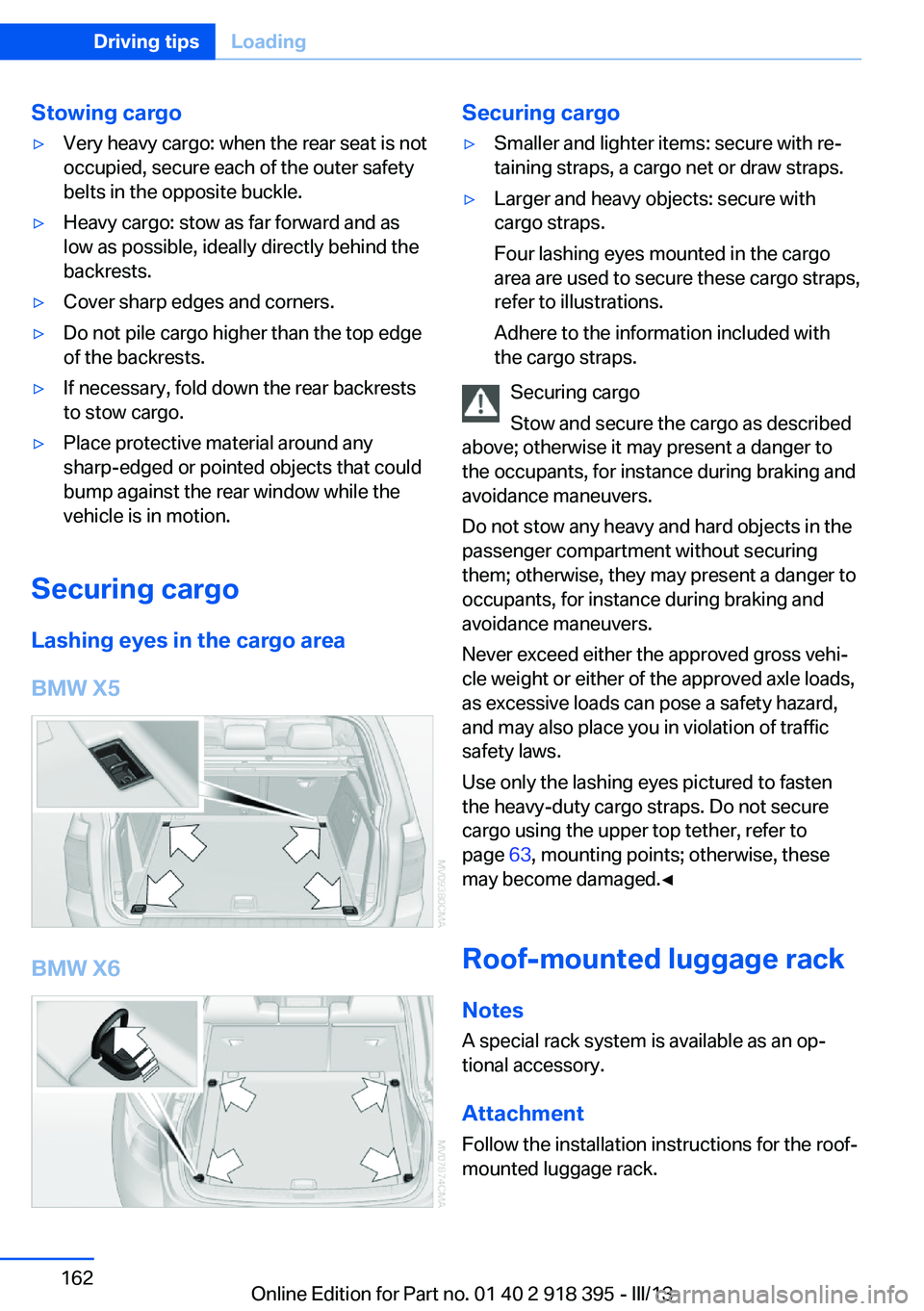
Lashing eyes in the cargo area
BMW X5
BMW X6
Securing cargo▷Smaller and lighter items: secure with re‐
taining straps, a cargo net or draw straps.▷Larger and heavy objects: secure with
cargo straps.
Four lashing eyes mounted in the cargo
area are used to secure these cargo straps,
refer to illustrations.
Adhere to the information included with
the cargo straps.
Securing cargo
Stow and secure the cargo as described
above; otherwise it may present a danger to
the occupants, for instance during braking and
avoidance maneuvers.
Do not stow any heavy and hard objects in the
passenger compartment without securing
them; otherwise, they may present a danger to
occupants, for instance during braking and
avoidance maneuvers.
Never exceed either the approved gross vehi‐
cle weight or either of the approved axle loads,
as excessive loads can pose a safety hazard,
and may also place you in violation of traffic
safety laws.
Use only the lashing eyes pictured to fasten
the heavy-duty cargo straps. Do not secure
cargo using the upper top tether, refer to
page 63, mounting points; otherwise, these
may become damaged.◀
Roof-mounted luggage rack
Notes A special rack system is available as an op‐
tional accessory.
Attachment Follow the installation instructions for the roof-
mounted luggage rack.
Seite 162Driving tipsLoading162
Online Edition for Part no. 01 40 2 918 395 - III/13
Page 165 of 345

Use coasting conditions
When approaching a red light, take your foot
off the accelerator and let the vehicle coast to
a halt.
On a downhill gradient, take your foot off the
accelerator and let the vehicle roll.
The flow of fuel is interrupted while coasting.
Switch off the engine during longer stops
Switch off the engine during longer stops, e.g.,
at traffic lights, railroad crossings or in traffic
congestion.
Fuel savings are already achieved after the en‐
gine is turned off for as little as 4 seconds.
Switch off any functions that
are not currently needed
Functions such as seat heating and the rear
window defroster require a lot of energy and
consume additional fuel, especially in city and
stop-and-go traffic.
Therefore, switch off these functions if they
are not actually needed.
Have maintenance carried
out
Have vehicles maintained regularly to achieve
optimal vehicle economy and operating life.
Have the maintenance carried out by your
service center.
Please also note the BMW Maintenance Sys‐
tem, refer to page 293.Seite 165Saving fuelDriving tips165
Online Edition for Part no. 01 40 2 918 395 - III/13
Page 276 of 345

Do not exceed the maximum permissible
speed
The maximum permissible speed for these tire
pressures is 100 mph/160 km/h. Do not ex‐
ceed this speed; otherwise, tire damage and
accidents may occur.◀
Tire inflation pressures for driving
above 100 mph or 160 km/h
Adjust the tire inflation pressures
To drive at maximum speeds in excess of
100 mph/160 km/h, adjust pressures to the re‐
spective tire inflation pressures listed on the
following pages in the column for traveling
speeds including those exceeding 100 mph or
160 km/h. Otherwise, tire damage and acci‐
dents could occur.◀
Observe all national and local maximum speed
limits; otherwise, violations of the laws could
occur.
Tire inflation pressures X5 xDrive35i/X5 xDrive35d with two rows of seats
Tire sizePressure specifications in bar/PSITraveling speeds of up to
100 mph/160 km/hTraveling speeds including
those exceeding 100 mph/
160 km/hAll pressure specifications in the ta‐
ble are indicated in bar/PSI with cold
tires.
Cold = ambient temperatureCompact wheel:
T 155/90 D 18 113 M
T 155/80 R 19 114 MSpeeds of up to 50 mph/80 km/h
4.2/60Without Sport Package:255/55 R 18 109 H M+S XL A/S RSC
255/55 R 18 109 H M+S XL RSC2.2/322.5/362.4/352.8/41255/50 R 19 107 H M+S XL A/S RSC
255/50 R 19 107 H M+S XL RSC2.2/322.6/382.4/352.9/42Front: 255/50 R 19 107 V XL RSC
Rear: 285/45 R 19 111 V XL RSC2.2/32
--
2.4/352.4/35
--
2.6/38Seite 276MobilityWheels and tires276
Online Edition for Part no. 01 40 2 918 395 - III/13
Page 277 of 345

Tire sizePressure specifications in bar/PSIFront: 275/40 R 20 106 W XL RSC
Rear: 315/35 R 20 110 W XL RSC2.3/33
--
2.4/352.4/35
--
2.6/38Front: 285/35 R 21 105 W XL RSC
Rear: 325/30 R 21 108 W XL RSC2.3/33
--
2.6/382.5/36
--
2.8/41Front: 275/40 R 20 106 V M+S XL
RSC
Rear: 315/35 R 20 110 V M+S XL
RSC2.3/33
--
2.4/352.4/35
--
2.7/39With Sport Package:255/55 R 18 109 H M+S XL RSC2.2/322.5/362.4/352.8/41255/50 R 19 107 H M+S XL RSC2.2/322.6/382.4/352.9/42Front: 255/50 R 19 107 V XL RSC
Rear: 285/45 R 19 111 V XL RSC2.2/32
--
2.4/352.7/39
--
2.9/42Front: 275/40 R 20 106 W XL RSC
Rear: 315/35 R 20 110 W XL RSC2.3/33
--
2.4/352.6/38
--
2.8/41Front: 285/35 R 21 105 W XL RSC
Rear: 325/30 R 21 108 W XL RSC2.3/33
--
2.6/382.6/38
--
3.1/45Front: 275/40 R 20 106 V M+S XL
RSC
Rear: 315/35 R 20 110 V M+S XL
RSC2.3/33
--
2.4/352.7/39
--
3.0/44
Tire inflation pressures X5 xDrive50i with two rows of seats
Tire sizePressure specifications in bar/PSITraveling speeds of up to
100 mph/160 km/hTraveling speeds including
those exceeding 100 mph/
160 km/hAll pressure specifications in the ta‐
ble are indicated in bar/PSI with cold
tires.
Cold = ambient temperatureSeite 277Wheels and tiresMobility277
Online Edition for Part no. 01 40 2 918 395 - III/13
Page 279 of 345

Tire inflation pressures X5 xDrive35i/X5 xDrive35d with three rows of seats
Tire sizePressure specifications in bar/PSITraveling speeds of up to
100 mph/160 km/hTraveling speeds including
those exceeding 100 mph/
160 km/hAll pressure specifications in the ta‐
ble are indicated in bar/PSI with cold
tires.
Cold = ambient temperatureWithout Sport Package:255/55 R 18 109 H M+S XL A/S RSC
255/55 R 18 109 H M+S XL RSC2.3/332.8/412.6/383.1/45255/50 R 19 107 H M+S XL A/S RSC
255/50 R 19 107 H M+S XL RSC2.5/363.0/442.8/413.3/48Front: 255/50 R 19 107 V XL RSC
Rear: 285/45 R 19 111 V XL RSC2.2/32
--
2.6/382.4/35
--
2.9/42Front: 275/40 R 20 106 W XL RSC
Rear: 315/35 R 20 110 W XL RSC2.3/33
--
2.7/392.4/35
--
2.9/42Front: 285/35 R 21 105 W XL RSC
Rear: 325/30 R 21 108 W XL RSC2.4/35
--
2.9/422.6/38
--
3.1/45Front: 275/40 R 20 106 V M+S XL
RSC
Rear: 315/35 R 20 110 V M+S XL
RSC2.3/33
--
2.7/392.4/35
--
2.9/42With Sport Package:255/55 R 18 109 H M+S XL RSC2.3/332.8/412.6/383.1/45255/50 R 19 107 H M+S XL RSC2.5/363.0/442.8/413.3/48Front: 255/50 R 19 107 V XL RSC
Rear: 285/45 R 19 111 V XL RSC2.2/32
--
2.6/382.8/41
--
3.3/48Front: 275/40 R 20 106 W XL RSC
Rear: 315/35 R 20 110 W XL RSC2.3/33
--
2.7/392.8/41
--
3.3/48Seite 279Wheels and tiresMobility279
Online Edition for Part no. 01 40 2 918 395 - III/13
Page 280 of 345

Tire sizePressure specifications in bar/PSIFront: 285/35 R 21 105 W XL RSC
Rear: 325/30 R 21 108 W XL RSC2.4/35
--
2.9/422.9/42
--
3.4/49Front: 275/40 R 20 106 V M+S XL
RSC
Rear: 315/35 R 20 110 V M+S XL
RSC2.3/33
--
2.7/392.8/41
--
3.3/48
Tire inflation pressures X5 xDrive50i with three rows of seats
Tire sizePressure specifications in bar/PSITraveling speeds of up to
100 mph/160 km/hTraveling speeds including
those exceeding 100 mph/
160 km/hAll pressure specifications in the ta‐
ble are indicated in bar/PSI with cold
tires.
Cold = ambient temperatureWithout Sport Package:255/55 R 18 109 H M+S XL A/S RSC
255/55 R 18 109 H M+S XL RSC2.3/332.8/412.6/383.1/45255/50 R 19 107 H M+S XL A/S RSC
255/50 R 19 107 H M+S XL RSC2.5/363.0/442.8/413.3/48Front: 255/50 R 19 107 W XL RSC
Rear: 285/45 R 19 111 W XL RSC2.2/32
--
2.6/382.4/35
--
2.9/42Front: 275/40 R 20 106 W XL RSC
Rear: 315/35 R 20 110 W XL RSC2.3/33
--
2.7/392.4/35
--
2.9/42Front: 285/35 R 21 105 Y XL RSC
Rear: 325/30 R 21 108 Y XL RSC2.4/35
--
2.9/422.6/38
--
3.1/45Front: 275/40 R 20 106 V M+S XL
RSC
Rear: 315/35 R 20 110 V M+S XL
RSC2.3/33
--
2.7/392.4/35
--
2.9/42With Sport Package:Seite 280MobilityWheels and tires280
Online Edition for Part no. 01 40 2 918 395 - III/13