2013 BMW 335I flat tire
[x] Cancel search: flat tirePage 100 of 242
Continued driving with a flat tire
If continuing to drive with a damaged tire:1.Avoid sudden braking and steering maneu‐
vers.2.Do not exceed a speed of 50 mph/80 km/h.3.Check the air pressure in all four tires at the
next opportunity.
If the tire inflation pressure in all four tires is
correct, the Flat Tire Monitor may not have
been initialized. In this case, initialize the
system.
Possible driving distance with complete loss of
tire inflation pressure:
The possible driving distance after a loss of tire
inflation pressure depends on the cargo load
and the driving style and conditions.
For a vehicle containing an average load, the
possible driving distance is approx.
50 miles/80 km.
When the vehicle is driven with a damaged tire,
its handling characteristics change, e.g., re‐
duced lane stability during braking, a longer
braking distance, and altered self-steering
properties. Adjust your driving style accord‐
ingly. Avoid abrupt steering maneuvers or driv‐
ing over obstacles, e.g., curbs, potholes, etc.
Because the possible driving distance depends
on how the vehicle is used during the trip, the
actual distance may be smaller or greater de‐
pending on the driving speed, road conditions,
external temperature, cargo load, etc.
Continued driving with a flat tire
Drive moderately and do not exceed a
speed of 50 mph/80 km/h.
A loss of tire inflation pressure results in a
change in the handling characteristics, e.g., re‐
duced lane stability during braking, a longer
braking distance and altered self-steering prop‐
erties.◀
Final tire failure
Vibrations or loud noises while driving can
indicate the final failure of the tire. Reduce speed
and stop; otherwise, pieces of the tire could
come loose and cause an accident. Do not con‐
tinue driving, and contact your service center. ◀
Collision warning with
braking function
The concept
If the vehicle is equipped with Active Cruise
Control with Stop & Go, the collision warning is
controlled via the cruise control radar sensor.
The system issues a two-phase warning of a
danger of collision at speeds above approx.
10 mph/15 km/h. The time of these warnings
may vary depending on the current driving sit‐
uation.
The collision warning is available even if cruise
control has been deactivated.
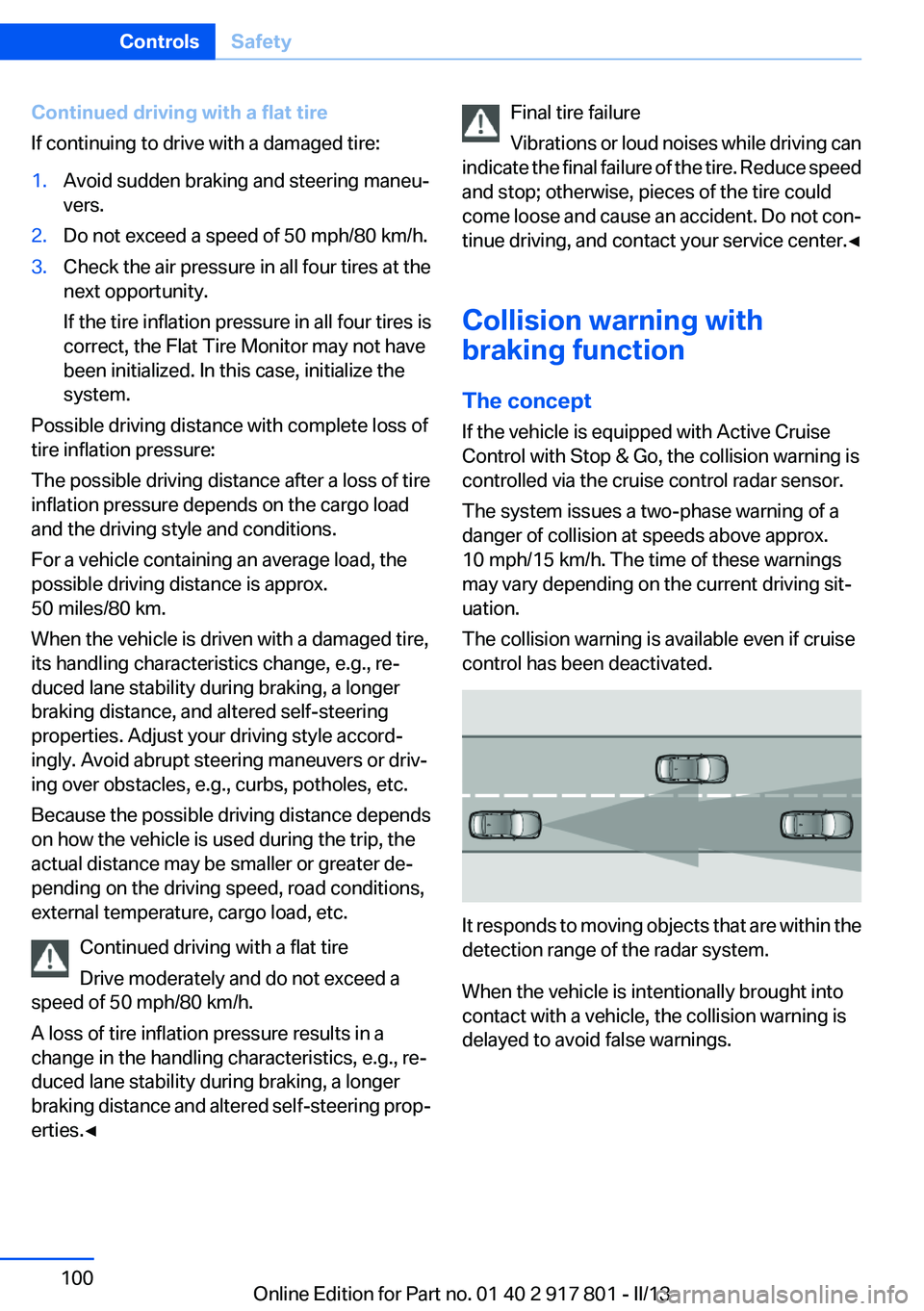
It responds to moving objects that are within the
detection range of the radar system.
When the vehicle is intentionally brought into
contact with a vehicle, the collision warning is
delayed to avoid false warnings.
Seite 100ControlsSafety100
Online Edition for Part no. 01 40 2 917 801 - II/13
Page 112 of 242
Variable sport steering
The variable sport steering increases the steer‐
ing angle of the front wheels at large steering
wheel angles, e.g., in tight curves or when park‐
ing. Steering becomes more direct.
It also varies the force required to turn the
wheels in accordance with the vehicle speed.
This results in a sporty steering response. In ad‐
dition, it becomes easier to steer during parking
and maneuvering.
Driving Dynamics Control
The concept
The Driving Dynamics Control can be used to
adjust the certain characteristics of the vehicle.
Various programs can be selected for this pur‐
pose. The Driving Dynamics Control and the
DSC OFF buttons can each be used to activate
a program.
Operating the programsPress the buttonProgramDSC OFF
TRACTIONSPORT+
SPORT
COMFORT
ECO PRO
Automatic program change
The system automatically switches to COM‐
FORT in the following situations:
▷Failure of DSC Dynamic Damping Control.▷The vehicle has a flat tire.▷When activating cruise control in TRAC‐
TION or DSC OFF mode.DSC OFF
When DSC OFF, refer to page 110, is active,
driving stability is limited during acceleration
and when driving in bends.
TRACTION
When TRACTION is active, the vehicle has max‐
imum traction on loose road surfaces. DTC Dy‐
namic Traction Control, refer to page 111, is ac‐
tivated. Driving stability is limited during
acceleration and when driving in bends.
SPORT+
Sporty driving with optimized chassis and
adapted engine control with limited driving sta‐
bilization.
Dynamic Traction Control is switched on.
The driver handles several of the stabilization
tasks.
Activating SPORT+ Press the button repeatedly until
SPORT+ appears in the instrument
cluster and the DSC OFF indicator lamp lights
up.
Automatic program change
When activating cruise control, the program au‐
tomatically switches to SPORT mode.
Indicator/warning lamps
SPORT+ is displayed in the instrument cluster.
The DSC OFF indicator lamp lights up:
Dynamic Traction Control is activated.
SPORT
Consistently sporty tuning of the suspension
and engine control for greater driving agility with
maximum driving stabilization.
The program can be configured to individual
specifications. The configuration is stored for
the remote control currently in use.Seite 112ControlsDriving stability control systems112
Online Edition for Part no. 01 40 2 917 801 - II/13
Page 161 of 242

LoadingVehicle equipment
All standard, country-specific and optional
equipment that is offered in the model series is
described in this chapter. Therefore, equipment
is also described that is not available in a vehicle,
e. g., because of the selected optional equip‐
ment or country variant. This also applies for
safety-related functions and systems.
Hints Overloading the vehicle
To avoid exceeding the approved carrying
capacity of the tires, never overload the vehicle.
Overloading can lead to overheating and in‐
creases the rate at which damage develops in‐
side the tires. This could result in a sudden loss
of tire inflation pressure.◀
No fluids in the trunk
Make sure that fluids do not leak into the
trunk; otherwise, the vehicle may be damaged. ◀
Determining the load limit1.Locate the following statement on your ve‐
hicle’s placard:▷The combined weight of occupants and
cargo should never exceed XXX kg or
YYY lbs. Otherwise, damage to the ve‐hicle and unstable driving situations may
result.2.Determine the combined weight of the
driver and passengers that will be riding in
your vehicle.3.Subtract the combined weight of the driver
and passengers from XXX kilograms or YYY
pounds.4.The resulting figure equals the available
amount of cargo and luggage load capacity.
For example, if the YYY amount equals
1,000 lbs and there will be four 150 lbs pas‐
sengers in your vehicle, the amount of avail‐
able cargo and luggage load capacity is
400 lbs: 1,000 lbs minus 600 lbs = 400 lbs.5.Determine the combined weight of luggage
and cargo being loaded on the vehicle. That
weight may not safely exceed the available
cargo and luggage load capacity calculated
in Step 4.
Load
The maximum load is the sum of the weight of
the occupants and the cargo.
The greater the weight of the occupants, the
less cargo that can be transported.
Seite 161LoadingDriving tips161
Online Edition for Part no. 01 40 2 917 801 - II/13
Page 164 of 242
Saving fuelVehicle equipment
All standard, country-specific and optional
equipment that is offered in the model series is
described in this chapter. Therefore, equipment
is also described that is not available in a vehicle,
e. g., because of the selected optional equip‐
ment or country variant. This also applies for
safety-related functions and systems.
General information
Your vehicle contains advanced technology for
the reduction of fuel consumption and emis‐
sions.
Fuel consumption depends on a number of dif‐
ferent factors.
The implementation of certain measures, driv‐
ing style and regular maintenance can have an
influence on fuel consumption and on the envi‐
ronmental impact.
Remove unnecessary cargo
Additional weight increases fuel consumption.
Remove attached parts
following use
Remove auxiliary mirrors, roof or rear luggage
racks which are no longer required following
use.
Attached parts on the vehicle impair the aero‐
dynamics and increase the fuel consumption.Close the windows and glass
sunroof
Driving with the glass sunroof and windows
open results in increased air resistance and
raises fuel consumption.
Tires
General information
Tires can affect consumption values in various
ways, for instance consumption can be influ‐
enced by the size of the tires.
Check the tire inflation pressure
regularly
Check and, if necessary, correct the tire inflation
pressure at least twice a month and before start‐
ing on a long trip.
Low tire inflation pressure increases rolling re‐
sistance and thus raises fuel consumption and
tire wear.
Drive away without delay
Do not wait for the engine to warm up while the
vehicle remains stationary. Start driving right
away, but at moderate engine speeds.
This is the fastest way for the cold engine to
reach its operating temperature.
Look well ahead when driving
Avoid unnecessary acceleration and braking.
By maintaining a suitable distance to the vehicle
driving ahead of you.
Driving smoothly and looking ahead reduces
fuel consumption.Seite 164Driving tipsSaving fuel164
Online Edition for Part no. 01 40 2 917 801 - II/13
Page 178 of 242
Wheels and tiresVehicle equipment
All standard, country-specific and optional
equipment that is offered in the model series is
described in this chapter. Therefore, equipment
is also described that is not available in a vehicle,
e. g., because of the selected optional equip‐
ment or country variant. This also applies for
safety-related functions and systems.
Tire inflation pressure
Safety information
The tire characteristics and tire inflation pres‐
sure influence the following:▷The service life of the tires.▷Road safety.▷Driving comfort.
Checking the pressure
Only check the tire inflation pressure when the
tires are cold. This means after driving no more
than 1.25 miles/2 km or when the vehicle has
been parked for at least 2 hours. When the tires
are warm, the tire inflation pressure is higher.
Check the tire inflation pressure regularly
Regularly check the tire inflation pressure
and correct it as needed: at least twice a month
and before a long trip. If you fail to observe this
precaution, you may be driving on tires with in‐
correct tire pressures, a condition that may not
only compromise your vehicle's driving stability,
but also lead to tire damage and the risk of an
accident.◀
After correcting the tire inflation pressure:
▷Reinitialize the Flat Tire Monitor.▷Reinitialize the Tire Pressure Monitor.Pressure specifications
The tire inflation pressure table, refer to
page 179, contains all pressure specifications
for the specified tire sizes at the ambient tem‐
perature. Pressure specifications apply to ap‐
proved tire sizes and recommended tire brands.
This information can be obtained from your
service center.
To identify the correct tire inflation pressure,
please note the following:▷Tire sizes of your vehicle.▷Maximum permitted driving speed.
Tire inflation pressures up to 100 mph/
160 km/h
For speeds of up to 100 mph/160 km/h and for
optimum driving comfort, note the pressure val‐
ues in the tire inflation pressure table, refer to
page 179, and adjust as necessary.
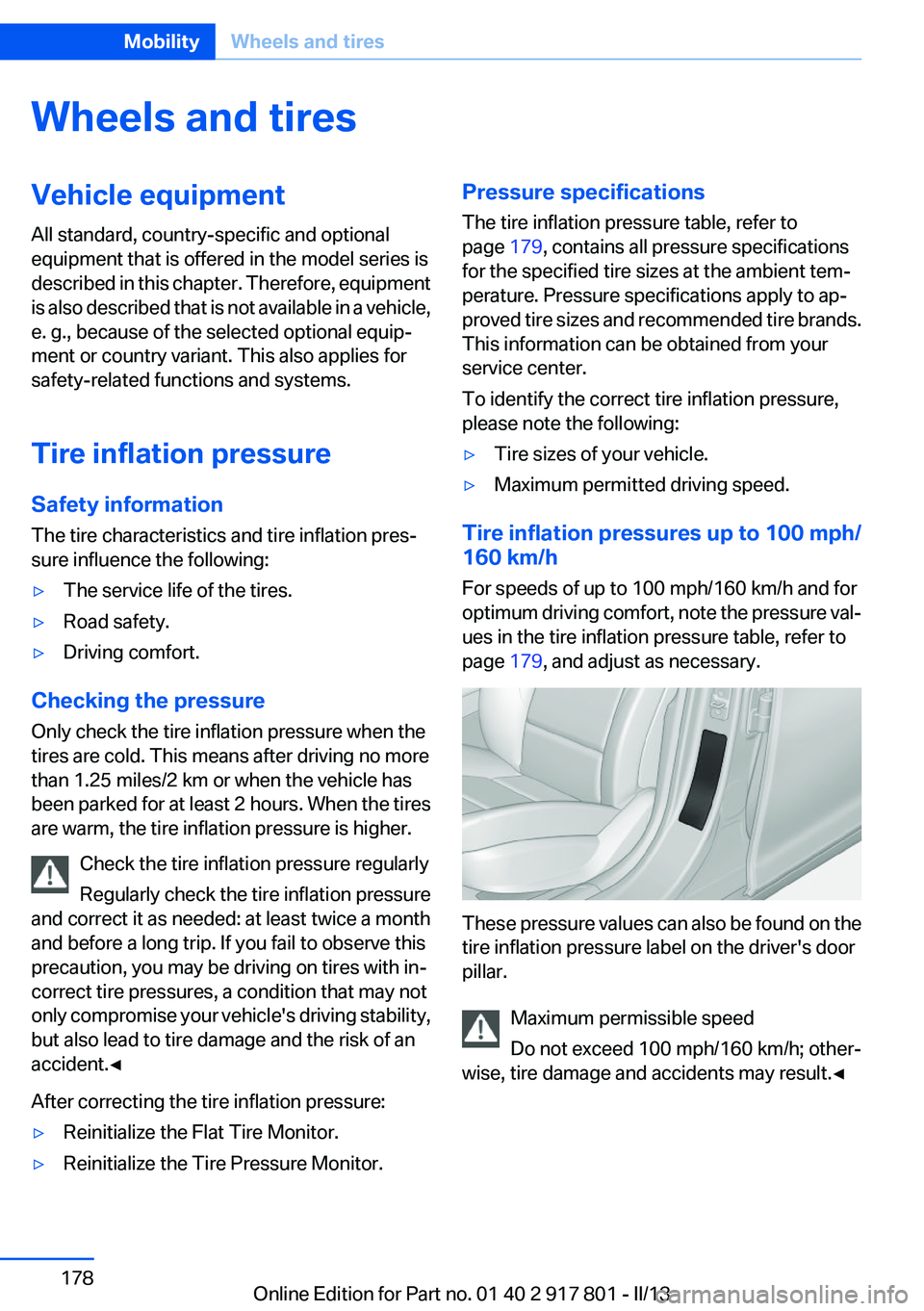
These pressure values can also be found on the
tire inflation pressure label on the driver's door
pillar.
Maximum permissible speed
Do not exceed 100 mph/160 km/h; other‐
wise, tire damage and accidents may result.◀
Seite 178MobilityWheels and tires178
Online Edition for Part no. 01 40 2 917 801 - II/13
Page 179 of 242
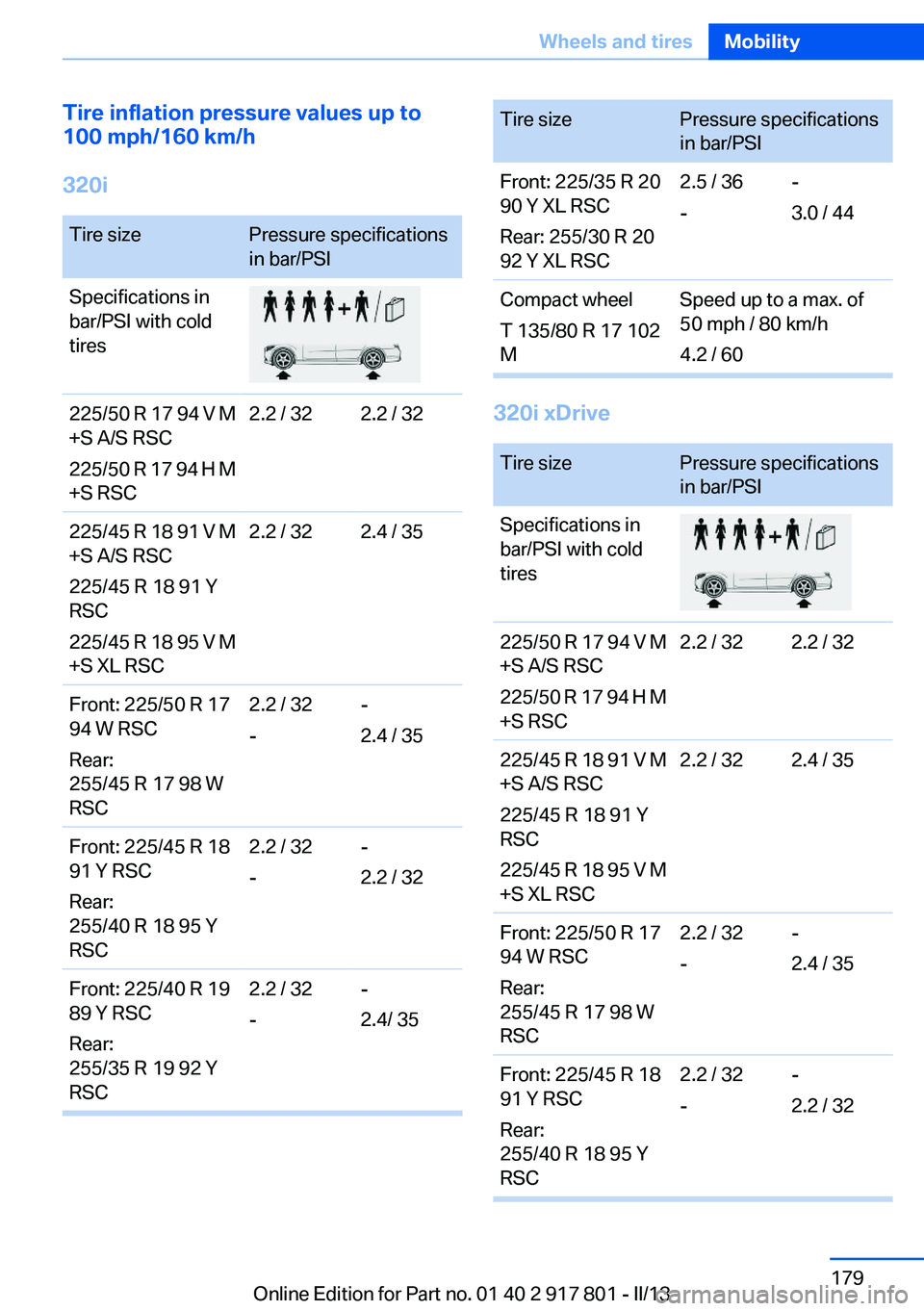
Tire inflation pressure values up to
100 mph/160 km/h
320iTire sizePressure specifications
in bar/PSISpecifications in
bar/PSI with cold
tires225/50 R 17 94 V M
+S A/S RSC
225/50 R 17 94 H M
+S RSC2.2 / 322.2 / 32225/45 R 18 91 V M
+S A/S RSC
225/45 R 18 91 Y
RSC
225/45 R 18 95 V M
+S XL RSC2.2 / 322.4 / 35Front: 225/50 R 17
94 W RSC
Rear:
255/45 R 17 98 W
RSC2.2 / 32
--
2.4 / 35Front: 225/45 R 18
91 Y RSC
Rear:
255/40 R 18 95 Y
RSC2.2 / 32
--
2.2 / 32Front: 225/40 R 19
89 Y RSC
Rear:
255/35 R 19 92 Y
RSC2.2 / 32
--
2.4/ 35Tire sizePressure specifications
in bar/PSIFront: 225/35 R 20
90 Y XL RSC
Rear: 255/30 R 20
92 Y XL RSC2.5 / 36
--
3.0 / 44Compact wheel
T 135/80 R 17 102
MSpeed up to a max. of
50 mph / 80 km/h
4.2 / 60
320i xDrive
Tire sizePressure specifications
in bar/PSISpecifications in
bar/PSI with cold
tires225/50 R 17 94 V M
+S A/S RSC
225/50 R 17 94 H M
+S RSC2.2 / 322.2 / 32225/45 R 18 91 V M
+S A/S RSC
225/45 R 18 91 Y
RSC
225/45 R 18 95 V M
+S XL RSC2.2 / 322.4 / 35Front: 225/50 R 17
94 W RSC
Rear:
255/45 R 17 98 W
RSC2.2 / 32
--
2.4 / 35Front: 225/45 R 18
91 Y RSC
Rear:
255/40 R 18 95 Y
RSC2.2 / 32
--
2.2 / 32Seite 179Wheels and tiresMobility179
Online Edition for Part no. 01 40 2 917 801 - II/13
Page 181 of 242
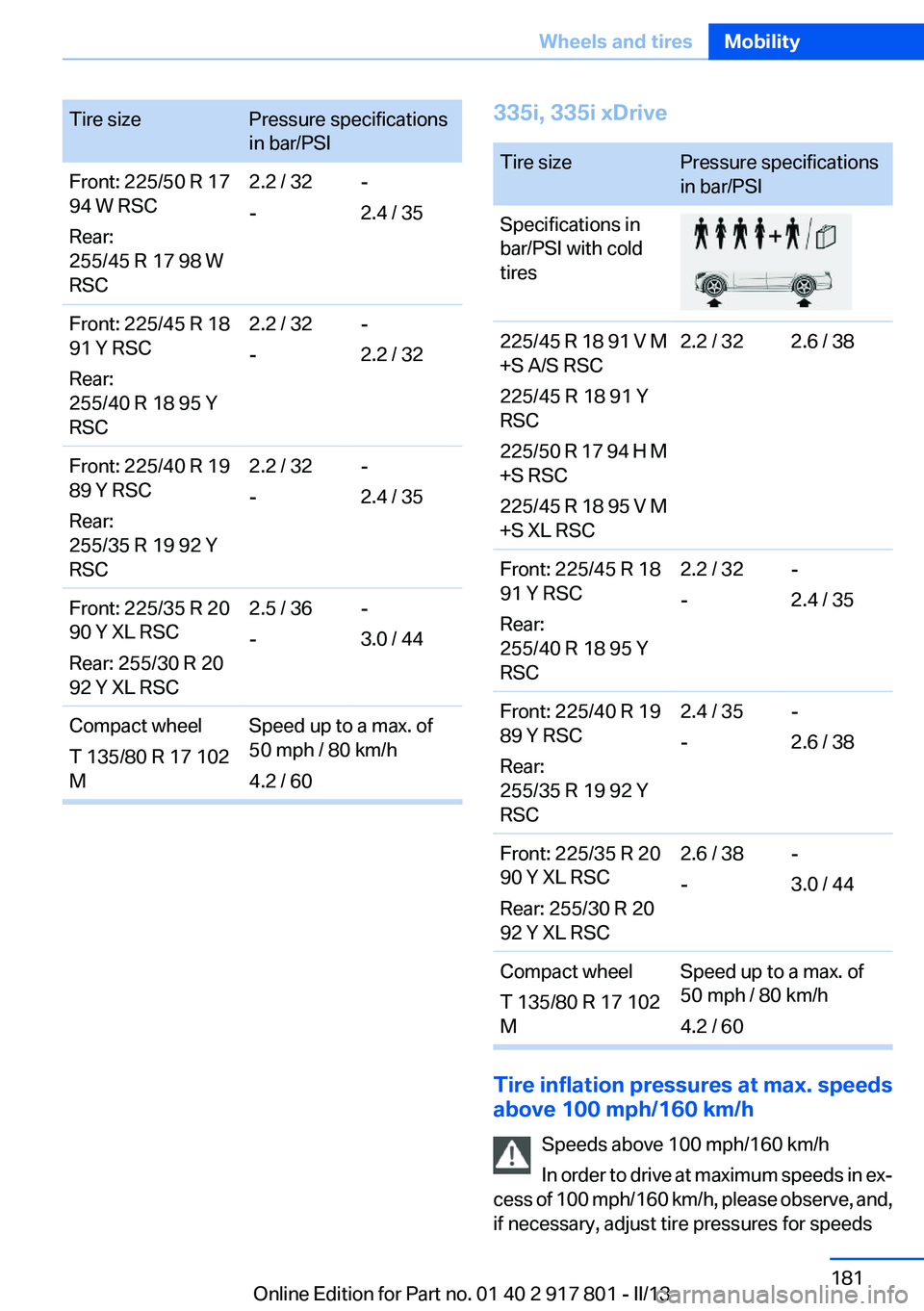
Tire sizePressure specifications
in bar/PSIFront: 225/50 R 17
94 W RSC
Rear:
255/45 R 17 98 W
RSC2.2 / 32
--
2.4 / 35Front: 225/45 R 18
91 Y RSC
Rear:
255/40 R 18 95 Y
RSC2.2 / 32
--
2.2 / 32Front: 225/40 R 19
89 Y RSC
Rear:
255/35 R 19 92 Y
RSC2.2 / 32
--
2.4 / 35Front: 225/35 R 20
90 Y XL RSC
Rear: 255/30 R 20
92 Y XL RSC2.5 / 36
--
3.0 / 44Compact wheel
T 135/80 R 17 102
MSpeed up to a max. of
50 mph / 80 km/h
4.2 / 60335i, 335i xDriveTire sizePressure specifications
in bar/PSISpecifications in
bar/PSI with cold
tires225/45 R 18 91 V M
+S A/S RSC
225/45 R 18 91 Y
RSC
225/50 R 17 94 H M
+S RSC
225/45 R 18 95 V M
+S XL RSC2.2 / 322.6 / 38Front: 225/45 R 18
91 Y RSC
Rear:
255/40 R 18 95 Y
RSC2.2 / 32
--
2.4 / 35Front: 225/40 R 19
89 Y RSC
Rear:
255/35 R 19 92 Y
RSC2.4 / 35
--
2.6 / 38Front: 225/35 R 20
90 Y XL RSC
Rear: 255/30 R 20
92 Y XL RSC2.6 / 38
--
3.0 / 44Compact wheel
T 135/80 R 17 102
MSpeed up to a max. of
50 mph / 80 km/h
4.2 / 60
Tire inflation pressures at max. speeds
above 100 mph/160 km/h
Speeds above 100 mph/160 km/h
In order to drive at maximum speeds in ex‐
cess of 100 mph/160 km/h, please observe, and,
if necessary, adjust tire pressures for speeds
Seite 181Wheels and tiresMobility181
Online Edition for Part no. 01 40 2 917 801 - II/13
Page 182 of 242
exceeding 100 mph/160 km/h from the relevant
table on the following pages. Otherwise tire
damage and accidents could occur.◀
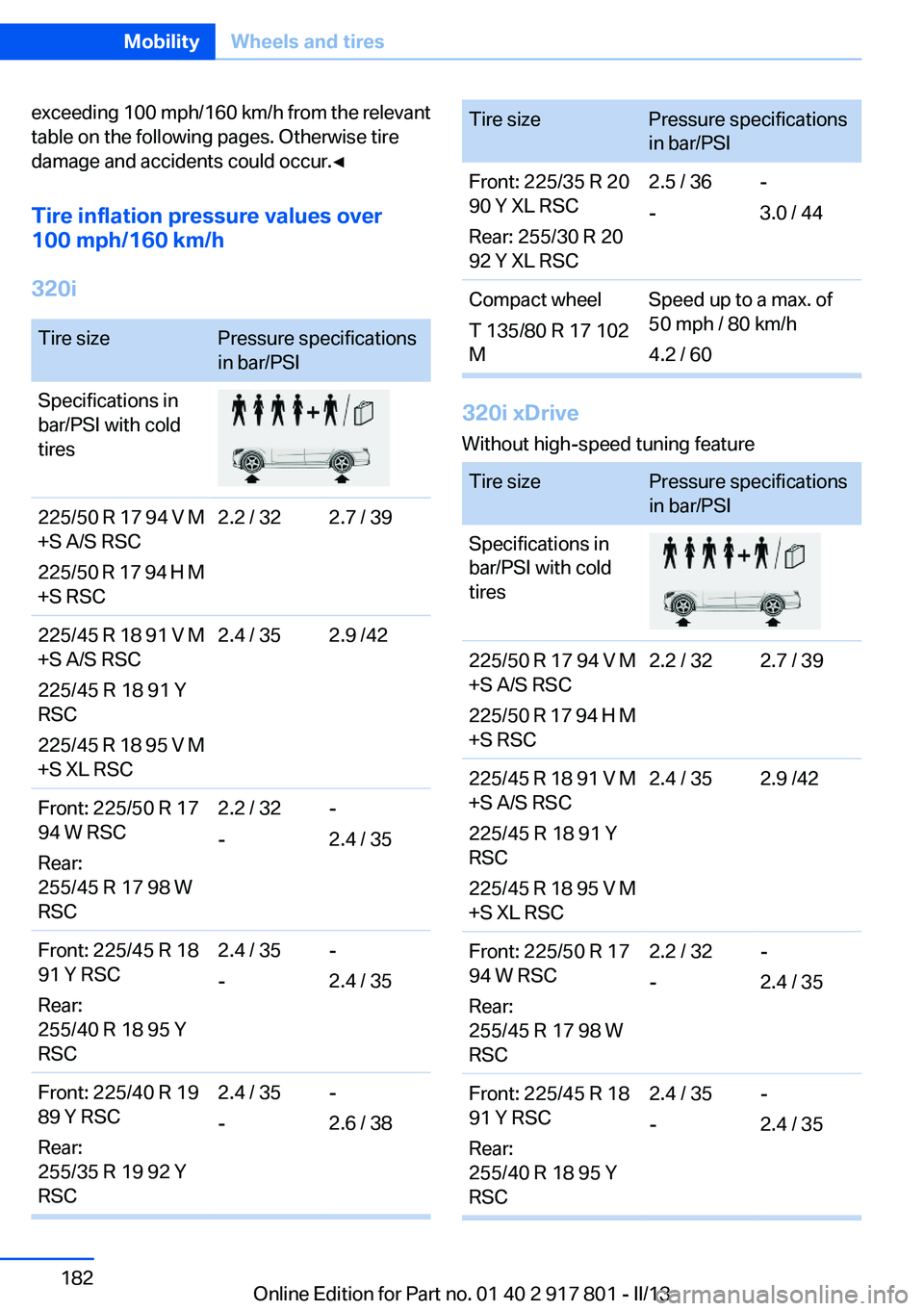
Tire inflation pressure values over
100 mph/160 km/h
320iTire sizePressure specifications
in bar/PSISpecifications in
bar/PSI with cold
tires225/50 R 17 94 V M
+S A/S RSC
225/50 R 17 94 H M
+S RSC2.2 / 322.7 / 39225/45 R 18 91 V M
+S A/S RSC
225/45 R 18 91 Y
RSC
225/45 R 18 95 V M
+S XL RSC2.4 / 352.9 /42Front: 225/50 R 17
94 W RSC
Rear:
255/45 R 17 98 W
RSC2.2 / 32
--
2.4 / 35Front: 225/45 R 18
91 Y RSC
Rear:
255/40 R 18 95 Y
RSC2.4 / 35
--
2.4 / 35Front: 225/40 R 19
89 Y RSC
Rear:
255/35 R 19 92 Y
RSC2.4 / 35
--
2.6 / 38Tire sizePressure specifications
in bar/PSIFront: 225/35 R 20
90 Y XL RSC
Rear: 255/30 R 20
92 Y XL RSC2.5 / 36
--
3.0 / 44Compact wheel
T 135/80 R 17 102
MSpeed up to a max. of
50 mph / 80 km/h
4.2 / 60
320i xDrive
Without high-speed tuning feature
Tire sizePressure specifications
in bar/PSISpecifications in
bar/PSI with cold
tires225/50 R 17 94 V M
+S A/S RSC
225/50 R 17 94 H M
+S RSC2.2 / 322.7 / 39225/45 R 18 91 V M
+S A/S RSC
225/45 R 18 91 Y
RSC
225/45 R 18 95 V M
+S XL RSC2.4 / 352.9 /42Front: 225/50 R 17
94 W RSC
Rear:
255/45 R 17 98 W
RSC2.2 / 32
--
2.4 / 35Front: 225/45 R 18
91 Y RSC
Rear:
255/40 R 18 95 Y
RSC2.4 / 35
--
2.4 / 35Seite 182MobilityWheels and tires182
Online Edition for Part no. 01 40 2 917 801 - II/13