2013 AUDI TT seats
[x] Cancel search: seatsPage 150 of 262

148 Child Safet y
be suppressed causing ser ious or even
fatal injury to the child .
- If you must install a rearward facing
child safety seat on the front passenger
seat because of exceptional circumstan
ces and the
P A SS EN GER AIR BA G OFF
light does not come on and stay on, im
med iately install the rear-facing child
safety seat in a rear seating position and
have t he a irbag system inspected by your
Audi dealer.
Installing the upper tether strap on the
anchorage
Fig. 12 4 Tet her st rap : proper ro uting a nd mountin g
F ig . 125 Tether strap: p rope r ro uting a nd mo unting
Inst all ing th e tether strap
.,. Release or deploy the tether strap on the
child restra int according to the child re
stra int manufacturer's instruct ions .
.,. Gu ide the upper tether st rap into the rear
cargo area
¢fig. 125 .
.,. Slide the tether strap hook over the anchor
bracket.
.,. Pull on the tether strap hook so that the
spring catch of the hook engages .
.,. Tighten the tether stra p firmly following
t he child res train t manufacturer 's instruc
t ions .
Releasing the teth er strap
.,. Loosen the tension follow ing the child re
straint manufacturer's instructions.
.,. Depress the spring catch on the hook and
release it from the anchorage .
(D Note
If you leave the child restraint with the
tether strap firm ly installed for several
days, this could leave a mark on the up
ho lstery on the seat cushion and backrest
i n the area where the tether strap was in
stalled . The upholstery would also be per
manently st retched a round the tether
strap. This applies especia lly to leather
seats .
· Using tether straps on rearward-facing
child restraints
C urrently, few rear-facing chi ld restraint sys
tems come with a tether . Please read and
heed the child restrain t system manufactur
er's instructions carefully to determine how to
properly install the tether .
A WARNING -
A child in a rearward-facing ch ild safety
seat installed on the front passenger seat
will be serio usly inju red and can be killed if
the front airbag infla tes - even wi th an Ad
vanced Airbag System.
- The infla ting airbag will h it the c hild
safety seat or infant carrier wi th great
force and will smash the child safety seat
a nd child against the backrest, or door .
- A t ight tether or o ther strap on a rea r
ward-facing child restraint attached to the front passenger seat can p ut too
much pressure on the weight-mat in the
seat and register a heavier weight in the
Advanced Airbag System . The heavier
weight registered can make the sys tem
work as though an adult we re on the seat
and deploy the Advanced Airbag when it
m ust be suppressed causing ser ious or
even fata l injury to the ch ild .
Page 159 of 262

than is being generated and ensures an optimal state of charge for the battery.
@ Tips
- But even energy management cannot
negate the limits o f physics. Consider
that the power and life of a battery are
li mited.
- If starting ab ility is threatened, you are
i nformed by a warning
¢ page 157,
Driver notification in the instrument
cluster display.
What you should know
The highest priority is given to maintaining
starting capability.
The battery is severely taxed in short-distance
driving, in city traffic and during the co ld time
of year. Abundant e lectrica l energy is re
quired, but only a litt le is generated. It is also
cr itical if the engine is not run ning and electri
cal components are turned on. In th is in
stance energy is being consumed but non e is
be ing gene rated.
It is in precisely these situations that you w ill
notice energy management actively regulat
in g the distribution of energy .
Vehicle stands for an extended period
If you do not drive your vehicle over a period
of several days or weeks, electrical compo
nents are gradually cut back or switched off.
This reduces energy consumption and mai n
tains sta rting capab ility over a longer per iod.
Take into consideration that when you un lock
your ve hicle, some co nvenience functions,
such as the remote key or power seat adjust
ment, may not be available . The convenience
f u nctions w ill be ava ilable again whe n you
turn on the igni tion and star t the eng ine.
With the engine turned off
If you listen to the radio, for example, with
the eng ine turned off, the battery is being dis
charged .
Intellig ent technolog y 157
If starting capability is jeo pardi zed d ue to en
ergy consumption, a message appears in the
drive r information d isplay .
You have to start t he engine to charge the
batte ry .
With the engine running
Although e lectrical energy is generated when
the ve hicl e is being driven, t he battery can be
c ome disc harged. This happe ns mostly when
li ttle energy is being generated and a g reat
deal consumed and t he battery's sta te of
c h arge is not optimal.
T o b ring the energy b alance b ack into equili
br ium, consumers which requ ire espe cially
la rge amounts of energy a re temporari ly cut
back or switched off . Heating systems in pa r
ticu lar require a great deal of energy. If yo u
notice, for example, that the heated seats* or
the heated rear window are not heating, they
have been temporarily cut back or sw itched
off . These systems w ill be available again as
soon as the ene rgy balance has been restored.
You w ill also notice that engine id le speed has
been increased slightly . T hi s is normal and not
a cause for conce rn . By i ncreas ing eng ine id le
speed the additional energy r equired is gene r
ated and the battery is charged.
Driver notification in the instrument
cluster display
If battery power drops into the range where it
can limit the ability of the engine to start, this
is shown in the instrument cluster display
with the following driver message:
(•) Low battery charge: battery will be
charged while driving
T his no tificat ion reminds yo u that the star ting
capability of the engine may be lim ited . As
soon as you sta rt dr iving again, the battery
will be recharged and the not ificat ion w ill go
out. •
•
Page 173 of 262

(D Note
To avoid scratching the display, you should never clean it dry.
Aluminum trim
Use only neutral -pH products to remove spots
and depos its from alum inum surfaces.
Chrome care products and alkaline cleaners
will attack alum inum su rfaces and can dam
age them ove r time.
A WARNING
Always read and heed a ll WARNINGS and
t he information<=>
page 164.
Fabrics and fabric coverings
Fabrics and fabric coverings (e .g. seats, door
trim panels, etc.) should be cleaned at regular
interva ls with a vacuum cleaner. T his removes
surface dirt particles which could become em
bedded in the fabr ic through use. Steam
cleaners should not be used, because the
steam tends to push the dirt deeper into the
fabric and lock it there.
Norm al cleaning
Generally, we recommend using a soft sponge
or a lint-free microfiber cloth to the clean fab
ric. Brushes should only be used for carpets
and floor mats, s ince other fabric surfaces
could be harmed by b rushes .
Normal surface sta ins can be cleaned using a
commercially available foam cleaner . Spread
the foam on the surface of the fabric with a
soft sponge and work it in gently . Do not satu
rate the fabric. Then pat the foam d ry using
absorbent, dry cloths (e.g. microfibe r clo th)
and vacuum it afte r it has dr ied comp lete ly.
Cl eaning stains
Stains caused by beve rages (e .g. coffee, fruit
juice, etc.) can be t reated with a mild deter
gent solution. App ly the dete rgent so lution
wi th a sponge. In the case of s tubbor n stains,
a detergent paste can be applied directly to
Cleaning and protec tion 17 1
the stain and worked into the fabric. After
wards, use copious amounts of clean water to remove the rema in ing detergent. Apply the
water with a damp cloth or sponge and pat
the fabric dry with an absorbent, dry cloth.
Stains from choco late or makeup should have
detergent paste (e.g . ox-gall soap) rubbed in
to them. Afterwards, remove the soap with
water (damp sponge).
A lcohol can be used to treat stains from
grease, o il, lipstick or a ballpoint pen. Melted
grease or dye must be patted off using ab
sorbent mater ial. It may be necessary to re
treat the areas with detergent paste and wa
te r.
In the case of genera l soiling of the uphols
tery and cover material, we recommend hir ing
a specia list that has the equipment to clean
t h e seat covers and othe r fabr ic surfaces by
shampooing and spray extraction .
A WARNING
Always read and heed all WARNINGS and
the info rmation
<=> page 164.
@ Tips
Open Velcro fasteners on your clothing can
damage the seat cover. Please make sure
that Ve lcro fasteners are closed.
Plastic parts and instrument panel
A lways use a clean clo th moistened in clea r
water to clean these areas . For pe rsistent d irt
u se an Aud i approved
solvent-free p lastic
clea ner/protectant.
A WARNING
Solvents can change the properties of
some p lastics and make it harder for the
a irbag to deploy.
-
- Never clean the instrument panel or the
surface of Airbag modu les with cleaning
products that co nta in solvents .
- Products containing solvents will make
the surface of this part porous. •
•
Page 174 of 262
172 Cleaning and protection
-Serious injuries can result if plastic parts
come loos e when the airbag is deployed.
- Always read and heed all WARNINGS and
the informat ion
¢ page 164.
(D Note
Clean ing agents containing solvents will
attac k the material and can change the
way it behaves .
Instrument cluster glass
~ Clean the glass with a soft, damp cloth .
I n order to preserve the anti-glare properties
of the inst rument cl uste r glass, it should on ly
be cleaned with a soft, damp cloth.
Natural leather
Applies to vehicles: with natural leather
Audi makes great efforts to maintain the
properties , natural look and feel of interior
leather.
G ener al
We offe r many different types of leather on
our vehicles. Most are different types of nappa
l eather, which has a smooth su rface and
comes in var ious co lo rs .
The in tensi ty of the color de termines the v is u
a l characterist ics and appearance . If the sur
face of the leathe r has a typical natural look,
then the leather is a nappa leather that has
been left in a relatively natural cond ition. This
leather offers par ticularly good com fort and
breathes well . F ine veins, closed grains , in sect
b ites, ski n folds , and subtle var iations in color
remain visib le. These characte ristics demon
strate that the mater ia l is na tural.
Natural nappa leather is not covered by a col
or finish .
It is therefore more sens itive to soil
ing a nd wear, which is something you need to
consider if ch ild ren, an ima ls o r othe r factors
migh t prove to be particularly hard on the
l eathe r.
B y contrast, leather types that are cove red by
a co lored f inish laye r are more durable. This has a positive effect on the leather's resis
t
ance to wear and soiling in dai ly use. On the
other hand, the typ ica l character istics of natu
ral leather are barely or not apparent. Howev
er, th is does not mean that the leather itse lf
is of inferior quality .
Care and handling
Because of the exclusive nature of the types of
l eather that Aud i uses and their unique prop
erties (such as sensit ivity to oils, grease, soil
ing, etc.) , you will need to be somewhat care
ful with these leathers, and a certain type of ca re is req uired. Fo r example, dark clothing
mater ials can disco lor leather seats (especia l
l y if such clo thing is damp and was not dyed
correct ly) . D ust and dirt pa rticl es i n pores,
f olds, and seams can have an abrasive effect
and can damage the leather surface as we ll as
weaken seams.
T he lea ther should be clea ned regularly as
neede d. After hav ing been used for a relat ive ly
long time, your leather seats will acq uire a
rich aged finish . This is a characteristic of nat
u ral leather and a sign of true quality .
In order to maintain the val ue of this nat ural
product
over the life of your ve hicle, you
sho uld follow t he recommendations be low:
(D Note
- T o keep your lea ther from b leaching o ut,
do not allow it to be exposed to bright
sunlight for long periods of time . If yo u
have to leave the veh icle parked outside
for long per iods, cover the leather to
protect it from direct exposure to sun
light .
- Sharp objects on cloth ing, such as zip
pers, rivets o r sharp pieces on belts can
leave permanent sc ratches or scrape
ma rks on the su rface of the leath er.
(l) Tips
- After each time you clean the leather and
a t regular intervals , use a leathe r preser
vative c reme that con tains UV-b locke rs
and tha t wo rks into the leathe r. T his
Page 199 of 262

-Never mount used tires on yo ur vehicle if
yo u are not sure of their "previous histo
ry." Old used tires may have been dam
aged even though the damage cannot be
seen that can lead to sudden tire failure
and loss of vehicle control.
- If you notice unusual vibration or if the
vehicle pulls to one side when d riving, al
ways stop as soon as it is safe to do so
and check the wheels and tires for dam
age .
(D Note
Please note that summe r and wi nte r tires
are designed for the cond itions that are
Glossary of tire and loading terminology
Accessory weight
means the comb ined weight (in excess of
those sta ndard items which may be rep laced)
of au toma tic transmission, power steer ing ,
power brakes, power windows, power seats,
radio, and heater, to the extent that these
items are availab le as factory-installed equip
ment (whether installed or not) .
Aspect ratio
means the rat io o f the height to the w idth of
the tire in percent . Numbers of 55 or lower in
dicate a low sidewall for improved steering re
sponse and better overa ll handling on dry
pavement .
Bead
means the part of the t ire t hat is made o f
steel wires, wrapped or reinforced by ply cords
and that is shaped to fit the r im.
Bead separation
means a b reakdown of the bond between
components in the bead .
Cord
means the strands forming the plies in the
tire.
Tire s an d wheel s 197
typica l in those seasons . Aud i recommends
using winter tires during the winter
months . Low temperatures signif icant ly
dec rease the e lasticity of summer t ires,
which affects tract ion and brak ing ability.
If summer t ires are used i n very co ld tem
peratures, cracks ca n form o n the tread
bars , res ulting in perma nen t tire damage
that can cause loud driving noise and un
bala nced ti re s. Audi i s not respon sible for
th is type of damage .
Cold tire inflation pressure
means the tire p ress ure recommended by t he
vehicle manufacture r fo r a tire o f a des ignated
s ize t hat has not bee n driven for more than a
coup le o f miles (k ilometers) at low speeds in
the three hour period before the tire press ure
is m easured or adjusted.
Curb weight
me ans the we ight of a motor ve hicle with
st andard equipmen t incl ud ing the max imum
capacity of fuel, oi l, and coolant, air condi
tioning and additional weig ht of optiona l
equipment.
Extra load tire
means a t ire designed to operate a t higher
loads and at higher inflat ion p ress ures than
the corresponding standar d tire. Extra load
ti res may be ident ified as "XL", "xl", "EXTRA
LOAD", or "RF" on the sidewall.
Gross Axle Weight Rating ("GAWR")
me ans the lo ad-ca rry ing capa city of a si ngle
axle system, measured a t the tire -ground in
te rfaces.
Gross Vehicle Weight Rating ("GVWR ")
mea ns the maximum total loaded we ight of
the ve hicl e. .,.. •
•
Page 232 of 262
230 Fuses and bulbs
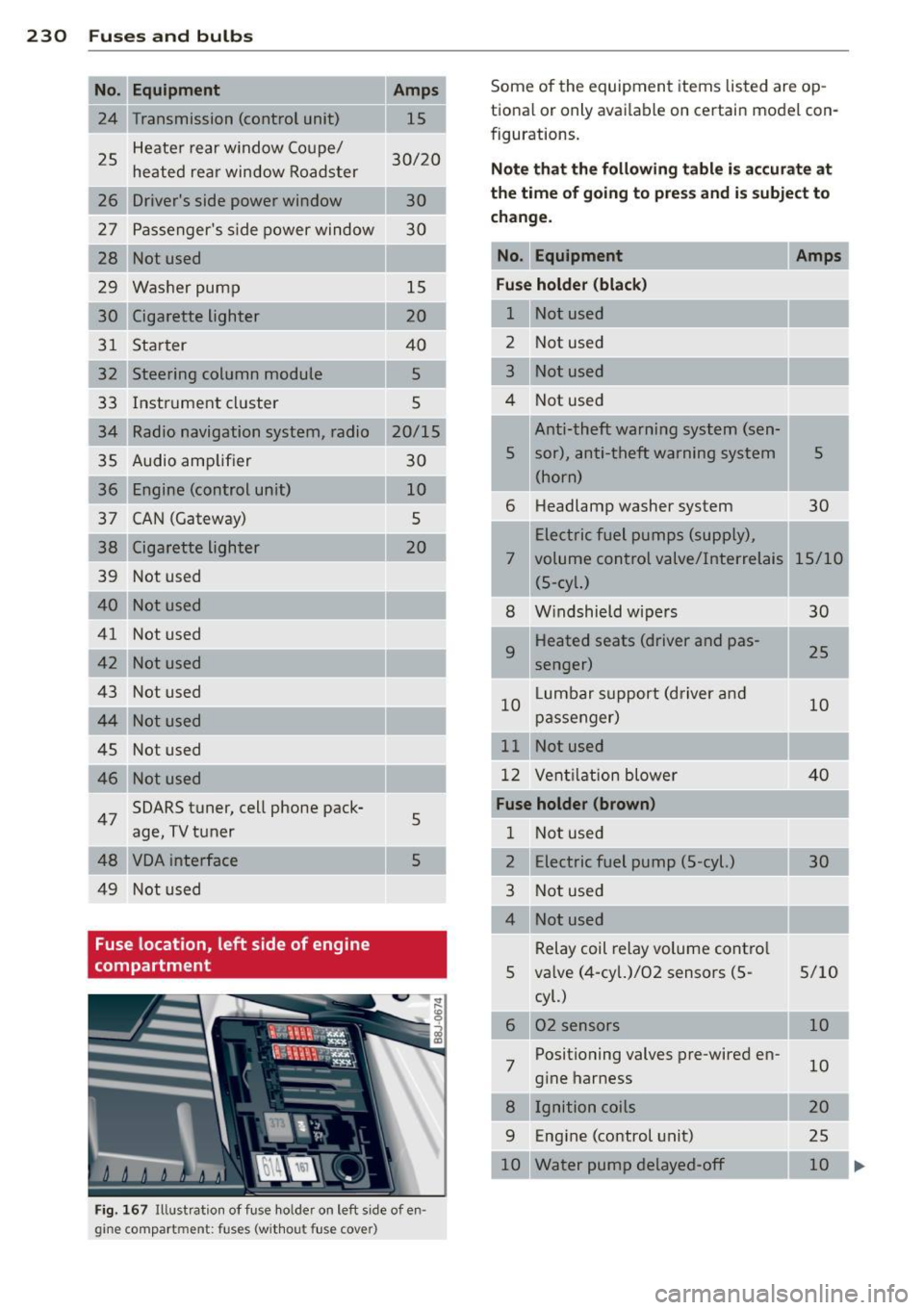
-No. Equipment
24 Transmission (control unit)
25 Heater rear
window Coupe/
heated rear window Roadster
26 Driver's side power window
27 Passenger's side power window
28 Not used
29 Washer pump
30 Cigarette lighter
31 Starter
32 Steering column module
33 Instrument cluster
34 Radio navigation system, radio
35 Audio amplifier
36 Engine (control unit)
37 CAN (Gateway)
38 Cigarette lighter
39 Not used
40
------------4 l Not used
42
43 Not used
44
45 Not used
46
47 SOARS tuner, cell phone pack-
age, TV tuner
48
49 Not used
Fuse location, left side of engine
compartment Amps
15
30/20
30
30
-15
20
40 5
5
20/15
30
10 5
20
-
-
5
5
Fig. 167 Illust ration of fuse holder on left side of en·
gine compartment: fuses (without fuse cover)
Some of the equipment items listed are op-
t ional or only available on certain model con-
figurations.
Note that the following table is accurate at
the time of going to press and is subject to
change.
No. Equipment Amps
Fuse holder (black)
1 Not used
-2 Not used
3 Not used
4 Not used
Anti-theft warning system (sen-
'
5 sor), anti-theft warning system 5
(horn)
6 Headlamp
washer system
30
Electric fuel pumps (supply),
7 volume control valve/Interrelais 15/10 (5-cyl.)
8 Windshield wipers
30
9 Heated seats (driver and pas-
25
senger)
10 Lumbar
support (driver and
10
passenger)
11 Not used
12 Ventilation blower 40
Fuse holder (brown)
1 Not used
2 Electric fuel pump (5-cyl.) 30
3 Not used
Relay coil relay volume control
5 valve (4-cyl.)/02 sensors (5- 5/10
7 cyl.)
02 sensors
Positioning valves pre-wired en
gine harness
Ignition coils
9 Engine (control unit)
10 Water pump delayed-off 10
10
20
25 10 ..,_.
Page 249 of 262

A
A/C operation . . . . . . . . . . . . . . . . . . . . . . . 69
Accessories . . . . . . . . . . . . . . . . . . . . . . . . 245
Acoust ic park assist . . . . . . . . . . . . . . . . . . 78
Adapt ive light .. ........... .. .. .. .... 43
defect ive . . . . . . . . . . . . . . . . . . . . . . . . . . 20
Adding Eng ine coolant .............. .... . .
E ng ine oi l .. ............. .... .. .. .
W indshield washer fl uid ... .. .. .. .. .
Addit ional accessories .... .. .. .. .. .. .
Additives Engine oil .. .... .. .... ... .. .. .. .. . 188
185
194
245
185
Ad justab le steer ing colum n .. .. .. .. .. .. 7 1
Adjusting front seats ....... .. .. .. .. .. 54
Ad justing steering co lumn ... .. .. .. .. .. 71
Ad just ing the seats ............. ... ... 55
Advanced Airbag System Chi ldren . .. ............. .... .. .. .
Components ............. .... .. .. .
Front airbags ............... ... .. .
H ow the components work together ..
Mo nitor ing . .. ........... .. .. .. .. . 131
115
113
116
1 19
Weight-sens ing mat ...... .. .. .. .. . 13 1
Airbag War ning/ indicator lights . ...... ... ... 15
Ai rbag system . . . . . . . . . . . . . . . . . 108, 127
Care . .. .. .. .. .. ........... .. .. ... 122
C hi ld restra ints ........... .... .. .. . 132
Components (front airbags) . . . . . . . . . 115
Danger of fitting a child safety seat on
the front passenger seat . . . . . . . . . . . . 110
D isposal . . . . . . . . . . . . . . . . . . . . . . . . . 122
Fr ont airbag s ............ .... .. .. .
H ow do the front a irbags wo rk? . .. .. .
H ow many airbags does my vehi cle
have? ... .. .. .. ... . .... ... .. .. .. .
Important safety instructions on the knee airbag system ....... .. .. .. .. .
Important things to know .. .. .. .. .. .
Indicator light .. ...... ... .... .. .. . 1
12
1 17
115 125
108 119
Knee airbags . . . . . . . . . . . . . . . . . . . . . . 123
Mo nitor ing .... ........... ... ... .. 119
P ASSENG ER AIR BAG OFF light .. .. .. . 119
Repa irs .. .. ............. .... .. .. .
Side airbags .. ........... .. .. .. .. .
When must the system be inspected? . 12
2
126 1 19
Inde x 247
All- wheel drive . ..... . .. .. ..... ... . .
Winter tires ... .... . ... ...... ... . .
Alloy w heels .. .. .. ................ .
Alternator lSS
211 169
refer to Generator .. . ... .... ... .. .. . 16
Anti-freeze
refer to Engine cooling system ... .. .. 187
A nti- lock b rake system
W arning/ind icator lights ........ .. .. . 18
Anti -lock braking system ............. 150
Anti-slip reg ulation
150
Ant i-theft systems
An ti- theft a la rm system ........ .. .. . 38
El ectronic immob ilizer .......... .... . 33
Ashtray .......... .. ..... ........... 62
Aste risk
What does it mean when something is marked w it h an aster isk? . . . . . . . . . . . . . . 6
A udi magnet ic r ide . . . . . . . . . . . . . . . 2 1, 78
Desc ription . . . . . . . . . . . . . . . . . . . . . . . . 78
Indicator light ..... . ... ...... ... .. . 21
Audi Se rv ice Repair Manuals and Litera-
tu re ..... .. .. .. .. .... . · · · · · · · · · · · ·
Automat ic be lt retractor .. ...... .... .
Automatic car wash
refer to Washing ... . ... .... ... .. . . 243
104
165
Automa tic transm iss ion . ......... .... . 80
D rivi ng No tes .. .. ............... .. . 82
Emergency prog ram . .. ..... ... .. .. . 85
Emergency re lease . .. .. ..... ... .. .. . 86
Ignit ion key safety lock . ..... ... .. .. . 72
K ick-down . . . . . . . . . . . . . . . . . . . . . . . . . 85
Launch Control Program .......... .. .
8S
Se lector lever lock ... ... .... ... .. .. . 81
Se lector lever positions
80
Tiptronic .. .. .. .... ... ....... ...... 84
T iptronic controls on the stee ring wheel 84
Auto Safety Hotline ................. . 98
Ave rage fuel mileage . . . . . . . . . . . . . . . . . 23
Average speed . . . . . . . . . . . . . . . . . . . . . . . 23
Avoid damaging the vehicle .... ... .. .. 160
B
Battery . . . . . . . . . . . . . . . . . . . . . . 190, 193
Charg ing . ... .... .. . .. .. ..... ... .. 193
Checking battery acid level ........ .. 193
•
•
Page 250 of 262

248 Index
Connecting ...... ..... ... .. .. .... . 190
Disconnecting . ....... ... .. .. .... . 190
Important warn ings . .... ... .. .... . 192
Locat ion 192
Low . .. .. .... ........... ........ . 156
Replacing the battery ......... .. ... 191
State of charge ..... .... .. .. .. .. .. . 156
W inte r operation .......... ... .. .. . 190
Working on the battery .. ...... .. .. . 192
Battery voltage ................ .... .. 19
Before driving . . . . . . . . . . . . . . . . . . . . . . . 90
Blended gasoline ........... ... .. .. . 176
Body cavity sealing . . . . . . . . . . . . . . . . . . 170
Boost . .. .. .. .. . .......... .. .. .... .. 28
Booster seats .............. ... .. .. . 138
Boost pressure indicator . ... .. .... .. . . 28
Brake fluid
Changing the brake flu id . .. .. .. .. .. .
190
Chec king the bra ke fluid level . .. .... . 189
What is the correct brake fl uid leve l? .. 189
What should I do if the brake fluid warn-
ing light comes on? .. ... .. .. ... ... .
189
Brake fl uid reservo ir ........ .. .. .... . 189
Brake system .............. .... .... . 189
Anti -lock brake system ........ .. .... 18
Brake ass ist system . .. .. .. .. .. .. .. . 150
Brake fl uid . ... .. ..... ... .. .. .. .. . 189
Brake flu id spec ifica tions for refill and re-
p la cemen t ... ......... .. .. .. .. .. .
190
Brake light defect ive . ... .. .. .... .. . . 20
Brake pads .. .. .. ..... ... .. .. .... . 159
General information . ... .. .. ... ... . 153
How does the moisture or road sa lt affect
the brakes? .............. .. .. .... .
153
Malfunc tio n . . . . . . . . . . . . . . . . . . . . . . . 14
Warn ing/ indicator l ights ....... .. .... 14
Worn brake pads symbol . . . . . . . . . . . . . 18
Break- in period ............ .. .. .. .. . 159
Brake pads ... ........... .. .. .... . 159
Tires
Bulbs
C
159
23 1
Califo rni a Proposit ion 65 Warning .. .. . 18 1
Battery specif ic .. ..... ... .. .. .... . 193
Capac it ies . .. ..... ........... ... .. . 240
Car care . ... .... .. ... .. .. ... .... . .. 164
Interior . . . . . . . . . . . . . . . . . . . . . . . . . . 170
Plastic and vinyl . .... .. ..... ... .. .. 168
Care of ex ter ior .. .. ............. .. .. 164
Cargo area
refer to Luggage compartment ....... . 96
Cata lytic co nverter ... ... ..... ... .. .. 160
CD cha nger . .... .. ............. .... . 64
Certification . . . . . . . . . . . . . . . . . . . . . . . 246
Chang ing a flat t ire ... ... ..... ... .. .. 224
Chang ing engine oil ................ . 186
Chassis
Undercoating .. .. ............. .. ..
170
also refer to Audi magnet ic r ide .. .. .. . 78
Checking
Battery ac id leve l ... ... ..... ... .. ..
193
Engine coolant level . . . . . . . . . . . . . . . . 187
Checking t ire press ure ........... .. .. 2 02
Child restraint
Danger of using child rest raints in the
front seat . ...... ................ .
110
Child restraints
Where can I get additional informat ion
about child restraints and the ir use? ..
149
Child restraint system anchors . ... .. .. 143
Child saf ety . .. .. .. .. .. ...... ... .. .. 130
Co nvertib le loc king retractor ... .. .... 140
G ui dance fixtures for lower anc ho rages 1 4 5
Important sa fe ty instru ctions for using
child safety seats ... .... .... ... .. ..
133
Important things to know whe n driving
with children .... ............... ..
130
Installing a c hild restra int using the
LATCH system . . . . . . . . . . . . . . . . . . . . .
146
Mounting and releasing the anchorage
hook ...... ... .. .. ... ....... .... .
146
Tether anchors . .. ............. .... 14 7
Tether straps .. .. ............. .... 14 7
Child safety seat ..... ... ..... ... .. .. 135
Co nvertib le locking retractor ......... 140
Installing ... .. .. ... .. .. ... ..... .. 140
U nused safety be lts on the rear seat 135
Child safety seats
Booster seats .... ............... ..
138
Co nvertib le child seats ............ . 136
How do I properly i nstall a child safety
. h" l ? 133 seat in my ve 1c e .............. .. . .