2013 AUDI S8 cooling
[x] Cancel search: coolingPage 82 of 318

80 Warm and cold
airflow and air distribution are controlled au
tomatically.
Adjusting the temperature
Temperatures between 60 °F (+16 °() and
84
°F (+28 °C) can be set. Outside of this
range,
lo or hi will appear in the climate con
trol system display. At both of these settings,
the climate control system runs continuously
at maximum cooling or heating power. There
is no temperature regulation.
~ Adjusting the airflow
You can adjust the airflow manually to suit
your needs. To have the airflow regulated au
tomatically, press the
! AUTO ! button.
~ Adjusting the air distribution
You can manually select the vents where the
air will flow. To have the air distribution regu
lated automatically, press the
IAUTOI button.
~ I lil* Adjusting Seat heating/
ventilation*
Pressing the button switches the seat heat
ing/ventilation on at the highest setting (level
3). The L EDs indicate the temperature level.
To reduce the temperature, press the button
again. To switch the seat heating/ventilation
off, press the button repeatedly until the LED
turns off.
After 10 minutes, the seat heating/ventilation
automatically switches from level 3 to level 2.
In vehicles without the four zone automatic
climate control*, buttons in the rear center
console control the seat heating for both out
er rear seats*.
~ Switch the defroster on/off
The windshield and side windows are defrost
ed or cleared of condensation as quickly as
possible. The maximum amount of air flows
mainly from the vents below the windshield.
Recirculation mode switches off. The tempera
ture is controlled automatically.
The
IAUTOI button switches the defroster off.
~ Switching rear window heater on/off
The rear window heater only operates when
the engine is running. It switches off auto
matically after 10 to 20 minutes, depending
on the outside temperature.
To prevent the rear window heater from
switching off automatically , press and hold
the~ button for more than 2 seconds. This
r ema ins stored until the ignition is switched
off.
I SYNC I Synchronization*
When synchronization is switched on, the set
tings for the driver's side are applied to the
front passenger's side (except for seat heat
ing/ventilation*). The rear seat is also
synchronized in vehicles with the 4-zone de
luxe automatic climate control system*. Syn
chronization switches off if the settings are
adjusted on the front passenger's side or in
the rear*.
You can synchronize the settings in a row by
pressing and holding a knob. For example, to
apply the settings for the front passenger's side to the driver's side, press and hold the
knob on the front passenger's side.
Air vents
You can open or close the center and rear
vents in the cockpit and the vents in the rear
center console and door pillars using the
ridged thumbwheels. The levers adjust the di
rection of the airflow from the vents.
,&. WARNING
- Do not use the recirculation mode for ex
tended periods of time. The windows
could fog up since no fresh air can enter
the vehicle. If the windows fog up, press
the air recirculation button again imme
diately to switch off the air recirculation
function or select defrost.
- Individuals with reduced sensitivity to
pain or temperature could develop burns
when using the seat heating function. To reduce the risk of injury, these individu-
als should not use seat heating . .,..
Page 214 of 318

212 Trailertowing
Trail er load dis tr ibut ion
Be sure the load in the trai ler is held securely
in place to prevent it from shifting forward,
backward or sideways.
N eve r all ow a p assenger to rid e in a trailer
~.&. in Driving instructions on page 213.
Engine cooling sy stem
Towing a tra iler makes the eng ine work hard
er . It is important that the cooling system's
performance is up to the addit ional load .
Make sure that the cooling system has eno ugh
flu id.
Tir e pressure
When tow ing a tra iler, inflate the t ires of your
vehicle to the co ld tire pressure listed under
" Full load " on the label loca ted o n the dr iver's
side B-pillar (v is ible when the door is open).
I nflate trailer tires to tra iler and tire manufac
turers' specifications.
Lights
Check to make sure both veh icle and trailer
l ights are wor king p roperly.
Safe ty chain s
Be sure tra iler safety cha ins are properly con
nected from the trailer to the hitch on the ve
h icle . Leave enough slack in the chains to per
mit turning corners . When you install safety
cha ins, make su re they w ill not drag on the
road when yo u are driving.
The chains shou ld cross under the tra iler
tongue to prevent it from dropping in case of
separat ion from the hitch .
Adjusting the Audi drive select
Make sure the vehicle is on a level surface be
for e
hitching up the tra iler and b efor e adjust
ing the tongue weight . The vehicle must be i n
auto or comfort driving mode and not raised
~ page 109, ~CD .
Make sure that the vehicle is lowered . In Info
tainment, select:
I CARI function button > Low
e r
control button . If you must drive under poor road conditions,
you can raise the vehicle
afte r coupling the
trailer or
a fter adjust ing the tongue we ight
~ page 111.
(D Note
-Changes in temperature or load can af
fect the height of the vehicle .
- Always select auto or comfort mode .
Otherw ise, the tongue load specified for
your vehicle will no longer be applicable.
Driving instructions
Driving with a trailer always requires extra
core and consideration.
T o obtain the best possible hand ling of vehicle
and trailer, please note the fo llowing:
.. Do not tow a loaded t railer when you r ca r it
self is not loaded .
.. Be especially carefu l when passing other
vehicles.
.. Observe speed limits.
.. Do not drive at the maximum permissible
speed .
.. Always apply brakes early .
.. Monitor the temperature gauge .
Weight di stribut ion
T owing a loaded trailer with an empty car re
su lts in a highly unstable d istribution of
weight. If this cannot be avoided, drive at very
l ow speeds only to avoid the risk of losing
steering control.
A "balanced" rig is easier to operate and con
trol. This means that the tow vehicle should
be loaded to the extent possible and permissi
ble , while keep ing the trailer as light as possi
ble under the ci rcumstances. Whenever poss i
ble , transfer some ca rgo to the luggage com
partment of the tow vehicle while obse rv ing
tong ue load requi rements and vehicle load ing
considerations .
Speed
The higher the speed, the more d ifficu lt it be
comes fo r the driver to cont rol the rig. Do not
1111>
Page 228 of 318

226 Cleaning and protec tio n
-When cleaning your safety belts, inspect
them for damage.
If you discover dam
age, see your Audi dealer .
- Always read and heed all WARNINGS and
other information
¢ page 215.
Cooler
Applies to vehicles: with cooler
A layer of ice or frost in the cooler interferes
with its cooling performance.
Cl ean ing
The refr igerator sho uld be cleaned regularly.
.. Wash the cooler w ith lukewarm water and a
mild cleaning solut ion, if necessary .
.. The n wipe the cooler dry.
.. Dust and dirt will accumu late near the ven
t il ation openings in the luggage compar t
ment due to normal cooler usage. This
should be cleaned regularly.
Defrost ing
.. Swi tch the cooler off¢ page 75.
.. Remove any food or beve rages and al low
the cooler to defrost with the door open .
.. Wipe the inside of the cooler dry and clean
the cooler , if necessary .
Defrost the cooler if yo u will not be using it
for extended periods of time .
@ Note
-Do not try to speed up the defrost ing
process by applying heat.
- To reduce the risk of personal injury or
damage to the refrigera to r,
- do not use any abrasive cleaners, sol
vents, wax, aggressive cleaning solu
tions, so lutions with strong fragrances,
etc.,
- do not clean the coo ler with cleaning
tools such as stee l wool.
1l Use o nly th e co rrect cle anin g so lu ti on s. Never use gas
o lin e or d ie se l fu el.
Engine compartment
Be especially careful when cleaning the en
gine compartment.
Always switch off the ign it ion before cle an
i ng th e eng in e¢ .&. .
Plenum panel
Remove leaves from the plenum panel i n front
of the windshield under the engine compart
ment. This prevents the water drain holes
from becoming b locked, and it prevents de
bris from entering the vehicle interior through
the heat ing and ventilat ion ducts .
Corrosi on protect ion
The engine compartment and transmission
have been corrosion-protected at the factory .
Good anti-corrosion treatment is very impor
tant, partic ularly in the winter.
If the vehicle
is frequently driven on salt treated roads, the
entire engine compartment and plenum panel
shou ld be thoroughly cleaned at the end of
winter and retreated to prevent salt damage .
At the same time, the underside of t he veh icle
shou ld be washed as well.
If the engine compartment is cleaned at any
time with grease remov ing solutions
1>, or if
you have the engine washed, the anti-corro
s ion treatment is almost a lways removed as
well . It is therefo re esse ntia l to have a lo ng
lasti ng corrosion pro te ct ion reapplied to all
surfaces, seams, joints and components in the
engine compartment .
A WARNING
Be aware: The engine compartment of any
motor vehicle is a potentially hazardous
area.
- Before working in the engine compart
ment, be sure to read the information
¢page 232.
Page 242 of 318

240 Checking and filling
Engine cooling system
Coolant
The engine coolant performs two functions: it
keeps the engine from overheating and it pro
tects the engine from freezing in the winter .
The cooling system is sealed and generally re
quires little attention.
The cooling system has been filled at the fac
tory with a permanent coolant which does not need to be changed. The coolant consists of a
mixture of water and the manufacturer's gly
col-based coolant additive Gl3 ant ifreeze
with anticorros ion add itives (50% for USA
models; 60% for Canadian models). This mix
ture both assures the necessary frost protec
tion and protects metal components in the
engine's cooling system from corrosion and
scaling. It also raises the boiling point of the
coolant.
Do not reduce the concentration of the coo l
ant in the summer by adding plain water .
The
proportion of coolant additive must be at
least 50% but not more than 60%
to main
tain antifree ze protection and cooling efficien
cy. If the coolant frost protection is too low,
the coolant could freeze and damage the veh i
cle heating and engine cooling system .
For year-round driving, antifree ze is added at
the factory for temperatures down to:
- -31°F(-35°C)USA
- - 40 °F ( - 40 °C) Canada.
A WARNING
Before you check anything in the engine
compartment, always read and heed all
WARNINGS
c:> &. in Working in the engine
compartment on page 232.
- Before winter sets in, have the coolant
checked to see if the coolant additive in
your vehicle is sufficient to meet the cli
mate conditions. This is especially impor
tant if you live in a region where the w in- ter
is extreme ly cold . If necessary, in
crease the proportion of coolant additive
to 60%.
- When adding coolant additive to your
cooling system, remember:
- We recommend using only coolant ad
ditive Gl2++ or Gl3 for your vehicle .
This coolant additive is available at au
thorized Audi dealers. Other types of
antifreeze can significantly reduce cor
rosion protection. The resulting corro
sion can ca use a loss of coolant and se
rious engine damage.
- Do not add any type of radiator leak seal
ant to your vehicle's engine coolant .
Add ing radiator repair fluid may adverse
ly affect the function and performance of
your cooling system and could result in
damage not covered by your New Vehicle
Limited Warranty.
Checking the engine coolant level
The engine coolant level can be checked with
a quick glance .
Fig. 200 Engin e compar tmen t: cover on t he coolant
expansio n ta nk
Before you check anything in the engine com
partment,
always read and heed all WARN
INGS c:> &. in Working in the engine compart
ment on page 232 .
Park your vehicle on a level surface .
.,. Switch off the ignition.
.,. Read the engine coolant level from the
coo lant expansion tank
c:> fig. 200,
c:> page 234. With a cold engine, the coolant
level should be between the "min" and
"max" markings. When the engine is warm, ..,
Page 243 of 318

the level may be slightly above the "max"
marking .
The location of the coolant expansion tank
can be seen in the engine compartment illus
tration ¢
page 234.
To obtain an accurate reading, the engine
must be switched
off.
The expansion tank in your vehicle is equipped
with an electric coolant level sensor.
When the coolant level is too low, the warning
light in the Auto-Check System
¢page 16will
illuminate until you add coolant and the level
has been restored to normal. Even though
there is an electric coolant level sensor , we
still recommend you check the coolant level
from time to time.
Coolant loss
Coolant loss may indicate a leak in the cooling
system. In the event of coolant loss, the cool
ing system should be inspected immediately
by your authorized Audi dealer.
It is not
enough merely to add coolant.
In a
sealed system, losses can occur only if
the boiling point of the coolant is exceeded as
a result of overheating.
& WARNING
The cooling system is under pressure and
can get very hot. Reduce the risk of scald
ing from hot coolant by following these
steps.
- Turn
off the engine and allow it to cool
down.
- Protect your face, hands and arms from
escaping fluid and steam by covering the
cap with a large, thick rag.
- Turn the cap slowly and very carefully in
a counter-clockwise direction while ap
plying light, downward pressure on the
top of the cap.
- To avoid being burned, do not spill anti freeze or coolant on the exhaust system or hot engine parts . Under certain condi
tions, the ethylene glycol in engine cool
ant can catch fire .
Checking and filling 241
@ Note
Do not add any type of radiator leak seal
ant to your vehicle's engine coolant. Add
ing radiator repair fluid may adversely af
fect the function and performance of your
cooling system and could result in damage not covered by your New Vehicle limited
Warranty .
Adding coolant
Be very careful when adding engine coolant.
Before you check anything in the engine com
partment,
always read and heed all WARN
INGS ¢ & in Working in the engine compart
ment on page 232 .
.,. Turn off the engine .
.,. let the engine cool down.
.,. Place a thick rag over the coolant expansion
tank ¢
page 240, fig . 200 and carefully
twist the cap counter-clockwise ¢&_ .
.,. Add coolant.
.,. Twist the cap on again
tightly.
Replacement engine coolant must conform to
exact specifications ¢
page 240, Coolant. We
recommend using only coolant additive G12+
+, G3 or in an emergency G12+. Do
not use a
different additive. In an emergency use plain
water until you can get the correct additive
and can restore the correct ratio. This should
be done as soon as possible.
If you have lost a considerable amount of
coolant , then you should add cold antifreeze
and cold water only when the engine is cold.
Always use
new engine coolant when refilling.
Do not fill coolant above the "MAX" mark. Ex
cess coolant will be forced out through the pressure relief valve in the cap when the en
gine becomes hot.
A WARNING
- The cooling system is under pressure and
can get very hot. Reduce the risk of
II-
•
•
Page 305 of 318
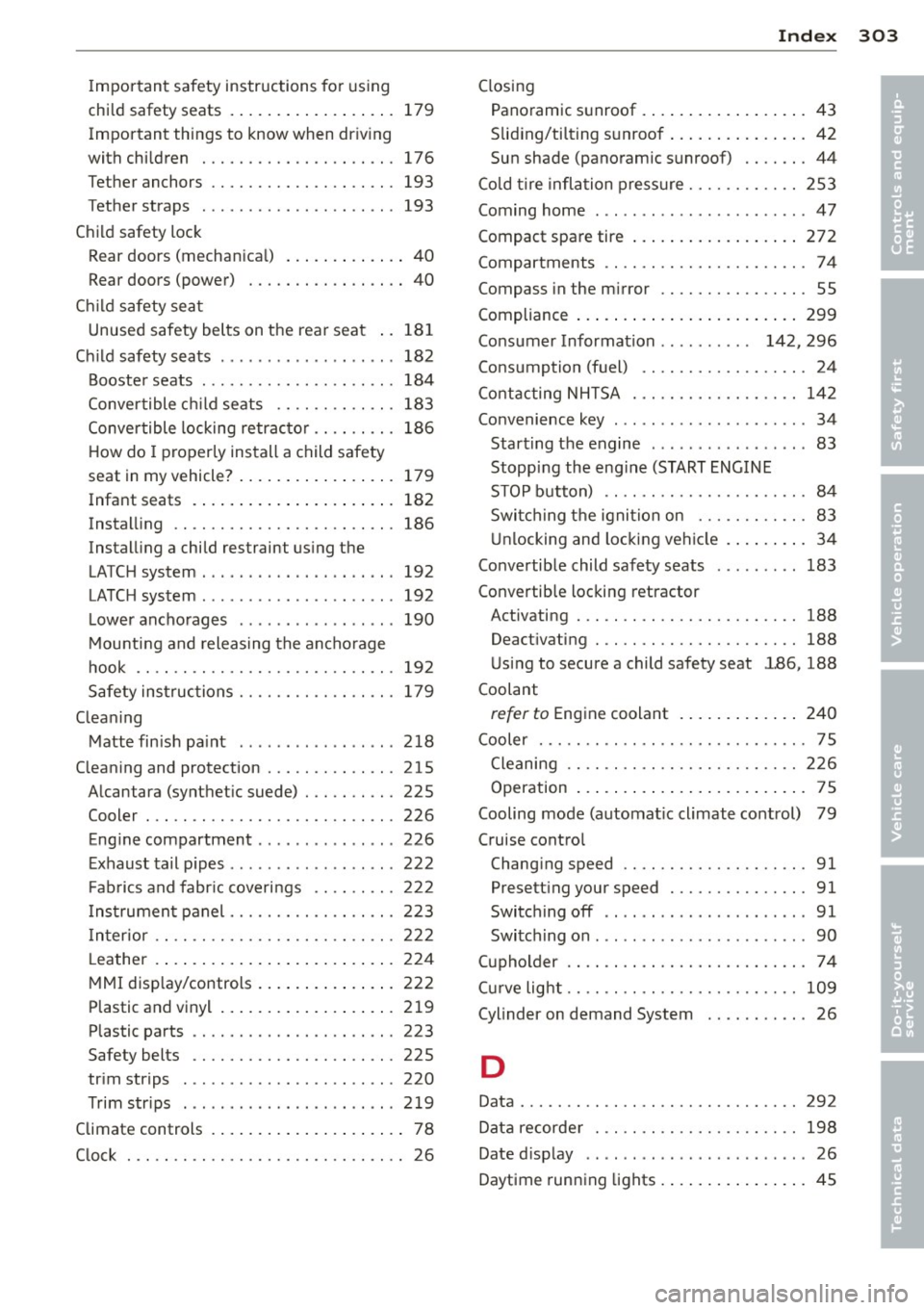
Important safety instructions for using
child safety seats . . . . . . . . . . . . . . . . . . 179
Important things to know when driving
with children ............ .... .. ... 176
Tether anchors ........... .... .. ... 193
T ether straps ............... ... ... 193
Child safety lock Rear doors (mechanical) ............. 40
Rear doors (power) ....... .. .. .. .. .. 40
Child safety seat Unused safety belts on the rear seat .. 181
Child safety seats ............. .... .. 182
Booster seats . . . . . . . . . . . . . . . . . . . . . 184
Convertible child seats .... .. .. .. .. . 183
Convertible locking retractor .. .. .. .. . 186
How do I properly install a child safety
seat in my vehicle? ................. 179
Infant seats . . . . . . . . . . . . . . . . . . . . . . 182
Installing .. ............. .... .. ... 186
Installing a child restraint using the
LATCH system . . . . . . . . . . . . . . . . . . . . . 192
LATCH system . . . . . . . . . . . . . . . . . . . . . 192
Lower anchorages ........... .... .. 190
Mounting and releasing the anchorage
hook .. .. .. .... ............. .. .. . 192
Safety instructions ........ .. .. .. .. . 179
Cleaning Matte finish paint ............ ... .. 218
Cleaning and protection ..... .. .. .. .. . 215
Alcantara (synthetic suede) . .. .. .. .. . 225
Cooler ... .. ................. .. ... 226
Engine compartment ........... .... 226
Exhaust tail pipes .... ..... .. .. .. .. . 222
Fabrics and fabric coverings .. .. .. .. . 222
I nstrument panel ......... .. .. .. .. . 223
I nterior .. .. ............. .... .. .. . 222
Leather .... ................ ... ... 224
MMI display/controls ......... ... .. . 222
Plastic and vinyl . . . . . . . . . . . . . . . . . . . 219
Plastic parts .. ........... .. .. .. ... 223
Safety belts ............. .... .. ... 225
trim strips ........... .... ... ... .. 220
Trim strips . ................ ... ... 219
Climate controls . . . . . . . . . . . . . . . . . . . . . 78
Clock . .. .. .. ................. .. .. .. 26
Index 303
Closing
Panoramic sunroof ................ .. 43
Slid ing/tilting sunroof ............... 42
Sun shade (panoramic sunroof) .... .. . 44
Cold tire inflation pressure ........ .... 253
Coming home . .. .. .. .. .. ...... ...... 47
Compact spare tire ................. . 272
Compartments .. .. ................. . 74
Compass in the mirror ............... . 55
Compliance ..... .... ............... 299
Consumer Information . . . . . . . . . . 142, 296
Consumption (fuel) ................. . 24
Contacting NHTSA .............. .. .. 142
Convenience key . . . . . . . . . . . . . . . . . . . . . 34
Starting the engine .. .... .. .... .... . 83
Stopping the eng ine (START ENGINE
STOP button) . . . . . . . . . . . . . . . . . . . . . . 84
Switching the ignition on ....... .. .. . 83
Unlocking and locking vehicle ....... .. 34
Convertible child safety seats . .... .. .. 183
Convertible locking retractor Activating . . . . . . . . . . . . . . . . . . . . . . . . 188
Deactivating . .. .. ................. 188
Using to secure a child safety seat 1.86, 188
Coolant
refer to Engine coolant ............ . 240
Cooler ..... .. .. .. .... ............. . 75
Cleaning .... .. .. ............... .. 226
Operation ......................... 75
Cooling mode (automatic climate control) 79
Cruise control Changing speed .. ............. .. .. . 91
Presetting your speed ............... 91
Switching off .. .. .. ..... ........... 91
Switching on . .. .. .. . .. .... ........ . 90
(upholder .... .. ...... ............. . 74
Curve light .. .. .. .. .. ............... 109
Cylinder on demand System ...... .. .. . 26
D
Data ........... .. .. . .............. 292
Data recorder . .. .. .. .. ........... .. 198
Date display ...... .. ..... ........... 26
Daytime running lights .............. .. 45
•
•
Page 315 of 318

Windshield Cleaning ... ..... ........ .. .. .. .... 52
defrosting .. ............. .. .. .. .. .. 80
Windshield washer system .. .. .. .. .. .. 52
Washer fluid level . . . . . . . . . . . . . . . . . . 21
Washer reservoir ............... .. . 247
Windshield wipers
Foldin g up . . . . . . . . . . . . . . . . . . . . . . . . 53
Ind icator light . . . . . . . . . . . . . . . . . . . . . 21
Replacing wind shie ld wiper blades . .. .. 53
Switching on/off . . . . . . . . . . . . . . . . . . . 52
Winter operation Batter y . . . . . . . . . . . . . . . . . . . . . . . . . . 243
Cooling system ............... .. .. . 240
D efrosting w indows ....... .. .. .. .. .. 80
Seat heating . . . . . . . . . . . . . . . . . . . . . . . 80
Steer ing whee l heating .......... .. .. 81
Tires . ..... .. .. ........... .. .. ... 203
Windows .. ............. .... .. ... 220
Winter tires .. ............. .... .. .. . 264
All-wheel drive ........... .. .. .. ... 264
X
Xenon-Lights . .. ........... .. .. .. ... 283
Xenon plus headlights ...... .. .. .. .. .. 45
Index 313
•
•