2013 AUDI S7 ABS
[x] Cancel search: ABSPage 199 of 310

ESC includes and/or works together with the
anti-lock brake system (ABS) , brake assist sys
tem, anti -slip regulation (ASR) , electronic dif
ferential lock (E DL) and e lectronic interaxle
d ifferential lock*. ESC is swi tched on all the
time. In certain situat ions when you need less
traction , you can switch off ASR by pressing
the button
[ru ~ fig . 181 . Be sure to switch
ASR on again when you no longer need less
traction.
Anti-lock braking system (ABS)
ABS prevents the wheels from locking up
when braking. The vehicle can still be steered even during hard braking . Apply steady pres
sure to the brake pedal. Do not pump the ped
al. A puls ing in the brake pedal indicates that
the system is he lping you to brake the vehicle.
Brake assist system
The brake assist system can decrease brak ing
d istance.
It increases braking power when the
driver presses the brake pedal quickly in emer
gency situations. You must press and hold the
brake pedal until the situation is over . In
vehicles with adaptive cruise control* , the
brake assist system is more sensitive if the
d istance detected to the vehicle ahead is too
small.
Anti-slip regulation (ASR)
ASR reduces engine power when the drive
wheels begin to spin and adapts the force to
the road condit ions. This makes it eas ier to
s tart, accelerate and drive up hills.
Electronic differential lock (EDL)
The EDL brakes wheels that are spinn ing and
transfers the drive power to the other drive
wheel or whee ls if the vehicle is equipped with
all-whee l drive*. This function is available up
to about 75 mph (120 km/h).
I n extreme cases , EDL automatically switches
off to help keep the brake on the braked wheel
from overheating. EDL wi ll switch on again au
tomatically when conditions have returned to
normal.
Intelligent technology 197
Electronic interaxle differential lock*/
selective wheel torque control*
The electronic interaxle differential lock (front
whee l drive) or the se lective wheel torque
cont rol (all-wheel dr ive) operates when dr iv
ing through curves . The front wheel on the in
s ide of the curve or both wheels on the inside
of the curve are braked selectively as needed .
T his min imizes sliding in the front wheels and
allows for more precise driving through
curves . Th e applicable system may no t acti
vate when driv ing in wet or snowy conditions.
A WARNING
-
-ESC, ABS, ASR, EDL and the electronic in
teraxle differential lock function* cannot
overcome the laws of physics. This is es
pecially important on slippery or wet
roads . If the systems begin acting to sta
bilize your vehicle, you should immedi
ately change your speed to match the
road and traffic conditions. Do not let
the increased safety provided by these
systems tempt you to t.;1ke risks. Doing
so will increase the risk o f a loss of vehi
cle control, collision and serious personal
injuries.
-Always adapt your speed to road, traffic
and weather conditions . The risk of los
ing control of the vehicle increases when
driving too fast, espec ially through
curves and on slippery or wet roads, and
when dr iving too close to vehicles up
ahead . ESC, ABS, the brake assist sys
tem, EDL, ASR and the elec tronic inter
axle differential lock function* cannot
prevent collisions .
- Always accelerate with special care on
even, smooth surfaces such as those that
are wet or covered with ice and snow.
The drive wheels can spin even with
these assistance systems that cannot al
ways he lp to red uce the risk of loss of ve -
hicle control. .,.
•
•
Page 200 of 310

198 Intelligent technology
@ Tips
- ABS and ASR on ly work correctly when
all four wheels are equipped w ith identi
ca l tires. Different tire si zes can lead to a
reduct ion in engine power.
- You may hear noises when the systems described are working.
- If the indicato r light
DJ or 11:11 (USA
models) 1i] (Canada models) appears,
there may be a malfunctio n¢
page 20,
¢ page 19.
Switching on and off
ESC turns on au toma tic ally when you s tart
t he engine.
F ig . 18 1 Cen te r con sol e w it h ESC OF F but ton
Sw itching sport mode on
Press the I~ OF FI button c::> fig . 181 . The ac
tions taken by the ESC system to stabilize the
ve hicl e are lim ited. In vehicles with front
wheel drive, the anti -s li p reg ulation (ASR) is
lim ited . In vehicles with a ll-wheel drive, the
ASR is switched off. The
It) ESC ind icator light
turns on and the message
St abili zation co n
trol (ESC): Off Warning ! Reduced stabilit y
¢.&. appears in the driver informa tion system
d isplay.
The follow ing examples are unusua l situa
tions where it may make sense to switch sport
mode on in orde r to allow the wheels to spin:
- Rocking the vehicle back and forth when it is
stuck
- Driving in deep snow or on loose ground
- Driving wi th s now cha ins
Switching sport mode off
Press the 1.$ O FF I button again. The I indica
tor light t urns off and the message
Stabiliza
tion control (ESC): On
appea rs in the dr iver
information system disp lay .
A WARNING
-
-Drive whee ls can sp in and you can lose
control of the vehicle more easi ly when
ASR and ESC are in sport mode, especial
ly when the road is slippe ry .
- Sw itch to sport mode only when your
driving skills, traffic and weather condi
tions permit .
@ Tips
- You cannot switch sport mode on when
adaptive cru ise contro l* is working .
-
- If the rear spoi ler system malfunct ions,
sport mode may not switc h on or it may
switch off agai n automatically .
Rear spoiler
The rear spoiler improves vehicle handling
and enhances driver control.
Fig . 182 Center co n so le: Sw it c h for rea r s poile r
The rea r spoi le r deploys and retracts. Spoiler
operation can be se t fo r automat ic or ma nual
operation.
Automatic mode (normal operation)
- Au tomatic deployment : At a speed of about
8 0 mph (130 km/h), the rea r spo ile r deploys
au tomatically.
- Automati c retr act ion: When speed drops be
low abou t 50 mph (80 km/h), the rear spoil-
er retracts a utomat ica lly. ..,.
Page 211 of 310

Trailer towing Driving with a trailer
General information
Your Audi was designed primarily for passen
ger transportation .
If you plan to tow a tra iler, p lease remember
that the addit ional load will affect durab ility,
economy and performance .
Trailer towing not on ly places more stress on
the vehicle, it also calls for more concentra
tion from the driver.
F or this reason, a lways fo llow the operating
and driving instructions provided and use
common sense.
(D Note
If you are going to tow a trai ler, you must
ac tivate the trailer operation mode
c::> page 209, Operating instructions.
Technical requirements
Traile r hitch
Use a weig ht-carrying hitch conforming to the
gross trailer we ight. The hitch must be suita
b le for your veh icle and trailer and must be
mounted securely on t he ve hicle's chassis at a
technically sound location . Use only a trail er
hi tch w ith a removab le ball moun t. A lways
check wi th t he tra ile r hi tch man ufa ctur er to
make sure that you are using the cor rect
h itch.
Do not us e a bumper hitch .
The hitch m ust be installed in such a way that
i t does not interfe re with the impac t-absorb
i ng bumper syst em. No mod ificat ions should
b e made to the vehi cle e xhaus t and br ake sys
tems . From t ime to time, check th at a ll hitc h
mo unt ing bo lts rem ain securely fas tened.
When you are not towing a trail er, remove the
tra ile r hi tch ball moun t. T h is prevents the
hi tch from causing damage sho uld your ve hi
cle be str uck from behind~ .&.
Trailer towin g 209
Trailer brakes
If your trailer is equippe d wi th a bra king sys
tem, check to be s ure that i t conforms to all
regulations .
T he trailer hyd ra u lic bra ke sys tem mus t not be
d irec tly connec ted to the vehicle's hydraulic
brake system .
Safety chains
Always use safety chains be tween your ve hicle
and t he tra ile r.
Trailer lights
Trai ler lights must meet all reg ulations. Be
su re to c heck with your Audi dea ler for correct
wir ing, switches and relays .
Mirrors
If you a re unable to see the traffic behind you
u sing the regula r outside mirrors, then you
must insta ll extended mir rors. It is important
t h at you
always have clea r vis io n to the rear.
_&. WARNING
-
Afte r removi ng the trailer hitch , do no t
s tor e i t in yo ur v ehicl e. In case of sudden
b raki ng, the hi tch co uld fly forwar d and in
j ur e you o r yo ur pass enge rs.
Operating instructions
Maximum trailer weight
A tra ile r fo r you r vehi cle is l imited to a typi cal
cla ss 1 o r class 2 tr ailer.
Trailer load distribution
Be sure the load in the tra ile r is held secure ly
in place to p revent it from shift ing fo rward,
ba ckward or sideways.
Never allow a passenger to ride in a trailer
c::> .& in Driving instructions on page 211 .
Engine cooling sy stem
Towing a t railer ma kes the engine wor k hard
er . It is impo rtant that the cooling system's
performance is up to the additional load.
•
•
Page 213 of 310

Always apply brakes early. When driving
downhill, shift into a lower gear to use the en
g ine braking effect to slow the vehicle . Use of
the brakes a lone can cause them to overheat
and fail.
Coolant temperature
The coolant temperature gauge ¢ page 11
must be observed carefully. The coo lant tem
perature can increase if you drive on long in
clines in a low gear at high engine speeds. Re
duce your speed immediately if the LEDs in
the top part of the display turn on .
For more information about indicator lights,
refer to.
c> page 16.
A WARNING
Anyone not properly restrained in a mov
ing vehicle is at a much greater risk in an
accident . Never let anyone r ide in your car
who is not properly wearing the restra ints
provided by Aud i.
Trailer towing tips
Important to know
Your vehicle hand les different ly when towing
-
a trailer because of the additional weight and
d ifferent weight distribution . Safety, perform
ance and economy w ill greatly depend on how
carefully you load your trailer and operate
your rig .
Before you actually tow your trailer, practice
turning, stopp ing and backing up in an area
away from traffic . Keep practicing until you
have become completely familiar with the way
your veh icle-trailer comb ination behaves and
responds .
Backing up is diff icult and requires practice .
Backing up with a tra iler genera lly requires
steer ing action opposite to that when backing
up your vehicle without a trailer.
Maintain a greater distance between your ve
hicle and the one in front of you. You will need
more room to stop. To compensate for the
Trailer towing 211
trailer, you wi ll need a larger than normal
turning radius.
When passing, remember that you cannot ac
ce lerate as fast as you norma lly would be
cause of the added load. Make sure you have
enough room to pass. After passing, allow
plenty of room for your trailer before chang
ing lanes again.
Avoid jerky starts, sharp turns or rapid lane
changes.
(0 Tips
- Do not tow a trailer during the break-in
period of your vehicle.
- If you tow a trailer, your Audi may re
quire more frequent maintenance due to
the extra load¢
page 289.
Parking on a slope
Do not pork on a slope with a trailer . If it can
not be avoided, do so only after doing the fol
lowing:
When parking:
"' App ly the foot brake .
.,. Have someo ne p lace chocks under both the
veh icle and the trailer wheels.
"' With chocks in place, slowly release the
brakes until the wheel chocks absorb the
load .
.,. Turn the wheels towards the curb .
.,. Apply the parking brake.
.,. Select the P selector lever posit ion .
When restarting after parking:
.,. Apply the foot brake.
.,. Start the engine .
.,. Select the D/S se lector lever position .
.,. Release the parking brake and slowly pull
out and away from the wheel chocks.
.,. Stop and have someone retr ieve the wheel
chocks .
111>
•
•
Page 222 of 310

220 Cleaning and protec tio n
when the cleaning so lution when cleaning the
display .
The MMI/RS E* contro ls must be cleaned first
with a brush so that d irt does not enter the
unit or enter between the buttons and the
housing . Then wiping the controls with a cloth
dampened with dish detergent and water is
recommended.
- To avoid scratching the disp lay, you
shou ld never clean it dry.
- To prevent damage, make sure fl uids do
not enter the controls .
Head-up Display
Applies to vehicles: with Head-up Display
The Head-up Display may be cleaned with a
damp cloth. The cloth should be free from
dust and lint, like a m icrofiber cloth for exam
ple .
Q) Note
-To prevent scratches, do not clean the
display when it is dry.
- To prevent damage, make sure that flu
i ds do not enter the disp lay.
Aluminum trim
Use only n eutral -pH products to remove spots
and depos its from alum inum surfaces .
Ch rome ca re products and alkaline cleaners
will attack alum inum s urfaces and can dam
age them over time.
A WARNING
Always read and heed a ll WARNINGS and
other information ¢
page 213.
Fabrics and fabric coverings
Fabrics and fabric coverings (e .g. seats, door
tr im panels, etc.) should be cleaned at reg ular
intervals with a vacuum cleaner . This removes
surface dirt particles which could become em bedded in the fabr ic through use . Steam cleaners should not be
used, because the
steam tends to p ush the dirt deeper into the
fabric and lock it there.
Normal cl eaning
Genera lly, we recommend using a soft sponge
o r a lint-free microfiber cloth to the clean fab
ric. Brushes shou ld only be used for carpets
and floor mats, since other fabric surfaces cou ld be harmed by brushes.
Normal s urface stains can be cleaned using a
commercially availab le foam cleaner . Spread
the foam on the surface of the fabric with a soft sponge and work it in gently . Do not satu
rate the fabric. Then pat the foam dry us ing
absorbent, dry cloths (e.g. m icrofiber cloth)
and vacuum it after it has dried completely.
Cle aning stains
Stains caused by beverages (e .g. coffee, fruit
juice, etc .) can be treated with a mild deter
gent solution. Apply the detergent solution
wi th a sponge. In the case of stubborn s tains,
a detergent paste can be applied directly to
the stain and worked i nto the fabric . After
wards, use copious amounts of clean water to
remove the rema ining deterge nt. Apply the
water with a damp cloth or sponge a nd pat
the fabr ic dry with an absorbent, dry cloth .
Stai ns from choco late or makeup should have
detergent paste (e.g. ox-gall soap) rubbed in
to them. Afterwa rds, remove the soap with
water (damp sponge) .
Alcohol can be used to treat stains from grease, o il , lipstick or a ballpoint pen . Melted
gre ase or dye mus t be patted
off using ab
sorbent material. It may be necessary to re
treat the areas with detergent paste and wa
ter.
In the case of general soiling of the upho ls
te ry and cover material, we recommend hiring
a specia list that has the equipment to clean
the seat covers and other fabric surfac es by
shampooing and spray extraction.
Page 224 of 310

222 Cleaning and protec tio n
and can damage the leather surface as well as
weaken seams .
The leather shou ld be cleaned reg ularly as
needed. After having been used for a re latively
l ong time, your leather seats will acquire a
rich ag ed finish. This is a characteristic of nat
ura l leather and a sign of true quality .
I n order to ma in tain the va lue of th is natura l
p rod uct over the life of your vehicle, you
should follow the recommendations below :
(U;) Note
-To keep your leather from bleaching ou t,
do not a llow it to be exposed to bright
sunlight for long periods of time .
If you
have to leave the vehicle parked outside
for long periods, cover the leather to protect it from d irect exposure to sun
li ght.
- Sharp objects on clothing, such as zip
pers, rivets or sharp pieces on belts can
leave permanent scratches or scrape
marks on the surface of the leather .
(D Tips
-After each t ime you clean the leather and
at regular intervals, use a leather preser
vat ive creme that conta ins UV-blockers
and that works into the leather. This
creme wi ll nourish and moistur ize the
l eather, helping i t to breathe and stay
supple. It also helps to b uild up a protec
tive coating on the surface .
- Clean the leather every 2 -3 months,
and clean any areas that get soiled.
- Remove fresh mar ks made by ba llpoi nt
pens, ink, lipst ick, shoe polish, etc. as
soon as possib le .
- Preserve the colo r of the leather as need
ed by using a special colored leather care
creme to touch up areas of uneven co lor.
Cleaning and caring for leather
upholstery and trim
Appl ies to vehicles : wi th natural lea the r
Natural leather requires special care and at
tention .
Normal cleaning
.. Clean soiled areas with a slightly moistened
cotton or woolen cloth .
More stubborn dirt
.. More stubborn dirt can be remov ed using a
cloth saturated with a mild soap solut ion (2
tablespoons mild liquid soap).
.. Never allow the soap solution to saturate
the leather, and make certain that no water
soaks into the seams .
.. Wipe off the soap so lution with a soft, dry
cloth.
Cle aning spot s
.. Remove fresh wat er-base d spots (suc h as
coffee , tea, juices, blood) with an absorbent
cloth or paper towel.
.. Remove fresh
gre ase or o il-ba sed spot s
(such as butter , mayonnaise, chocolate) with
an absorbent cloth or paper towel, or use
the cleaner from the leather care kit if the
spot has not yet penetrated into the surface
of the leather.
.. Use an oil/grease d issolving spray, if
oil /
gr ease spots ha ve dr ied on.
.. Remove specific k inds of spots (ballpoint
pen, felt marker, fingerna il polish, water
based pa int, shoe polish, etc .) with a spot
remover specifically fo rmu lated for leather.
L e ather care
.. Every half year use an approved leather care
product (available from your Audi dealer) to
care for the leather .
.. App ly the product very spar ingly.
.. Wipe it off with a damp cloth.
If you have any questions about cleaning and
ca ring for the leather in your vehicle, it is best
to contact your authorized Aud i dea ler, who
will be g lad to help you and tell you abo ut o ur
f ull range of leather care products, such as : .,_
Page 242 of 310

24 0 Ch eck ing and filling
The location of the brake fluid reservo ir can be
seen in the engine compartment illustration
¢ page 232.
The fl uid level may drop slightly after some
time due to the automatic adjustment of the
brake pads. This is not cause for alarm.
I f the brake fluid level falls
considerably be
low the "MIN" mark, the brake warning/ind i
cator light
1111 (U .S . models)/ . (Canadian
models) will come on¢
page 15. Do not con
tinue to operate the vehicle. The comp lete
brake system shou ld be thoroughly checked
by an au thorized Audi dealer or other quali
fied facility and the cause corrected . If the
brake fluid level is too low, the brake warn ing/
indicator light w ill illuminate . Contact an au
thor ized Audi dealer
imm ediatel y.
Changing brake fluid
Have the brake fluid changed by an experi
enced technician .
Brake fluid absorbs moisture from the a ir . If
the water content in the brake fluid is too
h igh , corros ion in the brake system may result
after a per iod of t ime . The bo iling po int of the
brake fluid w ill also decrease considerably and
dec rease braking performance.
Therefore, the brake flu id must be changed
ev ery two year s. Always use new b rake fluid
which conforms to Fede ral Motor Vehicle
Standard "FMVSS
116 DO T 4".
The brake flu id reservoir can be difficult to
r each, therefo re , we recommend that you
have the brake fl uid changed by yo ur author
ized
Audi d ealer. Your dea ler has the correct
too ls, the right brake fluid and the know -how
to do this for you .
A WARNING
-Brake fluid is poisonous . It must be stor
ed only in the closed orig inal container
out of the reach of children!
- Brake fa ilure can result from old or inap
propriate brake fluid. Observe these pre
caut ions: -
Use only brake fluid that meets SAE
specification
J 1703 and conforms to
Federa l Motor Vehicle Standard
116.
Always check with your authorized Audi
dealer to make sure you are using the
correct brake fluid . The correct type of
brake f lu id is also ind icated on the
brake flu id reservoir.
- T he brake fluid must be new. Heavy use
of the bra kes ca n cause a vapo r lock if
the b rake fluid is left in the system too
l ong . This can seriously affect the effi
c iency of the brakes as well as your
safety. This co uld resu lt in an accident.
(D Note
Bra ke fluid will damage the paint of you r
vehicle .
(® For the sake of the environment
Because of the p rob lem of p roper disposal
of b ra ke fluid as well as the spec ial too ls
r equired and the necessary expertise, we
re commend that you have the brake fluid
changed by yo ur authorized Aud i dea ler.
Battery
General information
U nder normal ope rat ing cond itions , the bat
tery in yo ur Audi does not need any ma inte
nance. With
high o utside tempe ra tu res or
l ong daily drives we recommend that you have
the e lectrolyte level checked by a service fa
cility. The electrolyte leve l should a lso be
checked each t ime the battery is charged
<=> page 243.
Have th e battery checked when yo u take your
veh icle in for service. You are well advised to
replace a battery that is o lder than S years .
With certain types of airbag deployment, the battery is disconnected from the veh icle elec
trical system for safety reasons<=>.&
in Re
pair , care and dispo sal of the airbags on
page
165.
Page 243 of 310
Disconne cting the batt ery t erminals
Some vehicle functions (power w indow regu
l ators, for example) are lost if the battery ter
minals are disconnected . These functions have
to be re learned after the battery terminals are
connected again. To prevent this, the battery
should only be disconnected from the vehicle
electrical system when absolutely necessary
for repairs .
Vehicles not driven fo r lo ng period s
If you do not drive your vehicle over a period
of several days or weeks, electrical compo
nents are gradually cut back or switched off .
This reduces energy consumption and main
tains starting capab ility over a longer per iod
c> page 202 . Some of the convenience func
tions may not operate, such as the inte rior
lights or power seat adjustment. The conven
ience functions will be ava ilable again when
you switch on the ignition and start the en
g ine.
Winter operation
D uring the winter months, batte ry capacity
tends to decrease as tempe ratu res d rop . This
is because more power is also consumed while
starting , and the headlights, rear window de
fogger, etc., are used more often.
Avoid unnecessary power consumption, par
ticularly in city t raffic or when traveling on ly
short distances. Let your a uthorized Audi
dealer check the capacity of the vehicle bat
tery before winter sets inc>
page 243. A well
charged battery w ill not only prevent starting
prob lems when the weather is cold, but will
also last longer .
@ Tips
If your vehicle is left standing for severa l
weeks at extremely low temperatu res, the
veh icle battery should be removed and
sto red where it will not freeze. This will
prevent it from being damaged and hav ing
t o be rep la ced.
Checkin g and fillin g 241
Working on the battery
Be especially careful when working on or near
the battery.
The battery is located in the luggage compart ment under the floor. Before you check any
th ing in the luggage compartment,
read and
he ed all WARNINGS
<=> ..&_ .
Always heed the safet y warnings , when work
i ng on the vehicle batte ry or the vehicle e lec
trical system to prevent inju ry.
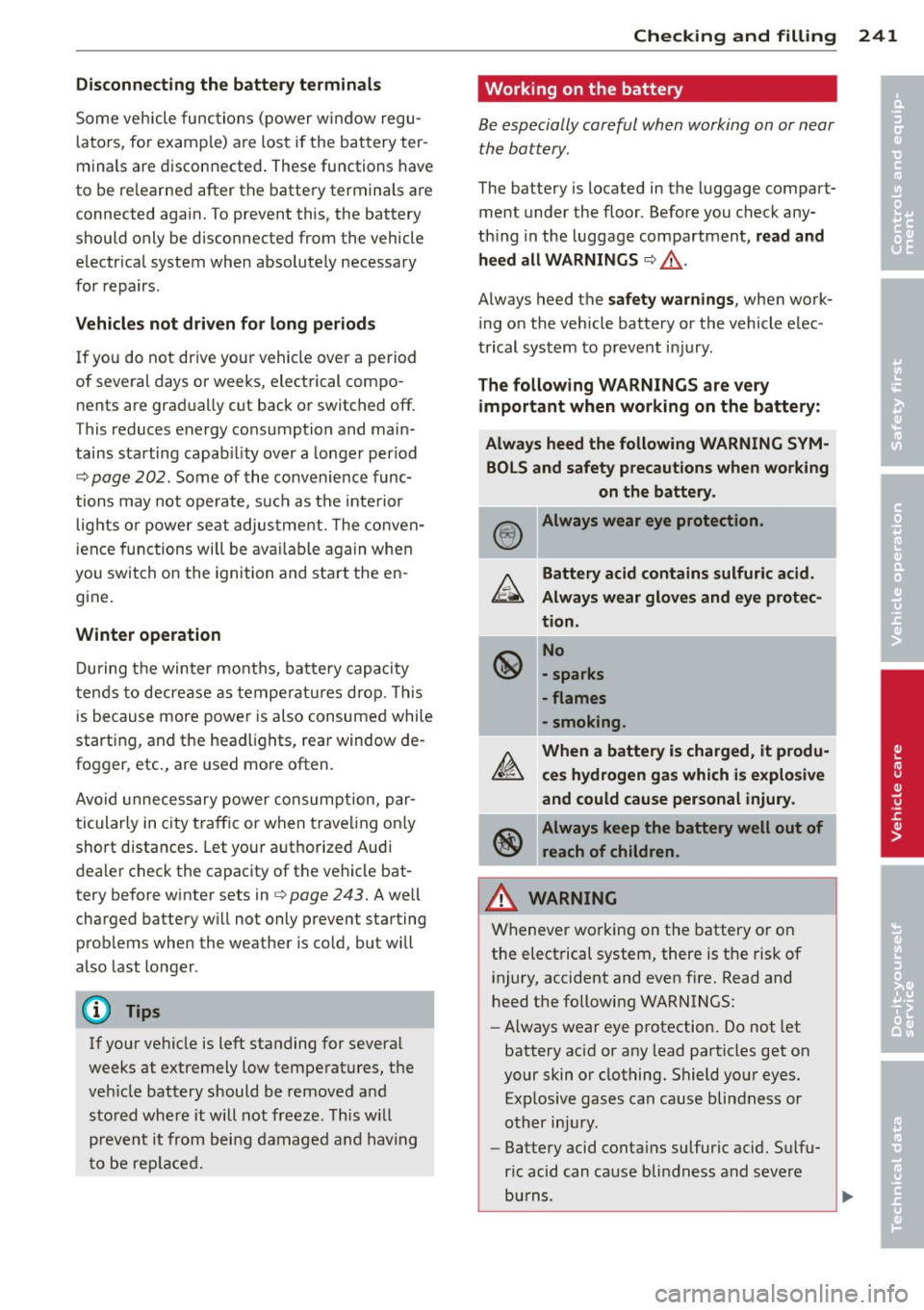
The following WARNINGS ar e very
important when wor king on the battery:
Always heed the following WARNING SYM BOLS and safety pre cautions when working
on the battery.
Always wear eye protection.
Battery acid contains sulfuri c acid .
Always w ear glove s and eye protec
tion.
No
- sparks
- flames
- smoking .
1
When a batter y is charged, it produ
ce s hydrogen g as which is e xplo sive
and could cause per sonal injury .
---·-
®
Always keep the battery well out of
reach of children .
A WARNING
Whenever working on the battery o r on
the electrical system, there is the risk of injury, accident and even fire. Read and
heed the following WARNINGS :
- Always wear eye protection. Do not let
-
battery ac id or any lead particles get on
your skin or clothing. Shield your eyes. Exp losive gases can cause blindness or
other inju ry.
- Battery acid conta ins sulfuric acid. Sulfu
ric acid can cause blindness and severe
bu rns.
•
•