2013 AUDI Q7 belt
[x] Cancel search: beltPage 215 of 348

to the backrest on the vehicle seat. Ad
just or remove the rear seat head restraint if it is diff icult to install the
child seat w ith the head restraint in place
¢ page 77. Install the head restraint
again immed iate ly once the child seat is
removed. Driving without head rest raints
o r with he ad restraints that are not prop
erly adjusted increases the risk of serious
or fatal neck injury dramatically.
- Always read and heed all WARNINGS
whenever using a child rest rained in ave
hicle is being used
¢page 175, Safety
belts,¢ page 184, Airbag system
and
¢ page 205, Important things to know.
A WARNING
If except ional circumstances requ ire the
use of a forward-facing child restra int on
the front passenger's seat, the ch ild's safe
ty and well-being require that the follow
ing special precautions be taken:
- Make sure the forward-fac ing seat has
been designed and certified by its manu
factur er for use on a front seat with a
passenge r fron t and side airbag.
- Always follow the manufacturer's in
st ruct ions provided with the child sa fety
sea t or infan t carrier.
- Always mov e the front passenge r seat in
to the rearmost posit ion of the passen
ger seat's fore and aft ad justment r ange,
and as far away from the airbag as possi
ble before instal ling the child restraint.
- Always m ake sure that noth ing prevents
the front passenger's seat from bei ng
moved to the rearmost position in its
fore and aft adjustment range .
- Always make sure the backrest is in an upright position.
- Make su re that the
PASSENGER AIR BAG
OFF
light comes on and stays on all the
time whenever the ignition is switched
on.
- If the light does not stay on, perform the
checks¢
page 195, Monitoring the Ad
vanced Airbag System.
-
Child S afety 213
-Take the chi ld restraint off the front pas
senger seat and install it properly at one
of the rear seat positions if the
PASSEN
GER AIR BA G OF F
light does not stay on
whenever the ignit ion is switched on.
Booster seats and safety belts
Properly used booster seats con help protect
children weighing between about 40 lbs. and
80 lbs . (18 kg and 36 kg) who are less than 4
ft. 9 in . (57 inches/1 .45 meters) tall.
In .... N 0 ±
~
Fig . 221 Rear seat: ch ild properly res trained in a boos
ter seat
The vehicle's safety belts alone will not fit most children until they are at least 4
ft. 9 in .
(57 inches/1.45 me ters) tall and weigh about
80 lbs . (36 kg) . Booster seats raise these chi l
dren up so tha t the safety belt w ill pass p rop
erly over the stronger parts of the ir bodies
and the safety be lt can he lp protect them in a
crash.
.,. Do not use the conver tible locking ret ra ctor
when using the ve hicl e's s afety be lt to re
s train a ch ild on a booster seat.
... The shoulder belt must lie as close to the
center of the ch ild's collar bone as possible
and must lie flat and snug on the upper
body. It must never lie across the throat or
neck . The lap belt must lie across the pelvis
and never across the stomach or abdomen .
Make s ure the belt lies flat and snug. Pull on
th e belt to tighten if necessary.
.,. If you must transport an o lder ch ild in a
booster seat on the front passenger sea t,
you can use the safety be lt height adjust
ment to he lp ad just the shou lder portion
properly.
Page 216 of 348

214 Child Saf ety
• Secure unused safety be lts on the rear seat
9 page 210.
Ch ildren up to at least 8 years old (over 40
l bs. or 18 kg) are best protected in chi ld safe
ty seats designed for their age and weight. Ex perts say that the ske leta l structure, particu
larly the pelvis, of these chi ldren is not fully
developed, and they must not use the vehicle
safety belts w ithout a su itable child restraint .
It is us ually best to put these children in ap
propriate booster seats. Be sure the booster
seat meets all applicab le safety standards.
Booster seats raise the seating position of the
child and reposition both the lap and shoulder
parts of the safety belt so that they pass
across the child's body in the right places. The
routing of the belt over the child's body is very
important for the ch ild's protection, whether
or not a booster seat is used . Children age 12
and under must always ride in the rear seat.
Ch ildren who are at least 4
ft . 9 in. (57 in
ches/1.4S meters) tall can generally use the
vehicle's three po int lap and shoulder belts .
Neve r use the lap belt portion of the veh icle's
safety belt a lone to restrain any child, regard
l ess of how b ig the child is. Always remembe r
that c hildren do not have the pronounced pe l
vic structure required for the proper function
of lap belt portion of the vehicle's three point
lap and shoulder be lts. The child's safety ab
solutely requires that a lap be lt portion of the
safety belt be fastened snugly and as low as
possible around the pelvis . Never let the lap
be lt portion of the safety belt pass over the
chi ld's stomach or abdomen.
In a crash, airbags must inflate within a blink
of an eye and with cons iderable force . In order
to do its job, the airbag needs room to inflate
so that it will be there to protect the occupant
as the occupant moves forward into the air bag.
A vehicle occupant who is out of position and
too close to the airbag gets in the way of an
i n flat ing airb ag. When an occupant is too
close, he or she wi ll be struck violen tly and will
receive serious or possib ly even fatal in
jury .
In orde r fo r the ai rbag to offer protect ion, i t is
i mportant that a ll vehicle occupants, espe cial
ly any children, who m ust be in the front seat
because of exceptiona l circumstances , be
proper ly restrained and as far away from the
airbag as possible . By keeping room between
the child's body and the front of the passen
ger compartment, the airbag can inflate com
pletely and prov ide supplemental protection
in certain frontal collisions .
.&, WARNING
Not using a booste r seat, using the boos
ter seat improperly, inco rrectly installing a
booster seat or using the vehicle sa fety
belt improperly increases the risk of seri
ous persona l injury and death in a collision
or other emergency situat ion. To he lp re
duce the risk of serious personal injury
and/or death:
- The shou lder belt must lie as close to the
center of the ch ild's collar bone as possi
b le and must lie flat and snug on the up
per body . It must neve r lie across the
throat or neck. The lap belt must lie
across the pe lvis and neve r ac ross t he
stomach o r abdomen. Make sure the belt
liesflat andsnug.Pullon thebelt to
tighten if necessary.
- Failure to p roperly ro ute s afe ty belts
over a child's body wi ll ca use seve re inj u
ries in an accident o r other emergency
situation
¢ page 175 .
- The rear side o f the child sa fety seat
should be pos itioned as close as possib le
to the backrest on the vehicle seat. Ad
just or remove the rear seat head re straint if it is difficu lt to install the ch ild
seat with the head restraint in p lace
c::> page 77 . Install the head restraint
aga in immediately once the ch ild seat is
removed. D riving without head restraints
or w ith head restra ints that a re not prop
erly ad justed increases the risk of serious
.
or fatal neck in jury dramatically . ""
Page 217 of 348

-Children on the front seat of any car,
even with Advanced A irbags, can be seri
ous ly injured or even killed when an a ir
bag inflates.
- Never let a child stand or kneel on any
seat, for examp le the front seat.
- Never let a child ride in the cargo area of
your vehicle .
- Always remember that a ch ild lean ing
forward, sitt ing sideways or out of posi
t ion in any way during an acc ident can be
struck by a deploying airbag . This will re
sult in se rious personal injury or death .
- If you must install a booster seat on the
front passenger seat because of excep
t ional circumstances the
PASSENGER
AIR BAG OFF
light must come on and
stay on, whenever the ignition is switch
ed on.
- If the
PASSENGER AIR BAG OFF light
does not come on and stay on, perform
the checks described¢
page 195, Moni
toring the Advanced Airbag System.
- Ta ke the child restrain t off the front pas
senger seat and install it properly at one
of the rear seat positions if the
PASSEN
GER AIR BAG OFF
light does not stay on
whenever the ignition is switched on.
- Always read and heed all WARNINGS
whenever using a child restrained in ave
hicle is being used¢
page 175, Safety
belts,¢ page 184, Airbag system
and
c:> page 205, Important things to know.
Installing a child safety
seat
Securing a child safety seat using a
safety belt
Safety belts for the rear sea ts and the fron t
passenger can be locked wi th the convertible
locking retractor to properly secure child
safety seats .
The safety belts emergency lock ing retractors
for the rear seats safety belts and for the
front passenger's seat safety belt have a con
ve rtible locking retractor for child restraints.
Child Sa fet y 215
The safety belt must be locked so that be lt
webbing cannot unree l. The retractor can be
activated to lock the safety belt and prevent
the safety belt webbing from loosening up
during normal dr iving . A child safety seat can
only be properly installed when the safety belt
i s locked so that the chi ld and child safety
seat w ill stay in place .
Always remember: Even though your vehicle is equipped with an Advanced Airbag system, all
ch ildren, especially those 12 years and young
er, shou ld always r ide in the back seat proper
ly restrai ned fo r the ir age and size.
A WARNING
Improperly installed chi ld safety seats in
crease the risk of serious personal injury
and death in a collision.
- Always ma ke sure that the safety belt re
tracto r is loc ked when installing a child
safety seat . An unlocked safety belt re
tractor cannot hold the child safety seat
in place during normal dr iving or in a
crash.
- Always buckle the child safety seat firmly
in place even if a ch ild is not sitt ing in it.
A loose child safety seat can fly around during a sudden stop or in a collision .
- Always make sure that the rear seat
backrest to which the center rear safety
be lt is attached is securely latched when
eve r the rea r center safety belt is being
used to secure a ch ild restra int.
- If the backrest is not securely latched,
the child and the child restraint will be
thrown forward together with the back rest and will strike parts of the vehicle
interior. The child can be seriously in
jured or killed.
- Never install rear-fa cing child safety
seats or infant carrie rs on the front pas
senger seat . A child will be serio usly in
jured and can be killed when the passen ger airbag inflates.
- The inflating airbag will h it the ch ild
safety seat or infant carrier with great
force and will smash the child safety seat
~
•
•
Page 219 of 348

-A tight tether strap on a rearward-facing
child restraint attached to the front pas
senger seat can put too much pressure on the weight-mat in the seat and regis
ter a heavier weight in the Advanced Air
bag System . The heavier weight regis
tered can make the system work as
though an adult were on the seat and de
ploy the Advanced Airbag when it must
be suppressed causing serious or even
fatal injury to the child .
- Make sure that the
PASSENGER AIR BAG
OFF
light comes on and stays on all the
time whenever the ignition is switched
on.
- If the
PASSENGER AIR BAG OFF light
does not come on and stay on, immedi
ately install the rear-facing child safety
seat in a rear seating position and have
the airbag system inspected by your Audi dealer.
Activating the convertible locking
retractor
Use the convertible locking retractor to se
cure a child restraint.
Always heed the child safety seat manufactur
er's instructions when installing a child re
straint in your vehicle . To activate the conver
tible locking retractor :
.. Place the child restraint on a seat, prefera
bly on the rear seat.
.. Slowly pull the belt
all the way out .
.. Route it around or through the child re
straint belt path~&_ .
.. Push the child safety seat down with your
full weight to get the safety belt really tight.
.. Insert the belt tongue into the buckle for
that seating position .
.. Guide the safety belt back into the retractor
until the belt lies flat and snug on the child
safety seat .
.. You should hear a "clicking " noise as the
belt winds back into the inertia reel. Test the
convertible locking retractor by pulling on
the belt . You should no longer be able to
Child Safety 21 7
pull the belt out of the retractor. The con
vertible locking retractor is now activated.
.. Make sure that the red release button is fac
ing away from the child restraint so that it
can be unbuckled quickly.
.. Pull on the belt to make sure the safety belt
is properly tight and fastened so that the
seat cannot move forward or sideways more
than one inch (2.5 cm).
_&. WARNING
Using the wrong child restraint or an im
properly installed child restraint can cause
serious personal injury or death in a crash.
- Always make sure that the safety belt re-
tractor is locked when installing a child
safety seat. An unlocked safety belt re
tractor cannot hold the child safety seat
in place during normal driving or in a
crash.
-Always buckle the child safety seat firmly in place even if a child is not sitting in it.
A loose child safety seat can fly around
during a sudden stop or in a crash.
- Always make sure the seat backrest to
which the child restraint is installed is in
an upright position and securely latched
into place and cannot fold forward . Oth
erwise, the seatback with the child safety
seat attached to it could fly forward in
the event of an accident or other emer
gency situation .
- Always read and heed all WARNINGS
whenever using a child restrained in ave
hicle is being used¢
page 205. Special
precautions apply when installing a child
safety seat on the front passenger seat
¢ page 186, Child restraints on the front
seat -some important things to know .
-
•
•
Page 220 of 348

218 Child Saf ety
Deactivating the convertible locking
retractor
The convertible locking retractor for child re
straints will be deactivated automatically when the belt is wound all the way back into the retractor.
.,. Press the red button on the safety be lt
buck le. The belt tongue wi ll pop out of the
buck le .
.. Guide the safety belt all the way back into
its stowed position .
A lways le t the safety belt retract complete ly
into its stowed position . The safety belt can
now be used as an ordinary safety belt with
out the convertib le locking r etractor for chi ld
restra ints .
I f the convertible locking retractor shou ld be
activated inadvertently, the safety belt m ust
be unfastened and guided completely back in
to its stowed pos ition to deactivate th is fea
ture. If the convertible locking retractor is not
deactivated, the safety belt will gradually be
come tighter and u ncomfortable to wear .
A WARNING
Improperly insta lled child safety seats in
crease the risk of ser ious personal inju ry
and death in a collision .
- Never unfaste n the safety belt to deacti
vate the convert ible lock ing ret ractor for
c hild rest rain ts while the veh icle is mov
ing. You would not be restrained and
cou ld be seriously injured in an accident.
- Always read and heed all WARN INGS
whenever using a child restrained in ave
hicle is being used
c::> page 205. Special
precautions apply when installing a ch ild
safety seat on the front passenger seat
<=> page 186, Child restraints on the front
seat -some important things to know .
LATCH Lower
anchorages and tethers
for children
Child Restraint System anchors and how
are they related to child safety
To p rov ide a simpler and more practicable way
to a ttach the child restra int on the vehi cle
seat, Federal regulat ions req uire spec ia l lowe r
anchorages in vehicles and devices on new
child restraints to attach to the vehicle ancho
rages.
T he combination of the tether anc horages and
the lowe r anchorages is now genera lly ca lled
t h e
LATCH system fo r "Lower Anchorages and
T ethers for Child ren."
F o rward-facing chi ld restrai nts ma nufactured
after September 1, 1999, are requ ired by U .S .
f edera l regu lations to comply with new child
head movement performance req uirements.
These new performance req uirements make a
tether necessary on most new child seats.
Installing a child restraint that requires a top
tether without one can seriously impair the performance of the c hild restra int and its abil
ity to protect the child in a coll is ion. Insta lling
a chi ld restraint that requires a top tether
without the top tether may be a violat ion of
state law.
Child restraint manufacturers offer LATCH
lower anchorages on their child seats w ith
hook -on or push-on connectors attached to
adjustable straps .
In add ition to the LATCH lower anchorages,
these chi ld restraint systems usually require
the use of tether straps to he lp keep the chi ld
rest raint firmly in place.
A WARNING
-Imp roper installat ion of ch ild restra ints
will i ncrease the r is k of injury a nd death i n
a crash.
-
Page 221 of 348
-Always follow the instructions provided
by the manufacturer of the ch ild re
straint you intend to install in your veh i
cle .
- Never install a child restraint without a
properly attached top tether strap if the
child restraint manufacturer's instruc
t ions req uire the top tether strap to be
used.
- Improper use of ch ild restra int LATCH
lower anchorage points can lead to injury
in a collision. The LA TCH lower anchorage
points are designed to withstand only
those loads imposed by correctly fitted
child restraints.
- Never mount two child restraint systems
on one LATCH lower anchorage point.
- Never secure or attach any luggag e or
other item to the LATCH lower anchorag
es .
{i) Tips
-In Canada, the terms "top tether" with
"lowe r universal anchorages" (or "lower
universal anchorage bars") are used to
desc ribe the system .
- In other countries, the term "ISOFIX" is
us ed to describe the lower anchorages.
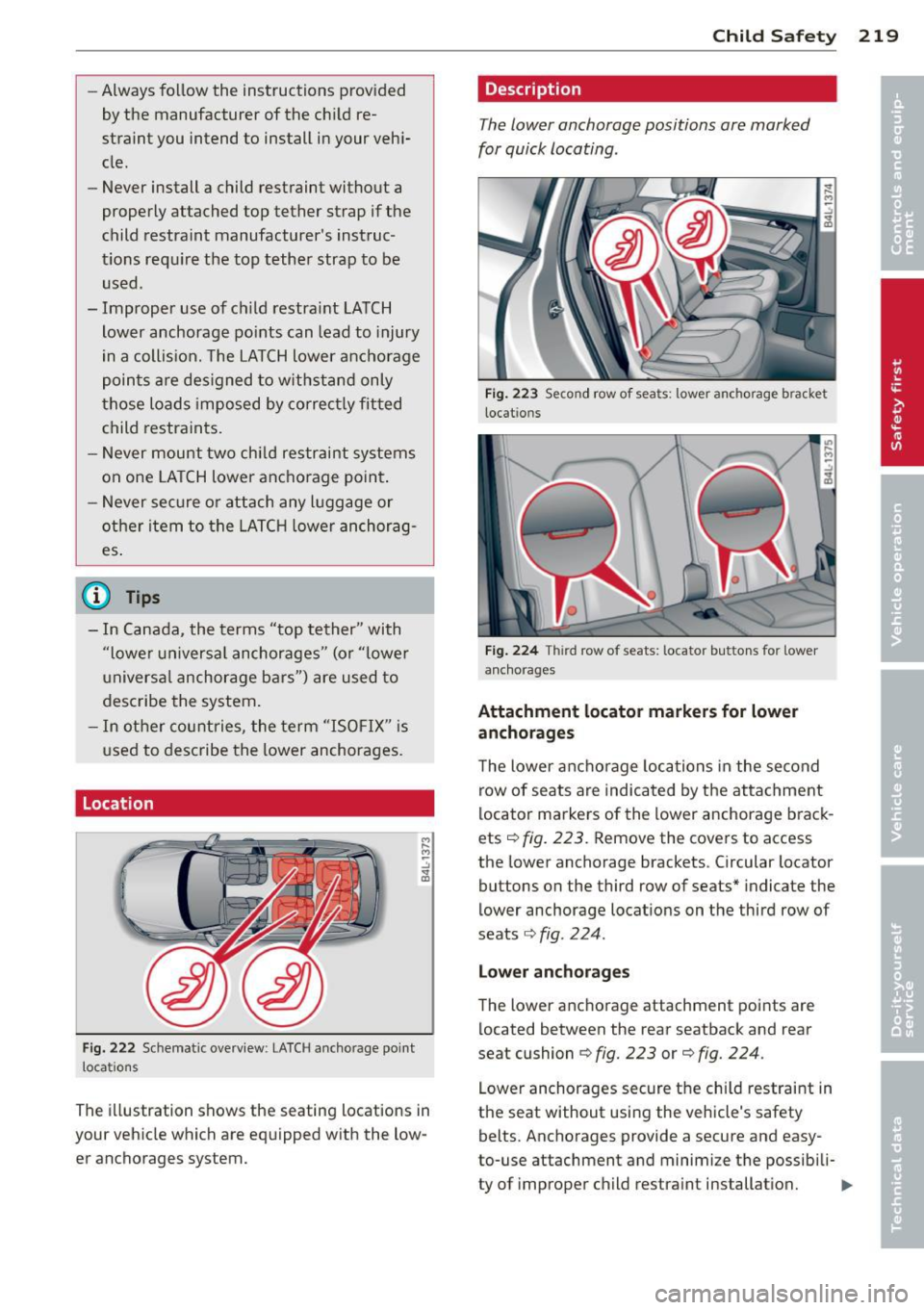
Location
Fig . 222 Schematic overv iew : LATCH anc horage poi nt
locations
The illustration shows the seating locations in
your vehicle which are equipped with the low er anchorages system.
Child Safety 219
Description
The lower anchorage positions are marked
for quick locating .
Fig. 223 Second row of seats: lower anc horage b racket
locat io n s
Fig. 224 Thir d row of seats: locato r buttons for lower
a nch orages
Attachment locator markers for lower
anchorages
T he lower anchorage locations in the second
row of seats are indicated by the attachment
locator markers of the lower anchorage brack
ets <=>
fig. 223. Remove the covers to access
the lower anchorage brackets . Circular locator
buttons on the third row of seats" indicate the
lower anchorage locations on the third row of
seats <=>
fig. 224 .
Lower anchorages
The lower anc horage attachment points are
located between the rear seatback and rear
seat cushion <=>
fig. 223 or<=> fig. 224.
Lower anchorages secure the child restraint in
the seat without using the vehicle's safety
belts. Anchorages provide a secure and easy
to-use attachment and minimi ze the possibili-
ty of improper child restraint installation. .,..
Page 222 of 348

220 Child Safe ty
A ll child restraints man ufactured after Sep
tember 1, 2002, must have lower anchorage
attachments for the
LATCH system.
Remember that the lower anchorage points
are on ly intended for installation and attach
ment of child restraints specifically certified
for use w ith
LATCH l ower anchorages . Child
restra ints that are not equipped with the tow
er anchorage attachments can still be instal led in compliance with the ch ild restra int
manufacturer's instruct ions on using vehicle
safety belts.
A WARNING
Improper use of LATCH lower anchorages
can ca use serio us pe rsonal injury in an ac
cident.
- Always carefully follow the ch ild re
strain ts manufac turer's instruct io ns for
proper installation of the child restraint
and proper use of the lower anchorages
or safety belts in your vehicle .
- Never secure o r attach any l uggage or
ot her items to the
LATCH lower ancho
rages.
- Always read and heed the important in
formation about child restraints in this
chapter and WARNINGS
¢ page 205,
Child Safety.
Guidance fixtures for lower anchorages
Applies to vehicles: with third row seating
Special guidance fixtures increase the conven
ience of the lower anchorages and are availa
ble from your authorized Audi dealer.
Fig . 225 Thir d row of seats: install ing the gu idance fix ·
tures
0
Fig. 226 Close-up: fitting the guidance fixture over t he
l ower anchorage bracket
T he lower ancho rage attachment poi nts are
located on the third row of seats between the
seatback and the seat cushion. Special guid
ance fixtures increase the conven ience of the
lower anchorages and help protect the seat
mater ial from possib le damage when instal
ling ch ild restra ints .
Installing the guid anc e fixture s
.,. Push down on the seat cushion so that the
tower anchorages are v is ible.
.,. Hold the guidance fixture with the part
number facing downward and push it in the
d irection of the arrow onto the anchorage
¢fig. 226 .
.,. Make s ure that ea ch of the two guidance fix
t ures per sea t snaps into place.
Removing the guidance fixtures
.,. Remove the ch ild restraint according the
child restraint manufacture r's instructions .
.,. Push down on the seat cus hion so that the
lowe r ancho rages are v is ible.
.,. Pull off the gu idance fixtures from the low
er ancho rages .
.,. Always remove the guidance fixtures and
keep them in a safe p lace when not in use .
You may find it easier to install c hild re
straints equ ipped with hooks attached to
straps witho ut the g uidance fixtures in place.
If this is the case, remove the guidance fix
tures by pulling them off the anchorages. However, the guidance fixtures can help you
to locate the
LATCH anchorages . ..,.
Page 223 of 348

_& WARNING
Improper use of tether anchorages or low
er anchorages can cause serious personal
injury in a crash.
- Always carefully follow the child re
straint manufacturer's instructions for
proper installation and use of child re
straint systems.
- Never use the
LATCH or tether anchorag
es to attach safety belts or other kinds of
occupant restraints.
- Child restraint tether attachments and
lower attachments are only designed to
secure a child restraint that has been
equipped to use these anchorages.
- Tether anchorages and lower anchorages
are designed to withstand only those
loads imposed by correctly fitted child
restraints. Under no circumstances can
they be used safely for adult or child
safety belts or harnesses.
- Never mount more than one child re
straint to a single tether or to a lower an
chorage point. Attaching two child re
straints to a single anchorage point can
cause the anchorage to fail and cause se
rious personal injury in a crash.
(D Note
-Remove the guidance fixtures before
folding the rear seatback to prevent
damaging the seat cushion.
- If you leave the guidance fixtures instal
led for several days, they could leave a
mark on the upholstery on the seat cush
ion and backrest in the area that the
guidance fixtures were installed. The up
holstery would also be permanently
stretched around the guidance fixtures.
This applies especially to leather seats.
Child Safety 221
Installing a child restra int with LATCH
lower anchorages
Whenever you install a child restraint always
follow the child restraint manufacturer's in
structions.
Fig. 227 Lower anchorages: proper mounting
Mounting
.. Make sure the seatback of the rear seat
bench is in the upright position and securely
latched in place.
.. Attach both hook-on connectors with the
spring catch release on the child safety seat
onto the LATCH lower anchorage so that the
connectors lock into place
¢fig. 227.
.. Pull on the connector attachments to make
sure they are properly attached to the LATCH
lower anchorage .
.. Pull straps tight following the child re
straint manufacturer's instructions.
Releasing
.. loosen the tension on the straps following
the child restraint manufacturer's instruc
tions.
.. Depress the spring catches to release the
anchorage hooks from the lower anchorag
es.
Remember: Use tether straps to help keep the
child restraint firmly in place.
A WARNING '-
Improper use of the LATCH system can in-
crease the risk of serious personal injury
and death in an accident.