2013 AUDI A4 SEDAN inflation pressure
[x] Cancel search: inflation pressurePage 245 of 294
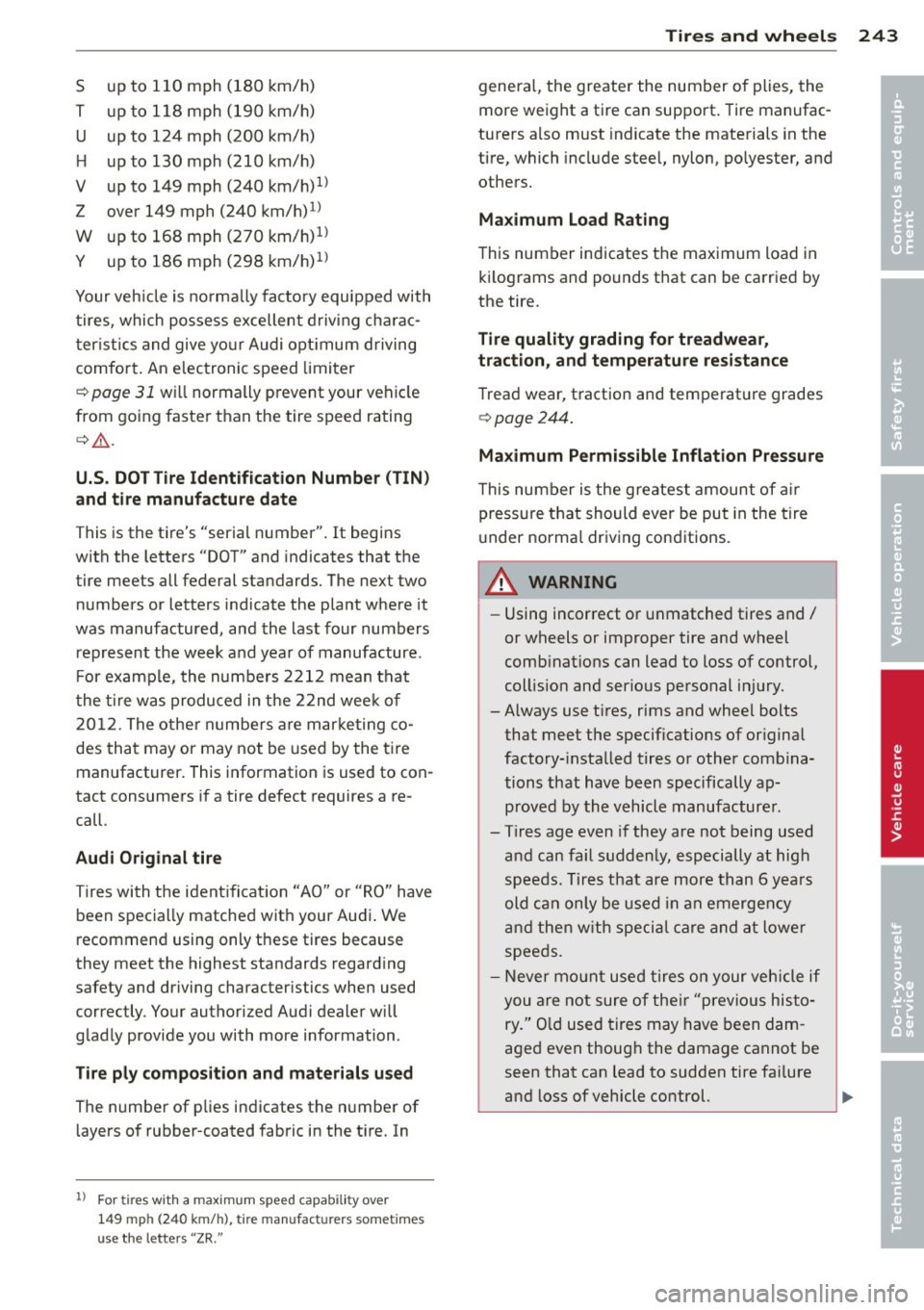
S up to 110 mph (180 km/h)
T up to 118 mph (190 km/ h)
U up to 124 mph (200 km/ h)
H up to 130 mph (210 km/h)
V up to 149 mph (240 km/h)
1
)
Z over 149 mph (240 km/h)1
)
W up to 168 mph (270 km/h)1
)
Y up to 186 mph (298 km/h)1>
Your vehicle is no rma lly facto ry equipped with
tires, which possess excellent driving cha rac
ter istics and give yo ur Audi opt imum driving
comfort . An e lectronic speed limiter
¢ page 31 wi ll normally prevent your vehicle
from going faster than the tire speed rating
¢ A .
U.S. DOT Tir e Identification Numbe r (TIN )
a nd tir e m anufactur e date
This is the t ire's "serial number". It begins
with the letters "DOT" and indicates that the
tire meets all federal standards. The next two
numbers or letters indicate the plant where it
was manufactured, and the last four numbers
represent the week and year of manufacture .
F or example, the numbers 2212 mean that
the t ire was produced in the 22nd wee k of
20 12. The othe r numbe rs a re mar ke ting co
des that may or may not be used by the tire
manufacturer . This information is used to con
tact consumers if a tire defect requires a re
call.
Audi Original tir e
Tires with the identi fication "AO" or "RO" have
been specia lly matched with your Audi . We
recommend using only t hese tires because
they meet the highest standards regard ing
safety and driving character istics when used
correctly . You r authorized Audi dealer will
g lad ly provide you with more information .
Tire ply composition and materi als used
The number of plies indicates the n umber of
layers of rubber-coated fabric in the tire. In
ll For tires w it h a max imum spee d capa bility over
1 4 9 mp h (2 40 k m/h ), t ire man ufact urers somet imes
u se the lette rs "ZR ."
Tire s an d wheel s 243
genera l, the greater the number of plies, the
more weight a tire can support . Tire manufac
turers also must indicate the materials in the
tire, which include steel, nylon, po lyester, and
others.
Maximum Load Rating
This number indicates the maximum load in
ki lograms and pounds that can be carr ied by
the tire.
Tir e quality grading for treadwear ,
tract ion, and temp eratu re resis tance
T read wear, t raction and temperat ure grades
¢ page 244.
Ma ximum Permissible Inflation Pressure
This number is the g reatest amount of a ir
pressure that should ever be put in the tire
u nder normal driving conditions.
A WARNING ~
- Using incorrect or unmatched tires and/
or wheels or improper tire and wheel
comb inat ions can lead to loss of control,
col lis ion and serious personal injury.
-Always use t ires, rims and whee l bolts
that meet the specif ications of original
factory- installed tires or other combina
tions that have been specifically ap
proved by the vehicle manufacture r.
- T ires age even if they are not being used
and can fai l sudden ly, especially at high
speeds. Tir es that are more than 6 yea rs
old can only be used in an emergency
a nd then w ith speci al care and at lower
speeds.
- Never mo unt used tires on your veh icle if
you are not sure of the ir "previous histo
ry." O ld used tires may have been dam
aged even thoug h the damage cannot be
seen that can lead to sudden tire fai lure
and loss of vehicle control.
•
•
Page 249 of 294

driving a few yards and correct if neces
sary . Follow the instructions from the
snow cha in manufacturer when doing so.
(D Tips
Where snow chains are mandatory oncer
tain roads, this norma lly also applies to
veh icles with all wheel drive.
Wheel bolts
Wheel bolts must always be tightened to the
correct torque.
The design o f whee l bolts is matched to the
factory insta lled r ims . If different rims are fit
ted, the correct wheel bo lts wit h the right
l ength and correctly shaped bolt heads must
be used. This ensures that wheels are f itted
securely and that the brake system functions
correctly .
In certain circumstances, you may not use
wheel bo lts from a different vehicle -even if it
is the same model
<=> page 274.
A WARNING
Improperly tightened or maintained wheel
bolts can become loose caus ing loss of
cont ro l, a co llision and serious persona l in
Jury .
- Always keep the w heel bolts and the
threads in the wheel hubs clea n so the
w hee l bolts can t urn easily and be p rop
erly t igh tened.
- Never grease or oil the wheel bolts and
the threads in the wheel h ubs. They can
become loose wh ile d riving if greased or
oiled, even if tightened to the specified
torq ue.
- Only use whee l bo lts that belong to the
rim being installed .
- Never use different whee ls bolts on your
vehicle.
- Alw ays m ain ta in the co rrec t tig hten ing
torq ue fo r the wheel bo lts to reduce the
risk of a wheel loss . If the tightening tor
que of the wheel bo lts is too low, they
can loosen and come out when the vehi-
Tire s an d wheel s 24 7
cle is mov ing. If the tightening torq ue is
too high, the wheel bolts and threads
can be damaged and the whee l can be
come loose.
@ Note
The specified torque for the whee l bolts is
90 ft lbs . (120 Nm) w ith a tolerance of
± 7,4 ft lbs. (± 10 Nm). Torque whee l bolts
diagonally . After changi ng a wheel, the
torque m ust be checked as soon as poss i
ble with a to rque wrench -preferably by an
a uthorized Aud i dea le r or qualified wor k
shop.
Low aspect ratio tires
Your A udi is fac tory -eq uipped w ith low aspect
ratio tires . These tires have been tho ro ughly
tested and been se lected specifically for your
model for their superb performance, road fee l
and handling under a variety of driving condi
tions . Ask your authorized Aud i dealer for
more details.
The low aspect ratio of these t ires is ind icated
by a numeral of
55 or less in the tire's size
designation. The numera l represents the ratio
of the tire's sidewa ll height in relation to its
tread width exp ressed in percentage. Conven
tiona l tires have a he ight/w idth ratio of 60 or
more.
The performance of low-a spect-r atio tire s is
particularly sensit ive to improper inflation
pre ssure. It is therefor e important that low
a spect ratio tire s are inflated to the specified
pres sure and that th e inflation pr essure i s
regularly checked and maintained. Tire pre s
sure s should be chec ked at lea st once a
month and always before a long trip
<=> page 236, Checking tire pressure.
What you can do to avo id tire and rim
damage
Low aspect ratio tires can be damaged mo re
easily by impact w ith potholes, curbs, gull ies
or ridges on the road, particularly if the tire is
under inflated . ..,.
•
•
Page 250 of 294

248 Tires and wheels
In order to minimize the occurrence of impact
damage to the tires of your vehicle, we recom
mend that you observe the following precau
tions :
- Always maintain recommended inflation
pressures. Check your tire pressure every
2,000 miles (3,000 km) and add a ir if neces
sary.
- Drive carefu lly on roads with potholes, deep
gullies or ridges. The impact from driving
through or over such obstacles can damage
your tires. Impact with a curb may also cause damage to your tires.
- After any impact, immediately inspect your
tires or have them inspected by the nearest
authorized Aud i dealer . Replace a damaged
t ir e as soon as possible .
- Inspect your t ires every 2,000 miles (3,000
km) for damage and wear . Damage is not al
ways easy to see. Damage can lead to loss of
air and underinflation, wh ich could event u
ally cause t ire failure.
If you believe that a
ti re may have been damaged, replace the
tire as soon as possible.
-These tires may wea r more quickly than oth
ers.
- Please also remember that, while these tires
deliver responsive handling, they may ride
less comfortably and make more noise than
other choices.
Reduced performance in winter/cold
season conditions
All tires are designed for certain purposes .
The low aspect ratio, ultra high performance
tires originally installed on your vehicle are in
tended for max imum dry and wet road per
f ormance and handling . They are not suitable
for cold, snowy or icy weather cond it ions.
If
you dr ive under those circumstances, you
should equip your vehicle with all-season or
winter tires, which offer better traction under
those conditions . We suggest you use the rec
ommended snow or all-season tires specified
for your vehicle, or their equiva lent .
Refer to~
page 245 for mo re detailed infor
mation regarding w inter tires.
Tire pressure
monitoring system
ill General notes
Applies to veh icles: w ith tire pressure monito ring system
Each tire, including the spare (if provided),
shou ld be checked monthly when co ld and in
flated to the inf lation pressure recommended
by the vehicle manufacturer on the vehicle
placard or tire inflation pressure label. (If your
vehicle has tires of a different size than the
s iz e indicated on the vehicle placard or tire in
flat io n pressu re label, you shou ld dete rmin e
the proper tire inflation pressure for those
tires) .
As an added safety feature, your veh icle has
been equipped with a tire pressure monitoring
system ( TPMS) that illuminates a low tire
pressure telltale when one or more of your
tires is significant ly under -inflated . Acco rding
ly, when the low tire pressure te lltale illumi
nates, you shou ld stop and check your tires as
soon as possib le, and inflate them to the
proper pressure. Driving on a sign ificantly un
der- inflated tire causes the tire to overheat
and can lead to tire fa ilure . Under -inflation al
so reduces fuel eff ic iency and tire tread life,
and may affect the vehicle 's hand ling and
stopp ing ability.
Please note that the TPMS is not a substitute
for proper tire ma intenance, and it is the driv
er's respons ibility to maintain correct tire
pressure, even if under -inflation has not
reached the level to trigger illumination of the
T PMS low tire p ressu re tellta le .
Your vehicle has also been equipped with a
TPMS malfunction indicator to ind icate when
the system is not operating properly . Th e
T PMS ma lfunction indicator is combined with
the low tire pressure telltale. When the sys
tem detects a malfunction, the telltale will
flash for approximately one minute and then
rema in con tinuously illuminated . Th is se
quence will continue upon subsequent vehicle
start-ups as long as the malfunct ion exists . .,.
Page 252 of 294

250 Tires and wheels
the tire to overheat and can lead to tire
failure. Under-inflation also is likely to
impair the vehicle's handling and stop
ping ability .
- The driver is responsible for maintaining
the correct tire pressures. You must
check the tire pressures regularly .
- Under certain conditions (such as a spor
ty driving style, winter conditions or un paved roads), the pressure monitor indi
cator may be delayed .
-Ask your authorized Audi dealer if run flat tires may be used on your vehicle.
Your vehicle registration becomes invalid
if you use these tires when not permit
ted. Damage to your vehicle or accidents
could also result.
@ Tips
- The tire pressure monitoring system
stops working when there is an ESC/ABS
malfunction.
- Using snow chains may result in a system
malfunction.
- The tire pressure monitoring system on
your Audi was developed using tires with the "AO" or "RO" identification on the
tire sidewall ¢
page 241. We recom
mend using these tires.
Reset tire pressure monitoring system
Applies to vehicles: with tire pressure monitoring system
If the tire pressure is adjusted, wheels are ro
tated or changed, the TPMS must be reset via
radio or MMI*.
11> Before resetting the TPMS, the current pres
sures of all four tires must correspond to
the specified values. Adjust the tire pressure and reset the pressure in the tire pressure
monitoring system according to the load
you are carrying
¢ page 234.
11> Turn on the ignition.
11> Select : the ICARI function button > Tire
pressure monitoring > Store now .
Or
i,. Select: the ICARI function button > Car sys·
terns
control button > Servicing & checks> Tire pressure monitoring
> Store tire pres
sures.
@ Tips
Do not store the tire pressure if there are
snow chains on the tire.
Page 290 of 294

288 Index
Tires and wheels
Checking tire pressure .............. 236
Cold t ire inflation pressure ... .. .... . 234
Dimensions .............. .. .. .... . 241
General notes . ............. .. .... . 230
Glossary of tire and loading terminolo -
gy .. .. .. .. ... .... ...... .. .. .. .. . 231
New tires and wheels .......... .. .. . 241
Replacing . . . . . . . . . . . . . . . . . . . . . . . . 242
Snow chains .. ........... .. .. .... . 246
Tires and vehicle load limits . ... .. .. . 238
Wheel bolts .............. ... .... . 247
Winter tires .............. ... .... . 245
Tire service life . ........... .... .... . 240
Tool kit . .. ................. .. .... . 251
Torn or frayed safety belts ............ 139
Touch-up paint . .. ...... .... ... .. .. . 202
Towing Front eyelet ............. .. .. ..... 265
Rear eyelet ... ........... .... .... . 265
Tow truck procedures .......... .. ... 264
TPM5 Tire pressure monitoring system .. ... 249
Trailer towing ... .......... .. .. .. .. . 196
Operating instructions ......... .. .. . 196
Technical requirements . . . . . . . . 196, 197
Tips ..... .. ................ ..... . 198
Transmission ............ .. .. .. .. .. .. 83
6-speed manual transmission . . . . . . . . . 83
multitronic . . . . . . . . . . . . . . . . . . . . . . . . 83
S tronic .... ................ ..... .. 89
tiptronic . . . . . . . . . . . . . . . . . . . . . . . . . . 83
Transmission malfunction (ind icator lamp) 95
Transmission malfunction (indicator light) 88
Transport Canada ................... 134
Travel mode ... .. ...... .... ... .. .. .. 46
Tread Wear Indicator (TWI) ... ... .. .. . 240
Trip computer
Fu el consumption . . . . . . . . . . . . . . . . . . 25
Mileage .................... ..... .. 25
Sing le-trip memory ........ ..... .. .. 25
Total-trip memory . . . . . . . . . . . . . . . . . . 25
Trip odometer ............. .... .... .. 12
Trunk
refer to Luggage compartment . . . 64, 132
Trunk escape handle ................ .. 40 Trunk
lid
refer to Rear lid . ................. .. 39
Turn signals . .... .. ............. ..... 45
Warning/indicator lights .......... .. . 23
u
Undercoating ..... ................ . 204
Unfastening safety belts ......... .. ..
141
Unidirectional tires .............. .... 230
Uniform tire quality grading .......... 244
Unlocking Rear lid ... .... .. ................. . 39
Unlocking/locking at the lock cylinder . . . . . . . . . . . . . . . . . . 3 7
by remote control ................ .. 35
with the centra l locking switch ..... .. . 36
with the convenience key ...... .. .. .. . 36
Use of jumper cables ............ .... 263
V
Valet parking ...... ................ .. 43
Vanity mirrors ..... ............. ..... 49
Vehicle-care products . . . . . . . . . . . . . . . . 199
Vehicle electrical system . . . . . . . . . . . . . . 17
Vehicle Identification Number (VIN) .. .. 268
Vehicle jack . .. .. .. ... .......... .... 255
Vehicle key . . . . . . . . . . . . . . . . . . . . . . . . . 33
Vehicle literature .. ............. ...... 5
Vehicle tool kit . ... ....... ...... .. .. 251
Ventilation . .. .. .. ............. .. .. . 68
w
Warning/indicator lights . . . . . . . . . . 10 , 13
Airbag system ... ................ .. 20
Anti-lock braking system (ABS) . .. .. .. . 19
Brake system .. .. ... .......... .. .. . 15
Electromechanical parking brake . .. .. . 16
Electronic power control . . . . . . . . . . . . . 20
Electronic Stabilization Control (ESC) .. . 19
Generator . . . . . . . . . . . . . . . . . . . . . . . . . 17
Malfunction Ind icator Lamp (MIL) .... . 20
Safety belt . . . . . . . . . . . . . . . . . . . . . . . . 17
Safety systems . . . . . . . . . . . . . . . . . . . . . 20
Turn signals ..... ................ .. 23
Warranty coverages ................. 272
Page 291 of 294

Washer reservoir ................... 229
Washing .................... ... ... 199
Automatic car wash ....... .. .. .. .. . 200
by hand .. .. ............. .. .. .. ... 200
General information 199
with a power washer ......... ... .. . 201
Waxing . ...... ................ .... 201
Wear indicator ............ .... .. ... 240
Weights . .. .. .... ............. .. .. . 268
What happens if you wear your safety belt
too loose? ... ... .. .. ...... .. .. .. .. . 140
What happens to unbelted occupants? .. 137
What impairs driving safety? . .. .. .. .. . 127
What should I do after changing a
wheel? .. .. ... ...... ............. .. 237
What should I do after replacing wheels? 237
Wheel bolts Torque ... .. ................. .. ... 247
Wheels . .. ... ...... ............. .. 230
Cast alloy .. ... .. .. ...... .. .. .. .. . 204
Checking tire pressure .......... .... 236
Cold tire inflation pressure . .. .. .. .. . 234
General notes ............ .. .. .. ... 230
Glossary of tire and loading termino lo-
gy ... ..... .. ................ .... 231
New tires and wheels ......... ... .. . 241
T ires and vehicle load limits .. .. .. .. . 238
When must a safety belt be rep laced? . . 139
When must the airbag system be inspect-
ed? .... ... ... ...... ............. .. 155
When should I adjust the tire pressures? 237
When should I check the tire pressures? . 237
Where are lower anchorages located? . . . 180
Where can I find the tire pressures for my
car? ... ..... .................. .... 236
Why safety belts? . . . . . . . . . . . . . . 136, 137
Window regulators Power locks .... .... ... .. .. .. .. .. .. 41
Windows Cleaning ... ................ ... ... 203
defrosting .. .. ........... .. .. .. .... 70
W indshield
C leaning ... ................ ... .... 50
defrosting .. ................ ... .... 70
Windshield washer fluid Low level . . . . . . . . . . . . . . . . . . . . . . . . . . 21
Index 289
Windshield washer system . . . . . . . . . . . . 50
Windshield wipers Folding up .. .. .. ................. . 51
Indicator light . .. .... ........... .. . 21
Replacing windsh ield wiper b lades .. .. . 51
Switching on/off ... .............. . .
Washer reservoir
Winter operation
so
229
Battery ....... ...... ............. 22S
Coolant system .. .. . .......... .... 222
Defrosting windows ............... .. 70
Seat heating . . . . . . . . . . . . . . . . . . . . . . . 70
Tires ............................ 189
Windows . .. .. .. ............... .. 203
Winter tires ... .. .. ................. 24S
All wheel drive ..... ............... 245
X
Xenon headlights . . . . . . . . . . . . 44, 46, 261
•
•