2013 Alfa Romeo Giulietta brake fluid
[x] Cancel search: brake fluidPage 10 of 292

SPEEDOMETER (SPEED INDICATOR)This shows the speed of the car.REV COUNTERThis indicates the engine rpm.FUEL LEVEL GAUGEThis shows the amount of fuel left in the tank.
0 - tank empty.
1 - tank full
The warning light in the gauge lights up when there are only 8 to 10
litres of fuel remaining in the tank; in the event of this happening,
refuel at the earliest opportunity.ENGINE COOLANT TEMPERATURE
GAUGEThis gauge indicates the temperature of the engine coolant. The
warning light in the gauge lights up to indicate an increase in coolant
temperature; in the event of this happening, switch off the engine
and contact Alfa Romeo Authorized Services.WARNING LIGHTS ON PANELGeneral warnings
The warning lights switch on together with a dedicated message
and/or acoustic signal where appropriate.These indications are concise and precautionary and, as such, must
not be considered as exhaustive and/or alternative to the information
contained in this Owner Handbook, which you are recommended to
read carefully in all cases.
Always refer to the information in this section in the event of a failure
indication.
Low brake fluid level (red)
Turning the key to the MAR position illuminates the warning light, but it
should switch off after a few seconds.
The warning light (or symbol on the display) comes on when the level
of the brake fluid in the reservoir falls below the minimum level,
possibly due to leaks in the circuit.
The display will show the dedicated message.Handbrake on (red)Turning the key to the MAR position illuminates the warning light, but it
should switch off after a few seconds.
The warning light (or symbol on the display) switches on when the
handbrake is engaged. If the car is moving the buzzer will also sound.
IMPORTANT If the warning light comes on when the vehicle is in
motion, check that the handbrake is not engaged.
6
GETTING TO
KNOW YOUR CAR
SAFETY
STARTING AND
DRIVING
IN AN EMERGENCY
SERVICING AND
MAINTENANCE
TECHNICAL
SPECIFICATIONS
INDEX
Page 155 of 292

INFLATION PROCEDURE
Wear the protective gloves provided with the kit.
Proceed as follows:
❒engage the handbrake, unscrew the tyre valve cap, take out the
flexible filler pipe A fig. 134 and tighten the ring nut B on the tyre
valve;
❒make sure that switch A fig. 135 for the compressor is in position 0
(off), start the engine, insert the plug into the luggage compartment
power socket (see fig. 136) or cigar lighter on central tunnel (see fig.
137) and switch on the compressor by bringing switch Afig. 135 to
position I (on);
❒inflate the tyre to the pressure indicated in the “Wheels” paragraph
in the “Technical specifications” section. In order to obtain a more
precise reading, check the pressure value on pressure gauge B
fig. 135 with the compressor off;❒if after five minutes it is still impossible to reach at least 1.8 bar,
disengage the compressor from the valve and power socket, then
move the car forwards by approx. ten metres in order to distribute
the sealing fluid inside the tyre evenly, then repeat the inflation
operation;
fig. 134
A0K0127
fig. 135
A0K0021
fig. 136
A0K0152
151GETTING TO KNOW
YOUR CAR
SAFETY
STARTING AND
DRIVINGIN AN
EMERGENCYSERVICING AND
MAINTENANCE
TECHNICAL
SPECIFICATIONS
INDEX
Page 182 of 292

SCHEDULED SERVICING PLAN1.4 Turbo Petrol and 1.4 Turbo MultiAir VERSIONSThousands of miles18 36 54 72 90 108
Thousands of kilometres 30 60 90 120 150 180
Months24 48 72 96 120 144
Check tyre conditions/wear and adjust pressure, if required●●●●●●
Check operation of lighting system (headlamps, direction indicators, hazard warning lights,
passenger compartment, luggage compartment, instrument panel warning lights, etc.)●●●●●●
Check operation of windscreen washer/wiper system●●●●●●
Check the position/wear of the windscreen/rear window wiper blades●●●●●●
Check condition and wear of front disc brake pads and operation of pad wear indicator●●●●●●
Check rear disc brake pad condition and wear●●●●●●
Condition and status visual check: bodywork exterior, underbody protection, pipes and hoses
(exhaust - fuel system - brakes), rubber elements (boots - sleeves - bushes etc.)●●●●●●
Check cleanliness of bonnet and boot locks, as well as cleanliness and lubrication of linkages●●●●●●
Check and, if necessary, top up fluid levels (engine cooling, hydraulic brakes/clutch, screen washer,
battery, etc.)●●●●●●
Check handbrake lever travel and adjust, if required●●●●●●
Check timing belt condition●●
Visually inspect conditions of the accessory drive belt(s)●●
Check exhaust emissions.●●●●●●
Check battery charge status and possibly recharge●●●●●●
178GETTING TO KNOW
YOUR CAR
SAFETY
STARTING AND
DRIVING
IN AN EMERGENCYSERVICING AND
MAINTENANCE
TECHNICAL
SPECIFICATIONS
INDEX
Page 183 of 292

Thousands of miles18 36 54 72 90 108
Thousands of kilometres 30 60 90 120 150 180
Months24 48 72 96 120 144
Check engine management system operation (through the diagnosis socket)●●●●●●
Replace accessory drive belt(s)●
Replacement of toothed timing belt
(*)
●
Replace spark plugs
(**)
●●●●●●
Replace air cleaner cartridge●●●
Change engine oil and oil filter (or every 24 months)
(***)
●●●●●●
Change brake fluid (or every 24 months)●●●
Change pollen filter (or every 12 months)●●●●●●
(*) Regardless of the distance covered, the timing belt must be changed every 4 years for particularly demanding use (cold climates, town driving, long periods of
idling) or at least every 5 years.
(**) For 1.4 Turbo Petrol and 1.4 Turbo MultiAir versions, in order to guarantee correct operation and prevent serious damage to the engine, it is essential to observe
the following: only use spark plugs specifically certified for these engines; all spark plugs should be of the same type and brand (see the “Engine” paragraph in the
"Technical Specifications" section); strictly comply with the replacement intervals in the Scheduled Servicing Plan; you are advised to contact Alfa Romeo
Authorized Services to have plugs replaced.
(***) If the vehicle has an annual mileage of less than 10,000 km, the engine oil and engine oil filter should be changed every 12 months.
179GETTING TO KNOW
YOUR CAR
SAFETY
STARTING AND
DRIVING
IN AN EMERGENCYSERVICING AND
MAINTENANCETECHNICAL
SPECIFICATIONS
INDEX
Page 184 of 292

1750 Turbo Petrol VERSIONSThousands of miles21 42 63 84 105
Thousands of kilometres 35 70 105 140 175
Months24 48 72 96 120
Check tyre conditions/wear and adjust pressure, if required●●●●●
Check operation of lighting system (headlamps, direction indicators, hazard warning lights,
passenger compartment, luggage compartment, instrument panel warning lights, etc.)●●●●●
Check operation of windscreen washer/wiper system●●●●●
Check the position/wear of the windscreen/rear window wiper blades●●●●●
Check condition and wear of front disc brake pads and operation of pad wear indicator●●●●●
Check rear disc brake pad condition and wear●●●●●
Condition and status visual check: bodywork exterior, underbody protection, pipes and hoses
(exhaust - fuel system - brakes), rubber elements (boots - sleeves - bushes etc.)●●●●●
Check cleanliness of bonnet and boot locks, as well as cleanliness and lubrication of linkages●●●●●
Check and, if necessary, top up fluid levels (engine cooling, hydraulic brakes/clutch, screen washer,
battery, etc.)●●●●●
Check handbrake lever travel and adjust, if required●●●●●
Check timing belt condition●
Visually inspect conditions of the accessory drive belt(s)●
Check exhaust emissions.●●●●●
Check battery charge status and possibly recharge●●●●●
Check engine management system operation (through the diagnosis socket)●●●●●
Replace accessory drive belt(s)●
180GETTING TO KNOW
YOUR CAR
SAFETY
STARTING AND
DRIVING
IN AN EMERGENCYSERVICING AND
MAINTENANCE
TECHNICAL
SPECIFICATIONS
INDEX
Page 185 of 292
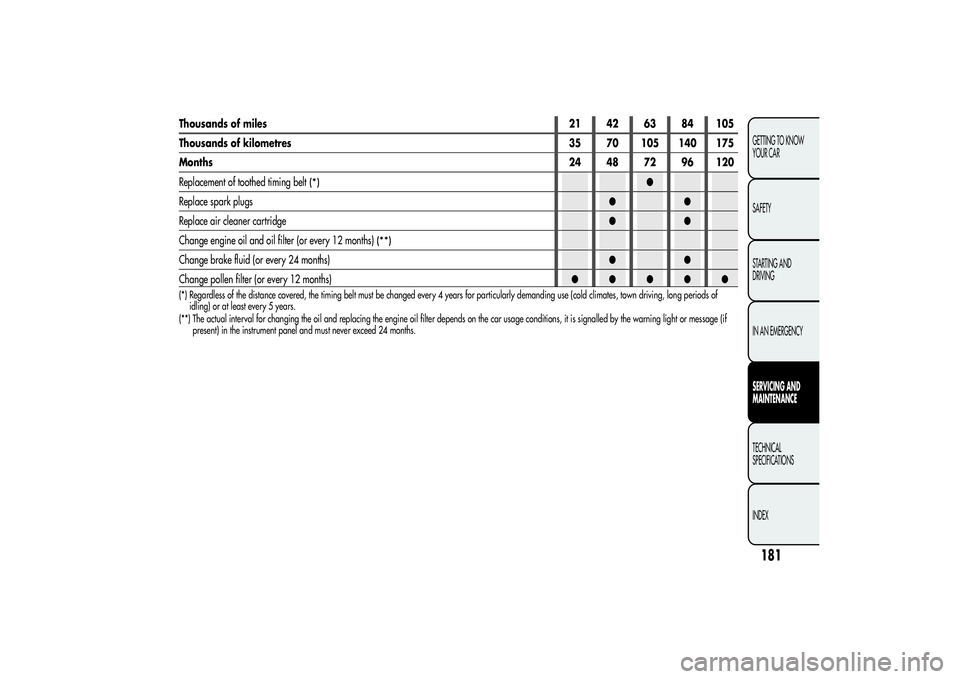
Thousands of miles21 42 63 84 105
Thousands of kilometres 35 70 105 140 175
Months24 48 72 96 120
Replacement of toothed timing belt
(*)
●
Replace spark plugs●●
Replace air cleaner cartridge●●
Change engine oil and oil filter (or every 12 months)
(**)
Change brake fluid (or every 24 months)●●
Change pollen filter (or every 12 months)●●●●●(*) Regardless of the distance covered, the timing belt must be changed every 4 years for particularly demanding use (cold climates, town driving, long periods of
idling) or at least every 5 years.
(**) The actual interval for changing the oil and replacing the engine oil filter depends on the car usage conditions, it is signalled by the warning light or message (if
present) in the instrument panel and must never exceed 24 months.
181GETTING TO KNOW
YOUR CAR
SAFETY
STARTING AND
DRIVING
IN AN EMERGENCYSERVICING AND
MAINTENANCETECHNICAL
SPECIFICATIONS
INDEX
Page 186 of 292

Diesel VERSIONSThousands of miles21 42 63 84 105
Thousands of kilometres 35 70 105 140 175
Months24 48 72 96 120
Check tyre conditions/wear and adjust pressure, if required●●●●●
Check operation of lighting system (headlamps, direction indicators, hazard warning lights,
passenger compartment, luggage compartment, instrument panel warning lights, etc.)●●●●●
Check operation of windscreen washer/wiper system●●●●●
Check the position/wear of the windscreen/rear window wiper blades●●●●●
Check condition and wear of front disc brake pads and operation of pad wear indicator●●●●●
Check rear disc brake pad condition and wear●●●●●
Condition and status visual check: bodywork exterior, underbody protection, pipes and hoses
(exhaust - fuel system - brakes), rubber elements (boots - sleeves - bushes etc.)●●●●●
Check cleanliness of bonnet and boot locks, as well as cleanliness and lubrication of linkages●●●●●
Check and, if necessary, top up fluid levels (engine cooling, hydraulic brakes/clutch, screen washer,
battery, etc.)●●●●●
Check handbrake lever travel and adjust, if required●●●●●
Check exhaust fumes/emissions●●●●●
Visually inspect conditions of the accessory drive belts●●
Check engine management system operation (through the diagnosis socket)●●●●●
Check battery charge status and possibly recharge●●●●●
Replace accessory drive belts●
182GETTING TO KNOW
YOUR CAR
SAFETY
STARTING AND
DRIVING
IN AN EMERGENCYSERVICING AND
MAINTENANCE
TECHNICAL
SPECIFICATIONS
INDEX
Page 187 of 292

Thousands of miles21 42 63 84 105
Thousands of kilometres 35 70 105 140 175
Months24 48 72 96 120
Replacement of toothed timing belt
(*)
●
Replace fuel filter●●
Replace air cleaner cartridge●●
Replace engine oil and oil filter (or every 24 months)
(**) (***)
Change brake fluid (or every 24 months)●●
Change pollen filter (or every 12 months)●●●●●(*) Regardless of the distance covered, the timing belt must be changed every 4 years for particularly demanding use (cold climates, town driving, long periods of
idling) or at least every 5 years.
(**) The actual interval for changing the oil and replacing the engine oil filter depends on the car usage conditions, it is signalled by the warning light or message (if
present) in the instrument panel and must never exceed 24 months.
(***) If the car is mainly used in towns and cities, change the engine oil and filter every 12 months.
183GETTING TO KNOW
YOUR CAR
SAFETY
STARTING AND
DRIVING
IN AN EMERGENCYSERVICING AND
MAINTENANCETECHNICAL
SPECIFICATIONS
INDEX