2013 Alfa Romeo Giulietta ignition
[x] Cancel search: ignitionPage 91 of 292

Anti-crush safety device
The car is equipped with an anti-crush function for the raising of the
front and rear windows.
This safety system detects the presence of an obstacle during the
window closing travel and intervenes by stopping and reversing the
window travel, depending on its position. This device is also useful
if the windows are activated accidentally by children on board the car.
The anti-crush safety function is active both during the manual and
the automatic operation of the window. When the anti-crush system is
activated, the window travel is immediately interrupted and then
reversed. The window cannot be operated in any way during this time.
IMPORTANT If the anti-crush protection intervenes 5 consecutive times
within a minute or is faulty, the automatic closing operation of the
window is inhibited, only allowing it in steps of half a second with the
button released for the subsequent manoeuvre.
In order to restore the correct operation of the system, the relevant
window must be lowered.
IMPORTANT With ignition key at STOP or removed, the electric
windows remain active for about 3 minutes and are deactivated when
a door is opened.
IMPORTANT With the anti-crush system, when the
button on the
remote control is pressed for longer than 2 seconds the windows will
open, whilst if the
button is pressed for longer than 2 seconds
the windows will close.
The system conforms to the 2000/4/EC standard concerning
the safety of passengers leaning out of the passenger
compartment.Incorrect use of the electric windows may be
dangerous. Before and during operation, always check
that no passenger is at risk of being injured directly
by the moving window or by objects getting caught in or
dragged by the window. When leaving the car, always remove
the key from the ignition to prevent accidental operation of the
electric windows from being a hazard for those still on board.
Electric window system initialisation
The system must be re-initialised after disconnecting the battery or if
the relevant protection fuse is blown.
Initialisation procedure:
❒fully close the window to initialise with manual operation;
❒after the window has reached the upper end of travel, hold down
the closing control for at least 1 second.
For versions/markets where provided, after a break in power supply
for the control units (battery replaced or disconnected or protective
fuses for the electric window control units replaced), the automatic
operation of the windows must be restored.
87GETTING TO
KNOW YOUR CARSAFETY
STARTING AND
DRIVING
IN AN EMERGENCY
SERVICING AND
MAINTENANCE
TECHNICAL
SPECIFICATIONS
INDEX
Page 99 of 292

HEADLIGHTSLIGHT BEAM DIRECTIONThe correct orientation of the headlights is important for the driver's
comfort and safety as well as for all other road users. This is also
covered by a specific rule of the highway code.
The headlights must be correctly aligned to ensure the best visibility
conditions for yourself and others when driving with lights on. To check
and, if necessary, adjust, contact Alfa Romeo Authorized Services.HEADLIGHT ALIGNMENT CORRECTORThis device works with the ignition key in the MAR position and the
dipped headlights on.
Headlight alignment adjustment
To adjust, press the
and
fig. 81 buttons. The adjustment
position is shown on the display.
Position 0
one or two people in the front seats.
Position 1
4 people.
Position 2
4 people + load in luggage compartment.
Position 3
driver + maximum permitted load stowed in the luggage
compartment.
IMPORTANT Check the alignment every time that the load carried
changes.
IMPORTANT If the car is equipped with Bixenon headlights, the
headlight alignment is controlled electronically, as a consequence the
and
buttons are not present.
FOG LIGHT ALIGNMENT(for versions/markets, where provided)
To check and, if necessary, adjust, contact Alfa Romeo Authorized
Services.ADJUSTING THE HEADLIGHTS ABROADThe dipped headlights are aligned to comply with the regulations of
the country of purchase. When travelling in countries with opposite
driving direction, to avoid dazzling the drivers on the other side of the
road, you need to cover areas of the headlight according to the
Highway code of the country you are travelling in.
fig. 81
A0K0339
95GETTING TO
KNOW YOUR CARSAFETY
STARTING AND
DRIVING
IN AN EMERGENCY
SERVICING AND
MAINTENANCE
TECHNICAL
SPECIFICATIONS
INDEX
Page 108 of 292

ENGINE STOPPING FAILURE
CONDITIONSWhen the system is operating, due to comfort, emission control and
safety reasons, the engine does not stop in some conditions, among
which:
❒engine still cold;
❒especially cold outside temperature;
❒battery not sufficiently charged;
❒particulate filter regeneration (DPF) in progress (diesel engines only);
❒driver's door not shut;
❒driver's seat belt not fastened;
❒reverse gear engaged (for example, for parking manoeuvres);
❒for versions equipped with dual zone automatic climate control (for
versions/markets, where provided), if an adequate level of thermal
comfort has not been reached or with MAX-DEF function activation;
❒during the first period of use, to initialise the system.
If the climate comfort is to be favoured, the Start&Stop
system can be deactivated, for a continuous operation of
the climate control system.
ENGINE RESTARTING CONDITIONSDue to comfort, emission control and safety reasons, the engine can
restart automatically without any action by the driver, under special
conditions, such as:
❒battery not sufficiently charged;
❒reduced braking system vacuum (e.g. if the brake pedal is pressed
repeatedly);
❒car moving (e.g. when driving on roads with a gradient);
❒engine stopping by Start&Stop system for over 3 minutes;
❒for versions equipped with dual zone automatic climate control
system (for versions/markets, where provided), if an adequate level
of thermal comfort has not been reached or MAX-DEF function
activation.
With gear engaged, automatic engine restarting is possible only by
fully depressing the clutch pedal. The driver is informed by the
displaying of a message on the display and - for versions/markets,
where provided - by the flashing of the symbol
.
Notes
If the clutch is not pressed, about 3 minutes after the engine stops, the
engine can be restarted only using the ignition key.
In cases when the engine stops and this is not desired, due for example
to the clutch pedal being released sharply with a gear engaged, if the
Start&Stop system is activated, the engine can be restarted by fully
depressing the clutch pedal or by placing the gear lever in neutral.
104GETTING TO
KNOW YOUR CAR
SAFETY
STARTING AND
DRIVING
IN AN EMERGENCY
SERVICING AND
MAINTENANCE
TECHNICAL
SPECIFICATIONS
INDEX
Page 109 of 292

SAFETY FUNCTIONSWhen the engine is stopped by the Start&Stop system, if the driver
releases his/her seat belt and opens the driver's or passenger's door,
the engine can be restarted only using the ignition key.
The driver is informed by a buzzer and by the flashing of the symbol
on the display; on some versions, a message is displayed as well.
"ENERGY SAVING" FUNCTION(for versions/markets, where provided)
If, following automatic engine restarting, the driver does not carry out
any action on the car for over 3 minutes, the Start&Stop system stops
the engine once and for all, to prevent fuel consumption. In these
cases, the engine can be restarted only using the ignition key.
NOTE In any case, it is possible to keep the engine running by
deactivating the Start&Stop system.IRREGULAR OPERATIONIn the event of malfunction, the Start&Stop system is deactivated.
The driver is informed of the fault by the flashing
symbol (versions
with multifunction display) or
symbol (versions with reconfigurable
multifunction display). For versions/markets where provided, a
message is also displayed.
In this case, contact Alfa Romeo Authorized Services.
CAR INACTIVITYIn the event of car inactivity (or if the battery is replaced), special
attention must be paid to the disconnection of the battery power
supply.
Proceed as follows: detach the connector A fig. 90 (by pressing button
B) from sensor C for monitoring the status of the battery installed on
the negative battery pole D. This sensor should never be disconnected
from the pole except if the battery is replaced.
In case of battery replacement, always contact Alfa
Romeo Authorized Services. Replace the battery with
one of the same type (HEAVY DUTY) and with the same
specifications.
IMPORTANT After turning the ignition key to STOP, wait at least 1
minute before disconnecting the electrical supply to the battery.
fig. 90
A0K0179
105GETTING TO
KNOW YOUR CARSAFETY
STARTING AND
DRIVING
IN AN EMERGENCY
SERVICING AND
MAINTENANCE
TECHNICAL
SPECIFICATIONS
INDEX
Page 110 of 292
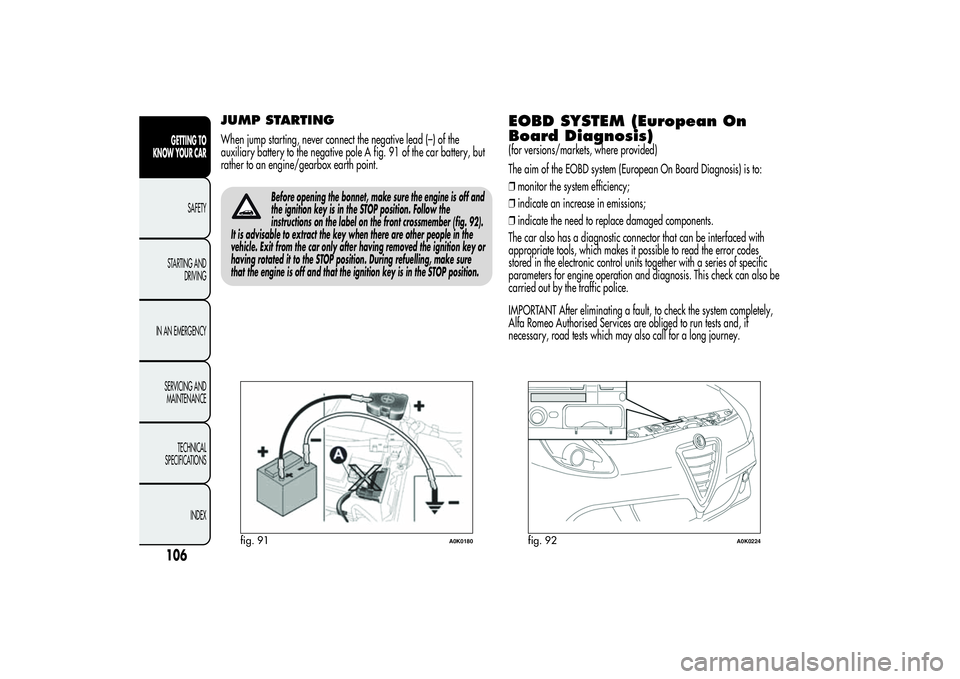
JUMP STARTINGWhen jump starting, never connect the negative lead (–) of the
auxiliary battery to the negative pole A fig. 91 of the car battery, but
rather to an engine/gearbox earth point.
Before opening the bonnet, make sure the engine is off and
the ignition key is in the STOP position. Follow the
instructions on the label on the front crossmember (fig. 92).
It is advisable to extract the key when there are other people in the
vehicle. Exit from the car only after having removed the ignition key or
having rotated it to the STOP position. During refuelling, make sure
that the engine is off and that the ignition key is in the STOP position.
EOBD SYSTEM (European On
Board Diagnosis)(for versions/markets, where provided)
The aim of the EOBD system (European On Board Diagnosis) is to:
❒monitor the system efficiency;
❒indicate an increase in emissions;
❒indicate the need to replace damaged components.
The car also has a diagnostic connector that can be interfaced with
appropriate tools, which makes it possible to read the error codes
stored in the electronic control units together with a series of specific
parameters for engine operation and diagnosis. This check can also be
carried out by the traffic police.
IMPORTANT After eliminating a fault, to check the system completely,
Alfa Romeo Authorised Services are obliged to run tests and, if
necessary, road tests which may also call for a long journey.
fig. 91
A0K0180
fig. 92
A0K0224
106GETTING TO
KNOW YOUR CAR
SAFETY
STARTING AND
DRIVING
IN AN EMERGENCY
SERVICING AND
MAINTENANCE
TECHNICAL
SPECIFICATIONS
INDEX
Page 122 of 292

Rear seats (warning light no. 2,
no. 3 and no. 4)For the rear seats, the reminder cycle is only activated when any seat
belt is unfastened (flashing red).
In this condition, the warning light for the seat belt which has been
unfastened will flash (red) for approximately 30 seconds. An acoustic
signal is also emitted.
The visual indication (flashing red) will start and stop independently for
each warning light if several seat belts are unfastened. The warning
light will become green when the relevant seat belt is fastened again.
The rear seat warning lights will switch off, regardless of the state
of the belt (red or green) approximately 30 seconds after the last
signal.
IMPORTANT
The warning lights are all off if all seat belts (front and rear) are
already fastened when the ignition key is turned to MAR.
All warning lights switch on when at least one belt changes from
fastened to unfastened or vice versa.
PRETENSIONERSThe car is equipped with front seat belt pretensioners, which draw
back the seat belts by several centimetres in the event of a violent
frontal impact. This guarantees the perfect adherence of the seat belts
to the occupants’ bodies before the restraining action begins.
It is evident that the pretensioners have been activated when the belt
withdraws towards the reel.
The car is also equipped with a second pretensioner (in the kick plate
area). Its activation is signalled by the shortening of the metal cable.
A slight discharge of smoke may be produced during the activation of
the pretensioner. This is not harmful and does not indicate the start
of a fire.
IMPORTANT To obtain the highest degree of protection from the action
of the pretensioner, wear the seat belt tight to the chest and pelvis.
The pretensioner does not require any maintenance or lubrication: any
changes to its original conditions will invalidate its efficiency. If, due
to exceptional natural events (floods, sea storms, etc.), the device
has been affected by water and mud, it must be replaced.LOAD LIMITERSTo increase protection, the front seat belt reels contain a load limiter
which controls the force acting on the chest and shoulders during
the belt restraining action in the event of a head-on collision.
118GETTING TO KNOW
YOUR CAR
SAFETY
STARTING AND
DRIVING
IN AN EMERGENCY
SERVICING AND
MAINTENANCE
TECHNICAL
SPECIFICATIONS
INDEX
Page 137 of 292

Do not travel carrying objects in your lap, in front of
your chest or between your lips (pipe, pencils, etc.):
they could cause severe injury if the airbag is
deployed.If the car has been subject to theft, attempted theft,
vandalism, or flooding, have the airbag system
inspected at Alfa Romeo Authorized Services.The airbags may also be deployed when the car is not
moving, if the key is in the ignition and turned to MAR
even when the engine is off, if the car is hit by another
moving vehicle. For this reason, children must never sit on the
front seat, even if the car is not moving. Also remember that no
safety device (airbags or pretensioners) will activate in the event
of impact when the key is at STOP. Non-deployment of these
devices under these circumstances does not therefore indicate a
system malfunction.
When the ignition key is turned to MAR, the
warning light (with passenger side front airbag
activated) switches on and flashes for a few seconds to
remind you that the passenger airbag will be deployed in a
crash, after which it should switch off.
The front airbag is designed to be deployed for
impacts of a greater intensity than for the
pretensioners. For impacts whose intensity falls
between the two levels, it is normal for only the pretensioners to
be activated.The airbag does not replace seat belts but increases
their effectiveness. Because front airbags are not
deployed for low-speed crashes, side collisions,
rear-end shunts or rollovers, occupants are protected, in addition
to any side bags, only by their seat belts, which must therefore
always be fastened.
133GETTING TO KNOW
YOUR CARSAFETYSTARTING AND
DRIVING
IN AN EMERGENCY
SERVICING AND
MAINTENANCE
TECHNICAL
SPECIFICATIONS
INDEX
Page 138 of 292

STARTING AND DRIVING
STARTING THE ENGINEPROCEDURE FOR PETROL VERSIONSProceed as follows:
❒engage the handbrake and place the gearbox lever in neutral;
❒fully depress the clutch pedal, without touching the accelerator;
❒turn the ignition key to AVV and release it as soon as the engine
starts.
IMPORTANT
❒If the engine does not start at the first attempt, return the ignition key
to STOP before repeating the starting procedure.
❒If, when the ignition key is at MAR, the instrument panel warning
light
remains on together with warning light
, turn the
key to STOP and then back to MAR; if the warning light remains on,
try the other keys provided. If you are still unable to start the engine
contact Alfa Romeo Authorized Services.
❒Never leave the ignition key at MAR when the engine is stopped.
PROCEDURE FOR DIESEL VERSIONSProceed as follows:
❒engage the handbrake and place the gearbox lever in neutral;
❒turn the ignition key to MAR: the warning lights
and
on
the instrument panel will switch on;
❒wait for the warning lights to switch off;❒fully depress the clutch pedal, without touching the accelerator;
❒turn the ignition key to AVV;
warning light switches off.
Waiting too long will waste the heating work carried out by the
glow plugs. Release the key as soon as the engine starts.
If the
warning light flashes for about 1 minute after
starting or during prolonged cranking, this indicates a fault
in the glow plug preheating system. Use the car normally
if the engine starts and go to Alfa Romeo Authorized Services as soon
as possible.
It is dangerous to run the engine in enclosed areas. The
engine takes in oxygen and releases carbon dioxide,
carbon monoxide and other toxic gases.It is advisable not to demand maximum performance from
your car (e.g. excessive acceleration, long distances at
maximum rpm, excessively intense braking, etc.) when it is
first used.When the engine is off, do not leave the ignition key turned
to MAR to prevent unnecessary electrical consumption from
draining the battery.
134GETTING TO KNOW
YOUR CAR
SAFETYSTARTING AND
DRIVINGIN AN EMERGENCY
SERVICING AND
MAINTENANCE
TECHNICAL
SPECIFICATIONS
INDEX