2013 Alfa Romeo Giulietta Air condition
[x] Cancel search: Air conditionPage 65 of 292

When the outside temperature is low, the system could automatically
turn the compressor on and turn air recirculation off for safer driving.TURNING THE CLIMATE CONTROL
SYSTEM OFFPress the
button (LED on button off).
With climate control off:
❒air recirculation is on, thus isolating the passenger compartment
from the outside;
❒the compressor is off;
❒the fan is off;
❒the heated rear window can be switched on or off;
❒the AQS (Air Quality System) function cannot be activated.
IMPORTANT The climate control system control unit stores the
temperatures set before the system was switched off and restores them
when any button of the system is pressed (except for button D).
To restart the climate control system in fully automatic mode press the
AUTO button.
START&STOPAutomatic Climate Control
The automatic climate control system manages the Start&Stop function
(engine off when speed is zero) to ensure adequate comfort inside
the car.
Specifically, the Start&Stop function is turned off when the weather is
particularly hot or cold to guarantee an adequate level of comfort
inside the passenger compartment; therefore, the engine will not be
stopped during these transient conditions, even if the speed is zero.When the Start&Stop function is active (engine off at zero car speed),
the climate control system will request the reactivation of the engine
if the inside temperature conditions rapidly deteriorate (or if the user
requests maximum cooling – LO – or quick demisting – MAX DEF).
With the Start&Stop function on (engine off at zero speed), air flow is
reduced to the minimum to maintain comfort conditions inside the
passenger compartment as long as possible when the system is in
AUTO mode (LED N on).
The climate control system control unit attempts to manage the
discomfort caused by the engine stopping (compressor and engine
coolant pump off) but operation of the climate control system can be
enhanced by turning the Start&Stop off by pressing the dedicated
button on the dashboard.
NoteIn particularly severe climate conditions it is recommended to
limit the use of the Start&Stop function to prevent the compressor from
continuously switching on and off, with consequent rapid misting of the
windows and accumulation of humidity with unpleasant smells in the
passenger compartment.
NoteWhen the Start&Stop function is on (engine off and vehicle
speed zero), the automatic recirculation management is turned off
always taking air in from outside, to reduce the probability of window
misting up (as the compressor is off).
ADDITIONAL HEATER(for versions/markets, where provided)
This allows the passenger compartment to be heated more quickly in
cold weather conditions. The additional heater turns off automatically
after the required comfort conditions are achieved.
61GETTING TO
KNOW YOUR CARSAFETY
STARTING AND
DRIVING
IN AN EMERGENCY
SERVICING AND
MAINTENANCE
TECHNICAL
SPECIFICATIONS
INDEX
Page 142 of 292

Climate control system
Using the climate control system will increase consumption: use the air
vents when the external temperature allows it.
Devices for aerodynamic control
The use of non-certified devices for aerodynamic control may adversely
affect air drag and fuel consumption.DRIVING STYLEStarting
Do not warm up the engine at low or high revs when the vehicle is
stationary; this causes the engine to warm up more slowly, thereby
increasing fuel consumption and emissions. It is therefore advisable to
move off immediately, slowly, avoiding high speeds: in this way the
engine will warm up more quickly.
Unnecessary actions
Avoid revving up when at traffic lights or before switching off the
engine. The latter action, like double-declutching, is unnecessary and
causes increased fuel consumption and pollution.
Gear selection
Use a higher gear when traffic and road conditions allow it. Using a
low gear for faster acceleration will increase consumption. In the same
way improper use of a high gear increases consumption, emissions
and engine wear.Maximum speed
Fuel consumption considerably increases as speed increases. Keep
your speed as even as possible, avoiding unnecessary braking and
acceleration which cause excessive fuel consumption and increased
emissions.
Acceleration
Accelerating violently severely affects consumption and emissions:
acceleration should be gradual and should not exceed the maximum
torque.
CONDITIONS OF USECold starting
Short distances and frequent cold start-ups will prevent the engine from
reaching optimal running temperature. This results in a significant
increase in consumption levels (from +15 to +30% on the urban cycle)
and emissions.
Traffic and road conditions
High fuel consumption is caused by heavy traffic, for instance when
travelling in a queue with frequent use of low gears or in large towns
with many traffic lights. Winding mountain roads and rough road
surfaces also adversely affect consumption.
Stops in traffic
During prolonged stops (e.g. level crossings) switch the engine off.
138GETTING TO KNOW
YOUR CAR
SAFETYSTARTING AND
DRIVINGIN AN EMERGENCY
SERVICING AND
MAINTENANCE
TECHNICAL
SPECIFICATIONS
INDEX
Page 181 of 292

SERVICING AND MAINTENANCE
SCHEDULED SERVICINGCorrect servicing is essential in guaranteeing a long life for the car
under the best conditions.
For this reason, Alfa Romeo has prepared a series of checks and
service operations to be carried out every 30,000 kilometres (for 1.4
petrol versions) or every 35,000 kilometres (for 1750 Turbo Petrol and
diesel versions).
Check the items on the Scheduled Servicing Plan (e.g. periodically
check level of liquids, tyre pressure, etc.) before 30,000/35,000 km
and between these services deadlines.
Scheduled Servicing is carried out at Alfa Romeo Authorized Services
according to a set time schedule. If, during each operation, in addition
to the ones scheduled, the need arises for further replacements or
repairs, these may be carried out only with the explicit agreement of
the Customer. If your car is used frequently for towing, the interval
between one service operation and the next should be reduced.WARNING
At 2,000 km from the next service operation the display will show a
message.
The Scheduled Services intervals are set out by the Manufacturer.
Failure to comply with the schedule may invalidate the warranty.
It is advisable to inform Alfa Romeo Authorized Services of any small
faults without waiting for the next scheduled service.
177GETTING TO KNOW
YOUR CAR
SAFETY
STARTING AND
DRIVING
IN AN EMERGENCYSERVICING AND
MAINTENANCETECHNICAL
SPECIFICATIONS
INDEX
Page 182 of 292

SCHEDULED SERVICING PLAN1.4 Turbo Petrol and 1.4 Turbo MultiAir VERSIONSThousands of miles18 36 54 72 90 108
Thousands of kilometres 30 60 90 120 150 180
Months24 48 72 96 120 144
Check tyre conditions/wear and adjust pressure, if required●●●●●●
Check operation of lighting system (headlamps, direction indicators, hazard warning lights,
passenger compartment, luggage compartment, instrument panel warning lights, etc.)●●●●●●
Check operation of windscreen washer/wiper system●●●●●●
Check the position/wear of the windscreen/rear window wiper blades●●●●●●
Check condition and wear of front disc brake pads and operation of pad wear indicator●●●●●●
Check rear disc brake pad condition and wear●●●●●●
Condition and status visual check: bodywork exterior, underbody protection, pipes and hoses
(exhaust - fuel system - brakes), rubber elements (boots - sleeves - bushes etc.)●●●●●●
Check cleanliness of bonnet and boot locks, as well as cleanliness and lubrication of linkages●●●●●●
Check and, if necessary, top up fluid levels (engine cooling, hydraulic brakes/clutch, screen washer,
battery, etc.)●●●●●●
Check handbrake lever travel and adjust, if required●●●●●●
Check timing belt condition●●
Visually inspect conditions of the accessory drive belt(s)●●
Check exhaust emissions.●●●●●●
Check battery charge status and possibly recharge●●●●●●
178GETTING TO KNOW
YOUR CAR
SAFETY
STARTING AND
DRIVING
IN AN EMERGENCYSERVICING AND
MAINTENANCE
TECHNICAL
SPECIFICATIONS
INDEX
Page 185 of 292
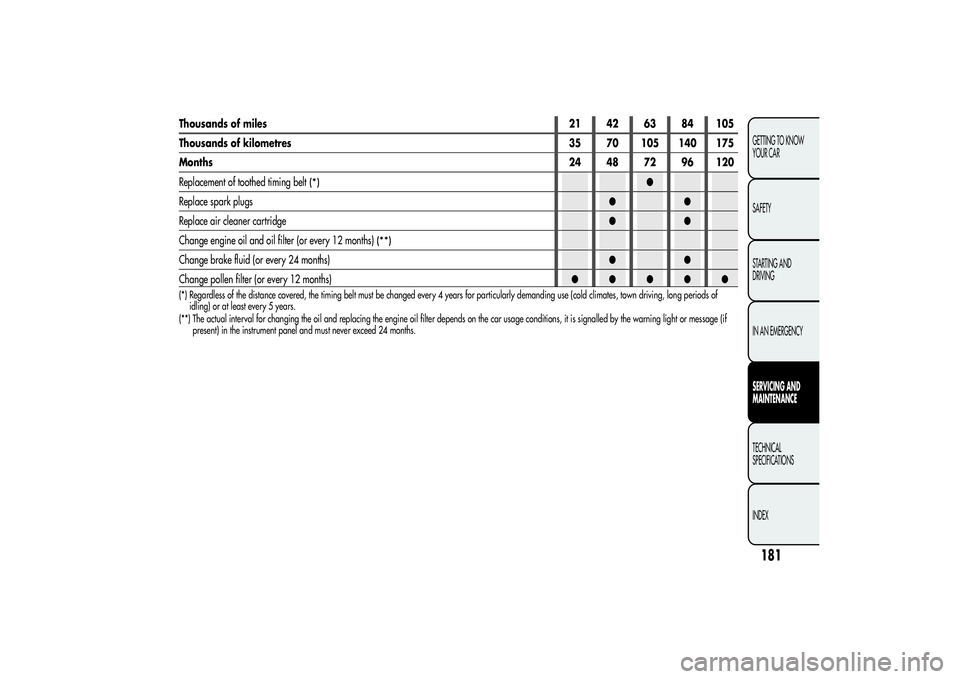
Thousands of miles21 42 63 84 105
Thousands of kilometres 35 70 105 140 175
Months24 48 72 96 120
Replacement of toothed timing belt
(*)
●
Replace spark plugs●●
Replace air cleaner cartridge●●
Change engine oil and oil filter (or every 12 months)
(**)
Change brake fluid (or every 24 months)●●
Change pollen filter (or every 12 months)●●●●●(*) Regardless of the distance covered, the timing belt must be changed every 4 years for particularly demanding use (cold climates, town driving, long periods of
idling) or at least every 5 years.
(**) The actual interval for changing the oil and replacing the engine oil filter depends on the car usage conditions, it is signalled by the warning light or message (if
present) in the instrument panel and must never exceed 24 months.
181GETTING TO KNOW
YOUR CAR
SAFETY
STARTING AND
DRIVING
IN AN EMERGENCYSERVICING AND
MAINTENANCETECHNICAL
SPECIFICATIONS
INDEX
Page 187 of 292

Thousands of miles21 42 63 84 105
Thousands of kilometres 35 70 105 140 175
Months24 48 72 96 120
Replacement of toothed timing belt
(*)
●
Replace fuel filter●●
Replace air cleaner cartridge●●
Replace engine oil and oil filter (or every 24 months)
(**) (***)
Change brake fluid (or every 24 months)●●
Change pollen filter (or every 12 months)●●●●●(*) Regardless of the distance covered, the timing belt must be changed every 4 years for particularly demanding use (cold climates, town driving, long periods of
idling) or at least every 5 years.
(**) The actual interval for changing the oil and replacing the engine oil filter depends on the car usage conditions, it is signalled by the warning light or message (if
present) in the instrument panel and must never exceed 24 months.
(***) If the car is mainly used in towns and cities, change the engine oil and filter every 12 months.
183GETTING TO KNOW
YOUR CAR
SAFETY
STARTING AND
DRIVING
IN AN EMERGENCYSERVICING AND
MAINTENANCETECHNICAL
SPECIFICATIONS
INDEX
Page 188 of 292

PERIODIC CHECKSEvery 1,000 km or before long journeys, check and restore the
following if necessary:
❒engine coolant, brake fluid and windscreen washer fluid level;
❒tyre inflation pressure and condition;
❒operation of lighting system (headlamps, direction indicators,
hazard warning lights, etc.);
❒operation of window washer/wiper system and positioning/wear of
windscreen/rear window wiper blades
Check and top up, if required, the engine oil level every 3,000 km.
HEAVY-DUTY USE OF THE CARIf you use the car mainly under one of the following conditions:
❒towing a trailer or caravan;
❒dusty roads;
❒short, repeated journeys (less than 7-8 km) at sub-zero outside
temperatures;
❒engine often idling or driving long distances at low speeds or long
periods of idleness;
the following checks must be performed more frequently than indicated
in the Scheduled Servicing Plan:
❒check front disc brake pad conditions and wear;
❒check cleanliness of bonnet and boot locks, cleanliness and
lubrication of linkage;
❒visually inspect conditions of: engine, gearbox, transmission, pipes
and hoses (exhaust - fuel system - brakes) and rubber elements
(boots - sleeves - bushes - etc.);
❒check battery charge and battery fluid level (electrolyte);
❒visually inspect condition of the accessory drive belts;
❒check and, if necessary, change engine oil and replace oil filter;
❒check and, if necessary, replace pollen filter;
❒check and, if necessary, replace air cleaner.
184GETTING TO KNOW
YOUR CAR
SAFETY
STARTING AND
DRIVING
IN AN EMERGENCYSERVICING AND
MAINTENANCE
TECHNICAL
SPECIFICATIONS
INDEX
Page 203 of 292
PRESERVING THE BODYWORKPaint
Touch up abrasions and scratches immediately to prevent the formation
of rust.
Maintenance of paintwork consists of washing the car: the frequency
depends on the conditions and environment where the car is used. For
example, it is advisable to wash the car more often in areas with
high levels of atmospheric pollution or salted roads.
To correctly wash the car, follow these instruction:
❒remove the aerial from the roof when using a carwash;
❒if high pressure jets or cleaners are used to wash the car, maintain a
distance of at least 40 cm from the bodywork to avoid damage or
alteration. Bear in mind that a build up of water could cause
damage to the car in the long term.
❒wash the body using a low pressure jet of water;
❒wipe a sponge with a slightly soapy solution over the bodywork,
frequently rinsing the sponge;
❒rinse well with water and dry with a jet of air or a chamois leather.
Dry the less visible parts (e.g. door frames, bonnet, headlight frames
etc.) with special care, as water may stagnate more easily in these
areas. Do not wash the car after it has been left in the sun or with the
bonnet hot: this may alter the shine of the paintwork.
Exterior plastic parts must be cleaned in the same way as the rest of
the car.
Detergents pollute the environment. Only wash your car in
areas equipped to collect and treat wastewater from this
type of activity.
In order to preserve the aesthetic properties of the
paintwork, abrasive products and/or polishes should not
be used to clean the car.
IMPORTANT
Avoid parking under trees; the resin dropped by trees makes the
paintwork go opaque and increases the possibility of corrosion.
Bird droppings must be washed off immediately and thoroughly as the
acid they contain is particularly aggressive.
Windows
Use specific detergents and clean cloths to prevent scratching or
altering the transparency.
IMPORTANT Wipe the inside surface of the rear window gently with a
cloth in the direction of the filaments to avoid damaging the heating
device.
Front headlights
Use a soft, damp cloth soaked in water and detergent for washing
cars.
IMPORTANT Never use aromatic substances (e.g. petrol) or ketenes
(e.g. acetone) for cleaning the plastic lenses of the front headlights.
IMPORTANT When cleaning the car with a pressure washer, keep the
water jet at least 20 cm away from the headlights.
199GETTING TO KNOW
YOUR CAR
SAFETY
STARTING AND
DRIVING
IN AN EMERGENCYSERVICING AND
MAINTENANCETECHNICAL
SPECIFICATIONS
INDEX