Page 57 of 650

To determine if a lap/shoulder belt
properly f its a child, have the child
put on the seat belt, then ask
yourself :Does the child sit all the way back
against the seat?
Do the child’s knees bend
comf ortably over the edge of the
seat?
When a child reaches the
recommended weight or height limit
for a forward-facing child seat, the
child should sit in a back seat on a
booster seat and wear the lap/
shoulder belt.
The f ollowing pages give
instructions on how to check proper
seat belt f it, what kind of booster
seat to use if one is needed, and
important precautions f or a child
who must sit in f ront.
1.
2.
CONT INUED
Checking Seat Belt Fit
Protecting L arger Children
Driver and Passenger Saf ety
53
Allowing a child age 12 or under
to sit in front can result in injury
or death if the passenger’s front
airbag inflates.
If a child must ride in front,
move the vehicle seat as far
back as possible, use a booster
seat if needed, have the child
sit up properly and wear the
seat belt properly.
12/07/20 10:36:33 31TK4640_058
2013 TL
Page 59 of 650

A child may continue using a booster
seat until the tops of their ears are
even with the top of the vehicle’s or
booster’s seat-back. A child of this
height should be tall enough to use
the lap/shoulder belt without a
booster seat.The National Highway Traffic Safety
Administration and Transport
Canada recommend that all children
age 12 and under be properly
restrained in the back seat.
If the passenger’s front airbag
inf lates in a moderate to severe
f rontal collision, the airbag can cause
serious injuries to a child who is
unrestrained, improperly restrained,
sitting too close to the airbag, or out
of position.
A side airbag also poses risks. If
any part of a larger child’s body
is in the path of a deploying side
airbag, the child could receive
possibly serious injuries.Of course, children vary widely. And
while age may be one indicator of
when a child can saf ely ride in f ront,
there are other important f actors you
should consider.
Physically, a child must be large
enough f or the lap/shoulder belt to
properly f it (see pages and ). If
the seat belt does not f it properly,
with or without the child sitting on a
booster seat, the child should not sit
in f ront.
To saf ely ride in f ront, a child must
be able to f ollow the rules, including
sitting properly, and wearing the seat
belt properly throughout the ride.
16 53
CONT INUED
When Can a Larger
Child Sit in Front
Physical Size
Maturity
Protecting L arger Children
Driver and Passenger Saf ety
55
12/07/20 10:36:48 31TK4640_060
2013 TL
Page 61 of 650

Your vehicle’s exhaust contains
carbon monoxide gas. Carbon
monoxide should not enter the
vehicle in normal driving if you
maintain your vehicle properly and
f ollow the inf ormation on this page.High levels of carbon monoxide can
collect rapidly in enclosed areas,
such as a garage. Do not run the
engine with the garage door closed.
Even with the door open, run the
engine only long enough to move the
vehicle out of the garage.
Have the exhaust system inspected
f or leaks whenever:
With the trunk lid open, airf low can
pull exhaust gas into your vehicle’s
interior and create a hazardous
condition. If you must drive with the
trunk open, open all the windows,
and set the climate control system as
shown below.
Select the f resh air mode.
Select the mode.
Set the f an speed to high.
Set the temperature control to a
comfortable setting.
If you must sit in your parked vehicle
with the engine running, even in an
unconfined area, adjust the climate
control system as f ollows:
The vehicle is raised f or an oil
change.
You notice a change in the sound
of the exhaust.
The vehicle was in a collision that
may have damaged the underside. 1.
2.
3.
4.
Carbon Monoxide Hazard
Driver and Passenger Saf ety
57
Carbon monoxide gas is toxic.
Breathing it can cause
unconsciousness and even kill
you.
Avoid any enclosed areas or
activities that expose you to
carbon monoxide.
12/07/20 10:37:02 31TK4640_062
2013 TL
Page 67 of 650

�Î�Î
�Î
�Î
The U.S. instrument panel is shown. Dif f erences f or the Canadian models are noted in the text.
Instrument Panel
Inst rument s and Cont rols
63
CRUISE MAIN INDICATOR CRUISE CONTROL INDICATOR
PARKING BRAKE AND
BRAKE SYSTEM
INDICATOR
HIGH BEAM INDICATOR
LOW FUEL INDICATOR IMMOBILIZER SYSTEM
INDICATOR
SIDE AIRBAG OFF INDICATOR
SH-AWD INDICATOR
LIGHTS ON INDICATOR LOW TIRE PRESSURE/TPMS INDICATOR
If e q u ip p e d
:
SECURITY SYSTEM INDICATOR
SUPPLEMENTAL RESTRAINT SYSTEM INDICATOR
ANTI-LOCK BRAKE SYSTEM (ABS) INDICATOR
ELECTRIC POWER STEERING
(EPS) INDICATOR
FOG LIGHT INDICATOR (
P .73)
( P .68)
(P .69) (P.
72)
(P.
72)
(P. 67
)(
P. 73)
(P.
65)
(P. 70
)
(
P. 71)
(
P. 67) (P.
66)
SYSTEM MESSAGE INDICATOR (
P.72)
MULTI-INFORMATION DISPLAY
SEAT BELT REMINDER INDICATOR ( P.64)
CHARGING SYSTEM INDICATOR
LOW OIL PRESSURE INDICATOR
MALFUNCTION INDICATOR LAMP (
P. 72)
( P. 71)
A/T model is shown.
(P. 71)
VEHICLE STABILITY
ASSIST (VSA) OFF
INDICATOR
VEHICLE STABILITY ASSIST (VSA)
SYSTEM INDICATOR BLIND SPOT INFORMATION SYSTEM
(BSI) INDICATOR
DOOR/TRUNK OPEN INDICATOR
(P. 68)
(
P. 71)
KEYLESS ACCESS SYSTEM
INDICATOR (P .74)
(P .75)
(
P. 65, 596)
( P. 64, 595)
( P. 64, 597)
(P. 65, 598)
(
P. 78)
12/07/20 10:37:48 31TK4640_068
P.
P.
P.
P.
2013 TL
Page 71 of 650
�Î
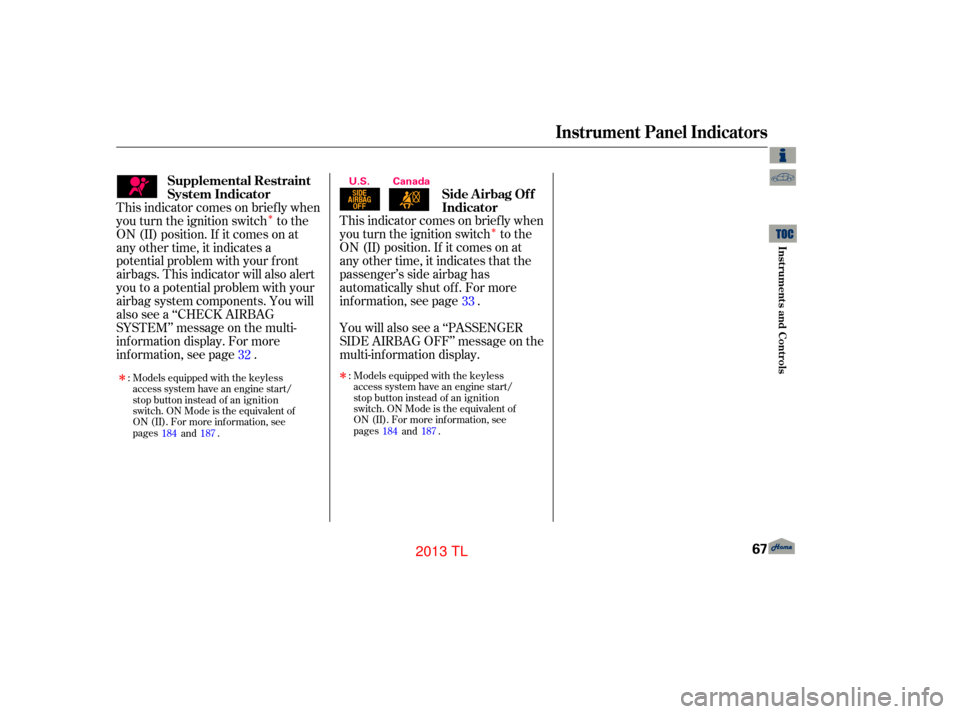
�ÎThis indicator comes on brief ly when
you turn the ignition switch to the
ON (II) position. If it comes on at
any other time, it indicates that the
passenger’s side airbag has
automatically shut off. For more
inf ormation, see page .
You will also see a ‘‘PASSENGER
SIDE AIRBAG OFF’’ message on the
multi-inf ormation display.
This indicator comes on brief ly when
you turn the ignition switch to the
ON (II) position. If it comes on at
any other time, it indicates a
potential problem with your f ront
airbags. This indicator will also alert
you to a potential problem with your
airbag system components. You will
also see a ‘‘CHECK AIRBAG
SYSTEM’’ message on the multi-
inf ormation display. For more
inf ormation, see page .
33
32
Supplemental Restraint
System Indicator
Side A irbag Of f
Indicator
Instrument Panel Indicators
Inst rument s and Cont rols
67
U.S. Canada
12/07/20 10:38:21 31TK4640_072
�ΠModels equipped with the keyless
access system have an engine start/
stop button instead of an ignition
switch. ON Mode is the equivalent of
ON (II). For more information, see
pages
and .
:
184 187
�Î
Models equipped with the keyless
access system have an engine start/
stop button instead of an ignition
switch. ON Mode is the equivalent of
ON (II). For more information, see
pages
and .
:
184 187
2013 TL
Page 73 of 650

�Î
This indicator normally comes on f or
a f ew seconds when you turn the
ignition switch to the ON (II)
position.
This indicator has two f unctions:If it comes on while driving, it
indicates that one or more of your
vehicle’s tires are signif icantly low
on pressure. You will also see a ‘‘CHECK TIRE
PRESSURE’’ message on the multi-
inf ormation display (see page ).
Check the tire pressure monitor on
the multi-inf ormation display and
determinethecause(seepage ).
If this indicator begins to flash,
there is a problem with the tire
pressure monitoring system
(TPMS). You will also see a
‘‘CHECK TPMS SYSTEM’’
message on the multi-
information display. The
indicator continues to flash for a
while (approximately 1 minute),
then stays on. If this happens,
have your dealer check the
system as soon as possible. For
more information, see page
.
If this happens, pull to the side of the
road when it is saf e, check which tire
has lost pressure on the multi-
inf ormation display, and determine
the cause. If it is because of a flat tire,
replace the flat tire with the compact
spare (see page ), and have the
f lat tire repaired as soon as possible.
If two or more tires are underinf lated,
call a prof essional towing service.
For more inf ormation, see page .
1.
2.
516
515
514
583
607
Instrument Panel Indicators
Low Tire Pressure/
TPMS Indicator
Inst rument s and Cont rols
69
12/07/20 10:38:38 31TK4640_074
�ÎModels equipped with the keyless
access system have an engine start/
stop button instead of an ignition
switch. ON Mode is the equivalent of
ON (II). For more information, see
pages
and .
:
184 187
2013 TL
Page 140 of 650

�Î
�Î
�Î
�Î
�Î
�Î
�Î
�Î
�Î �Î
�Î �Î
�Î
To use the horn, press the center pad of the steering wheel.
If equipped
Ref er to the navigation system owner’s manual.
1:
2:
3:
4
: Switch location varies on models.
Controls Near the Steering Wheel
136
SEAT HEATER SWITCHES
PADDLE SHIFTERS
CRUISE CONTROL BUTTONS WINDSHIELD WIPERS/WASHERS
STEERING WHEEL
ADJUSTMENTS MULTI-INFORMATION
DISPLAY BUTTONSHORN
KEYLESS ACCESS REMOTE SLOTENGINE START/STOP BUTTON
A/T model with navigation system is shown. VOICE CONTROL BUTTONS for
NAVIGATION SYSTEM /
BLUETOOTH HANDSFREELINK
SYSTEM
SEAT HEATER/VENTILATION BUTTONS
(
P. 387)
( P. 407 , )
(P .146) (
P. 79)
(P. 401) (P. 197
) (P. 204
)
(
P. 202) (P. 184
)
REMOTE AUDIO CONTROL BUTTONS
HEADLIGHTS/TURN SIGNALS/
FOG LIGHTS
(
P .139 , )
INSTRUMENT PANEL
BRIGHTNESS
( P. 143)
( P .525)
BLIND SPOT INFORMATION
SYSTEM (BSI) OFF BUTTON
HEADLIGHT WASHER
BUTTON (
P .511)
(P. 138) PASSENGER AIR BAG
OFF INDICATOR
(P. 34)
HAZARD WARNING
BUTTON
REAR WINDOW DEFOGGER/
HEATED MIRROR BUTTON
(
P .145, P.169 )
PHONE BUTTON
( P .424)
INTERFACE DIAL (P. 285)
SELECTOR KNOB ( P. 236)
(
P. 145)
(
P .499)
(P .137)
VEHICLE STABILITY ASSIST
(VSA) SYSTEM OFF SWITCH
1
3
2
2
2 2
3 2
4
12/07/20 10:46:46 31TK4640_141
Inst rument s and Cont rols
P.4
25
P.1
43
2013 TL
Page 168 of 650
To remove a f ront or rear center
head restraint f or cleaning or repair,
pull it up as f ar as it will go. Push the
release button, then pull the restraint
out of the seat-back.To remove either rear outer head
restraint, push the tilt button, then
f old the head restraint backward.
Push the release button, then pull
the restraint out of the seat-back.Make sure the head restraint locks
in position when you reinstall it. When reinstalling a head restraint,
put the legs back in place. Then
adjust it to the appropriate height
while pressing the release button.
Seats
Removing t he Head Rest raint
164
Rear Outer
TILT BUTTON
RELEASE BUTTON
Failure to reinstall, or correctly
reinstall, the head restraints can
result in severe injury during a
crash.
Always replace the head
restraints before driving.
12/07/20 10:50:25 31TK4640_169
Inst rument s and Cont rols
2013 TL
