Page 108 of 240
Under the bonnet
106
PETROL ENGINE
1. Screenwash reservoir.
2. Fusebox.
3. Engine coolant header tank.
4. Brake and clutch fl uid reservoir.
5. Air fi lter.
6. Engine oil dipstick.
7. Engine oil fi ller cap.
8. Power steering fl uid reservoir. Battery connections:
+ Positive terminal.
- Negative point (earth). Take care when working under the
bonnet.
Page 109 of 240
Under the bonnet
107
CHECKS
6
DIESEL ENGINE
4. Brake and clutch fl uid reservoir.
5. Air fi lter.
6. Engine oil dipstick. 7. Engine oil fi ller cap.
8. Power steering fl uid reservoir.
9. Priming pump.
1. Screenwash reservoir.
2. Fusebox.
3. Engine coolant header tank.
Battery connections:
+ Positive terminal.
- Negative point (earth).
Take care when working under the bonnet.
Page 110 of 240

Levels
108
LEVELS
Oil change
This must be carried out at the
intervals specifi ed and the viscosity
grade of the oil selected must fulfi l the
requirements in the manufacturer's
servicing schedule. Ask for advice from
a CITROËN dealer.
Remove the dipstick before fi lling.
Check the level after fi lling (never
exceed the max mark).
Refi t the oil fi ller cap before closing the
bonnet.
Changing the brake fluid
The brake fl uid must be changed at
the intervals stated, according to the
manufacturer's servicing schedule.
Use fl uids recommended by the
manufacturer, which meet the
DOT4 standard.
The level must be between the MIN
and MAX marks on the reservoir.
If fl uid has to be added frequently,
this indicates a fault which must be
checked by a CITROËN dealer or
a qualifi ed workshop as soon as
possible.
Warning lamps
If you have to remove / refi t the
engine style cover, handle it with
care to avoid damaging the fi xing
clips.
Oil level
It is recommended that the oil level be
checked every 3 000 miles (5 000 km)
and topped up if necessary between oil
changes.
Check the level with the vehicle level,
engine cold, using the dipstick.
Dipstick Viscosity selection
In all cases, the oil selected must meet
the manufacturer's requirements.
These regular maintenance
operations will keep your vehicle
in good working order. Ask for
advice from a CITROËN dealer or refer
to the servicing and warranty booklet in
the handbook pack.
Checks using the warning
lamps in the instrument panel is
described in chapter 2, refer to the
"Instruments and controls" section.
There are two marks on
the dipstick:
A = maximum
If you fi ll past this mark,
consult a CITROËN
dealer or a qualifi ed
workshop.
B = minimum
Never allow the level to
fall below this mark.
To maintain the reliability
of engines and emission
control systems, the use
of additives in engine oil
is prohibited.
Page 115 of 240

DIESEL
Fuel
11 3
CHECKS
6
FUEL CUT-OFF
In a serious collision, a mechanism
automatically prevents fuel from
reaching the engine. The fl ashing of this warning
lamp is accompanied by a
message in the screen.
Check that there is no odour or
leakage of fuel outside the vehicle and
re-establish the fuel supply:
- switch off the ignition (STOP position),
- remove the key,
- put the key back in the ignition,
- switch on the ignition and start.
DIESEL PRIMING PUMP
If you should run out of fuel, it is
necessary to prime the fuel circuit:
- fi ll the fuel tank with at least fi ve litres of Diesel,
- squeeze and release the manual priming pump, under the bonnet
under the protective cover,
- operate the starter until the engine starts.
Refer to the "Under the bonnet"
section of chapter 6. Quality of the fuel used for
Diesel engines
The Diesel engines are perfectly
compatible with biofuels which conform
to current and future European
standards (Diesel fuel which complies
with standard EN 590 mixed with a
biofuel which complies with standard
EN 14214) available at the pumps
(containing up to 7 % Fatty Acid Methyl
Ester).
The B30 biofuel can be used in certain
Diesel engines; however, this use
is subject to strict application of the
special servicing conditions. Contact
a CITROËN dealer or a qualifi ed
workshop.
The use of any other type of (bio)
fuel (vegetable or animal oils, pure
or diluted, domestic fuel...) is strictly
prohibited (risk of damage to the
engine and fuel system).
Page 124 of 240

Changing a bulb
122
CHANGING A BULB
Type B
Bayonet bulb: press
on the bulb then turn it
anticlockwise. Type A
All glass bulb: pull gently
as it is fi tted by pressure.
Open the bonnet. To access the bulbs,
reach behind the headlamp unit.
Carry out the operations in reverse
order to refi t each bulb and check that
the bonnet is closed securely. Type C
Halogen bulb: release
the retaining spring from
its housing.
Halogen bulbs must be changed
with the headlamp off. Wait a few
minutes (risk of serious burns).
Do not touch the bulb directly with your
fi ngers, use lint-free cloths.
It is normal for condensation to form
inside the headlamps. Regular use of
the vehicle eliminates this misting. The bulbs must be changed with
the ignition off or with the battery
disconnected. Wait approximately
3 minutes after changing the bulb
before reconnecting the battery.
Check that the lamps operate correctly
after each operation.
High pressure washing
Types of bulb
Various types of bulb are fi tted to your
vehicle. To remove them:
When using this type of washing
on stubborn dirt, do not persist on
the headlamps, the lamps and their
edges to avoid damaging their coating
and seals.
Type D
Light emitting diode
(LED): for replacement
of the daytime running
lamps, contact a
CITROËN dealer or a
qualifi ed workshop.
Page 129 of 240

Changing a fuse
127
QUICK HELP
7
CHANGING A FUSE
The fuseboxes are located:
- in the lower dashboard on the left-hand side (behind the cover),
- under the bonnet (near the battery).
If fi tted on your vehicle, an additional
fusebox is used for towing, the
towbar and the connections for
the coachbuilder and platform cab
modifi cations. It is located on the right
behind the load retaining partition.
The indications communicated
are only those fuses which can be
changed by the user using the tweezer,
located behind the dashboard storage
compartment on the right-hand side.
For any other work, visit a CITROËN
dealer or a qualifi ed workshop.
Removing and fitting a fuse
Always replace a failed fuse with a
fuse of the same rating.
CITROËN will not accept responsibility
for the cost incurred in repairing
your vehicle or for rectifying the
malfunctions resulting from the
installation of accessories not
supplied and not recommended by the
CITROËN network and not installed
in accordance with its instructions,
in particular when the combined
consumption of all of the additional
equipment connected exceeds
10 milliamperes.
Motor trade technicians: for
complete information on the fuses
and relays, refer to the "Repair
manual" diagram via the dealer
network. Before replacing a fuse, the cause
of the incident must be found and
rectifi ed.
- Use the tweezer.
Page 132 of 240
Changing a fuse
130
FUSES UNDER THE BONNET
After opening the bonnet, unclip and tilt
the box to gain access to the fuses. Fuses
F Amperes
A Allocation
1 20 Engine management
2 15 Horn
3 10 Front and rear screenwash pump
4 20 Headlamp wash pump or LED
5 15 Engine components
6 10 Steering wheel angle sensor, DSC
7 10 Brake switch, clutch switch
8 25 Starter
9 10 Headlamp beam motor, parc management
unit
10 30 Engine components
11 40 Spare
12 30 Wipers
13 40 Built-in systems interface
14 30 Pump
15 10 Right-hand main beam headlamp
16 10 Left-hand main beam headlamp
17 15 Right-hand dipped beam headlamp
18 15 Left-hand dipped beam headlamp
Page 227 of 240
141
Exterior
VISUAL SEARCH
10
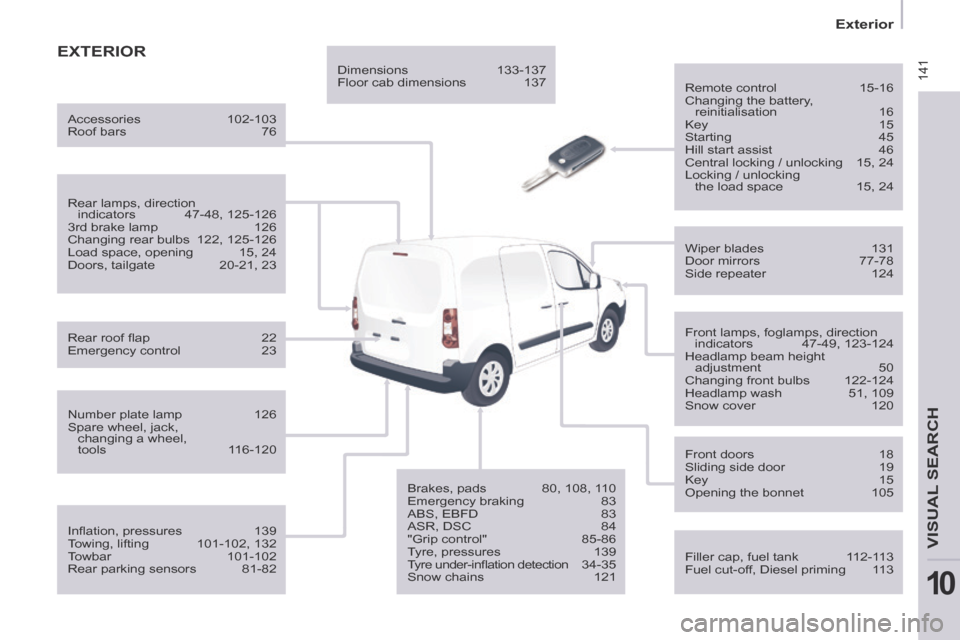
EXTERIOR
Remote control 15-16
Changing the battery,
reinitialisation 16 Key 15
Starting 45
Hill start assist 46
Central locking / unlocking 15, 24
Locking / unlocking the load space 15, 24
Filler cap, fuel tank 112-113
Fuel cut-off, Diesel priming 113 Wiper blades 131
Door mirrors 77-78
Side repeater 124
Front lamps, foglamps, direction indicators 47-49, 123-124
Headlamp beam height
adjustment 50 Changing front bulbs 122-124
Headlamp wash 51, 109
Snow cover 120
Front doors 18
Sliding side door 19
Key 15
Opening the bonnet 105
Infl ation, pressures 139
Towing, lifting 101-102, 132
Towbar 101-102
Rear parking sensors 81-82 Number plate lamp 126
Spare wheel, jack, changing a wheel,
tools 116-120
Rear lamps, direction
indicators 47-48, 125-126
3rd brake lamp 126
Changing rear bulbs 122, 125-126
Load space, opening 15, 24
Doors, tailgate 20-21, 23 Accessories 102-103
Roof bars 76
Rear roof fl ap 22
Emergency control 23 Dimensions
133-137
Floor cab dimensions 137
Brakes, pads 80, 108, 110
Emergency braking 83
ABS, EBFD 83
ASR, DSC 84
"Grip control" 85-86
Tyre, pressures 139
Tyre under-infl ation detection 34-35
Snow chains 121


