Page 34 of 152

4-9
4of sparks, open flames, or other sources of ig-
nition such as the pilot lights of water heaters
and clothes dryers.
2. Do not overfill the fuel tank. When refueling, be sure to insert the pump nozzle into the fuel
tank filler hole. Stop filling when the fuel reach-
es the bottom of the filler tube. Because fuel
expands when it heats up, heat from the en-
gine or the sun can cause fuel to spill out of
the fuel tank.
3. Wipe up any spilled fuel immediately.NOTICE: Immediately wipe off spilled fuel
with a clean, dry, soft cloth, since fuel may
deteriorate painted surfaces or plastic
parts.
[ECB00981]
4. Turn the fuel tank cap fully clockwise to make sure it is securely closed.
WARNING
EWB02531Gasoline is poisonous and can cause injury or
death. Handle gasoline with care. Never siphon
gasoline by mouth. If you should swallow
some gasoline or inhale a lot of gasoline vapor,
or get some gasoline in your eyes, see your
1. Maximum fuel level
2. Fuel tank filler tube
Recommended fuel:PREMIUM UNLEADED GASOLINE ONLY
For Europe: PREMIUM UNLEADED GASO-
LINE ONLY with a research octane number
of 97 or higher
Fuel tank capacity: 10.0 L (2.64 US gal, 2.20 Imp.gal)
Fuel reserve amount: 1.9 L (0.50 US gal, 0.42 Imp.gal)
U1PD60E0.book Page 9 Monday, June 13, 2011 2:57 PM
Page 45 of 152
5-3
5
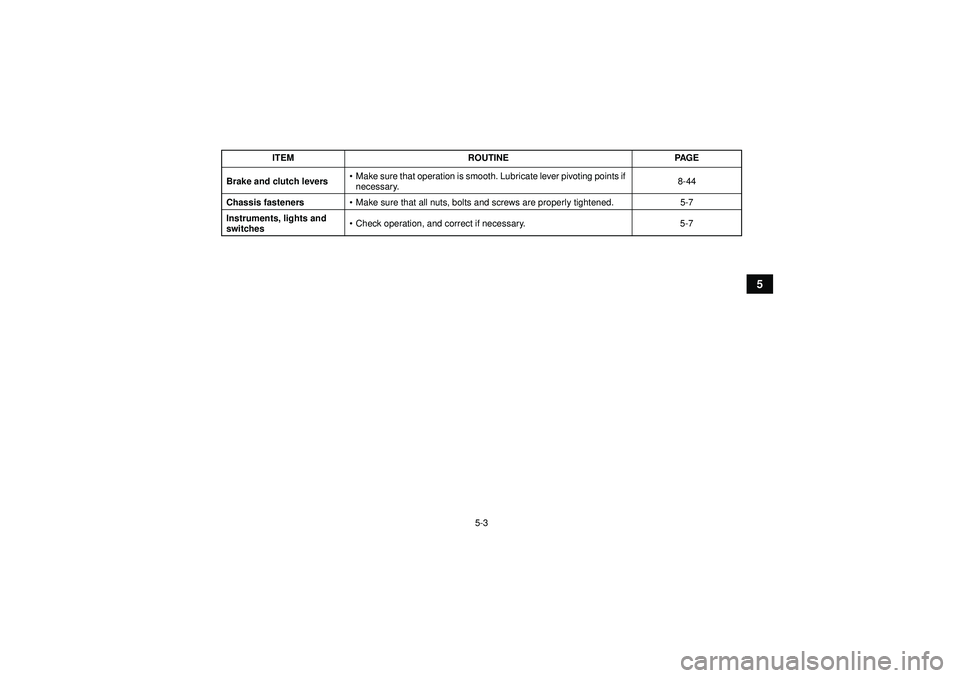
Brake and clutch levers
Make sure that operation is smooth. Lubricate lever pivoting points if
necessary. 8-44
Chassis fasteners Make sure that all nuts, bolts and screws are properly tightened. 5-7
Instruments, lights and
switches
Check operation, and correct if necessary. 5-7
ITEM ROUTINE PAGE
U1PD60E0.book Page 3 Monday, June 13, 2011 2:57 PM
Page 49 of 152
5-7
5
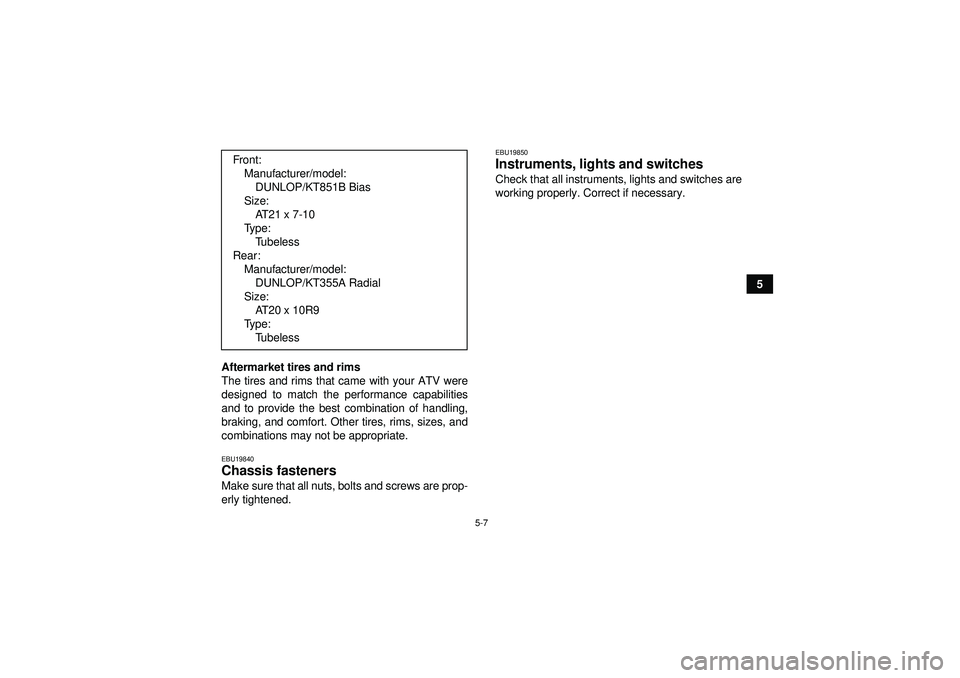
Aftermarket tires and rims
The tires and rims that came with your ATV were
designed to match the performance capabilities
and to provide the best combination of handling,
braking, and comfort. Other tires, rims, sizes, and
combinations may not be appropriate.
EBU19840Chassis fasteners Make sure that all nuts, bolts and screws are prop-
erly tightened.
EBU19850Instruments, lights and switches Check that all instruments, lights and switches are
working properly. Correct if necessary.
Fro nt:
Manufacturer/model:DUNLOP/KT851B Bias
Size: AT21 x 7-10
Ty p e : Tu b e l e s s
Rear: Manufacturer/model:DUNLOP/KT355A Radial
Size: AT20 x 10R9
Ty p e : Tu b e l e s s
U1PD60E0.book Page 7 Monday, June 13, 2011 2:57 PM
Page 50 of 152

6-1
6
EBU19881
OPERATION
EBU19901Read the Owner’s Manual carefully before riding
the ATV. If there is a control or function you do not
understand, ask your Yamaha dealer.
WARNING
EWB00631Read the Owner ’s Manual carefully to become
familiar with all controls in order to help pre-
vent any loss of control, which could cause an
accident or injury.EBU20184Starting a cold engine NOTICEECB00150See the “Engine break-in ” section on page 6-5
prior to operating the engine for the first time.1. Set the parking brake.
2. Turn the fuel cock to “ON ”.
3. Turn the key to “ON ” and the engine stop
switch to “”. 4. Shift the transmission into neutral. The neutral
indicator light should come on. If the indicator
light does not come on, have a Yamaha deal-
er check the electrical circuit.
TIPThis model is equipped with an ignition circuit cut-
off system. The engine can be started under the
following conditions.�The transmission is in neutral.�The clutch is disengaged with the transmission
in gear. However, it is recommended to shift into
neutral before starting the engine.5. Use the starter (choke) in reference to the fig-ure:
Position (1):
Cold engine start with ambient temperature
below 5 ° C (40 °F).
Position (2):
Cold engine start with ambient temperature
between 0 ° C (30 °F) and 30 ° C (90 °F).
Position (3):
Cold engine start with ambient temperature
above 25 °C (80 °F).
U1PD60E0.book Page 1 Monday, June 13, 2011 2:57 PM
Page 52 of 152
6-3
6
EBU20291Starting a warm engine Follow the same procedure as for starting a cold
engine, with the exception that the starter (choke)
is not required when the engine is warm. Instead,
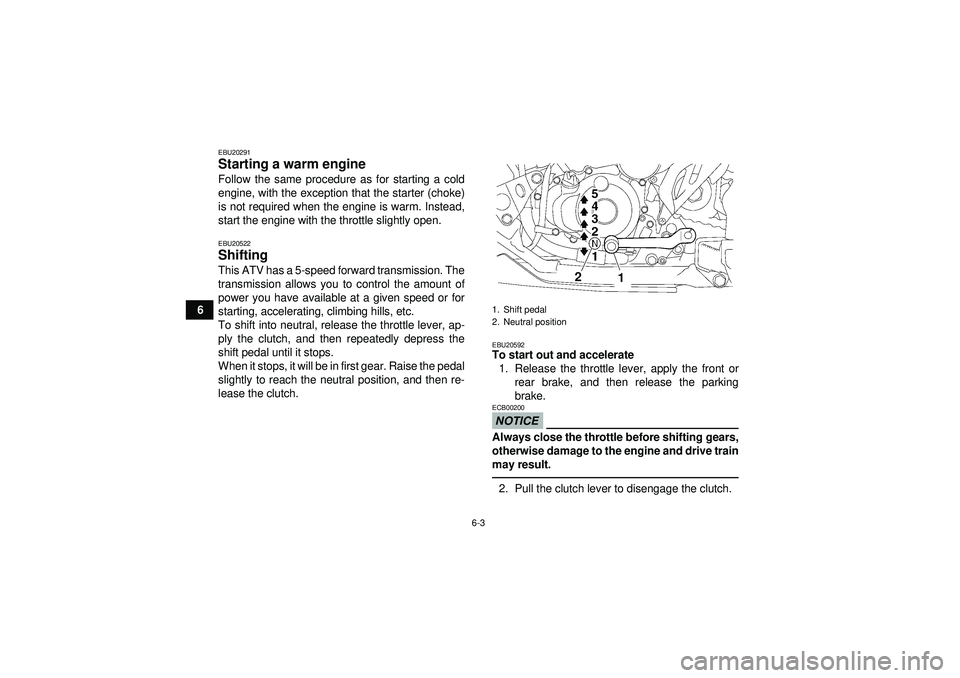
start the engine with the throttle slightly open.EBU20522Shifting This ATV has a 5-speed forward transmission. The
transmission allows you to control the amount of
power you have available at a given speed or for
starting, accelerating, climbing hills, etc.
To shift into neutral, release the throttle lever, ap-
ply the clutch, and then repeatedly depress the
shift pedal until it stops.
When it stops, it will be in first gear. Raise the pedal
slightly to reach the neutral position, and then re-
lease the clutch.
EBU20592To start out and accelerate1. Release the throttle lever, apply the front or rear brake, and then release the parking
brake.NOTICEECB00200Always close the throttle before shifting gears,
otherwise damage to the engine and drive train
may result.2. Pull the clutch lever to disengage the clutch.1. Shift pedal
2. Neutral position
1
2
U1PD60E0.book Page 3 Monday, June 13, 2011 2:57 PM
Page 69 of 152
![YAMAHA YFZ450 2012 Owners Manual 7-12
7
trol.
[EWB02631]
NOTICE: Do not shift gears without
releasing the throttle. Damage to the engine or
drive train may occur.
[ECB01071]
Use this same procedure as you move into the
higher ge](/manual-img/51/53816/w960_53816-68.png "YAMAHA YFZ450 2012 Owners Manual 7-12
7
trol.
[EWB02631]
NOTICE: Do not shift gears without
releasing the throttle. Damage to the engine or
drive train may occur.
[ECB01071]
Use this same procedure as you move into the
higher ge")
7-12
7
trol.
[EWB02631]
NOTICE: Do not shift gears without
releasing the throttle. Damage to the engine or
drive train may occur.
[ECB01071]
Use this same procedure as you move into the
higher gears. Be sure to coordinate the use of the
throttle and shift pedal properly.
Avoid higher speeds until you are thoroughly famil-
iar with the operation of your ATV.
When slowing down or stopping, release the throt-
tle and apply the brakes smoothly and evenly. As
you slow down, shift to a lower gear. Be sure that
the engine has sufficiently slowed before engaging
a lower gear. Improper use of the brakes or shifting
can cause the tires to lose traction, reducing con-
trol and increasing the possibility of an accident.
TURNING YOUR ATV
WARNING
EWB01771Always follow proper procedures for turning
as described in this Owner ’s Manual. Practice
turning at low speeds before attempting to turn
at faster speeds. Do not turn at speeds too fast
for your skills or the conditions. ATV could go
out of control, causing a collision or overturn.
To achieve maximum traction on unpaved surfac-
es, the two rear wheels turn together at the same
speed. Therefore, unless the wheel on the inside
of the turn is allowed to slip or lose some traction,
the ATV will resist turning. A special turning tech-
nique must be used to allow the ATV to make turns
quickly and easily. It is essential that this skill be
learned first at low speed.
As you approach a curve, slow down and begin to
turn the handlebars in the desired direction. As you
do so, put your weight on the footrest to the outside
of the turn (opposite your desired direction) and
lean your upper body into the turn. Use the throttle
to maintain an even speed through the turn. This
maneuver will let the wheel on the inside of the turn
slip slightly, allowing the ATV to make the turn
properly.
U1PD60E0.book Page 12 Monday, June 13, 2011 2:57 PM
Page 75 of 152

7-18
7
CROSSING A SLOPE
WARNING
EWB01632Improperly crossing hills or turning on hills
could cause loss of control or cause the ATV to
overturn.�Always follow proper procedures as de-
scribed in the Owner
’s Manual.�Avoid hills with excessively slippery or loose
surfaces.�Avoid crossing the side of a steep hill.�Shift your weight to the uphill side of the
ATV.�Never attempt to turn the ATV around on any
hill until you have mastered the turning tech-
nique as described in the Owner ’s Manual on
level ground. Be very careful when turning
on any hill.Traversing a sloping surface on your ATV requires
you to properly position your weight to maintain
proper balance. Be sure that you have learned the
basic riding skills on flat ground before attempting
to cross a sloping surface. Avoid slopes with slip-
pery surfaces or rough terrain that may upset your
balance. As you travel across a slope, lean your body in the
uphill direction. It may be necessary to correct the
steering when riding on loose surfaces by pointing
the front wheels slightly uphill. When riding on
slopes, be sure not to make sharp turns either up
or down hill.
If your ATV does begin to tip over, gradually steer
in the downhill direction if there are no obstacles in
your path. As you regain proper balance, gradually
steer again in the direction you wish to travel.U1PD60E0.book Page 18 Monday, June 13, 2011 2:57 PM
Page 88 of 152
8-8
8
EBU23071TIP�Some maintenance items need more frequent service if you are riding in unusually wet, dusty, sandy or
muddy areas, or at full-throttle.�Hydraulic brake service
Regularly check and, if necessary, correct the brake fluid level.
Every two years replace the internal components of the brake master cylinders and calipers, and
change the brake fluid.
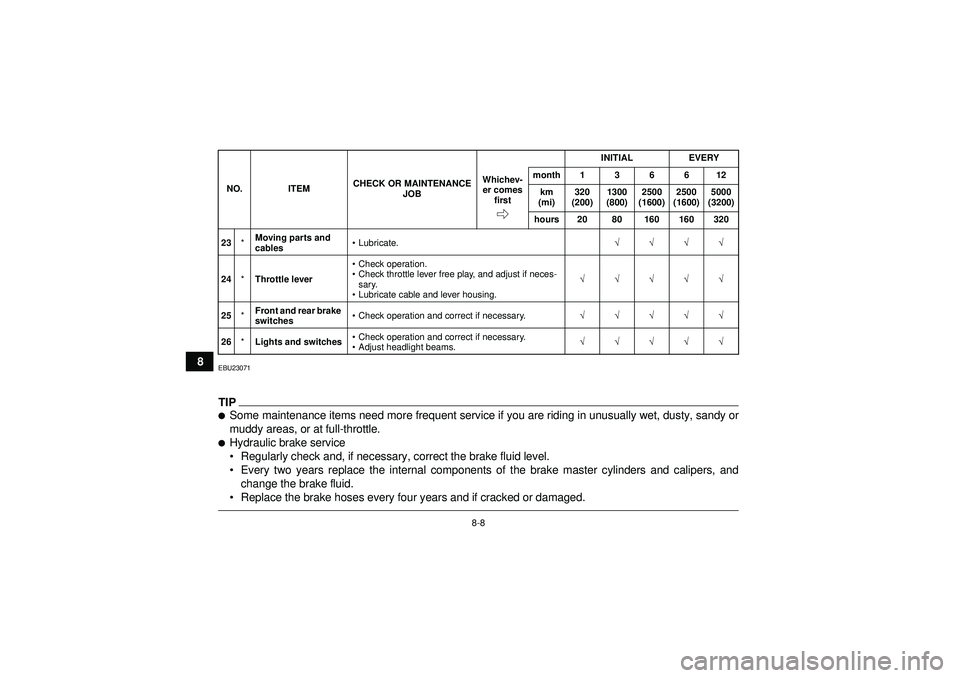
Replace the brake hoses every four years and if cracked or damaged.23 *Moving parts and
cables
Lubricate. √√√√
24 *Throttle lever
Check operation.
Check throttle lever free play, and adjust if neces-
sary.
Lubricate cable and lever housing. √√√√√
25 *Front and rear brake
switches
Check operation and correct if necessary. √√√√√
26 *Lights and switches
Check operation and correct if necessary.
Adjust headlight beams. √√√√√
NO. ITEM
CHECK OR MAINTENANCE
JOB INITIAL EVERY
Whichev- er comes first month136612
km
(mi) 320
(200) 1300
(800) 2500
(1600) 2500
(1600) 5000
(3200)
hours 20 80 160 160 320U1PD60E0.book Page 8 Monday, June 13, 2011 2:57 PM