Page 30 of 90

EAU12350
Pass switch “ ”
Press this switch to flash the head-
light.
EAU12400
Dimmer switch “ / ”
Set this switch to “ ” for the high
beam and to “ ” for the low beam.
EAU12460
Turn signal switch “ / ”
To signal a right-hand turn, push this
switch to “ ”. To signal a left-hand
turn, push this switch to “ ”. When
released, the switch returns to the
center position. To cancel the turn
signal lights, push the switch in after it
has returned to the center position.
EAU12500
Horn switch “ ”
Press this switch to sound the horn.
EAU12721
Start switch “ ”
With the sidestand up, push this
switch while applying the front or rear
brake to crank the engine with the
starter. See page 5-1 for starting ins-
tructions prior to starting the engine.
EAU44710
The engine trouble warning light and
ABS warning light (ABS model only)
will come on when the key is turned
to “ON” and the start switch is pus-
hed, but this does not indicate a mal-
function.
EAU12733
Hazard switch “ ”
With the key in the “ON” or “ ”
position, use this switch to turn on the
hazard lights (simultaneous flashing
of all turn signal lights).
The hazard lights are used in case of
an emergency or to warn other drivers
when your vehicle is stopped where it
might be a traffic hazard.
ECA10061
Do not use the hazard lights for an
extended length of time with the
engine not running, otherwise the
battery may discharge.
EAU12900
Front brake lever
1. Front brake lever
The front brake lever is located on the
right handlebar grip. To apply the
front brake, pull this lever toward the
handlebar grip.
NOTICE
INSTRUMENT AND CONTROL FUNCTIONS
3-12
3
Page 31 of 90

EAU12950
Rear brake lever
1. Rear brake lever
The rear brake lever is located on the
left handlebar grip. To apply the rear
brake, pull this lever toward the hand-
lebar grip.
EAU12995
ABS (for ABS models)
The Yamaha ABS (Anti-lock Brake
System) features a dual electronic
control system, which acts on the
front and rear brakes independently.
The ABS securely controls wheel loc-
kup during emergency braking on
changing road surfaces and under
various weather conditions, thereby
maximizing tire adhesion and perfor-
mance while providing a smooth bra-
king action. The ABS is monitored by
an ECU, which will have recourse to
manual braking if a malfunction
occurs.
EWA10090
�The ABS performs best on long
braking distances.
�On certain (rough or gravel)
roads, the braking distance
may be longer with than wit-
hout the ABS. Therefore,
always keep a sufficient distan-
ce to the vehicle ahead to
match the riding speed.
TIP
�The ABS performs a self-diagno-
sis test for a few seconds each
time the vehicle first starts off
after the key was turned to “ON”.
During this test, a “clicking” noi-
se can be heard from the front of
the vehicle, and if either brake
lever is even slightly applied, a
vibration can be felt at the lever,
but these do not indicate a mal-
function.
�When the ABS is activated, the
brakes are operated in the usual
way. A pulsating action may be
felt at the brake levers, but this
does not indicate a malfunction.
�This ABS has a test mode which
allows the owner to experience
the pulsating at the brake levers
when the ABS is operating.
However, special tools are requi-
red, so please consult your
Yamaha dealer when performing
this test.WARNING
INSTRUMENT AND CONTROL FUNCTIONS
3-13
3
Page 38 of 90

EAU15303
Sidestand
1. Sidestand switch
The sidestand is located on the left
side of the frame. Raise the sidestand
or lower it with your foot while holding
the vehicle upright.
TIP
The built-in sidestand switch is part of
the ignition circuit cut-off system,
which cuts the ignition in certain
situations. (See page 3-21 for an
explanation of the ignition circuit cut-
off system.)
EWA10240
The vehicle must not be ridden with
the sidestand down, or if the sides-
tand cannot be properly moved up
(or does not stay up), otherwise the
sidestand could contact the ground
and distract the operator, resulting
in a possible loss of control. Yama-
ha’s ignition circuit cut-off system
has been designed to assist the
operator in fulfilling the responsibi-
lity of raising the sidestand before
starting off. Therefore, check this
system regularly as described
below and have a Yamaha dealer
repair it if it does not function pro-
perly.
EAU45051
Ignition circuit cut-off
system
The ignition circuit cut-off system
(comprising the sidestand switch and
brake light switches) has the following
functions.
�It prevents starting when the
sidestand is up, but neither brake
is applied.
�It prevents starting when either
brake is applied, but the sides-
tand is still down.
�It cuts the running engine when
the sidestand is moved down.
Periodically check the operation of
the ignition circuit cut-off system
according to the following procedure.
WARNING
ZAUM0648
1
INSTRUMENT AND CONTROL FUNCTIONS
3-20
3
Page 39 of 90

INSTRUMENT AND CONTROL FUNCTIONS
3-21
3
With the engine turned off:
1. Move the sidestand down.
2. Make sure that the engine stop switch is turned on.
3. Turn the key on.
4. Keep the front or rear brake applied.
5. Push the start switch.
Does the engine start?
With the engine still off:
6. Move the sidestand up.
7. Keep the front or rear brake applied.
8. Push the start switch.
Does the engine start?
With the engine still running:
9. Move the sidestand down.
Does the engine stall?
The system is OK. The scooter can be ridden.The sidestand switch may not be working correctly.
The scooter should not be ridden until
checked by a Yamaha dealer.
The brake switch may not be working correctly.
The scooter should not be ridden until
checked by a Yamaha dealer.
The sidestand switch may not be working correctly.
The scooter should not be ridden until
checked by a Yamaha dealer.
YES NO YES NO NO YES
If a malfunction is noted, have a Yamaha
dealer check the system before riding.
WARNING
Page 40 of 90
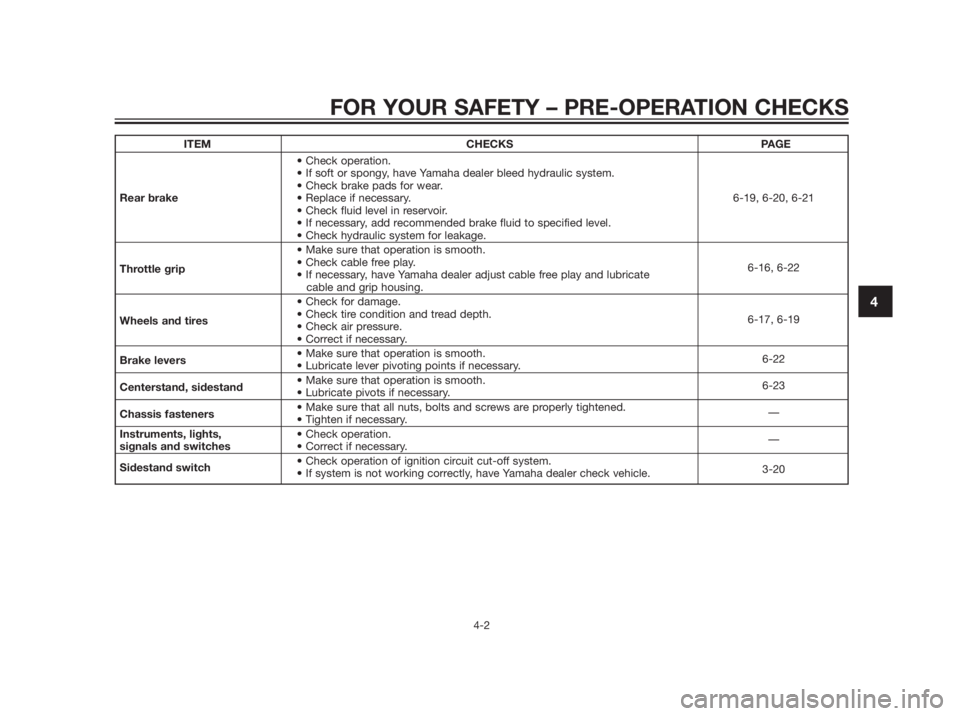
FOR YOUR SAFETY – PRE-OPERATION CHECKS
4-1
4
EAU15596
Inspect your vehicle each time you use it to make sure the vehicle is in safe operating condition. Always follow the ins-
pection and maintenance procedures and schedules described in the Owner’s Manual.
EWA11151
Failure to inspect or maintain the vehicle properly increases the possibility of an accident or equipment dama-
ge. Do not operate the vehicle if you find any problem. If a problem cannot be corrected by the procedures pro-
vided in this manual, have the vehicle inspected by a Yamaha dealer.
Before using this vehicle, check the following points:
WARNING
ITEM CHECKS PAGE
Fuel3-15
Engine oil 6-10
Final transmission oil 6-12
Coolant 6-13
Front brake 6-19, 6-20, 6-21
Page 41 of 90
ITEM CHECKS PAGE
Rear brake 6-19, 6-20, 6-21
Throttle grip
6-16, 6-22
cable and grip housing.
Wheels and tires
6-17, 6-19
Brake levers
6-22
Centerstand, sidestand
6-23
Chassis fasteners
—
Instruments, lights, • Check operation.
signals and switches—
Sidestand switch
3-20
FOR YOUR SAFETY – PRE-OPERATION CHECKS
4-2
4
Page 43 of 90
ECA15022
If a warning light, indicator light or
indicator does not go off, see
pages 3-4 or 3-6 for the correspon-
ding warning light, indicator light or
indicator circuit check.
2. Close the throttle completely.
3. Start the engine by pushing the
start switch while applying the
front or rear brake. NOTICE: For
maximum engine life, never
accelerate hard when the engi-
ne is cold!
[ECA11041]
1. Rear brake lever
2. Front brake lever
3. Start switch
3. If the engine does not start, rele-
ase the start switch, wait a few
seconds, and then try again.
Each starting attempt should be
as short as possible to preserve
the battery. Do not crank the
engine more than 10 seconds on
any one attempt.EAU45091
Starting off
1. While pulling the rear brake lever
with your left hand and holding
the grab bar with your right hand,
push the scooter off the centers-
tand.
1. Grab bar
1. Grab bar
NOTICE
OPERATION AND IMPORTANT RIDING POINTS
5-2
5
Page 44 of 90

2. Sit astride the seat, and then
adjust the rear view mirrors.
3. Switch the turn signals on.
4. Check for oncoming traffic, and
then slowly turn the throttle grip
(on the right) in order to take off.
5. Switch the turn signals off.EAU16780
Acceleration and
deceleration
The speed can be adjusted by ope-
ning and closing the throttle. To incre-
ase the speed, turn the throttle grip in
direction (a). To reduce the speed,
turn the throttle grip in direction (b).
EAU16793
BrakingEWA10300
�Avoid braking hard or suddenly
(especially when leaning over
to one side), otherwise the sco-
oter may skid or overturn.
�Railroad crossings, streetcar
rails, iron plates on road cons-
truction sites, and manhole
covers become extremely slip-
pery when wet. Therefore, slow
down when approaching such
areas and cross them with cau-
tion.
�Keep in mind that braking on a
wet road is much more difficult.
�Ride slowly down a hill, as bra-
king downhill can be very diffi-
cult.
1. Close the throttle completely.
2. Apply both front and rear brakes
simultaneously while gradually
increasing the pressure.
WARNING
(a)(b)
OPERATION AND IMPORTANT RIDING POINTS
5-3
5