Page 34 of 96

eyes, see your doctor immediately.
If gasoline spills on your skin, wash
with soap and water. If gasoline
spills on your clothing, change your
clothes.
EAU33520
ECA11400
Use only unleaded gasoline. The
use of leaded gasoline will cause
severe damage to internal engine
parts, such as the valves and piston
rings, as well as to the exhaust sys-
tem.
Your Yamaha engine has been desig-
ned to use regular unleaded gasoline
with a research octane number of 91
or higher. If knocking (or pinging)
occurs, use a gasoline of a different
brand or premium unleaded fuel. Use
of unleaded fuel will extend spark plug
life and reduce maintenance costs.
EAU13445
Catalytic converters
This vehicle is equipped with catalytic
converters in the exhaust system.
EWA10862
The exhaust system is hot after
operation. To prevent a fire hazard
or burns:
�Do not park the vehicle near
possible fire hazards such as
grass or other materials that
easily burn.
�Park the vehicle in a place
where pedestrians or children
are not likely to touch the hot
exhaust system.
�Make sure that the exhaust
system has cooled down befo-
re doing any maintenance
work.
�Do not allow the engine to idle
more than a few minutes. Long
idling can cause a build-up of
heat.
ECA10701
Use only unleaded gasoline. The
use of leaded gasoline will cause
unrepairable damage to the cataly-
tic converter.
NOTICE
WARNING
NOTICE
Recommended fuel:
REGULAR UNLEADED
GASOLINE ONLY
Fuel tank capacity:
11.8 L (3.12 US gal, 2.60 Imp.gal)
INSTRUMENT AND CONTROL FUNCTIONS
3-16
3
Page 42 of 96
FOR YOUR SAFETY – PRE-OPERATION CHECKS
4-1
4
EAU15596
Inspect your vehicle each time you use it to make sure the vehicle is in safe operating condition. Always follow the ins-
pection and maintenance procedures and schedules described in the Owner’s Manual.
EWA11151
Failure to inspect or maintain the vehicle properly increases the possibility of an accident or equipment dama-
ge. Do not operate the vehicle if you find any problem. If a problem cannot be corrected by the procedures pro-
vided in this manual, have the vehicle inspected by a Yamaha dealer.
Before using this vehicle, check the following points:
WARNING
ITEM CHECKS PAGE
Fuel3-15
Engine oil 6-10
Final transmission oil 6-13
Coolant 6-14
Front brake 6-20, 6-21, 6-22
Page 47 of 96

Front
RearEAU16820
Tips for reducing fuel
consumption
Fuel consumption depends largely on
your riding style. Consider the follo-
wing tips to reduce fuel consumption:
�Avoid high engine speeds during
acceleration.
�Avoid high engine speeds with no
load on the engine.
�Turn the engine off instead of let-
ting it idle for an extended length
of time (e.g., in traffic jams, at
traffic lights or at railroad cros-
sings).
EAU16830
Engine break-in
There is never a more important
period in the life of your engine than
the period between 0 and 1000 km
(600 mi). For this reason, you should
read the following material carefully.
Since the engine is brand new, do not
put an excessive load on it for the first
1000 km (600 mi). The various parts in
the engine wear and polish themsel-
ves to the correct operating clearan-
ces. During this period, prolonged
full-throttle operation or any condition
that might result in engine overhea-
ting must be avoided.
EAUS1840
0–500 km (0–300 mi)
�Avoid prolonged operation above
5000 r/min.
500–1000 km (300–600 mi)
�Avoid prolonged operation above
7500 r/min. NOTICE: After 1000
km (600 mi) of operation, be
sure to replace the engine oil,
final transmission oil and the
oil filter element.
[ECA12931]
OPERATION AND IMPORTANT RIDING POINTS
5-4
5
Page 48 of 96
1000 km (600 mi) and beyond
�The vehicle can now be operated
normally.
ECA10310
�Keep the engine speed out of
the tachometer red zone.
�If any engine trouble should
occur during the engine break-
in period, immediately have a
Yamaha dealer check the vehi-
cle.
EAU17213
Parking
When parking, stop the engine, and
then remove the key from the main
switch.
EWA10311
�Since the engine and exhaust
system can become very hot,
park in a place where pedes-
trians or children are not likely
to touch them and be burned.
�Do not park on a slope or on
soft ground, otherwise the
vehicle may overturn, increa-
sing the risk of a fuel leak and
fire.
�Do not park near grass or other
flammable materials which
might catch fire.
WARNING
NOTICE
OPERATION AND IMPORTANT RIDING POINTS
5-5
5
Page 51 of 96
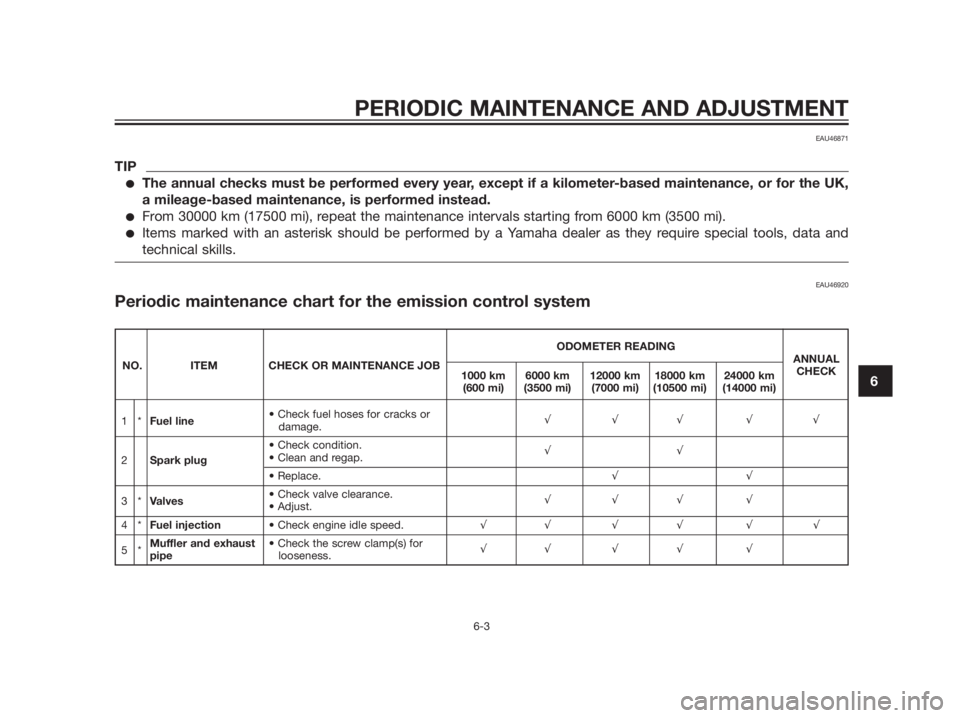
PERIODIC MAINTENANCE AND ADJUSTMENT
6-3
6
EAU46871
TIP
�The annual checks must be performed every year, except if a kilometer-based maintenance, or for the UK,
a mileage-based maintenance, is performed instead.
�From 30000 km (17500 mi), repeat the maintenance intervals starting from 6000 km (3500 mi).
�Items marked with an asterisk should be performed by a Yamaha dealer as they require special tools, data and
technical skills.
EAU46920
Periodic maintenance chart for the emission control system
ODOMETER READING
NO. ITEM CHECK OR MAINTENANCE JOBANNUAL
1000 km 6000 km 12000 km 18000 km 24000 kmCHECK
(600 mi) (3500 mi) (7000 mi) (10500 mi) (14000 mi)
1*Fuel line
damage.333 33
2Spark plug
33
33
3*Valves
333 3
4*Fuel injection33 3 3 3 3
5*Muffler and exhaust
pipelooseness.33 3 3 3
Page 66 of 96

EAU21401
Valve clearance
The valve clearance changes with
use, resulting in improper air-fuel mix-
ture and/or engine noise. To prevent
this from occurring, the valve clearan-
ce must be adjusted by a Yamaha
dealer at the intervals specified in the
periodic maintenance and lubrication
chart.
EAU21873
Tires
To maximize the performance, durabi-
lity, and safe operation of your vehi-
cle, note the following points regar-
ding the specified tires.
Tire air pressure
The tire air pressure should be chec-
ked and, if necessary, adjusted befo-
re each ride.
EWA10501
Operation of this vehicle with
improper tire pressure may cause
severe injury or death from loss of
control.
�The tire air pressure must be
checked and adjusted on cold
tires (i.e., when the temperatu-re of the tires equals the
ambient temperature).
�The tire air pressure must be
adjusted in accordance with
the riding speed and with the
total weight of rider, passenger,
cargo, and accessories appro-
ved for this model.
Tire air pressure (measured on
cold tires):
0–90 kg (0–198 lb):
Front:
190 kPa (1.90 kgf/cm
2,
28 psi, 1.90 bar)
Rear:
220 kPa (2.20 kgf/cm
2,
32 psi, 2.20 bar)
90 kg – mximum load:
Front:
210 kPa (2.10 kgf/cm
2,
30 psi, 2.10 bar)
Rear:
250 kPa (2.50 kgf/cm
2,
36 psi, 2.50 bar)
Maximum load*:
YP125R 182 kg (401 lb)
YP125RA 179 kg (395 lb)
YP125R Sport 180.5 kg (398 lb)
YP125RA Business 171.8 kg (379 lb)
* Total weight of rider, passenger,
cargo and accessories WARNING
ZAUM0053
PERIODIC MAINTENANCE AND ADJUSTMENT
6-18
6
Page 79 of 96

EAU47910
Replacing the license plate
light bulb
1. Remove the license plate light
cover by removing the screw.
1. Screw
2. License plate light bulb socket
2. Remove the burnt-out bulb by
pulling it out from the socket.
3. Insert a new bulb into the socket.
4. Install the license plate light
cover by installing the screw.
EAU43233
Replacing an auxiliary light
bulb
This model is equipped with two auxi-
liary lights. If an auxiliary light bulb
burns out, replace it as follows.
1. Remove the auxiliary light bulb
socket (together with the bulb) by
pulling it out.
1. Auxiliary light bulb socket
2. Remove the burnt-out bulb by
pulling it out.
3. Insert a new bulb into the socket.
4. Install the socket (together with
the bulb) by pushing it in.
EAU25881
Troubleshooting
Although Yamaha scooters receive a
thorough inspection before shipment
from the factory, trouble may occur
during operation. Any problem in the
fuel, compression, or ignition sys-
tems, for example, can cause poor
starting and loss of power.
The following troubleshooting charts
represent quick and easy procedures
for checking these vital systems your-
self. However, should your scooter
require any repair, take it to a Yamaha
dealer, whose skilled technicians
have the necessary tools, experience,
and know-how to service the scooter
properly.
Use only genuine Yamaha replace-
ment parts. Imitation parts may look
like Yamaha parts, but they are often
inferior, have a shorter service life and
can lead to expensive repair bills.
PERIODIC MAINTENANCE AND ADJUSTMENT
6-31
6
Page 80 of 96
EWA15141
When checking the fuel system, do
not smoke, and make sure there
are no open flames or sparks in the
area, including pilot lights from
water heaters or furnaces. Gasoli-
ne or gasoline vapors can ignite or
explode, causing severe injury or
property damage.
WARNING
PERIODIC MAINTENANCE AND ADJUSTMENT
6-32
6