2012 YAMAHA FX HO CRUISER warning
[x] Cancel search: warningPage 92 of 114

Care and storage
86
flows out continually from the jet thrust
nozzle.
(8) Run the engine at idling speed for about
3 minutes watching the engine condition.
If the engine stops while flushing, turn the
water supply off immediately and perform
the procedure again from step 7.
NOTICE: Do not supply water to the
cooling water passages when the en-
gine is not running. The water could
flow back through the muffler into the
engine, causing severe engine dam-
age.
[ECJ00122]
(9) Turn the water supply off.
(10) Discharge the remaining water out of the
cooling water passages by alternately
squeezing and releasing the throttle lever
quickly for 10 to 15 seconds.
(11) Stop the engine.
(12) Remove the garden hose adapter, and
then securely install the flushing hose
connector cap by tightening it until it
stops.
(13) Securely close the stern storage com-
partment.
(14) Securely install the removable watertight
storage compartment and seats in their
original positions.
EJU33735Cleaning the watercraft
(1) Remove the seats. (See page 46 for seat
removal and installation procedures.)(2) Rinse the engine and engine compart-
ment with a small amount of water.
NOTICE: Do not use high-pressure
water when rinsing the engine or en-
gine compartment as severe engine
damage could result.
[ECJ00571]
(3) Drain the water from the engine compart-
ment. (See page 58 for information on
draining the bilge water.)
(4) Wipe the engine and engine compart-
ment with a dry cloth.
(5) Wash down the hull, deck, and jet pump
with fresh water.
(6) Wipe the hull, deck, and jet pump with a
dry cloth.
(7) Wipe all vinyl and rubber components,
such as the seats and engine compart-
ment seals, with a vinyl protectant.
(8) To minimize corrosion, spray metallic
parts of the hull, deck, and engine with a
rust inhibitor.
(9) Allow the engine compartment to air dry
completely before installing the seats.
(10) Securely install the seats in their original
positions.
EJU33686Battery care
If the watercraft will not be used for more than
a month, remove the battery from the water-
craft, check it, and then store it in a cool, dry
place.
WARNING
EWJ00791
Battery electrolyte is poisonous and dan-
gerous, causing severe burns, etc. Elec-
trolyte contains sulfuric acid. Avoid
contact with skin, eyes, or clothing.
Antidotes
External: Flush with water.
Internal: Drink large quantities of water or
milk. Follow with milk of magnesia, beaten
UF2T70E0.book Page 86 Thursday, December 29, 2011 2:12 PM
Page 94 of 114
Care and storage
88
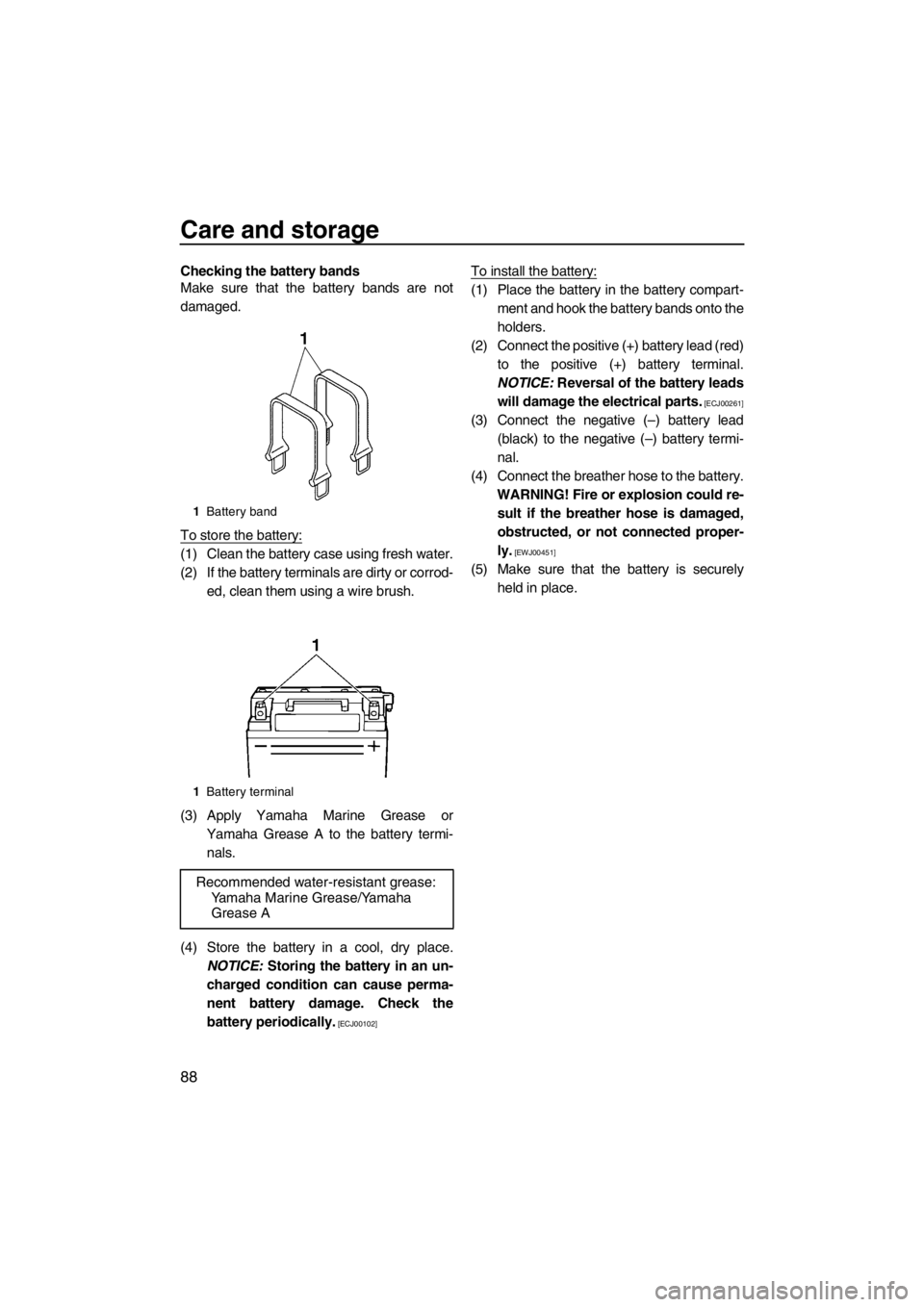
Checking the battery bands
Make sure that the battery bands are not
damaged.
To store the battery:
(1) Clean the battery case using fresh water.
(2) If the battery terminals are dirty or corrod-
ed, clean them using a wire brush.
(3) Apply Yamaha Marine Grease or
Yamaha Grease A to the battery termi-
nals.
(4) Store the battery in a cool, dry place.
NOTICE: Storing the battery in an un-
charged condition can cause perma-
nent battery damage. Check the
battery periodically.
[ECJ00102]
To install the battery:
(1) Place the battery in the battery compart-
ment and hook the battery bands onto the
holders.
(2) Connect the positive (+) battery lead (red)
to the positive (+) battery terminal.
NOTICE: Reversal of the battery leads
will damage the electrical parts.
[ECJ00261]
(3) Connect the negative (–) battery lead
(black) to the negative (–) battery termi-
nal.
(4) Connect the breather hose to the battery.
WARNING! Fire or explosion could re-
sult if the breather hose is damaged,
obstructed, or not connected proper-
ly.
[EWJ00451]
(5) Make sure that the battery is securely
held in place.
1Battery band
1Battery terminal
Recommended water-resistant grease:
Yamaha Marine Grease/Yamaha
Grease A
UF2T70E0.book Page 88 Thursday, December 29, 2011 2:12 PM
Page 95 of 114

Care and storage
89
EJU33492
Long-term storage
WARNING
EWJ00330
Always place the watercraft upright in a
horizontal position when storing it, other-
wise fuel could leak out into the engine or
engine compartment, which could create a
fire hazard.
Storage for long periods of time, such as win-
ter storage, requires preventive maintenance
to ensure against deterioration. It is advisable
to have the watercraft serviced by a Yamaha
dealer prior to storage.
However, the following procedures can be
performed easily by the owner.
EJU40762Cleaning
(1) Flush the cooling water passages. (See
page 85 for information on flushing the
cooling water passages.)
TIP:
If you will be storing the watercraft for a pro-
longed period, such as winter storage, top off
the fuel tank with fresh gasoline and add fuel
stabilizer and conditioner to the fuel tank ac-
cording to the manufacturer’s instruction be-
fore starting the engine.
(2) Clean the watercraft. (See page 86 for in-
formation on cleaning the watercraft.)
Wax the hull with a non-abrasive wax.
EJU42540Lubrication
Use a suitable marine grease applicator and
spray a rust inhibitor between the inner and
outer cables to lubricate the cables and purge
out any dirt and moisture.
To keep moving parts sliding or rotating
smoothly, lubricate them with water-resistant
grease.
●Steering cable (jet thrust nozzle end) and
Q.S.T.S. rod (jet thrust nozzle end)
●Shift cable (shift lever end)
●Shift cable (reverse gate end)Recommended water-resistant grease:
Yamaha Marine Grease/Yamaha
Grease A
UF2T70E0.book Page 89 Thursday, December 29, 2011 2:12 PM
Page 97 of 114

Maintenance
91
EJU33768
Maintenance
Periodic checks and lubrication will keep your
watercraft in the safest and most efficient con-
dition possible. Therefore, make sure to carry
out the periodic maintenance. Safety is an ob-
ligation of the watercraft owner. Proper main-
tenance must be carried out to keep the
exhaust emission and sound levels within the
regulated limits. The most important points of
watercraft inspection and lubrication are ex-
plained on the following pages.
See a Yamaha dealer for genuine Yamaha re-
placement parts and optional accessories de-
signed for your watercraft.
Remember, failures that are the result of the
installation of parts or accessories which are
not qualitatively equivalent to genuine
Yamaha parts are not covered by the limited
warranty.
Maintenance, replacement, or repair of the
emission control devices and system may
be performed by any marine SI engine re-
pair establishment or individual. Warranty
repair, however, must be performed at an
authorized Yamaha marine dealership.
WARNING
EWJ00311
Be sure to turn off the engine when you
perform maintenance unless otherwise
specified. If you are not familiar with ma-
chine servicing, this work should be done
by a Yamaha dealer or other qualified me-
chanic.
EJU33802Tool kit
A tool kit is included with this watercraft. Place
the tool kit in a waterproof bag and alwayscarry it with you whenever you use the water-
craft.
EJU42020Removing and installing the engine
cover
The engine cover is removable.
To remove the engine cover:
(1) Remove the seats. (See page 46 for seat
removal and installation procedures.)
(2) Remove the engine cover screws.
1Tool bag
2Screwdriver
3Garden hose adapter
410/12 mm box wrench
5Pliers
6Open-end wrench
1Engine cover screw
1
UF2T70E0.book Page 91 Thursday, December 29, 2011 2:12 PM
Page 100 of 114

Maintenance
94
EJU36942Engine oil and oil filter
WARNING
EWJ00340
Engine oil is extremely hot immediately af-
ter the engine is turned off. Coming in con-
tact with or getting any engine oil on your
clothes could result in burns.
NOTICE
ECJ00991
Do not run the engine with too much or not
enough oil in the engine, otherwise the en-
gine could be damaged.
It is recommended to have a Yamaha dealer
change the engine oil and the engine oil filter.
However, if you choose to change the oil and
filter on your own, consult a Yamaha dealer.
Nuts and boltsCheck —
Air filter elementCheck —
Engine oilReplace 94
Oil filterReplace 94
Valve clearanceCheck, adjust — Item OperationInitial Thereafter every
Page 10
hours50 hours100
hours200
hours
6
months12
months12
months24
months
UF2T70E0.book Page 94 Thursday, December 29, 2011 2:12 PM
Page 103 of 114

Trouble recovery
97
Engine runs irregu-
larly or stallsFuel Fuel tank empty Refill as soon as pos-
sible55
Stale or contaminat-
edHave serviced by
Yamaha dealer—
Fuel tank Water or dirt present Have serviced by
Yamaha dealer—
Spark plug Fouled or defective Have serviced by
Yamaha dealer—
Incorrect heat range Have serviced by
Yamaha dealer—
Gap incorrect Have serviced by
Yamaha dealer—
Spark plug
capNot connected or
looseHave serviced by
Yamaha dealer—
Cracked, torn, or
damagedHave serviced by
Yamaha dealer—
Electrical wir-
ingLoose connection Have serviced by
Yamaha dealer—
Fuel injec-
tion systemFaulty or clogged in-
jectorsHave serviced by
Yamaha dealer—
Warning light or in-
dicator blinks or
comes onFuel level
warningFuel tank empty Refill as soon as pos-
sible55
Oil pressure
warningOil pressure dropped Have serviced by
Yamaha dealer44
Engine over-
heat warningJet intake clogged Clean
99
Check engine
warningFaulty sensors Have serviced by
Yamaha dealer45 TROUBLE POSSIBLE CAUSE REMEDY PAGE
UF2T70E0.book Page 97 Thursday, December 29, 2011 2:12 PM
Page 104 of 114

Trouble recovery
98
Watercraft slow or
loses powerShift lever Not completely shift-
ed into forward posi-
tionPush lever forward
until it stops 32
Watercraft
operation
modeLow RPM Mode acti-
vatedDeactivate Low RPM
Mode 35
Cavitation Jet intake clogged Clean 99
Impeller damaged or
wornHave serviced by
Yamaha dealer99
Engine over-
heat warningEngine speed reduc-
tion control activatedClean jet intake and
cool engine44
Oil pressure
warningEngine speed reduc-
tion control activatedAdd oil
44
Spark plug Fouled or defective Have serviced by
Yamaha dealer—
Incorrect heat range Have serviced by
Yamaha dealer—
Gap incorrect Have serviced by
Yamaha dealer—
Spark plug
capNot connected or
looseHave serviced by
Yamaha dealer—
Electrical wir-
ingLoose connection Have serviced by
Yamaha dealer—
Fuel Stale or contaminat-
edHave serviced by
Yamaha dealer—
Air filter Clogged Have serviced by
Yamaha dealer—
Oil buildup Have serviced by
Yamaha dealer—
Throttle lever Faulty Have serviced by
Yamaha dealer— TROUBLE POSSIBLE CAUSE REMEDY PAGE
UF2T70E0.book Page 98 Thursday, December 29, 2011 2:12 PM
Page 105 of 114

Trouble recovery
99
EJU34623
Emergency procedures EJU34634Cleaning the jet intake and impeller
WARNING
EWJ00782
Before attempting to remove weeds or de-
bris from the jet intake or impeller area,
shut the engine off and remove the clip
from the engine shut-off switch. Severe in-
jury or death could result from coming in
contact with the rotating parts of the jet
pump.
If weeds or debris gets caught in the jet intake
or impeller, cavitation can occur, causing jet
thrust to decrease even though engine speed
rises. If this condition is allowed to continue,
the engine will overheat and may seize.
NOTICE: If weeds or debris gets caught in
the jet intake, do not operate the watercraft
above trolling speed until they have been
removed.
[ECJ00653]
If there is any sign that the jet intake or impel-
ler is clogged with weeds or debris, return to
shore and check the intake and impeller. Al-ways stop the engine before beaching the wa-
tercraft.
(1) Place a suitable clean cloth or carpeting
underneath the watercraft to protect it
from abrasions and scratches. Turn the
watercraft on its side as shown. NOTICE:
Always turn the watercraft over onto
its port (left) side. When turning the
watercraft on its side, support the bow
so that the handlebars are not bent or
damaged.
[ECJ00661]
UF2T70E0.book Page 99 Thursday, December 29, 2011 2:12 PM