2012 VOLVO V60 electric
[x] Cancel search: electricPage 272 of 400

06 During your journey
Recommendations during driving
06
270
General
Economical drivingDriving economically means driving smoothly
while thinking ahead and adjusting your driving
style and speed to the prevailing conditions.
•Drive in the highest gear possible, adapted
to the current traffic situation and road -
lower engine speeds result in lower fuel
consumption.
•Avoid driving with open windows.
•Avoid sudden unnecessary acceleration
and heavy braking.
•Remove unnecessary items from the car -
the greater the load the higher the fuel con-
sumption.
•Use engine braking to slow down, when it
can take place without risk to other road
users.
•A roof load and ski box increase air resis-
tance, leading to higher fuel consumption
- remove the load carriers when not in use.
•Do not run the engine to operating tem-
perature at idling speed, but rather drive
with a light load as soon as possible - a
cold engine consumes more fuel than a
warm one.
•Cars with the D5 engine and 6-speed man-
ual transmission or DRIVe engine and 6-
speed manual transmission are started in2nd gear under normal conditions on level
ground.
For more information and further advice, see
the pages 12 and 363.
WARNING
Never switch off the engine while moving,
such as downhill, this deactivates important
systems such as the power steering and
brake servo.
Driving in waterThe car can be driven through water at a maxi-
mum depth of 25 cm at a maximum speed of
10 km/h. Extra caution should be exercised
when passing through flowing water.
During driving in water, maintain a low speed
and do not stop the car. When the water has
been passed, depress the brake pedal lightly
and check that full brake function is achieved.
Water and mud for example can make the
brake linings wet resulting in delayed brake
function.
•Clean the electric contacts of the electric
engine block heater and trailer coupling
after driving in water and mud.
•Do not let the car stand with water over the
sills for any long period of time - this could
cause electrical malfunctions.
IMPORTANT
Engine damage can occur if water enters
the air filter.
In depths greater than 25 cm, water could
enter the transmission. This reduces the
lubricating ability of the oils and shortens
the service life of these systems.
In the event of the engine stalling in water,
do not try restart - tow the car from the water
to a workshop - an authorised Volvo work-
shop is recommended. Risk of engine
breakdown.
Engine, gearbox and cooling systemUnder special conditions, for example hard
driving in hilly terrain and hot climate, there is
a risk that the engine and drive system may
overheat - in particular with a heavy load.
For information about overheating when driv-
ing with a trailer, see page 283.
•Remove any auxiliary lamps from in front
of the grille when driving in hot climates.
•If the temperature in the engine's cooling
system is too high the instrument panel's
warning symbol is illuminated and there is
a text message displayed there
High
engine temp Stop safely - stop the car in
a safe way and allow the engine to run at
idling speed for several minutes to cool
down.
ProCarManuals.com
Page 273 of 400

06 During your journey
Recommendations during driving
06
271
•If the text message High engine temp
Stop engine or Coolant level low, Stop
engine is shown then the engine must be
switched off after stopping the car.
•In the event of overheating in the gearbox
a built-in protection function is activated
which, amongst other things, illuminates
the instrument panel's warning symbol and
there is a text message displayed there
Transmission hot Reduce speed orTransmission hot Stop safely - follow
the recommendation given and lower the
speed and stop the car in a safe way and
allow the engine to run at idling speed for
a few minutes to allow the gearbox to cool
down.
•If the car overheats, the air conditioning
may be switched off temporarily.
•Do not turn the engine off immediately you
stop after a hard drive.
NOTE
It is normal for the engine's cooling fan to
operate for a while after the engine has been
switched off.
Open tailgate
WARNING
Do not drive with the tailgate open. Toxic
exhaust fumes could be drawn into the car
through the cargo area.
Do not overload the batteryThe electrical functions in the car load the bat-
tery to varying degrees. Avoid using the key
position II when the engine is switched off.
Instead use the I mode - which uses less
power.
Also, be aware of different accessories that
load the electrical system. Do not use functions
which use a lot of power when the engine is
switched off. Examples of such functions are:
•ventilation fan
•headlamps
•windscreen wiper
•audio system (high volume).
If the battery voltage is low the information dis-
play shows the text
Low battery Power save
mode. The energy-saving function then shuts
down certain functions or reduces certain
functions such as the ventilation fan and/or
audio system.
–In which case, charge the battery by star-
ting the engine and then running it for atleast 15 minutes - battery charging is more
effective during driving than running the
engine at idling speed while stationary.
Before a long journey
•Check that the engine is working normally
and that fuel consumption is normal.
•Make sure that there are no leaks (fuel, oil
or other fluid).
•Check all bulbs and tyre tread depths.
•Carrying a warning triangle is a legal
requirement in certain countries.
Winter drivingCheck the following in particular before the
cold season:
•The engine coolant must contain at least
50% glycol. This mixture protects the
engine against frost erosion down to
approximately –35 °C. To achieve optimum
antifreeze protection, different types of gly-
col must not be mixed.
•The fuel tank must be kept filled to prevent
condensation.
•Engine oil viscosity is important. Oils with
lower viscosity (thinner oils) facilitate star-
ting in cold weather and also reduce fuel
consumption while the engine is cold. For
more information on suitable oils, see
page 360.
ProCarManuals.com
Page 275 of 400

06 During your journey
Refuelling
06
273 Refuelling
Opening/closing the fuel filler flap
Open the fuel filler flap using the button on the
lighting panel - the flap opens when the button
is released.
The arrow on the information display's
symbol reminds which side of the car
the fuel filler cap is located.
•Close the fuel filler flap by pressing it in until
a click confirms that it is closed.
Opening the fuel filler flap manually
The fuel filler flap can be opened manually
when electric opening from the passenger
compartment is not possible.
1. Open/remove the side hatch in the cargo
area (same side as fuel filler flap).
2. Expand/open a perforated section in the
isolation and locate a green cord with han-
dle.
3. Pull the cord gently straight back until the
fuel filler flap folds out with a "click".
IMPORTANT
Pull the wire gently - minimal force is
required to disengage the hatch lock.
Opening/closing the fuel cap
The fuel filler cap can be attached onto the flap.
A certain overpressure may arise in the tank in
the event of high outside temperatures. Open
the cap slowly.
•After refuelling - refit the cap and turn it
until one or more clicking sounds are
heard.
Filling up with fuel
•Do not overfill the tank but fill until the
pump nozzle cuts out.
NOTE
Excess fuel in the tank can overflow in hot
weather.
ProCarManuals.com
Page 281 of 400

06 During your journey
Loading
06
* Option/accessory, for more information, see Introduction.279 Lowering the rear seat backrest
To simplify loading in the cargo area, the rear
seat backrest can be folded down, see
page 84.
Load retaining eyelets
The folding load retaining eyelets are used to
fasten straps in order to anchor items in the
cargo area.
WARNING
Hard, sharp and/or heavy objects that are
loose or protrude could cause injury during
heavy braking.
Always secure large and heavy objects with
a seatbelt or cargo retaining straps.
Bag holder*
Bag holder under folding hatch in the floor.
The bag holder keeps carrier bags in place and
prevents them from overturning and spreading
their contents across the cargo area.
1. Fold up the holder, which is part of the floor
hatch.
2. Fasten the bags with strap and secure the
carrying handle in the hooks.
12 V electrical socket*
Lower the cover to access the electrical
socket.
•The socket also provides voltage when the
remote control key is not in the ignition
switch.
NOTE
Remember that using the electrical socket
with the engine switched off involves the
risk of discharging the car's battery.
ProCarManuals.com
Page 285 of 400

06 During your journey
Driving with a trailer
06
* Option/accessory, for more information, see Introduction.283 General
Payload depends on the car's kerb weight. The
total of the weight of the passengers and all
accessories, e.g. towbar, reduces the car's
payload by a corresponding weight. For more
detailed information on weights, see
page 355.
If the towing bracket is mounted by Volvo, then
the car is delivered with the necessary equip-
ment for driving with a trailer.
•The car's towing bracket must be of an
approved type.
•If the towbar is retrofitted, check with your
Volvo dealer that the car is fully equipped
for driving with a trailer.
•Distribute the load on the trailer so that the
weight on the towing bracket complies
with the specified maximum towball load.
•Increase the tyre pressure to the recom-
mended pressure for a full load. For tyre
pressure label location, see page 301.
•The engine is loaded more heavily than
usual when driving with a trailer.
•Do not tow a heavy trailer when the car is
brand new. Wait until it has been driven at
least 1000 km.
•The brakes are loaded much more than
usual on long and steep downhill slopes.
Downshift to a lower gear and adjust your
speed.
•For safety reasons, the maximum permit-
ted speed for the car when coupled with a
trailer should not be exceeded. Follow the
regulations in force for the permitted
speeds and weights.
•Maintain a low speed when driving with a
trailer up long, steep ascents.
•Avoid driving with a trailer on inclines of
more than 12%.
Trailer cableAn adapter is required if the car's towing
bracket has 13 pin electrics and the trailer has
7 pin electrics. Use an adapter cable approved
by Volvo. Make sure the cable does not drag
on the ground.
Direction indicators and brake lights on
the trailer
If any of the trailer's lamps for direction indica-
tors are broken, then the combined instrument
panel's symbol for direction indicators flashes
faster than normal and the display shows the
text
Bulb fail - Ind. signal trailer.
If any of the trailer's lamps for the brake light
are broken then the
Bulb fail - Stop lamp
trailer text is shown.
Level control*The rear shock absorbers maintain a constant
height irrespective of the car's load (up to the
maximum permissible weight). When the car isstationary the rear of the car lowers slightly,
which is normal.
Trailer weightsFor information on Volvo's permitted trailer
weights, see page 356.
NOTE
The stated maximum permitted trailer
weights are those permitted by Volvo.
National vehicle regulations can further limit
trailer weights and speeds. Towbars can be
certified for higher towing weights than the
car can actually tow.
WARNING
Follow the stated recommendations for
trailer weights. Otherwise, the car and trailer
may be difficult to control in the event of
sudden movement and braking.
Manual gearbox
OverheatingWhen driving with a trailer in hilly terrain in a hot
climate there may be a risk of overheating.
•Do not run the engine at higher revolutions
than 4500 rpm (diesel engines: 3500 rpm)
- otherwise the oil temperature may
become too high.
ProCarManuals.com
Page 307 of 400
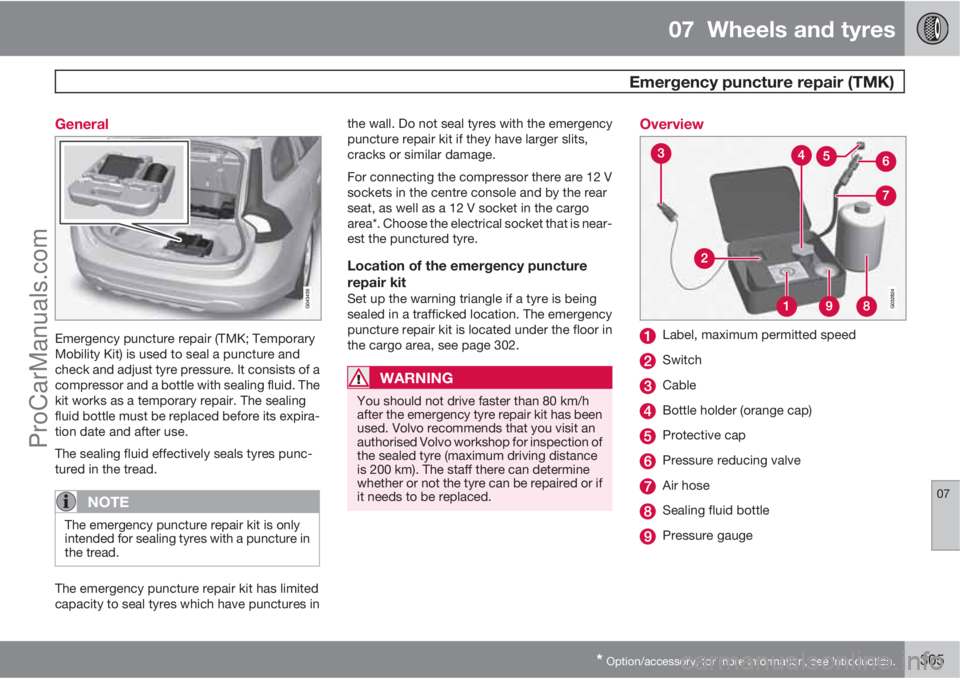
07 Wheels and tyres
Emergency puncture repair (TMK)
07
* Option/accessory, for more information, see Introduction.305 General
Emergency puncture repair (TMK; Temporary
Mobility Kit) is used to seal a puncture and
check and adjust tyre pressure. It consists of a
compressor and a bottle with sealing fluid. The
kit works as a temporary repair. The sealing
fluid bottle must be replaced before its expira-
tion date and after use.
The sealing fluid effectively seals tyres punc-
tured in the tread.
NOTE
The emergency puncture repair kit is only
intended for sealing tyres with a puncture in
the tread.
The emergency puncture repair kit has limited
capacity to seal tyres which have punctures inthe wall. Do not seal tyres with the emergency
puncture repair kit if they have larger slits,
cracks or similar damage.
For connecting the compressor there are 12 V
sockets in the centre console and by the rear
seat, as well as a 12 V socket in the cargo
area*. Choose the electrical socket that is near-
est the punctured tyre.
Location of the emergency puncture
repair kit
Set up the warning triangle if a tyre is being
sealed in a trafficked location. The emergency
puncture repair kit is located under the floor in
the cargo area, see page 302.
WARNING
You should not drive faster than 80 km/h
after the emergency tyre repair kit has been
used. Volvo recommends that you visit an
authorised Volvo workshop for inspection of
the sealed tyre (maximum driving distance
is 200 km). The staff there can determine
whether or not the tyre can be repaired or if
it needs to be replaced.
Overview
Label, maximum permitted speed
Switch
Cable
Bottle holder (orange cap)
Protective cap
Pressure reducing valve
Air hose
Sealing fluid bottle
Pressure gauge
ProCarManuals.com
Page 322 of 400

08 Maintenance and service
Lamps
08
320
Pull out the headlamp's locking pins.
Release the headlamp by alternately
tilting and pulling it out.
IMPORTANT
Do not pull the electrical cable, only the con-
nector.
3. (Second illustration)
Detach the headlamp connector by
pressing down the clip with your thumb.
At the same time, guide out the con-
nector with your other hand.
4. Lift out the headlamp and place it on a soft
surface to avoid scratching the lens.
5. Replace the bulb in question.
Securing the headlamp
1. Plug in the connector, a clicking sound
should be heard.
2. Reinstall the headlamp and locking pins.
The short pin is fitted closest to the grille.
Check that they are correctly inserted.
3. Check the lighting.
The headlamp must be mounted and the con-
nector correctly installed before the lighting is
switched on or the remote control key is
inserted into the ignition switch.
Removing the cover
Before starting to replace a bulb, see
page 319.
1. Unscrew the cover's four screws with the
tool (1) in the tool kit, see page 294. They
should not be detached completely.
(3 - 4 turns are sufficient.)
IMPORTANT
Use the tool in the toolkit to remove and
attach this correctly.
2. Slide the cover to one side.
3. Remove the cover.
Reinstall the cover in reverse order.
ProCarManuals.com
Page 330 of 400

08 Maintenance and service
Battery
08
328
Symbols on the battery
Use protective goggles.
Further information in the
owner's manual.
Store the battery out of
the reach of children.
The battery contains cor-
rosive acid.
Avoid sparks and naked
flames.
Risk of explosion.
Must be taken for recy-
cling.
NOTE
An expended battery must be recycled in an
environmentally responsible manner - it
contains lead.
Replacing the main battery
RemovalFirst of all: Take the remote control key from
the ignition switch and wait at least 5 minutes
before any electrical connections are touched
- this is because the car's electrical system
needs to store the necessary information to
control modules.
ProCarManuals.com