Page 219 of 400

04 Comfort and driving pleasure
Comfort inside the passenger compartment
04
* Option/accessory, for more information, see Introduction.217 Vanity mirror
G021438
Vanity mirror with lighting.
The light illuminates automatically when the
cover is lifted.
12 V socket
12 V socket in tunnel console, front seat.
The electrical socket can be used for various
accessories designed for 12 V, e.g. TV screens,
music players and mobile phones. For the
socket to supply current, the remote control
key must be in at least key position I, see
page 80.
IMPORTANT
Max. socket is 10 A (120 W) if one socket is
used at a time. If both sockets are used
simultaneously, 7.5 A (90 W) per socket is
applicable.
WARNING
Always leave the plug in the socket when
the socket is not in use.
NOTE
Optional equipment and accessories - e.g.
TV screens, music players and mobile
phones - which are connected to one of the
passenger compartment's 12V electrical
sockets, could be activated by the climate
control system, even when the remote con-
trol key has been removed or when the car
is locked, for example, when the parking
heater is activated at a preset time.
For this reason remove the plugs from the
electrical sockets for optional equipment or
accessories when not in use because the
battery could be drained in the event of such
an occurrence!
Electrical socket in cargo area*For more information, see page 279.
ProCarManuals.com
Page 223 of 400
05 Infotainment system
General information on infotainment
05
221
key being in the ignition switch by pressing the
On/Off button.
While the engine is being started the infotain-
ment system is switched off temporarily and
continues once the engine has started.
NOTE
Avoid using the Infotainment system when
the engine is switched off as this loads the
battery.
ProCarManuals.com
Page 252 of 400

05 Infotainment system
Remote control*
05
250* Option/accessory, for more information, see Introduction.
KeyFunction
Navigate up/down
Navigate right/left
Confirm selection or go to the
menu system for the selected
source
Volume, decrease
Volume, increase
0-9Preset channels, number and let-
ter input
Shortcuts for favourite setting.
Information about the current
programme, song, etc. Also used
when there is more information
available than can be shown in
the TV screen.
Selection of language for sound-
track
KeyFunction
Subtitles, selection of language
for text
Teletext*, On/Off
Replacing the battery in the remote
control
NOTE
Battery life is normally 1-4 years and
depends on how much the remote control
is used.
The remote control is powered by four batter-
ies of the AA/LR6 type.
Take along extra batteries for a long journey.
1. Push down the catch on the battery cover
and slide the battery cover in the direction
of the infrared lens.
2. Remove the used batteries, turn the new
batteries in accordance with the symbols
in the battery compartment and fit them.
3. Refit the cover.
NOTE
Be sure to dispose of the exhausted batter-
ies in an environmentally safe manner.
ProCarManuals.com
Page 273 of 400

06 During your journey
Recommendations during driving
06
271
•If the text message High engine temp
Stop engine or Coolant level low, Stop
engine is shown then the engine must be
switched off after stopping the car.
•In the event of overheating in the gearbox
a built-in protection function is activated
which, amongst other things, illuminates
the instrument panel's warning symbol and
there is a text message displayed there
Transmission hot Reduce speed orTransmission hot Stop safely - follow
the recommendation given and lower the
speed and stop the car in a safe way and
allow the engine to run at idling speed for
a few minutes to allow the gearbox to cool
down.
•If the car overheats, the air conditioning
may be switched off temporarily.
•Do not turn the engine off immediately you
stop after a hard drive.
NOTE
It is normal for the engine's cooling fan to
operate for a while after the engine has been
switched off.
Open tailgate
WARNING
Do not drive with the tailgate open. Toxic
exhaust fumes could be drawn into the car
through the cargo area.
Do not overload the batteryThe electrical functions in the car load the bat-
tery to varying degrees. Avoid using the key
position II when the engine is switched off.
Instead use the I mode - which uses less
power.
Also, be aware of different accessories that
load the electrical system. Do not use functions
which use a lot of power when the engine is
switched off. Examples of such functions are:
•ventilation fan
•headlamps
•windscreen wiper
•audio system (high volume).
If the battery voltage is low the information dis-
play shows the text
Low battery Power save
mode. The energy-saving function then shuts
down certain functions or reduces certain
functions such as the ventilation fan and/or
audio system.
–In which case, charge the battery by star-
ting the engine and then running it for atleast 15 minutes - battery charging is more
effective during driving than running the
engine at idling speed while stationary.
Before a long journey
•Check that the engine is working normally
and that fuel consumption is normal.
•Make sure that there are no leaks (fuel, oil
or other fluid).
•Check all bulbs and tyre tread depths.
•Carrying a warning triangle is a legal
requirement in certain countries.
Winter drivingCheck the following in particular before the
cold season:
•The engine coolant must contain at least
50% glycol. This mixture protects the
engine against frost erosion down to
approximately –35 °C. To achieve optimum
antifreeze protection, different types of gly-
col must not be mixed.
•The fuel tank must be kept filled to prevent
condensation.
•Engine oil viscosity is important. Oils with
lower viscosity (thinner oils) facilitate star-
ting in cold weather and also reduce fuel
consumption while the engine is cold. For
more information on suitable oils, see
page 360.
ProCarManuals.com
Page 274 of 400
06 During your journey
Recommendations during driving
06
272
IMPORTANT
Low viscosity oil must not be used for hard
driving or in hot weather.
•The condition of the battery and charge
level must be inspected. Cold weather pla-
ces great demands on the battery and its
capacity is reduced by the cold.
•Use washer fluid to avoid ice forming in the
washer fluid reservoir.
To achieve optimum roadholding Volvo rec-
ommends using winter tyres on all wheels if
there is a risk of snow or ice.
NOTE
The use of winter tyres is a legal requirement
in certain countries. Studded tyres are not
permitted in all countries.
Slippery driving conditionsPractise driving on slippery surfaces under
controlled conditions to learn how the car
reacts.
ProCarManuals.com
Page 281 of 400

06 During your journey
Loading
06
* Option/accessory, for more information, see Introduction.279 Lowering the rear seat backrest
To simplify loading in the cargo area, the rear
seat backrest can be folded down, see
page 84.
Load retaining eyelets
The folding load retaining eyelets are used to
fasten straps in order to anchor items in the
cargo area.
WARNING
Hard, sharp and/or heavy objects that are
loose or protrude could cause injury during
heavy braking.
Always secure large and heavy objects with
a seatbelt or cargo retaining straps.
Bag holder*
Bag holder under folding hatch in the floor.
The bag holder keeps carrier bags in place and
prevents them from overturning and spreading
their contents across the cargo area.
1. Fold up the holder, which is part of the floor
hatch.
2. Fasten the bags with strap and secure the
carrying handle in the hooks.
12 V electrical socket*
Lower the cover to access the electrical
socket.
•The socket also provides voltage when the
remote control key is not in the ignition
switch.
NOTE
Remember that using the electrical socket
with the engine switched off involves the
risk of discharging the car's battery.
ProCarManuals.com
Page 292 of 400
06 During your journey
Towing and recovery
06
290
Jump startingDo not tow the car to bump start the engine.
Use a donor battery if the battery is discharged
and the engine does not start, see page 116.
IMPORTANT
The catalytic converter may be damaged
during attempts to tow-start the engine.
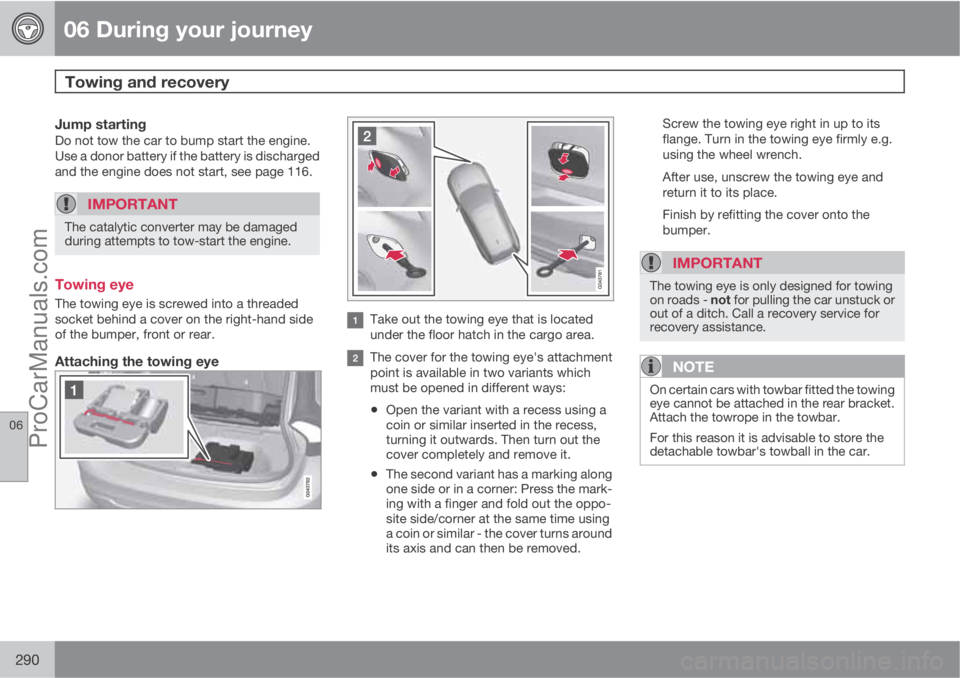
Towing eye
The towing eye is screwed into a threaded
socket behind a cover on the right-hand side
of the bumper, front or rear.
Attaching the towing eye
Take out the towing eye that is located
under the floor hatch in the cargo area.
The cover for the towing eye's attachment
point is available in two variants which
must be opened in different ways:
•Open the variant with a recess using a
coin or similar inserted in the recess,
turning it outwards. Then turn out the
cover completely and remove it.
•The second variant has a marking along
one side or in a corner: Press the mark-
ing with a finger and fold out the oppo-
site side/corner at the same time using
a coin or similar - the cover turns around
its axis and can then be removed.Screw the towing eye right in up to its
flange. Turn in the towing eye firmly e.g.
using the wheel wrench.
After use, unscrew the towing eye and
return it to its place.
Finish by refitting the cover onto the
bumper.
IMPORTANT
The towing eye is only designed for towing
on roads - not for pulling the car unstuck or
out of a ditch. Call a recovery service for
recovery assistance.
NOTE
On certain cars with towbar fitted the towing
eye cannot be attached in the rear bracket.
Attach the towrope in the towbar.
For this reason it is advisable to store the
detachable towbar's towball in the car.
ProCarManuals.com
Page 312 of 400
310
Engine compartment............................................................................. 312
Lamps................................................................................................... 319
Wiper blades and washer fluid.............................................................. 325
Battery................................................................................................... 327
Fuses..................................................................................................... 333
Car care................................................................................................ 344
ProCarManuals.com