2012 VOLVO V60 heating
[x] Cancel search: heatingPage 161 of 400
04 Comfort and driving pleasure
Climate control
04
* Option/accessory, for more information, see Introduction.159
NOTE
Heating or cooling cannot be hastened by
selecting a higher/lower temperature than
the actual temperature required.
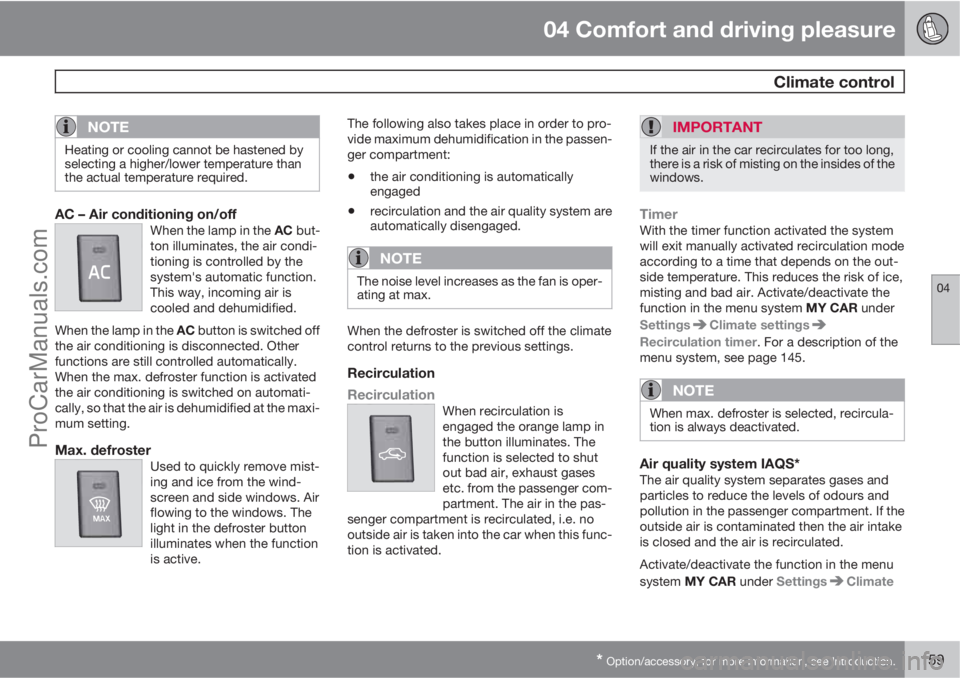
AC – Air conditioning on/offWhen the lamp in the AC but-
ton illuminates, the air condi-
tioning is controlled by the
system's automatic function.
This way, incoming air is
cooled and dehumidified.
When the lamp in the AC button is switched off
the air conditioning is disconnected. Other
functions are still controlled automatically.
When the max. defroster function is activated
the air conditioning is switched on automati-
cally, so that the air is dehumidified at the maxi-
mum setting.
Max. defrosterUsed to quickly remove mist-
ing and ice from the wind-
screen and side windows. Air
flowing to the windows. The
light in the defroster button
illuminates when the function
is active.
The following also takes place in order to pro-
vide maximum dehumidification in the passen-
ger compartment:
•the air conditioning is automatically
engaged
•recirculation and the air quality system are
automatically disengaged.
NOTE
The noise level increases as the fan is oper-
ating at max.
When the defroster is switched off the climate
control returns to the previous settings.
Recirculation
Recirculation
When recirculation is
engaged the orange lamp in
the button illuminates. The
function is selected to shut
out bad air, exhaust gases
etc. from the passenger com-
partment. The air in the pas-
senger compartment is recirculated, i.e. no
outside air is taken into the car when this func-
tion is activated.
IMPORTANT
If the air in the car recirculates for too long,
there is a risk of misting on the insides of the
windows.
TimerWith the timer function activated the system
will exit manually activated recirculation mode
according to a time that depends on the out-
side temperature. This reduces the risk of ice,
misting and bad air. Activate/deactivate the
function in the menu system MY CAR under
Settings
Climate settings
Recirculation timer. For a description of the
menu system, see page 145.
NOTE
When max. defroster is selected, recircula-
tion is always deactivated.
Air quality system IAQS*The air quality system separates gases and
particles to reduce the levels of odours and
pollution in the passenger compartment. If the
outside air is contaminated then the air intake
is closed and the air is recirculated.
Activate/deactivate the function in the menu
system MY CAR under Settings
Climate
ProCarManuals.com
Page 164 of 400

04 Comfort and driving pleasure
Fuel-driven engine block heater and passenger compartment heater*
04
162* Option/accessory, for more information, see Introduction.
Fuel-driven heater
General information about the parking
heater
The parking heater heats the engine and pas-
senger compartment and can be started
directly or with the timer.
Two different times can be selected using the
timer. Here, time refers to the time when the car
is heated and ready. The car's electronic sys-
tem calculates when heating should be started
based on the outside temperature.
The heater cannot start if the outside tempera-
ture exceeds 15 °C. At –5 °C or lower the
maximum running time of the parking heater is
50 minutes.
WARNING
The car must be outdoors when the parking
heater is used.
NOTE
When the parking heater is active there may
be smoke from the right-hand wheel hous-
ing, which is perfectly normal.
Refuelling
Warning label on fuel filler flap.
WARNING
Fuel which spills out can be ignited. Switch
off the fuel-driven heater before starting to
refuel.
Check the information display to see that
the parking heater is switched off. When it
is running, the information display shows
Park heat ON.
Parking on a hillIf the car is parked on a steep hill, the front of
the car should point downhill to ensure that
there is a supply of fuel to the parking heater.
Battery and fuelIf the battery has insufficient charge or the fuel
level is too low, the parking heater will be
switched off automatically and a message
appears on the information display. Acknowl-
edge the message by pressing the indicator
stalk READ button once, see page 163.
IMPORTANT
Repeated use of the parking heater com-
bined with short journeys may discharge the
battery and impair starting.
The car should be driven for the same time
as the heater is used to ensure that the car's
battery is recharged adequately to replace
the energy consumed by the heater when it
is used on a regular basis.
ProCarManuals.com
Page 166 of 400

04 Comfort and driving pleasure
Fuel-driven engine block heater and passenger compartment heater*
04
164* Option/accessory, for more information, see Introduction.
A display text clears automatically after a time
or after one press on the indicator stalk
READ button.
Direct start and immediate stop
1.
Scroll with the thumbwheel to Direct start
Park heat.
2.
Press RESET to select between
ON andOFF.
ON: Parking heater switched on manually or
with programmed timer.
OFF: Parking heater switched off.
Following the direct start of the heater it will be
activated for 50 minutes.
Heating of the passenger compartment will
begin as soon as the engine coolant has
reached the correct temperature.
NOTE
The car can be started and driven while the
parking heater is running.
Setting the timer
The time when the car shall be used and heated
is specified with the timer.
Select between
TIMER 1 and TIMER 2.
NOTE
The timer can only be programmed when
the remote control key is in key position I,
see page 80 - programming must therefore
be carried out before starting the engine.
1.
Scroll with the thumbwheel to Park heat
timer 1.
2.
Briefly press RESET to move to the flash-
ing hours setting.
3. Select the required hour using the thumb-
wheel.
4.
Briefly press RESET to move to the flash-
ing minutes setting.
5. Select the required minute using the
thumbwheel.
6.
Briefly press RESET to confirm the setting.
7.
Press RESET to activate the timer.
After setting
Park heat timer 1 a second start
time can be programmed with Park heat timer
2 by scrolling to it with the thumbwheel.Set the alternative time in the same way as
Park heat timer 1.
Deactivating a timer-started heaterA timer-started heater can be switched off
manually before the set time has elapsed. Pro-
ceed as follows:
1.
Press READ.
2. Use the thumbwheel to scroll to the text
Park heat timer 1 or 2.
>
The text
ON flashes on the display.
3.
Press RESET.
>
The text
OFF is shown with a constant
glow and the heater is switched OFF.
A timer-started heater can be switched off in
accordance with the instructions in the section
"Direct start and immediate stop", see
page 164.
Clock/timerThe heater's time is connected to the car's
clock.
NOTE
All timer programming will be cleared if the
car's clock is reset.
ProCarManuals.com
Page 167 of 400

04 Comfort and driving pleasure
Additional heater*
04
* Option/accessory, for more information, see Introduction.165 General information about the
additional heater
In cold climate zones1 an additional heater may
be required to obtain the correct operating
temperature in the engine and to obtain suffi-
cient heating in the passenger compartment.
Fuel-driven additional heater
A fuel-driven additional heater is fitted in cars
with diesel engines.
The heater starts automatically when extra
heat is required when the engine is running.
The heater is switched off automatically when
the correct temperature is reached or when the
engine is switched off.
NOTE
When the additional heater is active there
may be smoke from the right-hand wheel
housing which is perfectly normal.
Auto mode or shutdownThe additional heater's automatic start
sequence can be switched off if required.
READ button
Thumbwheel
RESET button
1. Before starting the engine: Select key posi-
tion I, see page 80.
2.
Scroll with the thumbwheel to
Additional
heat auto.
3.
Press RESET to select between
ON andOFF.
NOTE
The menu options are only visible in key
position I - any adjustments must therefore
be made before starting the engine.
Passenger compartment heater*If the additional heater is supplemented with
timer function then it can be used as a fuel-
driven passenger compartment heater, see
page 162.
Electric additional heater
Cars with certain petrol engines2 have an elec-
tric additional heater integrated into the car's
climate control system.
In a semi-cold
1 climate zone diesel-driven cars
have an electric additional heater instead of a
fuel-driven version.
The heater cannot be controlled manually but
is instead activated automatically after the
engine has been started in outside tempera-
tures below 14 °C and is switched off after the
set passenger compartment temperature has
been reached.
1An authorised Volvo dealer has information regarding the geographical areas concerned.2An authorised Volvo dealer has information regarding the engines concerned.
ProCarManuals.com
Page 272 of 400

06 During your journey
Recommendations during driving
06
270
General
Economical drivingDriving economically means driving smoothly
while thinking ahead and adjusting your driving
style and speed to the prevailing conditions.
•Drive in the highest gear possible, adapted
to the current traffic situation and road -
lower engine speeds result in lower fuel
consumption.
•Avoid driving with open windows.
•Avoid sudden unnecessary acceleration
and heavy braking.
•Remove unnecessary items from the car -
the greater the load the higher the fuel con-
sumption.
•Use engine braking to slow down, when it
can take place without risk to other road
users.
•A roof load and ski box increase air resis-
tance, leading to higher fuel consumption
- remove the load carriers when not in use.
•Do not run the engine to operating tem-
perature at idling speed, but rather drive
with a light load as soon as possible - a
cold engine consumes more fuel than a
warm one.
•Cars with the D5 engine and 6-speed man-
ual transmission or DRIVe engine and 6-
speed manual transmission are started in2nd gear under normal conditions on level
ground.
For more information and further advice, see
the pages 12 and 363.
WARNING
Never switch off the engine while moving,
such as downhill, this deactivates important
systems such as the power steering and
brake servo.
Driving in waterThe car can be driven through water at a maxi-
mum depth of 25 cm at a maximum speed of
10 km/h. Extra caution should be exercised
when passing through flowing water.
During driving in water, maintain a low speed
and do not stop the car. When the water has
been passed, depress the brake pedal lightly
and check that full brake function is achieved.
Water and mud for example can make the
brake linings wet resulting in delayed brake
function.
•Clean the electric contacts of the electric
engine block heater and trailer coupling
after driving in water and mud.
•Do not let the car stand with water over the
sills for any long period of time - this could
cause electrical malfunctions.
IMPORTANT
Engine damage can occur if water enters
the air filter.
In depths greater than 25 cm, water could
enter the transmission. This reduces the
lubricating ability of the oils and shortens
the service life of these systems.
In the event of the engine stalling in water,
do not try restart - tow the car from the water
to a workshop - an authorised Volvo work-
shop is recommended. Risk of engine
breakdown.
Engine, gearbox and cooling systemUnder special conditions, for example hard
driving in hilly terrain and hot climate, there is
a risk that the engine and drive system may
overheat - in particular with a heavy load.
For information about overheating when driv-
ing with a trailer, see page 283.
•Remove any auxiliary lamps from in front
of the grille when driving in hot climates.
•If the temperature in the engine's cooling
system is too high the instrument panel's
warning symbol is illuminated and there is
a text message displayed there
High
engine temp Stop safely - stop the car in
a safe way and allow the engine to run at
idling speed for several minutes to cool
down.
ProCarManuals.com
Page 273 of 400

06 During your journey
Recommendations during driving
06
271
•If the text message High engine temp
Stop engine or Coolant level low, Stop
engine is shown then the engine must be
switched off after stopping the car.
•In the event of overheating in the gearbox
a built-in protection function is activated
which, amongst other things, illuminates
the instrument panel's warning symbol and
there is a text message displayed there
Transmission hot Reduce speed orTransmission hot Stop safely - follow
the recommendation given and lower the
speed and stop the car in a safe way and
allow the engine to run at idling speed for
a few minutes to allow the gearbox to cool
down.
•If the car overheats, the air conditioning
may be switched off temporarily.
•Do not turn the engine off immediately you
stop after a hard drive.
NOTE
It is normal for the engine's cooling fan to
operate for a while after the engine has been
switched off.
Open tailgate
WARNING
Do not drive with the tailgate open. Toxic
exhaust fumes could be drawn into the car
through the cargo area.
Do not overload the batteryThe electrical functions in the car load the bat-
tery to varying degrees. Avoid using the key
position II when the engine is switched off.
Instead use the I mode - which uses less
power.
Also, be aware of different accessories that
load the electrical system. Do not use functions
which use a lot of power when the engine is
switched off. Examples of such functions are:
•ventilation fan
•headlamps
•windscreen wiper
•audio system (high volume).
If the battery voltage is low the information dis-
play shows the text
Low battery Power save
mode. The energy-saving function then shuts
down certain functions or reduces certain
functions such as the ventilation fan and/or
audio system.
–In which case, charge the battery by star-
ting the engine and then running it for atleast 15 minutes - battery charging is more
effective during driving than running the
engine at idling speed while stationary.
Before a long journey
•Check that the engine is working normally
and that fuel consumption is normal.
•Make sure that there are no leaks (fuel, oil
or other fluid).
•Check all bulbs and tyre tread depths.
•Carrying a warning triangle is a legal
requirement in certain countries.
Winter drivingCheck the following in particular before the
cold season:
•The engine coolant must contain at least
50% glycol. This mixture protects the
engine against frost erosion down to
approximately –35 °C. To achieve optimum
antifreeze protection, different types of gly-
col must not be mixed.
•The fuel tank must be kept filled to prevent
condensation.
•Engine oil viscosity is important. Oils with
lower viscosity (thinner oils) facilitate star-
ting in cold weather and also reduce fuel
consumption while the engine is cold. For
more information on suitable oils, see
page 360.
ProCarManuals.com
Page 277 of 400

06 During your journey
Fuel
06
275
IMPORTANT
•Always refuel with unleaded petrol so as
not to damage the catalytic converter.
•Do not use additives not recommended
by Volvo.
Bioethanol E85
Do not modify the fuel system or its compo-
nents, and do not replace components with
parts that are not specifically designed for use
with bioethanol.
WARNING
Methanol must not be used. A decal on the
inside of the fuel filler flap shows the correct
alternative fuel.
The use of components not designed for
bioethanol engines could cause fire, injury
or engine damage.
Reserve fuel canThe reserve fuel can should be filled with petrol,
see the NOTE box, page 114.
IMPORTANT
Make sure the reserve fuel can is securely
fastened and that its cap is sealed.
WARNING
Ethanol is sensitive to sparks, and explosive
gases could form in the reserve fuel can if it
is refuelled with ethanol.
Diesel
Only use diesel fuel from well-known produc-
ers. Never use diesel of dubious quality. Diesel
should fulfil the EN 590 or JIS K2204 stand-
ards. Diesel engines are sensitive to contami-
nants in the fuel, such as excessively high vol-
umes of sulphur particles for example.
At low temperatures (-6 °C to -40 °C), a paraffin
precipitate may form in the diesel fuel, which
may lead to ignition problems. Special diesel
fuel designed for low temperatures around
freezing point is available from the major oil
companies. This fuel is less viscous at low tem-
peratures and reduces the risk of paraffin pre-
cipitate.
The risk of condensation in the fuel tank is
reduced if the tank is kept well filled. Whenrefuelling, check that the area around the fuel
filler pipe is clean. Avoid spilling fuel onto the
paintwork. Wash off any spillage with deter-
gent and water.
IMPORTANT
Only ever use fuel that fulfils the European
diesel standard.
The sulphur content must be a maximum of
50 ppm.
IMPORTANT
Diesel type fuels that must not be used:
•Special additives
•Marine diesel fuel
•Heating oil
•FAME1 (Fatty Acid Methyl Ester) and
vegetable oil.
These fuels do not fulfil the requirements in
accordance with Volvo recommendations
and generate increased wear and engine
damage that is not covered by the Volvo
warranty.
Empty tankThe design of the fuel system in a diesel engine
means that if the vehicle runs out of fuel, the
1Diesel fuel may contain a certain amount of FAME, but further amounts must not be added.
ProCarManuals.com
Page 285 of 400

06 During your journey
Driving with a trailer
06
* Option/accessory, for more information, see Introduction.283 General
Payload depends on the car's kerb weight. The
total of the weight of the passengers and all
accessories, e.g. towbar, reduces the car's
payload by a corresponding weight. For more
detailed information on weights, see
page 355.
If the towing bracket is mounted by Volvo, then
the car is delivered with the necessary equip-
ment for driving with a trailer.
•The car's towing bracket must be of an
approved type.
•If the towbar is retrofitted, check with your
Volvo dealer that the car is fully equipped
for driving with a trailer.
•Distribute the load on the trailer so that the
weight on the towing bracket complies
with the specified maximum towball load.
•Increase the tyre pressure to the recom-
mended pressure for a full load. For tyre
pressure label location, see page 301.
•The engine is loaded more heavily than
usual when driving with a trailer.
•Do not tow a heavy trailer when the car is
brand new. Wait until it has been driven at
least 1000 km.
•The brakes are loaded much more than
usual on long and steep downhill slopes.
Downshift to a lower gear and adjust your
speed.
•For safety reasons, the maximum permit-
ted speed for the car when coupled with a
trailer should not be exceeded. Follow the
regulations in force for the permitted
speeds and weights.
•Maintain a low speed when driving with a
trailer up long, steep ascents.
•Avoid driving with a trailer on inclines of
more than 12%.
Trailer cableAn adapter is required if the car's towing
bracket has 13 pin electrics and the trailer has
7 pin electrics. Use an adapter cable approved
by Volvo. Make sure the cable does not drag
on the ground.
Direction indicators and brake lights on
the trailer
If any of the trailer's lamps for direction indica-
tors are broken, then the combined instrument
panel's symbol for direction indicators flashes
faster than normal and the display shows the
text
Bulb fail - Ind. signal trailer.
If any of the trailer's lamps for the brake light
are broken then the
Bulb fail - Stop lamp
trailer text is shown.
Level control*The rear shock absorbers maintain a constant
height irrespective of the car's load (up to the
maximum permissible weight). When the car isstationary the rear of the car lowers slightly,
which is normal.
Trailer weightsFor information on Volvo's permitted trailer
weights, see page 356.
NOTE
The stated maximum permitted trailer
weights are those permitted by Volvo.
National vehicle regulations can further limit
trailer weights and speeds. Towbars can be
certified for higher towing weights than the
car can actually tow.
WARNING
Follow the stated recommendations for
trailer weights. Otherwise, the car and trailer
may be difficult to control in the event of
sudden movement and braking.
Manual gearbox
OverheatingWhen driving with a trailer in hilly terrain in a hot
climate there may be a risk of overheating.
•Do not run the engine at higher revolutions
than 4500 rpm (diesel engines: 3500 rpm)
- otherwise the oil temperature may
become too high.
ProCarManuals.com