Page 26 of 211
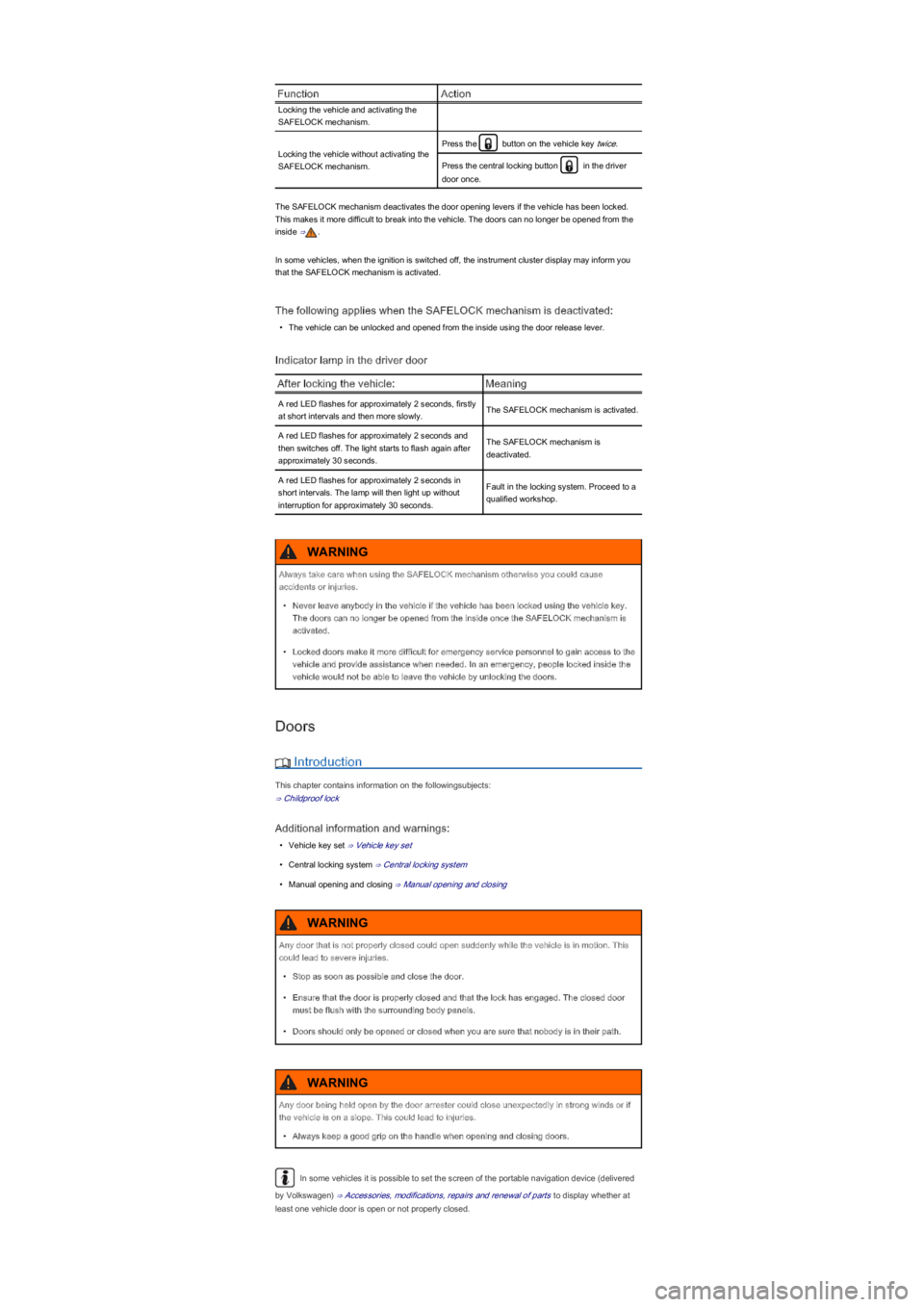
FunctionAction
Locking the vehicle and activating the
SAFELOCK mechanism.
Locking the vehicle without activating the
SAFELOCK mechanism.
Press the button on the vehicle key twice.
Press the central locking button in the driver
door once.
The SAFELOCK mechanism deactivates the door opening levers if the vehicle has been locked.
This makes it more difficult to break into the vehicle. The doors can no longer be opened from the
inside ⇒.
In some vehicles, when the ignition is switched off, the instrument cluster display may inform you
that the SAFELOCK mechanism is activated.
The following applies when the SAFELOCK mechanism is deactivated:
\f
Page 27 of 211
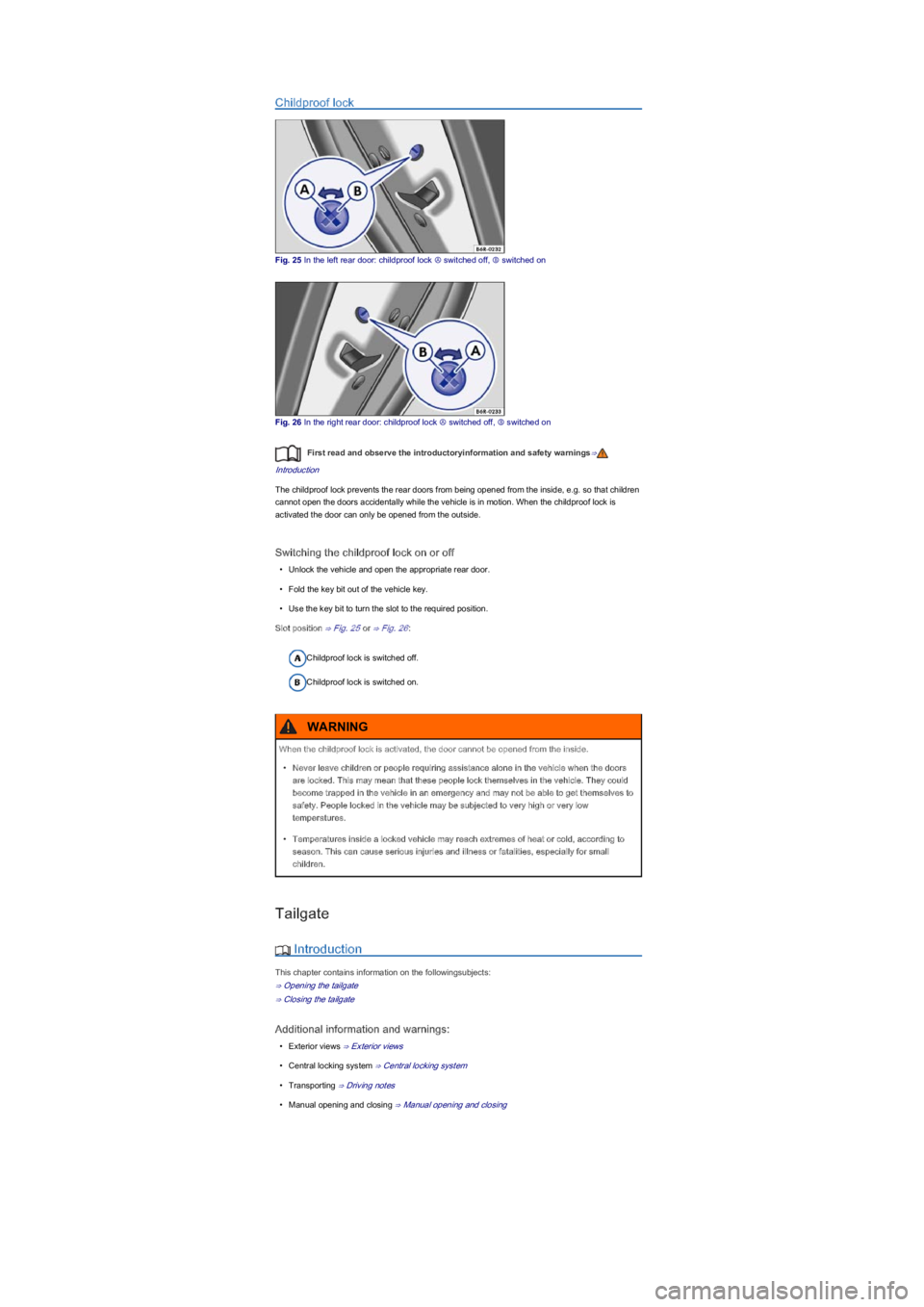
Childproof lock
Fig. 25 In the left rear door: childproof lock Ⓐ switched off, Ⓑ switched on
Fig. 26 In the right rear door: childproof lock Ⓐ switched off, Ⓑ switched on
First read and observe the introductoryinformation and safety warnings⇒
Introduction
The childproof lock prevents the rear doors from being opened from the inside, e.g. so that children
cannot open the doors accidentally while the vehicle is in motion. When the childproof lock is
activated the door can only be opened from the outside.
Switching the childproof lock on or off
\f
Page 31 of 211
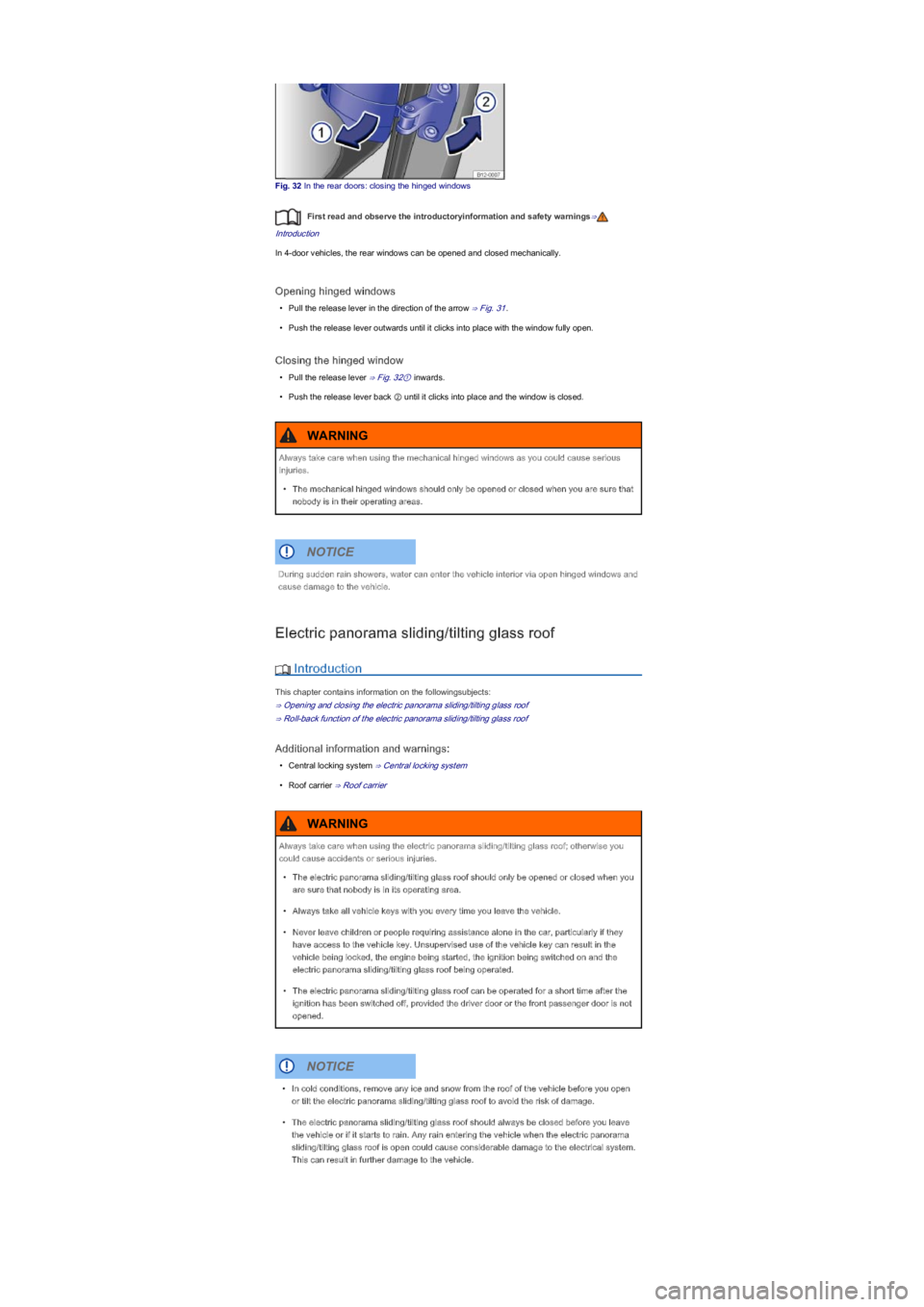
Fig. 32 In the rear doors: closing the hinged windows
First read and observe the introductoryinformation and safety warnings⇒
Introduction
In 4-door vehicles, the rear windows can be opened and closed mechanically.
Opening hinged windows
\f
Page 32 of 211
Leaves and other loose objects must be removed from the guide rails of the electric
panorama sliding/tilting glass roof at regular intervals, using a vacuum cleaner or by hand.
If there is a fault in the electric panorama sliding/tilting roof, the roll-back function will not
work properly. Go to a qualified workshop
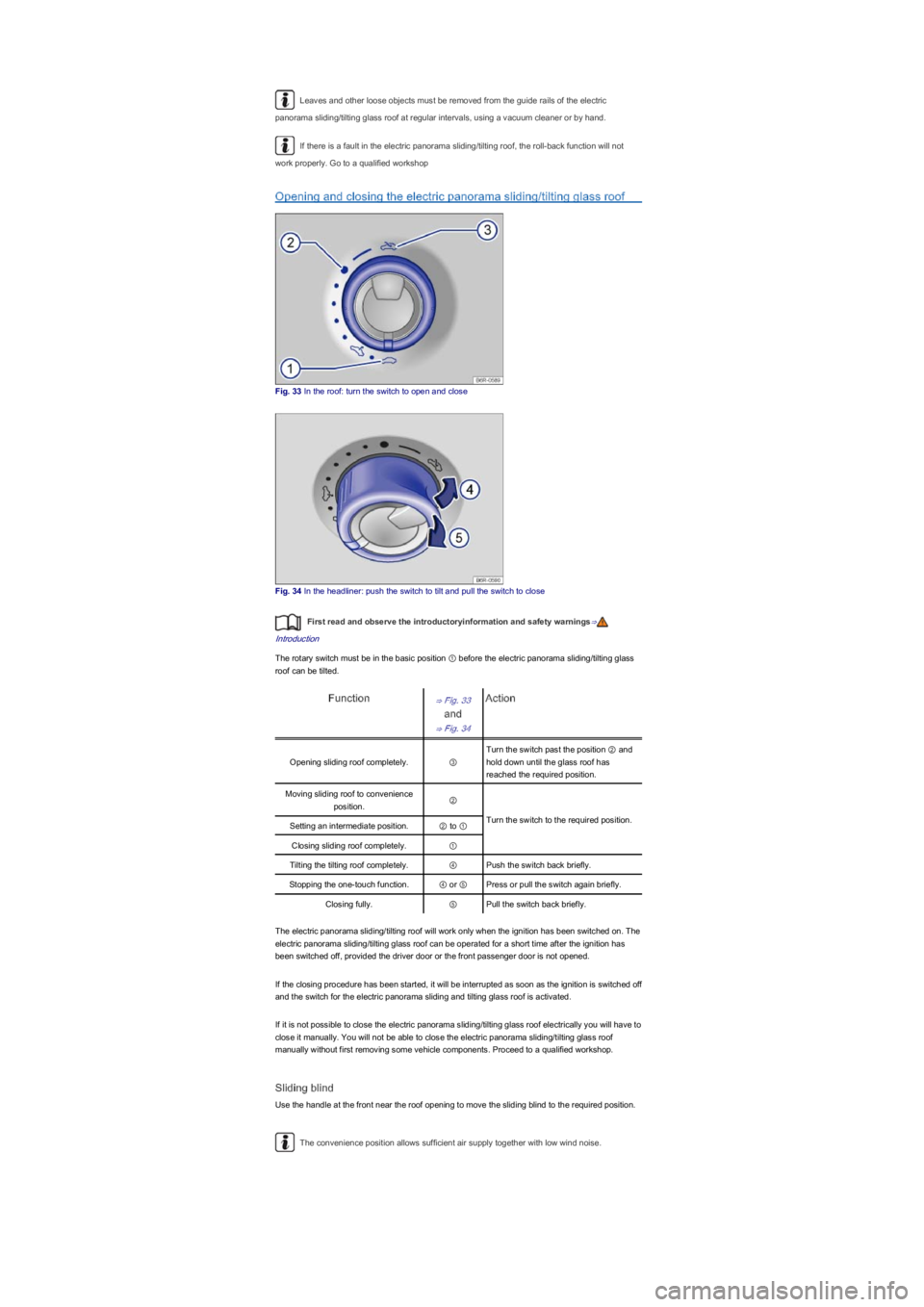
Opening and closing the electric panorama sliding/tilting glass roof
Fig. 33 In the roof: turn the switch to open and close
Fig. 34 In the headliner: push the switch to tilt and pull the switch to close
First read and observe the introductoryinformation and safety warnings⇒
Introduction
The rotary switch must be in the basic position ① before the electric panorama sliding/tilting glass
roof can be tilted.
Function⇒ Fig. 33
and
⇒ Fig. 34
Action
Opening sliding roof completely.③
Turn the switch past the position ② and
hold down until the glass roof has
reached the required position.
Moving sliding roof to convenience
position.②
Turn the switch to the required position.Setting an intermediate position.② to ①
Closing sliding roof completely.①
Tilting the tilting roof completely.④Push the switch back briefly.
Stopping the one-touch function.④ or ⑤Press or pull the switch again briefly.
Closing fully.⑤Pull the switch back briefly.
The electric panorama sliding/tilting roof will work only when the ignition has been switched on. The
electric panorama sliding/tilting glass roof can be operated for a short time after the ignition has
been switched off, provided the driver door or the front passenger door is not opened.
If the closing procedure has been started, it will be interrupted as soon as the ignition is switched off
and the switch for the electric panorama sliding and tilting glass roof is activated.
If it is not possible to close the electric panorama sliding/tilting glass roof electrically you will have to
close it manually. You will not be able to close the electric panorama sliding/tilting glass roof
manually without first removing some vehicle components. Proceed to a qualified workshop.
Sliding blind
Use the handle at the front near the roof opening to move the sliding blind to the required position.
The convenience position allows sufficient air supply together with low wind noise.
Page 33 of 211
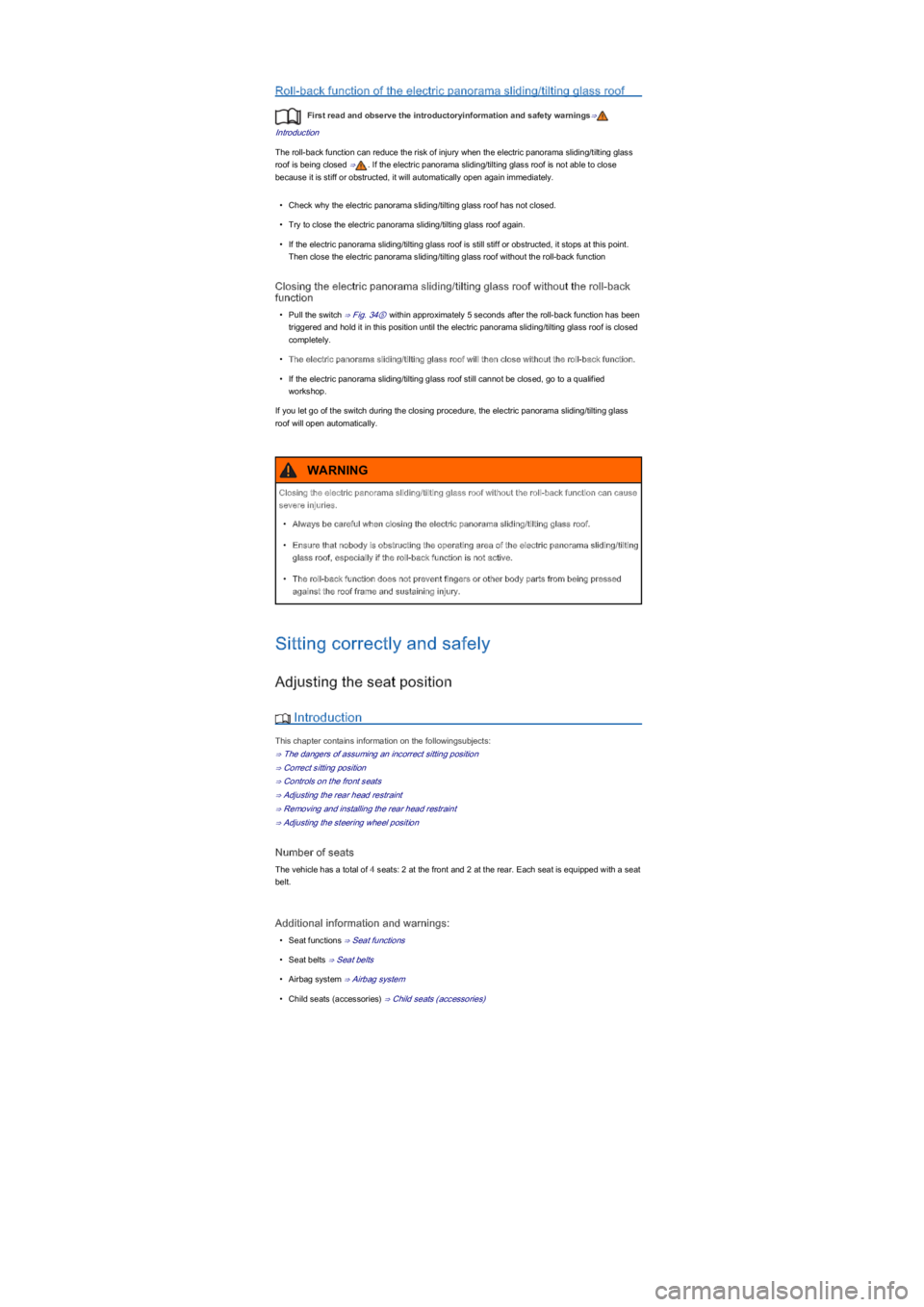
Roll-back function of the electric panorama sliding/tilting glass roof
First read and observe the introductoryinformation and safety warnings⇒
Introduction
The roll-back function can reduce the risk of injury when the electric panorama sliding/tilting glass
roof is being closed ⇒. If the electric panorama sliding/tilting glass roof is not able to close
because it is stiff or obstructed, it will automatically open again immediately.
\f
Page 34 of 211
The dangers of assuming an incorrect sitting position
First read and observe the introductoryinformation and safety warnings⇒
Introduction
If the seat belts are not worn or are worn incorrectly, the risk of severe or fatal injuries increases.
Seat belts can only provide optimal protection if the seat belt routing is correct. Assuming an
incorrect sitting position considerably impairs the level of protection provided by a seat belt. This
could lead to severe or even fatal injuries. The risk of severe or fatal injuries is especially increased
when a triggering airbag strikes an occupant who has assumed an incorrect sitting position. The
driver is responsible for all vehicle passengers, especially if they are children.
The following list contains examples of sitting positions that could be dangerous for all occupants.
Whenever the vehicle is in motion:
\f
Page 37 of 211
In 4-door vehicles: on the interior side of the seat only.
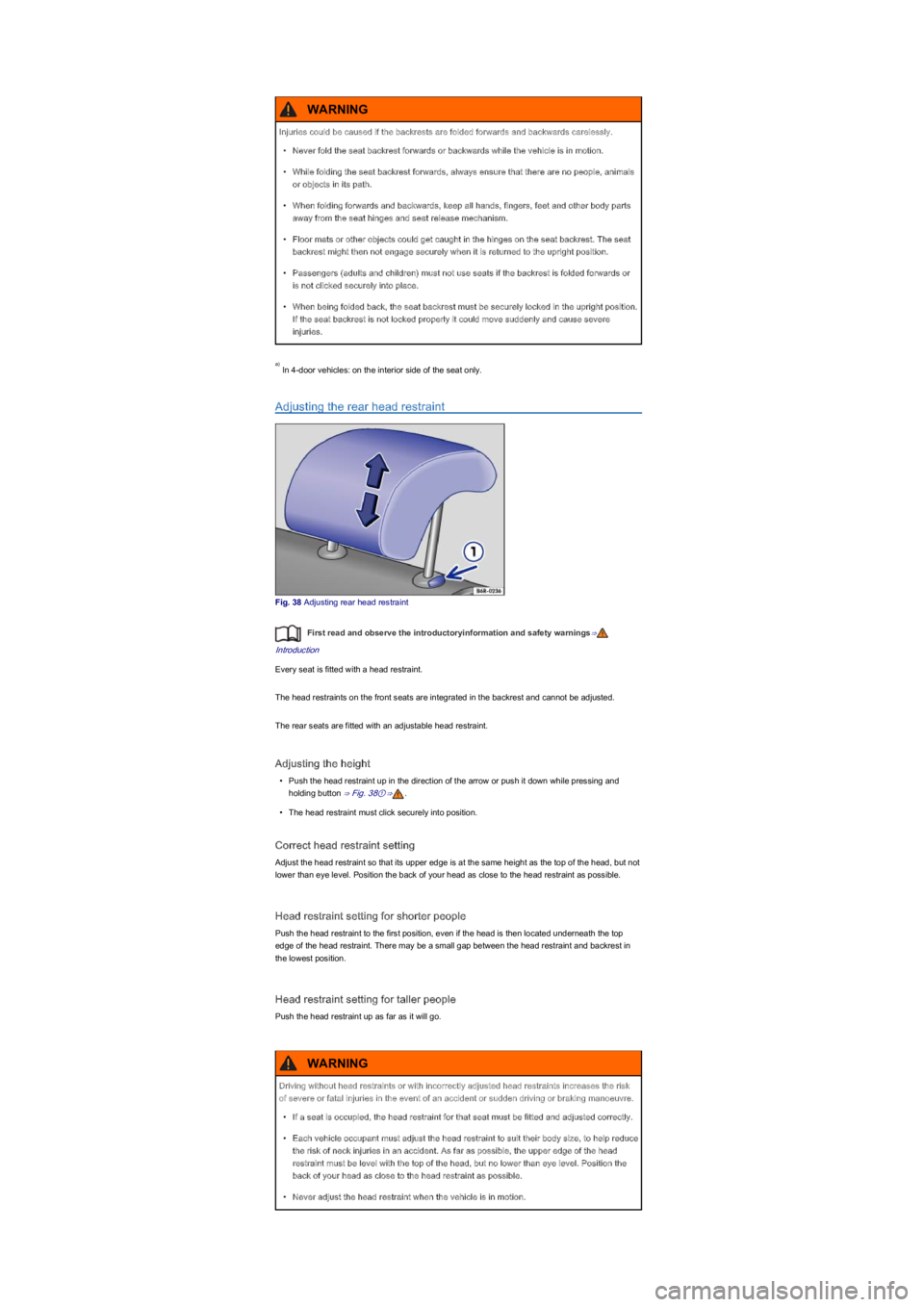
Adjusting the rear head restraint
Fig. 38 Adjusting rear head restraint
First read and observe the introductoryinformation and safety warnings⇒
Introduction
Every seat is fitted with a head restraint.
The head restraints on the front seats are integrated in the backrest and cannot be adjusted.
The rear seats are fitted with an adjustable head restraint.
Adjusting the height
\f
Page 42 of 211
Lights
up or
flashes
Possible causeSolution
Seat belt not fastened for a rear seat
passenger.Fasten the seat belt.
Seat belt fastened for a rear seat
passenger.
Several warning and indicator lamps will light up briefly as a functional check when the ignition is
switched on. They will switch off after a few seconds.
An acoustic signal will sound for a few seconds if the seat belts are not fastened as the car pulls off
and reaches a speed of more than approximately 25 km/h (15 mphyf��RU�LI�WKH�VHDW�EHOWV�DUH
unfastened while the vehicle is in motion. The warning lamp will also flash.
When the ignition is switched on, the warning lamp will not go out until the driver and front
passenger fasten their seat belts.
Belt status display for the rear seats
After the ignition has been switched on, the belt status display ⇒ Fig. 43 in the instrument cluster
display shows the driver whether the rear seat passengers have fastened their seat belts. The
symbol indicates that the passenger on this seat has fastened his or her seat belt.
The belt status display will be shown for approximately 30 seconds if a seat belt is fastened or
unfastened on the rear seats. The display can be hidden by pressing the button in
the instrument cluster.
If a seat belt for one of the rear seats is unfastened while the vehicle is in motion, the belt status
display will flash for a maximum of 30 seconds. If the vehicle is travelling faster than approximately
25 km/h (15 mphyf�DQ�DFRXVWLF�VLJQDO�ZLOO�DOVR�VRXQG.
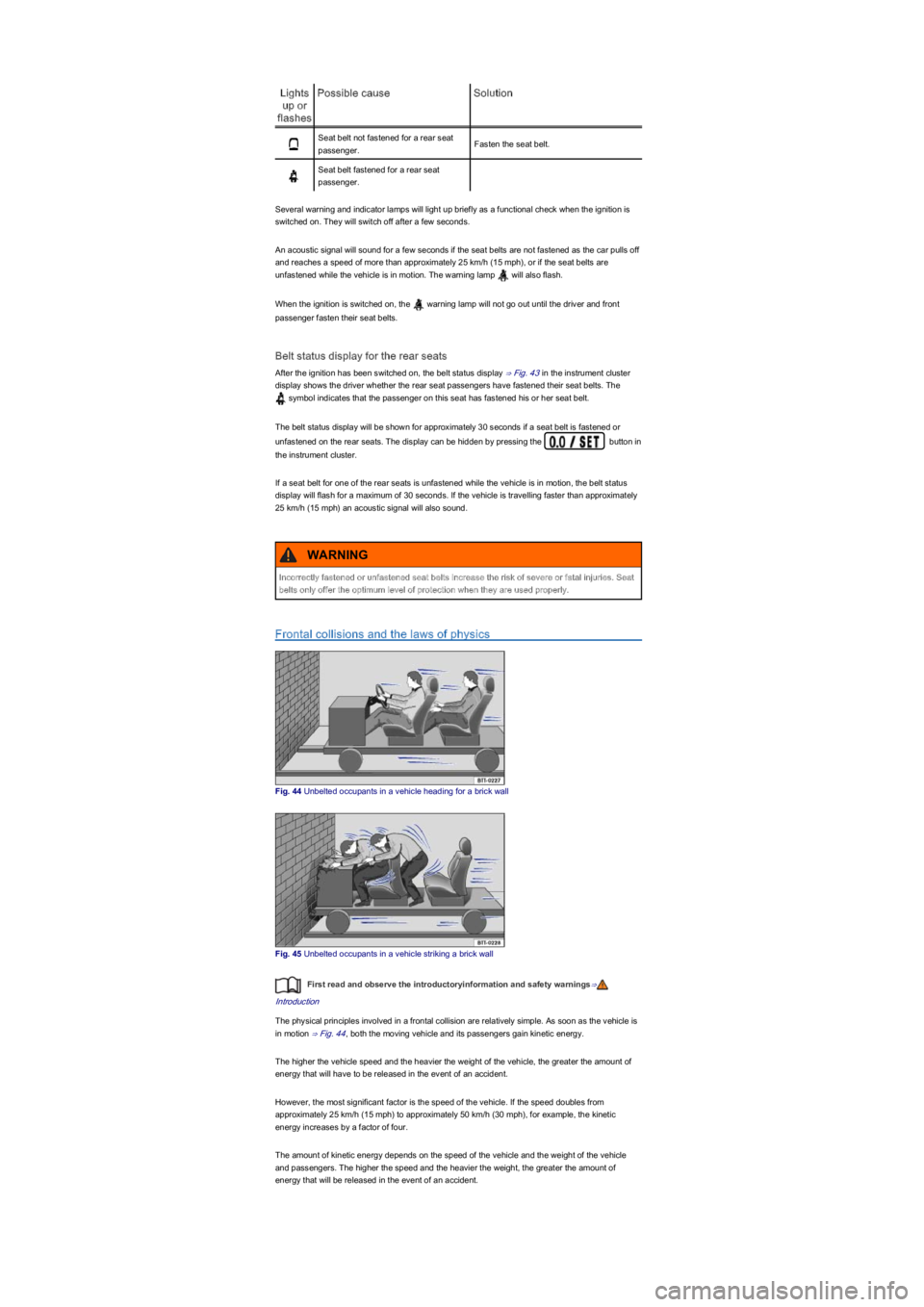
Frontal collisions and the laws of physics
Fig. 44 Unbelted occupants in a vehicle heading for a brick wall
Fig. 45 Unbelted occupants in a vehicle striking a brick wall
First read and observe the introductoryinformation and safety warnings⇒
Introduction
The physical principles involved in a frontal collision are relatively simple. As soon as the vehicle is
in motion ⇒ Fig. 44, both the moving vehicle and its passengers gain kinetic energy.
The higher the vehicle speed and the heavier the weight of the vehicle, the greater the amount of
energy that will have to be released in the event of an accident.
However, the most significant factor is the speed of the vehicle. If the speed doubles from
approximately 25 km/h (15 mphyf�WR�DSSUR[LPDWHO\���bNP�K����bPSK\f, for example, the kinetic
energy increases by a factor of four.
The amount of kinetic energy depends on the speed of the vehicle and the weight of the vehicle
and passengers. The higher the speed and the heavier the weight, the greater the amount of
energy that will be released in the event of an accident.
Incorrectly fastened or unfastened seat belts increase the risk of severe or fatal injuries. Seat
belts only offer the optimum level of protection when they are used properly.
WARNING