2012 VOLKSWAGEN TRANSPORTER prevents opening
[x] Cancel search: prevents openingPage 48 of 486

CD
The electric sliding doors must be locked be-fore using a car wash. Otherwise the electric sliding doors could open unexpectedly and any water entering the vehicle could cause damage. <1
Roll-back function on the electric sliding doors
r-T'n First read and observe the Introductory L-J,:.JJ information and safety warnings & on page 46.
The roll-back function for the electric sliding doors can reduce the risk of injuries while opening and closing the sliding doors &.
If a sliding door is stuck or if it Is obstructed in any way when closing, it is opened again Immediately.
If a sliding door is stuck or if it is obstructed in any way when opening, the sliding door stops at this point.
• Check to see why the sliding door does not open or close.
• Try to open or close the sliding door again.
Closing the sliding door without the roll-back function
• Press and hold the button§) 27. The sliding door closes with maximum force.
Childproof lock in the sliding door
Fig. 29 In the left sliding door: child proof lock-@ switched off. @ switched on
r-T'n First read and observe the introductory L-J,:.JJ information and safety warnings & on page 46.
48 Before the journey
A WARNING
Closing the electric sliding doors without the roll-back function could lead to severe Inju-ries.
• Always take care when closing electric sliding doors.
• Ensure that nobody obstructs the path of the electric sliding doors, especially If the roll-back function Is not active.
• The roll-back function does not prevent fingers or other body parts getting pinched against the door frame and becoming Injured.
Fig. 30 In the right sliding door: childproof lock -® switched off. @switched on
The child proof lock prevents the sliding doors from being opened from the inside, e.g. so that children cannot open the doors accidentally while the vehi-cle is in motion. When the child proof lock is activa-ted the sliding door can be opened from the out-
Page 52 of 486

Childproof lock in the tailgate
Fi_Q-34 On the front of the tailgate: child proof lock -®switched off, @ switched on
rJ'n First read and observe the introductory l-J.:.U information and safety warnings & on page 49.
The childproof lock prevents the tailgate being opened from the inside. When the child proof lock is activated the tailgate can be opened from the outside only.
Switching the child lock on and off
• Open the tailgate.
• Use the vehicle key to bring the slot to the de-sired position.
Wing doors
CQJ Introduction
This chapter contains information on the following subjects:
Warning lamp . . . . . . . . . . 53
Opening the wing doors 53 Closing the wing doors 54 Unlocking and locking the wing doors from the inside . . . . . . . . . . . . . . . . . . . . . . . . . . . . . . 54 Child proof lock in the wing doors . 55
Additional information and warnings:
• Exterior views =>page 5
• Central locking system =>page 39
• Transporting =>page 125
• Manual opening and closing =>page 413
52 Before the journey
Slot position =>Fig. 34:
@ Child lock is switched on.
A WARNING
When the childproof lock Is activated, the tail-gate cannot be opened from the Inside.
• Never leave children or people requiring assistance alone In the vehicle when the doors are locked. This may mean that these people lock themselves In the vehicle. They could become trapped In the vehicle In an emergency and may not be able to get them-selves to safety. People locked In the vehicle may be subjected to very high or very low temperatures.
• Temperatures Inside a locked vehicle may reach extremes of heat or cold, according to season. This can cause serious Injuries and Illness or fatalities, especially to small chil-dren.
Incorrect and unsupervised unlocking, open-Ing or closing of the wing doors can cause accidents and serious Injuries.
• Therefore wing doors should only be opened or closed when you are sure that no-body Is In their path.
• Never close the wing door by pushing it down with your hand on the glass window. The glass window could shatter and cause in-juries.
• After closing the wing doors, check to make sure that they are closed and locked correctly so that they do not open while the vehicle Is In motion. The closed wing doors must be flush with the surrounding body pan-
•
Page 55 of 486
Opening the wing door from the inside
• Make sure that the child proof lock is not active and that the safety knob is in the upper position 35{!).
• Pull the lever® to unlock the wing doors.
• Push the left-hand wing door back to open it. <1
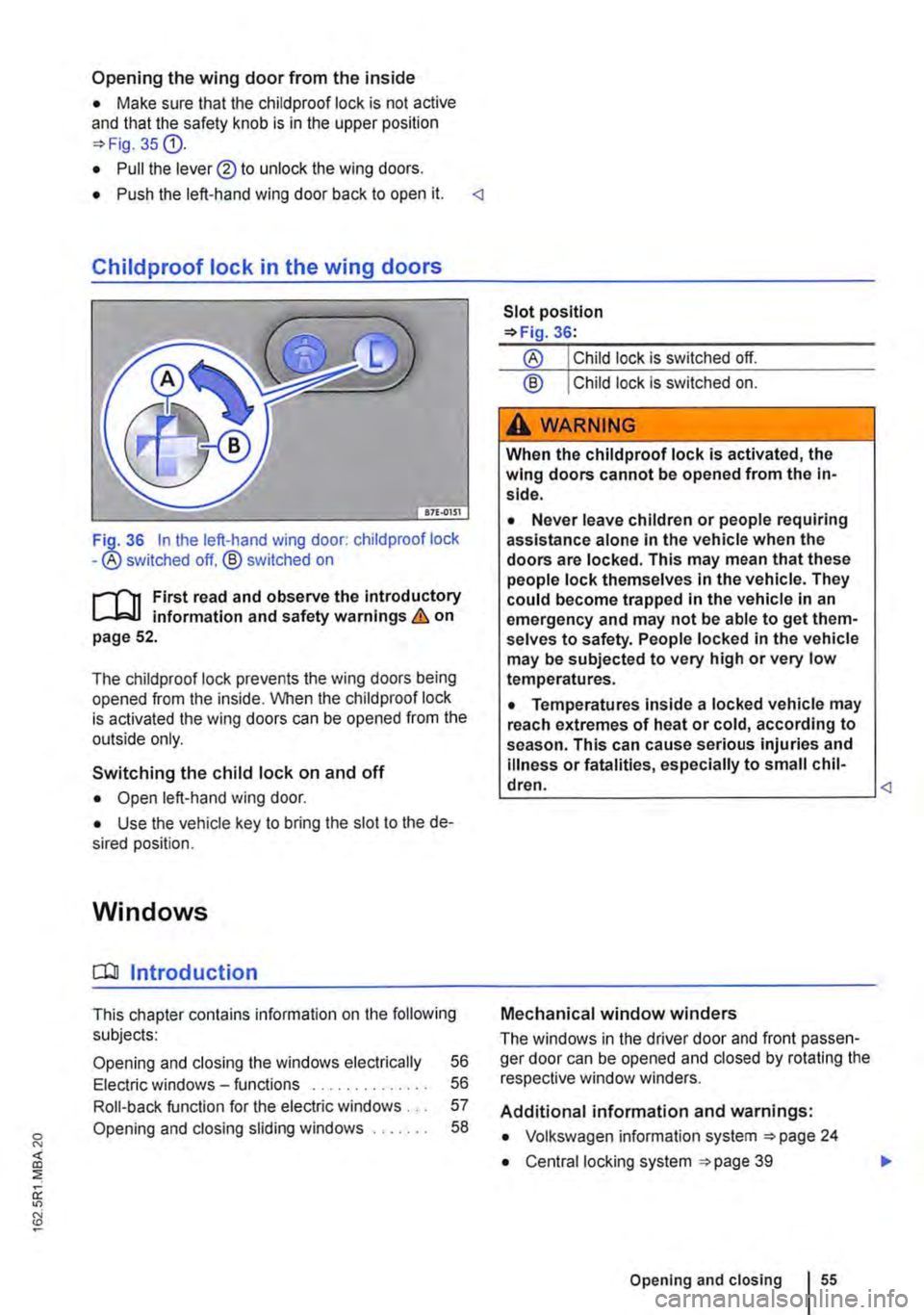
Childproof lock in the wing doors
36 In the left-hand wing door: child proof lock -® switched off. ® switched on
,......,.., First read and observe the introductory information and safety warnings & on page 52.
The chiidproof lock prevents the wing doors being opened from the inside. When the child proof lock is activated the wing doors can be opened from the outside only.
Switching the child lock on and off
• Open left-hand wing door.
• Use the vehicle key to bring the slot to the de-sired position.
Windows
a:n Introduction
This chapter contains information on the following subjects:
Opening and closing the windows electrically 56
Electric windows -functions . . . . . . . . . . . . . . 56
Roll-back function for the electric windows . . . 57
Opening and closing sliding windows . . . . . . . 58
® Child lock is switched on.
A WARNING
When the child proof lock is activated, the wing doors cannot be opened from the in-side.
• Never leave children or people requiring assistance alone in the vehicle when the doors are locked. This may mean that these people lock themselves in the vehicle. They could become trapped in the vehicle in an emergency and may not be able to get them-selves to safety. People locked in the vehicle may be subjected to very high or very low temperatures.
• Temperatures inside a locked vehicle may reach extremes of heat or cold, according to season. This can cause serious injuries and illness or fatalities, especially to small chil-dren. <1
Mechanical window winders
The windows in the driver door and front passen-ger door can be opened and closed by rotating the respective window winders.
Additional information and warnings:
• Volkswagen information system 24
• Central locking system 39
Opening and closing I 55
..
Page 218 of 486

Manual pop-up roof, California
C::O Introduction
This chapter contains information on the following subjects:
Opening the manual pop-up roof.......... 219
Closing the manual pop-up roof . 220
Roller shutter
Above the front seats there is a roller shutter, which must always be closed while the vehicle is in motion. This prevents the pop-up roof canvas from hanging down through the ceiling access and blocking the driver's view. Keeping the roller shut-ter closed also reduces wind noise while the vehi-cle is in motion.
A WARNING
Incorrect handling of the manual pop-up roof can cause accidents and serious injuries.
• Never drive the vehicle with the pop-up roof open. The pop-up roof must always be completely closed and securely locked while the vehicle is in motion.
• Never drive with people in the pop-up roof.
• Only open or close the pop-up roof while the vehicle Is stationary.
• Only mount a luggage roof rack when the pop-up roof is completely closed and secure-ly locked.
A WARNING
Careless or inattentive use of the manual pop-up roof could cause serious Injuries.
• The pop-up roof should only be opened or closed when you are sure that nobody is in its operating area.
• Never leave children or people requiring assistance alone in the vehicle.
• Always take all vehicle keys with you ev-ery time you leave the vehicle.
218 I Before the journey
CD
Incorrect handling of the manual pop-up roof can cause damage to it or to other parts of the vehicle.
• Make sure there Is adequate space before opening the pop-up roof.
• When closing the pop-up roof, always open the roller shutter and one of the vehicle doors to allow the excess air pressure to escape.
• Only close the pop-up roof when it is dry to prevent the build up of mould or mildew.
• Open the pop-up roof occasionally to air it out when it Is not being used for long periods oftime.
• Clean the pop-up roof bellows with water only. Never use household cleaners or Impreg-nating fabric treatment products.
• Close the pop-up roof during storms with driving rain and wind gusts. Otherwise the bel-lows could leak despite their specially treated fabric.
Page 221 of 486

Electric pop-up roof, California
o:IJ Introduction
This chapter contains information on the following subjects:
Opening the electric pop-up roof . . . . . . . . . . . 222
Closing the electric pop-up roof . . . 223
Preliminary work for closing the electric pop-up roof manually . . . . . . . . . . . . . . . . . . . . . . . . 224
Closing the electric pop-up roof manually . 225 Securing the pop-up roof manually from outside the vehicle . . . . . 225
Roller shutter
Above the front seats there is a roller shutter, which must always be closed while the vehicle is in motion. This prevents the pop-up roof canvas from hanging down through the ceiling access and blocking the driver's view. Keeping the roller shut-ter closed also reduces wind noise while the vehi-cle is in motion.
Additional information:
• Central control panel 204
• Rectifying faults on the camping equipment 254
• Winter conditions 253
• Vehicle tool kit 416
A WARNING
Incorrect handling of the pop-up roof can cause accidents and serious Injuries.
• Never drive the vehicle with the pop-up roof open. The pop-up roof must always be completely closed and securely locked while the vehicle Is In motion.
• Never drive with people In the pop-up roof.
• Only open or close the pop-up roof while the vehicle Is stationary.
• Only mount a luggage roof rack when the pop-up roof is completely closed and secure-ly locked.
A WARNING
Careless or inattentive use of the pop-up roof could cause serious Injuries.
• The pop-up roof should only be opened or closed when you are sure that nobody is in its operating area.
A WARNING (Continued)
• Never leave children or people requiring assistance alone In the vehicle.
• Always take all vehicle keys with you ev-ery time you leave the vehicle.
A WARNING
Driving at high vehicle speeds and with a strong headwind after closing the pop-up roof manually could cause the pop-up roof to lift up or open on Its own and potentially cause serious Injuries.
• If you close the pop-up roof manually, do not drive faster than 60 km/h.
• Drive especially carefully and slowly In the presence of a strong headwind.
• The pop-up roof should be checked by a qualified workshop as soon as possible.
CD
Incorrect handling of the pop-up roof can cause damage to it or to other parts of the vehi-cle.
• Make sure there is adequate space before opening the pop-up roof.
• When closing the pop-up roof, always open the roller shutter and one of the vehicle doors to allow the excess air pressure to escape.
• Only close the pop-up roof when it is dry to prevent the build up of mould or mildew.
• Open the pop-up roof occasionally to air it out when it is not being used for long periods of time.
• Clean the pop-up roof bellows with water only. Never use household cleaners or Impreg-nating fabric treatment products.
• Close the pop-up roof during storms with driving rain and wind gusts. Otherwise the bel-lows could leak despite their specially treated fabric.
m Roof hydraulics: the pop-up height of the W pop-up roof will be checked automatically and altered if necessary at regular intervals after the ignition has been switched off and the ignition key removed: first after 10 hours and then every five hours. .,.
Equipment, California 221
Page 328 of 486
Settings for optimal road visibility
• Switch off air recirculation mode 330.
• Set blower® to level 1 or 2.
• Set the temperature selector G) to the required position.
• Open and position all vents on the dash panel.
• Turn the air distribution Fig. 258 0 to the desired position.
Rear window heating
A button for the rear window heating @ may be contained in the dash panel.
• When the engine is running, press the @ but-ton to switch on the rear window heating.
• The rear window heating is switched off auto-matically after approx. 10 minutes. To switch it off before the automatic switch-off, press the(!) but-ton again.
A WARNING
Stale air can quickly make the driver tired and affect their concentration, which in turn can cause collisions, accidents and serious inju-ries.
• Never switch off the blowers or switch on the air recirculatlon mode for an extended pe-riod as this prevents fresh air from entering the vehicle Interior.
.........r'n First read and observe the Introductory L-.lr:.ll Information and safety warnings & on page 322.
The cooling system for the vehicle interior only works when the engine is running and the blower is switched on.
The air conditioning system operates most effec-tively with the windows and the sliding/tilting roof closed. However, if the vehicle has heated up after standing in the sun for some time, the air inside can be cooled more quickly by opening the win-dows and the sliding/tilting roof for a short time.
Settings for optimal road visibility
Switching the cooling system on not only reduces the temperature of the vehicle interior, but also the humidity. This improves comfort for the vehicle oc-cupants and prevents the windows from misting when the outside humidity is high.
Climatic
• Switch off air recirculation mode 330.
• Set the blowers to the required level.
• Set the temperature to +22•c (+72.F).
• Open and position all vents on the dash panel 329.
• Turn the air distribution controller to the desired position.
• Press the@) button to switch the cooling sys-tem on. The indicator lamp in the button lights up.
328 I While driving
Cllmatronlc
• Press button.
• Set the temperature to +22•c (+72.F).
• Open and position all vents on the dash panel 329.
The cooling system cannot be switched on
The following criteria may prevent the cooling sys-tem from being switched on:
• The engine is not running.
• The blower is switched off.
• The air conditioning system fuse has blown.
• The ambient temperature is lower than approxi-mately +3"C (+38°F).
• The compressor has been temporarily switched off because the coolant temperature is too high.
• There is a different fault in the vehicle. The air conditioning system should be checked by a quali-fied workshop.
Things to note
If the humidity and temperature outside the vehicle are high, condensation can drip off the evaporator in the cooling system and form a pool underneath the vehicle. This is normal and does not indicate a